Struggling with emotional communication in your marriage? You’re not alone. Emotional connection goes beyond daily conversations – it’s about understanding and expressing feelings effectively. This guide breaks down how to improve communication, especially for neurodiverse couples, where emotional processing can differ.
Key Takeaways:
- Emotions are more than words: 70% of communication comes from body language, tone, and expressions.
- For neurodiverse couples: Challenges like delayed emotional processing or sensory overload require tailored approaches.
- Practical strategies: Active listening, ‘I’ statements, and daily check-ins can strengthen emotional bonds.
- Conflict resolution: Create safe spaces, take breaks when overwhelmed, and focus on empathy.
- When to seek help: Therapy can address recurring struggles and rebuild connections.
This guide provides tools to navigate emotional challenges, improve understanding, and build a stronger partnership.
Neurodiverse Relationship Support at Growth and Change Counseling
sbb-itb-596b85d
How Emotional Communication Works in Neurodiverse Marriages
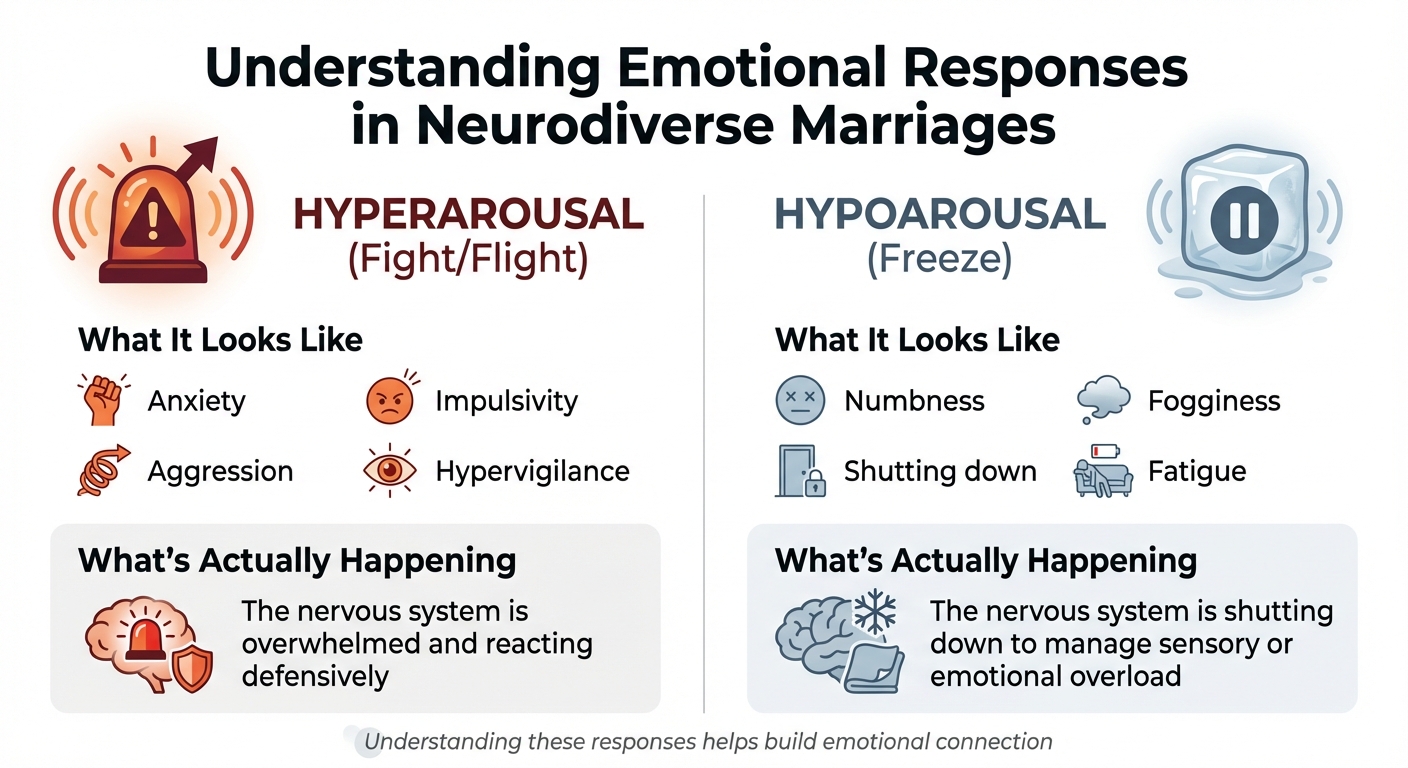
Emotional Response Types in Neurodiverse Relationships: Hyperarousal vs Hypoarousal
When one partner is neurodivergent – whether they are on the autism spectrum, have ADHD, or experience another neurological difference – emotional communication often follows a unique rhythm. These differences stem from varying emotional processing styles. Therapist Liz Zhou highlights the "double empathy problem", where both partners may struggle to understand each other’s social cues and emotional expressions due to their differing neurotypes [10]. This dynamic opens the door to exploring how emotions are processed in distinct ways.
Different Ways of Processing Emotions
For neurodivergent individuals, identifying and expressing emotions can sometimes feel like navigating a maze. Many experience alexithymia [8], which makes it hard to recognize or articulate their feelings. This can sometimes come across as being distant or uncaring, even when that’s far from the truth.
Timing is another key element. Neurodivergent partners may process emotions on a delayed timeline – where the weight of a hurtful comment might not fully register until hours, days, or even weeks later [9].
Sensory overload is another factor that can influence emotional responses. Bright lights, loud noises, or certain textures can trigger a fight-or-flight reaction, leading to emotional shutdowns [6][10]. What might look like anger or withdrawal could actually be a response to being overwhelmed. Additionally, emotional expression isn’t always verbal. Neurodivergent partners might communicate through stimming, referencing familiar quotes, sharing music, or using visuals to express what they’re feeling [9].
| Emotional Response Type | What It Looks Like | What’s Actually Happening |
|---|---|---|
| Hyperarousal (Fight/Flight) | Anxiety, aggression, impulsivity, hypervigilance [8] | The nervous system is overwhelmed and reacting defensively |
| Hypoarousal (Freeze) | Numbness, fogginess, shutting down, fatigue [8] | The nervous system is shutting down to manage sensory or emotional overload |
Understanding these varied responses is a crucial step toward building a shared emotional framework.
Creating a Common Language for Emotions
Given these differences, couples can strengthen their emotional connection by crafting a shared language. Abstract emotional terms like "stressed" or "support" can mean different things to different people. Neurodiverse couples often find it helpful to create a personalized emotional dictionary. Instead of assuming a mutual understanding, ask questions like, "What does ‘overwhelmed’ mean to you?" or "How do you define ‘support’?" [10].
Visual aids can also be a game-changer when words fall short. Tools like emotion wheels, color cards, mood-tracking apps, or even simple "energy meters" (e.g., rating energy levels from low to high) can help bridge communication gaps [8][9]. Some couples go a step further by creating sensory inventories together. These inventories identify sensory triggers – like loud chewing or harsh lighting – and comforts, such as weighted blankets or calming scents, that influence their emotional well-being [10].
Couples therapist Daniel Dashnaw explains it this way: "We’re running different emotional software. Let’s sync up with compassion." [9]
This approach normalizes delayed emotional check-ins, giving partners the space to process and revisit conflicts a few days later instead of demanding immediate resolutions. It also emphasizes the importance of asking clarifying questions instead of expecting the other person to "just know." Ultimately, these strategies reinforce the idea that being different doesn’t mean being deficient.
Practical Strategies for Better Emotional Communication
Use these strategies to minimize misunderstandings and create a sense of emotional safety, even when processing styles differ.
Active Listening and Validation Methods
Active listening means tuning into the emotions behind the words. Reflective listening, for instance, involves paraphrasing what your partner says before responding. This not only confirms you’ve understood them correctly but also shows you’re genuinely invested in their perspective [11][14].
"The goal of reflective listening is not to ‘win’ an argument, but to witness and respect your partner’s perspective" [14]
For neurodiverse couples, standard active listening might need a few tweaks. Eye contact, for example, can feel overstimulating rather than reassuring for some neurodivergent individuals. Instead, try sitting side-by-side or engaging in "parallel play" – quietly doing an activity together while talking. Silence is another key element. If your partner pauses, resist the urge to fill the gap; they may just need more time to process [11][12].
Structured turn-taking can also help avoid interruptions or one-sided conversations. Take Tom and Maya, for example, a couple working with the ADHD & Autism Clinic in 2024. Tom, who has ADHD, often interrupted Maya, who is autistic, during serious discussions. Their therapist introduced "talking tokens" to limit each person’s turns to speak. This gave Maya the space she needed to process while encouraging Tom to practice self-restraint [12].
Validation is another essential aspect. It means recognizing your partner’s emotions as real and legitimate, even if you don’t share the same feelings. Go beyond surface emotions like frustration or anger to understand the deeper ones – like fear, hurt, or inadequacy [2]. When someone validates your emotions, they’re acknowledging the entirety of your experience [3].
| Technique | Standard Approach | Neurodiverse Adaptation |
|---|---|---|
| Eye Contact | Maintain constant eye contact to show interest | Use eye contact only if it feels comfortable; focus on parallel activities or quiet companionship instead [12] |
| Response Time | Respond promptly to keep the flow | Allow extended processing time and view silence as a form of reflection [11][12] |
| Verbal Cues | Rely on subtext and social nuances | Use clear, direct, and explicit language; avoid metaphors or indirect hints [11][13] |
| Turn-Taking | Let the conversation flow naturally | Use tools like talking tokens or timers to structure conversations and prevent interruptions [12] |
| Validation | Verbally agree or empathize | Incorporate visual aids like emotion wheels or written notes to confirm understanding [12] |
Once you’ve mastered listening, it’s time to focus on expressing your own emotions clearly.
Using ‘I’ Statements to Express Feelings and Needs
Clear communication through ‘I’ statements pairs perfectly with reflective listening. Unlike "you" statements, which often come across as accusatory – like "You never listen to me!" – ‘I’ statements focus on your own experience, reducing defensiveness and keeping the conversation constructive [3][16].
The formula is simple: "I feel [emotion] when [factual situation]." For example, instead of saying, "You’re so selfish", try, "I feel hurt when my needs aren’t considered." The first approach criticizes, while the second invites understanding [3].
Stick to observable facts in the "when" part of your statement. Avoid accusatory language or sweeping generalizations. For instance, "I feel lonely when you turn on the TV without talking to me first" focuses on a specific behavior without questioning your partner’s intentions [3].
"When spouses can clearly state what they need from their partner without blame or criticism, and especially by using ‘I’ statements, they help their partner see where they can focus their efforts to reconnect successfully" [16]
For neurodiverse couples, this directness is especially important. Expecting your partner to "read between the lines" often leads to miscommunication [1][16]. Be explicit about what you need: "I need us to talk about the kids’ school" is far clearer than "You never help with the kids" [16].
Before delivering an ‘I’ statement, check in with yourself. If your emotions are running high – say, a 10 out of 10 over something minor like a dirty mug – take a moment to cool down first. Activities like walking, taking a bath, or deep breathing can help you approach the conversation more calmly [3]. You can also soften your delivery by acknowledging your partner’s good intentions: "I know you care about how I feel, so I wanted to share this with you" [3].
With these tools in place, you can approach conflict in a way that strengthens your relationship.
Handling Conflict with Open Communication
Conflict is inevitable, but how you handle it determines whether it becomes a source of growth or harm. The key is creating a safe space for tough conversations – one where both partners feel respected and heard.
Recognize when emotions are running too high for rational discussion. When overwhelmed, your brain often shifts into fight, flight, or freeze mode, making problem-solving nearly impossible [15][2]. If you or your partner are emotionally flooded, take a 20-minute break to let your nervous system reset. This allows your "thinking brain" to re-engage [3][15].
Empathy should always come first, even before diving into solutions.
"Empathy is connecting to another person’s feelings by seeing things from their perspective, staying out of judgment, and letting them know they’re not alone" [1]
Suspend judgment and acknowledge your partner’s feelings, even if they differ from your own [17].
For neurodiverse couples, scheduled conversations can help reduce anxiety and allow time for preparation [12][13]. Take Laura and Nathan, for example. Nathan struggled with sensory overload from background noise, while Laura preferred having music in shared spaces. By scheduling "quiet times" during meals and agreeing on noise-canceling headphones, they found a middle ground for better communication [12].
Having a safe exit plan is also essential. Agree on cues – like a specific word or hand signal – that either partner can use to pause the conversation if things get too intense [12]. This isn’t about avoiding conflict but ensuring discussions remain productive and respectful.
After resolving a conflict, take time to debrief together. Reflect on what worked, what didn’t, and how you can handle things differently next time. These post-conflict discussions can strengthen your problem-solving skills and reinforce the idea that you’re working as a team.
| Trigger | Solution |
|---|---|
| Criticism | Use "I" statements to express positive needs instead of focusing on negatives [16] |
| Defensiveness | Look for the truth in your partner’s complaint and accept their influence [16][1] |
| Emotional Flooding | Take a 20-minute break to let emotions settle before continuing [3][15] |
| Unmet Secondary Needs | Focus on addressing 1–2 specific needs at a time rather than tackling everything at once [15] |
Exercises to Build Emotional Connection
Strengthening emotional intimacy doesn’t require extravagant gestures or costly outings. Simple, consistent practices can create lasting bonds, especially when tailored to accommodate the unique emotional needs in neurodiverse relationships. These exercises complement earlier communication strategies, adding depth to emotional connections.
Daily Emotional Check-Ins
A straightforward way to foster connection is through a "20-Minute Stress-Reducing Conversation." This involves setting aside 20 to 30 minutes each day to talk about daily stressors – work challenges, family concerns, or personal frustrations – without focusing solely on relationship issues, though intensive therapy for couples in crisis may be necessary for deeper conflicts. The aim is to create a space for both partners to actively listen and share. Questions like, "What was the best part of your day?" can spark meaningful dialogue, especially when scheduled at a time when both partners are most open to connecting.
For neurodiverse couples, timing these check-ins during emotionally approachable moments – often earlier in the day – can make a big difference. If one partner finds it hard to transition from work mode to emotional connection, taking an extra 10 to 20 minutes for personal decompression activities like stretching, listening to calming music, or a quick shower can help. A simple gesture like a hug or kiss can also reinforce connection [18].
Empathy Mapping Exercises
Building on active listening techniques, empathy mapping exercises can help partners refine their emotional understanding of each other. These exercises contribute to updating "Love Maps", a concept that involves staying attuned to your partner’s inner world, including their current stresses, dreams, and values [19]. One way to practice this is through emotion coaching: one partner shares a recent emotional experience, and the other listens and reflects the feelings back without jumping to solutions. For instance, saying, "It sounds like you felt frustrated when your boss changed the project deadline", validates the experience and strengthens emotional alignment. For those seeking professional guidance, a marriage therapist in Roseville CA can provide structured support for these exercises.
This approach is especially helpful for neurodiverse couples, where subtle nonverbal cues might sometimes go unnoticed [3, 11].
"Empathy is connecting to another person’s feelings by seeing things from their perspective, staying out of judgment, and letting them know they’re not alone" [1].
If your partner’s emotions aren’t immediately clear, asking follow-up questions can help until you genuinely understand and can say, "That makes sense to me."
Building Rituals of Connection
Incorporating small, consistent rituals into daily life can significantly enhance emotional bonds. Research highlights that couples who respond to each other’s bids for connection – such as sharing news, offering a smile, or a casual touch – 86% of the time are far more likely to maintain strong relationships compared to those who respond only 33% of the time [20]. These rituals provide opportunities to nurture the "Emotional Bank Account" established through earlier practices.
Transition rituals can help couples shift from individual responsibilities to moments of shared connection. Simple activities like taking a walk together, stretching, or listening to music can ease this shift [18]. Daily appreciation practices also play a big role. Acknowledging small gestures – like saying, "I noticed you made coffee this morning, and it made me feel cared for" – builds goodwill. Researchers suggest maintaining a positive-to-negative interaction ratio of around 20:1 to keep this emotional reservoir thriving [33, 28].
For neurodiverse couples, being clear and intentional about these rituals is particularly helpful. Instead of vague phrases like "We need to talk", try a softer, more specific approach, such as, "I’ve been feeling a little lonely lately; could we sit down together?" This clarity reduces uncertainty and helps both partners prepare for a meaningful interaction [18].
Getting Professional Help for Communication Problems
Sometimes, home exercises just aren’t enough to address deeply ingrained communication struggles or the unique challenges faced in neurodiverse relationships. In fact, research from the Journal of Marital and Family Therapy reveals that about 70% of couples who go through marriage counseling report improvements in their relationship [21].
Knowing when to seek professional help is key. If conflicts escalate or become toxic, it’s a clear signal to involve a professional. Another warning sign is the "pursue-withdraw pattern", where one partner pushes for connection while the other withdraws, making resolution feel impossible [4]. This dynamic can be especially challenging in neurodiverse relationships, where differences in emotional processing often complicate conflicts. For these couples, professional guidance can make a significant difference [18, 9].
Therapists specializing in neurodiverse couples focus on bridging differences and teaching practical tools, like repair scripts and co-regulation techniques, to manage intense emotions [36, 37, 34]. Sessions often include real-time coaching and actionable homework to help couples practice new habits in their daily lives [21]. These targeted approaches are designed to create meaningful, lasting change.
The Marriage Rescue Institute Program
For couples in crisis, the Marriage Rescue Institute offers a structured, 12-week coaching program [23]. Led by John Mark Kane, LMFT, the program teaches couples essential skills to rebuild even the most strained relationships [35, 38].
This program takes a hands-on approach, with therapists actively guiding couples through structured interventions to achieve noticeable progress quickly. As John Kane puts it:
"If we don’t have the relational intelligence to relate to each other in healthy ways, we will resort to manipulative ways of behaving to try to get our needs met and we will hurt and abuse each other in that process" [21].
At Growth and Change Counseling, a standardized "foundational approach" ensures consistent, high-quality care across all therapists. Many couples see improvements within just 6 to 8 sessions [35, 38]. Karin Weisse, LMFT, describes the process:
"At Growth and Change Counseling, we have a foundational process… This process is tailored to the situation that you are dealing with and helps you develop the relational intelligence to put your relationships and mental health back together" [22].
Standard sessions are $165 for 45 minutes, and the practice works with major insurance providers like Anthem Blue Cross, Aetna, United Health Care, Oxford, and Oscar Health. They also offer superbills for out-of-network reimbursement, making professional help more accessible.
Additional Services for Emotional and Relationship Health
Growth and Change Counseling doesn’t stop at couples therapy. They also provide individual, family, and parent coaching services to address a wide range of emotional challenges. Individual therapy focuses on issues like anxiety, depression, addiction, and trauma. Jamula Taylor, LMFT, explains:
"We understand that our mental health conditions are related to the breakdown in our relationships and that we can’t simply make depression, anxiety, or other problems go away by simply treating the symptoms" [22].
For neurodiverse families, specialists like Arione Capolupo bring expertise in Autism Spectrum Disorder (ASD) and Applied Behavioral Analysis (ABA). Services are available in Campbell, San Jose, Los Angeles, and Roseville, California, as well as through telehealth across the state. For couples with financial concerns, sliding scale options start at $100+ per 45-minute session with Associate Marriage and Family Therapists, making therapy more affordable for those in need.
Conclusion
Building emotional communication in marriage isn’t about achieving perfection – it’s about putting in intentional effort. Research shows that the stability of a relationship doesn’t hinge on avoiding conflict altogether but rather on how couples navigate disagreements. Gentle approaches, taking ownership, and fostering emotional safety are key. As Dr. Sarah Schewitz explains:
"The happiest couples aren’t the ones who never argue – they’re the ones who know how to repair and reconnect after an argument" [5].
For neurodiverse couples, this intentionality can be especially impactful. Nonverbal cues heavily shape how messages are received, which often leads to differing interpretations of the same conversation. By moving past surface-level frustrations and addressing deeper emotions, couples can foster a more meaningful connection [2]. When one partner communicates openly, it helps the other better understand their thoughts and feelings – not just in the moment but over time [7].
Practical tools like active listening, using “I” statements, daily check-ins, and empathy mapping encourage a shift from reactive to responsive communication [1]. Consistently practicing these strategies strengthens the resilience of the relationship.
When challenges feel too overwhelming to manage alone, professional support can make a significant difference. As Jenni Hartwell emphasizes:
"The goal of therapy is not to force change, but to build bridges – new ways of connecting emotionally, communicating effectively, problem-solving, and interpreting each other with compassion and acceptance" [24].
Whether it’s through programs like Growth and Change Counseling‘s Marriage Rescue Institute 12-week program or individual therapy to address issues such as anxiety, depression, or trauma, seeking help is a powerful way to show commitment to your relationship [25].
FAQs
How can neurodiverse couples improve communication to meet their unique needs?
Neurodiverse couples can build a stronger emotional bond by tailoring communication to suit each partner’s unique way of thinking and understanding. A great starting point is to allow processing time – instead of expecting instant replies, share topics beforehand and give your partner space to reflect. After discussions, a quick summary of the main points can help ensure both are on the same page.
Another key approach is using clear and direct language. Avoid assumptions and focus on explicit communication: use "I" statements to express your feelings, ask specific questions for clarity, and steer clear of vague phrases that might lead to misunderstandings. Recognizing sensory or emotional differences is also important. For instance, you can agree on simple cues, like a hand signal, to indicate when a break is needed, fostering a respectful and shared communication style.
Regular check-ins, such as a short weekly meeting, can provide an opportunity to review what’s working and make adjustments. For couples looking for structured support, Growth and Change Counseling, through The Marriage Rescue Institute, offers neurodiverse-focused couples counseling with strategies designed to improve communication and connection.
How can couples develop a shared emotional language in their marriage?
Developing a shared emotional language allows couples to connect more deeply by helping them understand and respond to each other’s feelings with clarity and empathy. This not only minimizes misunderstandings but also builds trust and strengthens the overall bond in the relationship.
Here’s how you can create this connection:
- Talk about your emotions openly. Make it a habit to share how you’re feeling and encourage your partner to do the same. Simply naming emotions can make it easier for both of you to understand and relate to one another.
- Practice empathetic listening. Show your partner you’re fully present by reflecting on what they share and asking thoughtful, open-ended questions. This creates a safe space where they feel truly heard and understood.
- Dig beneath the surface. Sometimes, the emotions we express are just the tip of the iceberg. Take time to gently explore the deeper needs or fears that may be driving those feelings.
For couples who want extra support in improving emotional communication, Growth and Change Counseling provides tailored coaching and therapy. Their practical, solutions-driven approach is designed to help you and your partner build a stronger, more emotionally connected relationship.
When is it time for couples to seek professional help for communication struggles?
Couples should think about reaching out for professional help when communication struggles persist and start to take a toll on their relationship. Some signs to look out for include frequent misunderstandings, feeling emotionally distant, or having repetitive arguments that leave both partners feeling drained or stuck. If conversations often spiral into anger, hurt feelings, or lead to one or both partners shutting down, it might be time to seek outside support.
Other warning signs might include manipulative or damaging behaviors, unresolved emotions like sadness or fear lurking beneath the surface, or the sense that, despite their best efforts, the relationship isn’t moving forward. For neurodiverse couples, unique communication styles can sometimes create additional hurdles, making professional guidance an even more helpful resource.
Programs like the 12-week couples coaching process from Growth and Change Counseling offer a structured, evidence-based approach to help partners rebuild trust, strengthen emotional bonds, and develop practical skills for better communication.
Related Blog Posts
- Emotional Intelligence for Neurodiverse Couples
- Understanding Emotional Cues in Neurodiverse Couples
- Q&A: Supporting Neurodiverse Couples with Mental Health Issues
- Ultimate Guide to Emotional Growth for Neurodiverse Couples
