Trauma impacts not just individuals but entire families, disrupting relationships, communication, and routines. Strong family connections, however, can play a key role in recovery. Research supports family-based approaches like Cognitive Behavioral Conjoint Therapy (CBCT) and Internal Family Systems (IFS) Therapy, which address both individual and relational challenges. Families that maintain open communication, provide support, and work together create a safe environment for healing. Therapy combining individual and family-focused methods can help rebuild bonds and foster recovery for everyone involved.
Key Points:
- Trauma affects family dynamics, including parent-child and partner relationships.
- Family therapy addresses interpersonal struggles often overlooked in individual treatments.
- Studies show family-based interventions reduce PTSD, anxiety, and depression.
- IFS Therapy focuses on healing internal conflicts, supported by neurobiological evidence.
- Combining family support with trauma-focused therapy improves outcomes for survivors and caregivers.
Therapy Options: Growth and Change Counseling offers family therapy in California, focusing on trauma recovery through systemic methods like IFS and attachment-based approaches. Sessions start at $100 with sliding scale options available.
Healing Family Trauma with Growth and Change Counseling
Research on Family Systems and Trauma Recovery
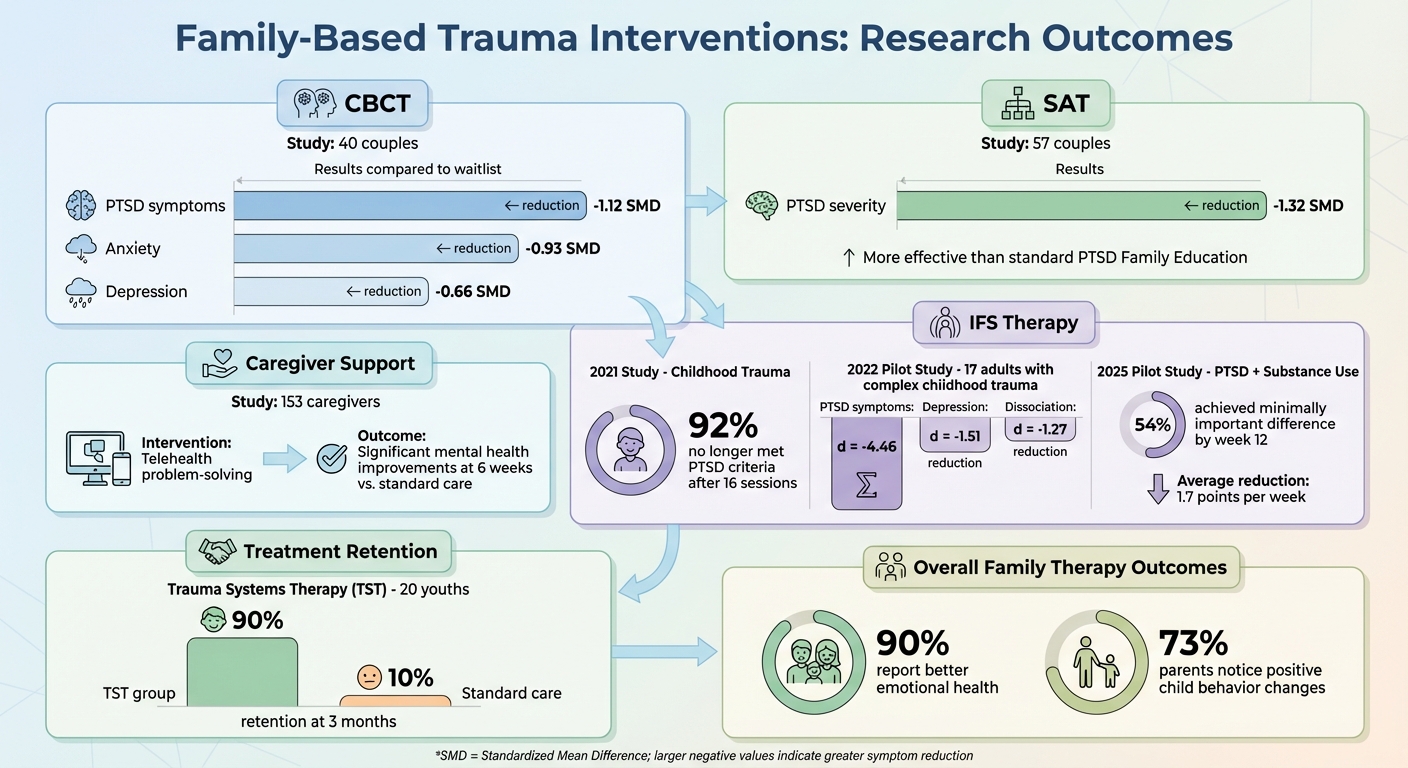
Family Therapy Impact on Trauma Recovery: Key Research Findings and Outcomes
Studies on Family Support and Trauma Outcomes
Research highlights how crucial family support is in trauma recovery. For example, a 2012 study involving 40 couples found that Cognitive Behavioral Conjoint Therapy (CBCT) significantly reduced PTSD symptoms (SMD -1.12), anxiety (SMD -0.93), and depression (SMD -0.66) compared to a waitlist group [6].
Another study, this one with 57 couples, demonstrated that Structural Approach Therapy (SAT) was more effective in reducing PTSD severity (SMD -1.32) than standard PTSD Family Education [6]. These reductions in symptoms not only improved mental health but also enhanced daily functioning and overall quality of life.
Interestingly, the benefits of family involvement aren’t limited to trauma survivors. A 2016 study of 153 caregivers revealed that a telehealth problem-solving intervention led to significant mental health improvements at six weeks when compared to standard care [2]. Healthier caregivers are better positioned to support the recovery process, creating a ripple effect that benefits the entire family unit.
These findings emphasize the importance of family support in trauma recovery and set the stage for exploring how systemic interventions can further enhance healing.
Systemic Approaches in Trauma Recovery
Family-based interventions go beyond addressing individual symptoms – they also focus on the relationship patterns that can either aid or hinder recovery. While many traditional trauma treatments concentrate on internal struggles like anxiety, flashbacks, or depression, they often overlook the interpersonal challenges that arise after trauma [1].
Systemic approaches recognize that family dynamics are deeply interconnected. A supportive family environment with strong communication and problem-solving skills can reduce PTSD symptoms. On the other hand, dysfunctional patterns – like emotional numbing or hyperarousal that leads to conflict – can exacerbate trauma’s effects [1]. The Family Systems Adaptation to Trauma (FSAT) Model provides a structured way to address trauma across individual, relational, and broader social systems, emphasizing that recovery unfolds within a network of relationships [4].
Research also points to specific family behaviors that promote healing. High levels of perceived social support from family members act as a protective shield against the effects of trauma. Open and honest communication between survivors and their loved ones is linked to better adjustment and lower PTSD severity. Families that exhibit commitment, control, and cohesion create safer spaces for survivors to process and reframe traumatic experiences [4].
Together, these studies highlight the profound influence of family dynamics on trauma recovery, reinforcing the idea that healing is often a collective process shaped by the relationships that surround the survivor.
Internal Family Systems (IFS) Therapy in Trauma Recovery
Core Principles of IFS Therapy
Internal Family Systems (IFS) therapy views the mind as a collection of distinct parts that interact much like members of a family. Instead of seeing trauma as something that damages the core self, IFS suggests it burdens specific parts of the mind with overwhelming emotions and rigid beliefs [7].
Central to IFS is the idea of the Self – a resilient inner presence characterized by what therapists call the "8 Cs": confidence, calmness, creativity, clarity, curiosity, courage, compassion, and connectedness [7][9]. This Self acts as a natural leader, guiding the healing process for wounded parts.
IFS identifies three key roles that parts can take on after experiencing trauma. Exiles are the vulnerable parts that carry the weight of traumatic memories and emotions. Managers work to maintain control, suppressing Exiles to avoid emotional distress. Firefighters, on the other hand, respond to the activation of Exiles with impulsive or reactive behaviors that often create further challenges [7].
A critical step in IFS therapy is the process of "unblending", where individuals learn to observe and engage with their parts without being overwhelmed by them. The ultimate goal is "unburdening", where Exiles release the intense emotions and beliefs tied to trauma, allowing them to return to their natural, balanced roles. As Dr. Frank Anderson explains:
"Self-Energy helps unbind parts corrupted by trauma, reconnecting them to their natural, adaptive roles, rather than merely soothing them" [7].
The effectiveness of IFS is supported by research. For instance, in a 2021 study on adults with childhood trauma, 92% of participants no longer met the criteria for PTSD after just 16 IFS sessions [7]. Similarly, a 2025 pilot study focusing on individuals with both PTSD and substance use disorder found that 54% achieved a minimally important difference (MID) in PTSD symptoms by week 12, with an average symptom reduction of 1.7 points per week [8].
These principles form the foundation of IFS therapy, offering a pathway to healing by addressing the mind’s internal dynamics.
Neurobiological Mechanisms in IFS Therapy
Beyond its psychological framework, IFS therapy also facilitates healing at the neurological level, particularly through a process known as memory reconsolidation. When the Self engages with wounded parts, it creates conditions for neural rewiring, leading to genuine emotional healing rather than just symptom management [7].
Activation of the Self plays a key role in calming the nervous system. By engaging the prefrontal cortex, the Self helps regulate the limbic system, reducing the hyperarousal and emotional instability commonly seen in PTSD. This dynamic between the prefrontal cortex and limbic system creates a stable foundation for safely processing traumatic experiences without retraumatization [7].
Research suggests that IFS also strengthens the brain’s functional connectivity between prefrontal and subcortical regions. This improved connectivity allows individuals to integrate traumatic memories more effectively, helping them create coherent narratives about their experiences without being overwhelmed by the emotional intensity [7].
A 2022 pilot study at the Trauma Center at JRI offers compelling evidence of IFS’s impact. In this study, 17 adults with PTSD and histories of complex childhood trauma underwent 16 weekly 90-minute IFS sessions. Led by Research Director Hilary B. Hodgdon, the results showed significant reductions in PTSD symptoms, with a large effect size (d = -4.46). Participants also reported decreased depression (d = -1.51) and dissociation (d = -1.27), along with increased self-awareness and self-compassion [9].
Another notable aspect of IFS is its systemic approach, which draws parallels between internal dynamics and external family relationships. By addressing internal conflicts between parts as if they were family disagreements, IFS creates a natural bridge between individual and family therapy [10][11]. This alignment with family systems theory further highlights its relevance in trauma recovery, offering a comprehensive approach to healing both the individual and their broader relational world.
sbb-itb-596b85d
Integrating Family Support into Trauma Recovery Interventions
Combining IFS with Other Family-Based Therapies
Trauma recovery works best when therapists address both a person’s inner struggles and their relationships with others. While Internal Family Systems (IFS) focuses on helping individuals connect with their internal parts, pairing it with family-based approaches creates a supportive environment for the whole family to heal together [12][1].
Psychoeducation plays a key role in this process. It helps family members understand PTSD symptoms as the brain’s way of adapting to trauma – not as personal flaws or attacks. This perspective shift allows families to stand united against the trauma itself, rather than blaming the survivor [12].
Therapists also need to carefully balance trauma processing to avoid overwhelming family members. The aim is to build what experts call a "safe and secure recovery environment", where traumatic memories can be revisited without causing additional stress. This ensures that family members can participate in the healing process in a way that feels manageable for everyone involved [2][6].
Attachment-based therapies, like Emotionally Focused Couple Therapy (EFCT), align well with IFS principles. Both approaches emphasize the importance of connection – whether it’s reconnecting with one’s internal parts in IFS or strengthening bonds between partners through secure attachment. Research, including randomized controlled trials, has shown EFCT to be particularly effective for female survivors of childhood abuse [1].
By integrating these strategies, therapists can create a comprehensive approach to trauma recovery that benefits both individuals and their families.
Clinical Outcomes and Benefits of Family Integration
Incorporating family support into trauma recovery doesn’t just help individuals heal internally – it also leads to measurable clinical improvements. Studies consistently show that involving families can significantly reduce PTSD symptoms and related challenges.
One of the most striking benefits is improved treatment retention. For example, a study involving 20 youths with severe post-traumatic stress symptoms compared Trauma Systems Therapy (TST) – which focuses on the child’s social environment – with standard care. After three months, 90% of the TST group were still engaged in treatment, compared to just 10% in the standard care group [13].
The positive effects extend beyond the trauma survivor. Research on Trauma-Focused Cognitive Behavioral Therapy (TF-CBT) involving parents revealed major improvements in parental depression and reductions in parenting challenges [2]. This ripple effect highlights how systemic approaches can foster healing throughout the entire family network. As Professor Briana S. Nelson Goff explains:
"The repercussions from trauma impact the family and social-cultural community systems of individual trauma survivors" [4].
Family Therapy at Growth and Change Counseling
At Growth and Change Counseling, the focus is on understanding that trauma doesn’t just affect one person – it impacts entire family dynamics. Their family therapy services are designed with a trauma-informed approach, taking into account how stress and trauma ripple through relationships and influence family functioning. Instead of addressing issues in isolation, they look at the family as a whole system, creating a foundation for using effective methods like Internal Family Systems (IFS) therapy [5][3].
Through IFS, therapists help families address internal conflicts within the broader family context. This method involves working with protective parts of individuals, building trust, and then guiding these parts to release pain and unhelpful beliefs tied to trauma [14]. The goal is to foster relational healing, as close relationships often play a critical role in recovery [1].
Safety and systemic healing are at the forefront of every session. Therapists carefully evaluate safety measures to ensure that families can process trauma in a way that safeguards individual well-being while maintaining the stability of the family unit [5].
Growth and Change Counseling offers family therapy in Campbell, San Jose, Los Angeles, and Roseville, CA, as well as through telehealth. Sessions are priced at $200 for 45 minutes with Licensed Marriage and Family Therapists (LMFTs), $150 with Associate Marriage and Family Therapists (AMFTs), and sliding scale options start at $100. This flexible pricing structure reflects their commitment to making therapy accessible for families seeking support.
Their approach also emphasizes the role of societal and cultural influences in shaping each family’s unique experiences. By tailoring interventions to address both individual trauma and the relational patterns that either help or hinder recovery, Growth and Change Counseling strengthens the family’s role as a key part of the healing process.
Conclusion
Research shows that close relationships can either sustain trauma symptoms or become a powerful pathway to healing [1]. By viewing trauma as something that affects the whole family, not just the individual, families can address both personal struggles and the patterns within their relationships. Simple actions like keeping routines, encouraging open communication, and tackling problems together can help strengthen a family’s ability to recover and thrive [3].
The numbers back this up: nearly 90% of people report better emotional health after family therapy, while about 73% of parents notice positive changes in their child’s behavior through systemic interventions [15]. These statistics highlight the critical role family dynamics play in either hindering or fostering recovery.
That’s where professional support becomes essential. Growth and Change Counseling offers trauma-informed family therapy designed to address both individual pain and the relational dynamics within families. With offices in Campbell, San Jose, Los Angeles, and Roseville, CA, and telehealth services available across California, they provide flexible options for families seeking help.
If your family is navigating the challenges of trauma, consider reaching out to professionals who understand the importance of healing within relationships. With the right guidance, families can move beyond trauma and embrace growth together.
FAQs
How do family relationships impact trauma recovery?
Family relationships hold a crucial place in trauma recovery, shaping how individuals process and move forward from difficult experiences. A supportive family environment can bolster resilience, while strained dynamics or poor communication can intensify trauma-related struggles.
Trauma doesn’t just impact the individual – it ripples through the entire family system. Family-focused interventions can address these challenges by improving communication, deepening emotional bonds, and helping everyone navigate the healing process together. By working with the entire family, mental health professionals can craft personalized strategies that encourage recovery for all members involved.
How does combining individual and family therapy support trauma recovery?
Combining individual and family therapy offers a powerful approach to trauma recovery. Family therapy focuses on the relationships and dynamics within the family, working to improve communication, build stronger connections, and create a nurturing space for healing. This ensures that trauma survivors feel supported and understood by their loved ones.
When combined with individual therapy – which zeroes in on personal trauma symptoms and emotional processing – this approach provides a more well-rounded path to recovery. It not only aids individuals in their healing journey but also enhances how the family functions as a whole. This reduces relational stress and encourages resilience. By addressing both personal struggles and family dynamics, this method builds trust and emotional connection, paving the way for lasting recovery.
How does Internal Family Systems (IFS) therapy support trauma recovery?
Internal Family Systems (IFS) therapy plays a crucial role in trauma recovery by guiding individuals to explore and connect with the different "parts" of their mind. These parts often emerge as a response to trauma and can include those carrying painful memories, acting in protective roles, or feeling disconnected. Through IFS, individuals gain greater self-awareness and learn to create balance within themselves, allowing them to process traumatic experiences in a safe way. This process can help reduce symptoms such as emotional dysregulation, dissociation, and hyperarousal.
IFS is especially helpful for people with complex trauma histories, such as those stemming from childhood experiences or combat exposure. By addressing trauma in the context of both the individual and their internal "family" of parts, this approach encourages healing and resilience. It helps individuals move toward a sense of harmony and wholeness, making it a valuable tool for achieving long-term recovery.
Related Blog Posts
- Trauma-Informed Family Therapy Techniques
- Family Therapy for Trauma Recovery: What Works
- Trauma-Informed Family Therapy for Attachment Issues
- How Family Therapy Improves Trauma Communication
