Trauma in cross-cultural relationships presents unique challenges due to differences in emotional expression, communication styles, and healing approaches. This article explores how trauma impacts these relationships and provides strategies for recovery, such as therapy, emotional awareness, and conflict resolution. Here’s a quick overview:
- Trauma Effects: Emotional dysregulation and physiological stress can strain relationships, especially when cultural norms shape how trauma is expressed.
- Barriers to Recovery: Challenges include communication mismatches, generational trauma, and trust issues.
- Solutions: Therapy options like EFT, IBCT, and the Gottman Method help couples reconnect and navigate differences. Emotional awareness, movement-based activities, and cultural education also play key roles.
- Support Services: Growth and Change Counseling offers tailored therapy for cross-cultural couples, while The Marriage Rescue Institute provides an intensive 12-week program for rebuilding relationships.
Cross-Cultural Relationships: Navigating Differences for Stronger Connections
How Trauma Affects Cross-Cultural Couples
Trauma impacts both the mind and body, activating automatic responses in the nervous system. For cross-cultural couples, these effects are even more complex because culture deeply influences how trauma is experienced and expressed. What one partner perceives as a normal reaction to stress might feel like rejection, hostility, or emotional distance to the other. The following sections explore how emotional dysregulation and cultural differences can amplify these challenges.
Emotional Dysregulation in Cross-Cultural Relationships
In many cases, trauma disrupts a relationship by leading to emotional dysregulation. This happens when stress and heightened emotions make it difficult for partners to communicate effectively, leading to misunderstandings and conflict.
"When emotion regulation skills aren’t used during conflict, many couples experience dysregulation… our ability to communicate effectively goes out the window!" – Rachel Burgreen, LCSW-S [5]
Physical signs often accompany this emotional turbulence. For example, a heart rate exceeding 100 beats per minute is a common indicator of acute physiological stress [5]. In such moments, the nervous system takes control, making it harder for partners to truly listen to one another. Trauma responses like hypervigilance, avoidance, or sudden flashbacks can further complicate interactions, especially when sensory triggers – such as smells, sounds, or tones of voice – bring up unresolved emotional memories.
Understanding these physiological responses can be a game changer. For instance, knowing that stress hormones may take about 20 minutes to subside allows couples to step back and reset before re-engaging in conversation. However, while emotional dysregulation disrupts communication, cultural norms often shape how these emotions are expressed and interpreted.
How Culture Shapes Trauma Responses
Culture plays a central role in how people process and express trauma [3]. For instance, someone raised in a culture that values emotional restraint may handle trauma differently than a partner from a culture that encourages open emotional expression. Neither approach is inherently wrong, but these contrasting styles can create friction within the relationship.
Research highlights the importance of addressing this internal stress. Studies show that high levels of unspoken stress can negatively impact relationship satisfaction. On the other hand, couples who actively share their stress with one another – especially at lower stress levels – tend to experience greater relationship satisfaction [2].
"Relationship satisfaction was higher when partners reported more engagement in stress communication at lower levels of internal stress." – Jenny Holzapfel et al., Researchers [2]
Cultural norms also influence how trauma is validated and understood, which can complicate the healing process. For cross-cultural couples, building positive dyadic coping – where partners support each other through stress – requires mutual recognition of each other’s stress signals. When cultural differences lead to mismatched communication styles, these signals may go unnoticed, escalating trauma responses and creating ongoing emotional strain. This makes it even more challenging for couples to navigate the road to recovery together.
Common Barriers to Trauma Recovery for Cross-Cultural Couples
Cross-cultural couples often face unique challenges that can hinder trust and emotional connection, making trauma recovery more complex. These challenges are deeply rooted in differences in cultural communication styles and perspectives, which can add layers of difficulty to an already sensitive process.
Communication Barriers
Communication issues in cross-cultural relationships go far beyond just language differences. Cultural norms around idioms, body language, and approaches to resolving conflict can lead to misunderstandings, especially during emotionally charged discussions about trauma. For instance, one partner might prefer a direct way of addressing issues, while the other leans toward a more indirect style. This mismatch can leave one feeling dismissed and the other feeling attacked. Christine Chae, LCSW, emphasizes the importance of cultural awareness in communication:
"Effective communication in cross-cultural relationships is more than a mere exchange of words; it’s a blend of empathy, understanding, and respect for the cultural nuances that shape how each partner perceives and interacts with the world." [1]
Additionally, trauma memories are often tied to sensory triggers, which can cause distress and complicate conversations. [4]
Historical and Generational Trauma
Trauma doesn’t just affect individuals – it can ripple through generations. This "soul wound", as some describe it, can be passed down through both genetic predispositions and learned behaviors. [7] For cross-cultural couples, these inherited traumas can bring different perspectives on healing. One partner might view trauma recovery as a psychological process best addressed through therapy, while the other may approach it through cultural or spiritual practices. [6]
On top of this, historical distrust between cultural groups can amplify stereotypes and make it even harder to be vulnerable with one another. Such dynamics can deepen emotional mistrust and create more barriers to healing. [6]
Trust and Emotional Closeness Problems
Trauma within intimate relationships – whether from betrayal, neglect, or violence – can severely damage the foundation of trust and safety. This kind of attachment-based trauma often makes it difficult for individuals to open up emotionally. Marla Leigh Caplan, a Licensed Trauma Therapist, explains:
"The traumatic experience most likely to develop into PTSD is relational or developmental trauma – the rupture that occurs when the foundation of our safety and trust is shattered in formative, intimate relationships." [4]
For cross-cultural couples, these challenges are compounded by additional stressors, such as navigating differences in cultural backgrounds, religious beliefs, or socioeconomic factors. [2] When this stress goes unspoken, it can lead to emotional withdrawal or heightened sensitivity, further straining the relationship and making emotional closeness harder to achieve.
sbb-itb-596b85d
Practical Solutions for Trauma Recovery
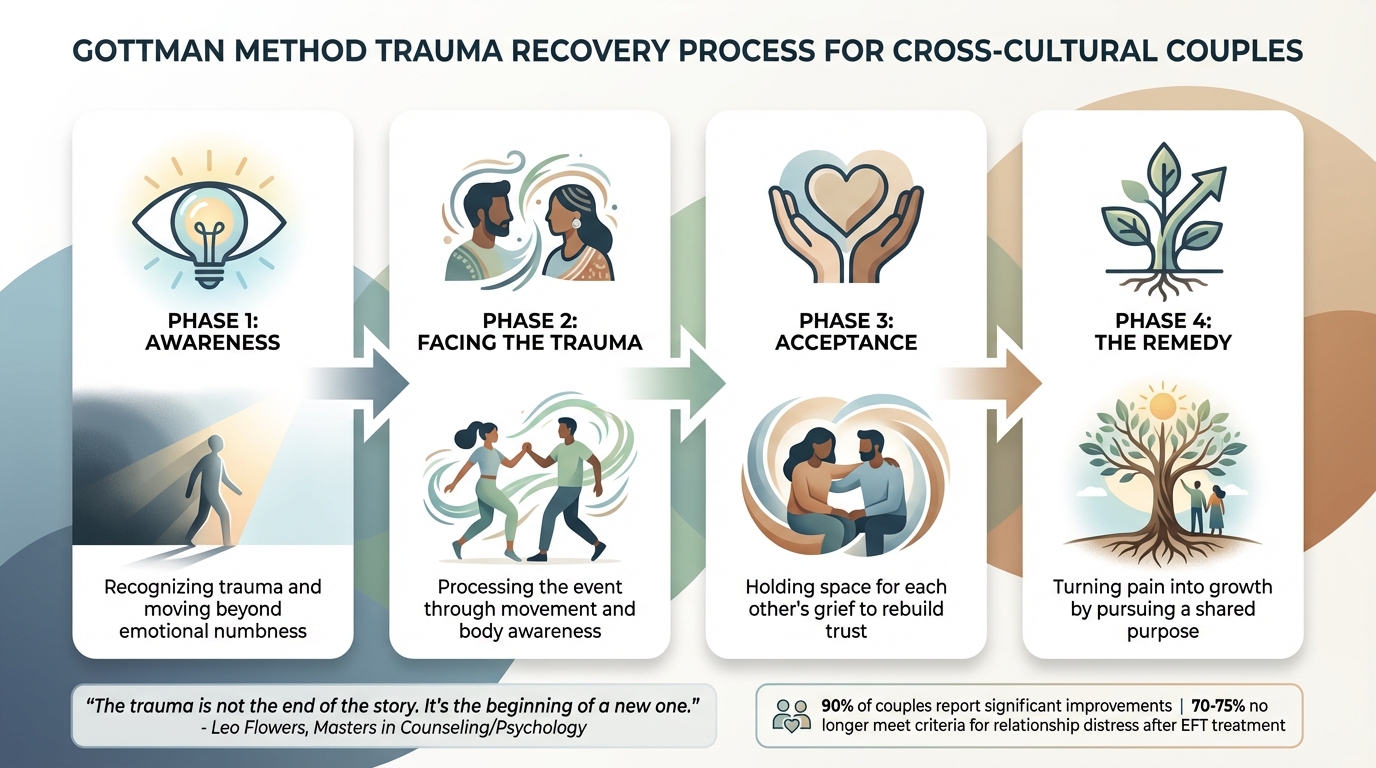
4-Phase Trauma Recovery Process for Cross-Cultural Couples Using the Gottman Method
Recovering from trauma in cross-cultural relationships requires thoughtful strategies that respect both partners’ backgrounds while fostering new ways to connect. When approached intentionally, working through trauma can even strengthen the bond between partners [8].
Therapy Approaches for Cross-Cultural Trauma
Evidence-based therapies offer meaningful ways to address the challenges that arise in cross-cultural relationships. Emotionally Focused Therapy (EFT) has shown impressive results: 90% of couples report significant improvements in their relationships, and 70%–75% no longer meet the criteria for relationship distress after treatment. This approach focuses on identifying and breaking negative cycles, such as the "Attack-Withdraw" pattern, where one partner criticizes while the other shuts down. By addressing the emotional needs behind these patterns, couples can foster healthier dynamics [10].
Integrative Behavioral Couple Therapy (IBCT) is another effective option, particularly for intercultural couples. It helps partners navigate differences in cultural practices, beliefs, and identities by balancing acceptance with positive change [9]. Meanwhile, the Gottman Method provides a structured four-phase recovery process:
- Awareness: Recognizing trauma and moving beyond emotional numbness.
- Facing the Trauma: Processing the event through movement and body awareness.
- Acceptance: Holding space for each other’s grief to rebuild trust.
- The Remedy: Turning pain into growth by pursuing a shared purpose.
As Leo Flowers, who holds a Masters in Counseling/Psychology, insightfully explains:
"The trauma is not the end of the story. It’s the beginning of a new one." [8]
Other approaches, like narrative therapy, help couples reframe their trauma stories, while tools such as cultural genograms – diagrams that map cultural influences across generations – offer insights into how family history shapes current behaviors and conflicts.
Developing Emotional Awareness and Communication
Beyond therapy, developing emotional awareness is essential for healing. Partners can deepen their understanding by sharing where they physically feel trauma – whether it’s tension in the chest, stomach discomfort, or tightness in the neck. This practice helps identify early signs of trauma triggers and prevents conflicts from escalating [8].
Movement-based activities like yoga, dancing, or hiking can also play a powerful role in recovery. They help partners reconnect with their emotions and move past feelings of numbness [8]. On the communication front, using "I" statements reduces defensiveness, while active listening creates a sense of safety. Some therapists suggest practicing Emotional Mental Models, which involve role-playing hypothetical scenarios to rehearse calm, regulated responses. Addressing miscommunications early also prevents minor cultural differences from spiraling into larger conflicts [1].
Steps for Resolving Conflict in Cross-Cultural Relationships
With therapeutic tools in place, partners can refine their conflict resolution skills. The first step is recognizing negative cycles – such as Attack-Withdraw or Withdraw-Withdraw – before they spiral out of control. Naming the emotional needs behind these patterns helps break the cycle [10].
Cultural education is another key element. Learning about each other’s culture fosters appreciation and reduces misunderstandings caused by differing communication styles. This process doesn’t require either partner to give up their heritage; instead, it encourages both to honor their traditions while creating shared boundaries.
Building resilience also involves practicing self-care that respects both cultural backgrounds. Some couples find healing by channeling their shared struggles into meaningful causes, such as advocacy or community service, turning pain into purpose [8].
It’s also important to recognize avoidance behaviors like "trauma blocking", where work, alcohol, or entertainment is used as a distraction. Redirecting energy toward genuine healing, rather than temporary escapes, is crucial for long-term recovery [8].
Growth and Change Counseling‘s Specialized Services
Cross-cultural couples dealing with trauma often require tailored support that addresses both the complexities of trauma and the nuances of cultural differences. Growth and Change Counseling, established by John Mark Kane, LMFT, provides access to therapists with direct experience in diverse cultural settings [12]. This specialized approach builds on previous methods designed for culturally adapted trauma recovery.
The practice emphasizes emotional regulation and typically sees progress within 6–8 sessions. Their approach fosters what they call "relational intelligence" – the ability to identify and address the root causes of conflict rather than just managing surface-level issues [11][12]. Jamula Taylor, LMFT, explains:
"We understand that our mental health conditions are related to the breakdown in our relationships and that we can’t simply make depression, anxiety, or other problems go away by simply treating the symptoms. We have to get down to the roots of the problems in order to help people effectively heal." [12]
For couples struggling with trauma-related intimacy challenges, April Silva, LMFT, a trauma specialist at the practice, adds:
"In cases of PTSD, I will help you uncover the underlying defenses that protected you through a traumatic experience but now are interfering with your ability to move forward in intimacy." [12]
The Marriage Rescue Institute Program
For cross-cultural couples facing crises such as infidelity, separation, or toxic conflict, The Marriage Rescue Institute offers an intensive 12-week coaching program aimed at restoring and rebuilding relationships. The program combines practical relational exercises with evidence-based methods like EMDR, Somatic Therapy, and Attachment Theory, all delivered with culturally sensitive care. Around 70% of couples report significant improvements, with the program designed to accelerate progress and reduce the need for prolonged therapy [11][12]. Arione Capolupo, LMFT, highlights:
"We don’t believe in endless therapy. Our goal is to get you in and out as quickly as reasonably can be done and do it in a way that hopefully you will never need to come back!" [12]
Therapy Pricing and Availability
With a focus on delivering results, Growth and Change Counseling offers transparent pricing and accessible service options. Sessions are priced at $165 for 45 minutes [11][12]. The practice accepts insurance from major providers like Anthem Blue Cross, Aetna, United Health Care, Oxford, and Oscar Health. For clients with plans such as Cigna, HealthNet, or Blue Shield of California, superbills are available for out-of-network reimbursement.
Services are offered both in-person at their locations in Campbell, San Jose, Los Angeles, and Roseville, California, and through secure, HIPAA-compliant telehealth across the state. Therapy is available in English, Spanish, and Afrikaans, ensuring that language is not a barrier to receiving care.
Strengthening Cross-Cultural Bonds at Growth and Change Counseling
Cross-cultural couples facing trauma often need culturally aware care and professional guidance to uncover hidden cultural conflicts that might not be immediately apparent. This process can pave the way for genuine understanding and healing[1]. The journey of recovery involves recognizing the trauma, confronting it, and finding ways to grow stronger together. As Leo Flowers, who holds a Master’s in Counseling/Psychology, insightfully puts it:
"The trauma is not the end of the story. It’s the beginning of a new one."[8]
This perspective encourages couples to view trauma not as a stopping point but as a chance to build a deeper connection.
One essential step in this process is developing a strong "us vs. the world" mindset to handle external pressures and miscommunications. Setting clear boundaries against outside influences – like family objections or societal biases – is crucial[13]. Couples who stand united in the face of criticism and cultural misunderstandings create a safe space for healing and growth[13]. Practicing cultural exchange and immersion also plays a vital role in fostering mutual understanding[13].
Growth and Change Counseling offers the specialized support cross-cultural couples need to navigate these unique challenges. Their approach focuses on "relational intelligence", addressing the root causes of issues rather than just treating symptoms. Programs like The Marriage Rescue Institute, an intensive 12-week couples coaching process grounded in evidence-based therapy, provide structured guidance to help couples rebuild their relationships.
With expert help and tailored therapy, couples can turn their struggles into opportunities for growth. Whether it’s addressing generational trauma, repairing trust, or bridging cultural communication gaps, professional support can make all the difference. Reach out to Growth and Change Counseling at their Campbell, San Jose, Los Angeles, or Roseville locations – or connect via telehealth anywhere in California – to take the first step toward healing and a stronger, more connected relationship.
FAQs
How do cultural differences affect trauma recovery in relationships?
Cultural backgrounds play a major role in how couples handle trauma recovery. Each partner’s upbringing influences their values, communication styles, and ways of coping, which can sometimes lead to misunderstandings. For example, one partner might want to openly discuss their emotions, while the other prefers to communicate through actions or nonverbal cues. This difference can create a gap in how they process trauma together.
On top of that, external pressures like immigration issues, family expectations, or societal norms can add layers of stress. These factors might make it even harder for couples to establish a safe and supportive environment for healing unless they consciously work on improving their communication and understanding of each other.
Tailored therapeutic approaches can make a big difference here. Growth and Change Counseling offers a 12-week Marriage Rescue Institute program designed to help couples develop emotional intelligence, resolve conflicts in a healthy way, and create a shared path toward recovery.
What therapy approaches work best for cross-cultural couples recovering from trauma?
Cross-cultural couples recovering from trauma often find therapy approaches that address both emotional regulation and cultural nuances to be especially helpful. Emotionally Focused Therapy (EFT) focuses on rebuilding emotional connections by addressing attachment needs, even when partners express emotions in different ways. The Gottman Method provides practical tools for resolving conflicts and includes culturally tailored exercises to encourage mutual understanding and respect. Meanwhile, Integrative Behavioral Couple Therapy (IBCT) emphasizes accepting cultural differences while offering actionable steps to improve communication and handle stress effectively.
For couples facing trauma-related challenges, such as PTSD, Cognitive-Behavioral Conjoint Therapy for PTSD (CBCT-PTSD) offers structured sessions. These sessions prioritize safety, provide education, and facilitate joint trauma processing. When combined with emotion-regulation strategies, these approaches can help couples work through conflicts, heal together, and strengthen their bond.
Growth and Change Counseling incorporates these proven methods into a 12-week intensive couples coaching program. The program is designed to provide trauma-informed and culturally sensitive care. Services are available in Campbell, San Jose, Los Angeles, Roseville, and through telehealth for couples across California.
How can cross-cultural couples overcome communication challenges during trauma recovery?
Cross-cultural couples often encounter distinct communication hurdles, particularly when working through trauma. Differences in how partners express themselves – like one favoring direct communication while the other leans on non-verbal cues or indirect expressions – can lead to frequent misunderstandings. To bridge these gaps, couples can try active listening (repeating or summarizing what was heard before responding), clarifying assumptions (asking questions such as, “Can you explain what you mean by that?”), and exploring creative ways to express emotions, like storytelling or shared journaling, in a manner that aligns with their cultural comfort zones.
Therapeutic methods such as Emotionally Focused Therapy (EFT) and the Gottman Method are designed to help couples address these challenges by fostering emotional closeness, creating shared rituals, and resolving ongoing conflicts. For a more structured approach, Growth and Change Counseling provides evidence-based tools, including a 12-week intensive couples coaching program, to help cross-cultural partners build healthier communication habits and deepen their connection while addressing trauma. These services are offered both in-person across California and through telehealth, ensuring a supportive and personalized experience for every couple.
Related Blog Posts
- Relationship Trauma: Root Causes and Solutions
- Top 7 Therapy Approaches for Cross-Cultural Couples with Addiction
- Trauma Recovery for Couples: A Path to Healing
- Study: Impact of Cultural Awareness on Marriage Counseling
