Trauma rarely affects just one person. It often changes the whole home. If you’re seeing more silence, more tension, or kids taking on adult jobs, those can be signs that trauma has shifted how your family works.
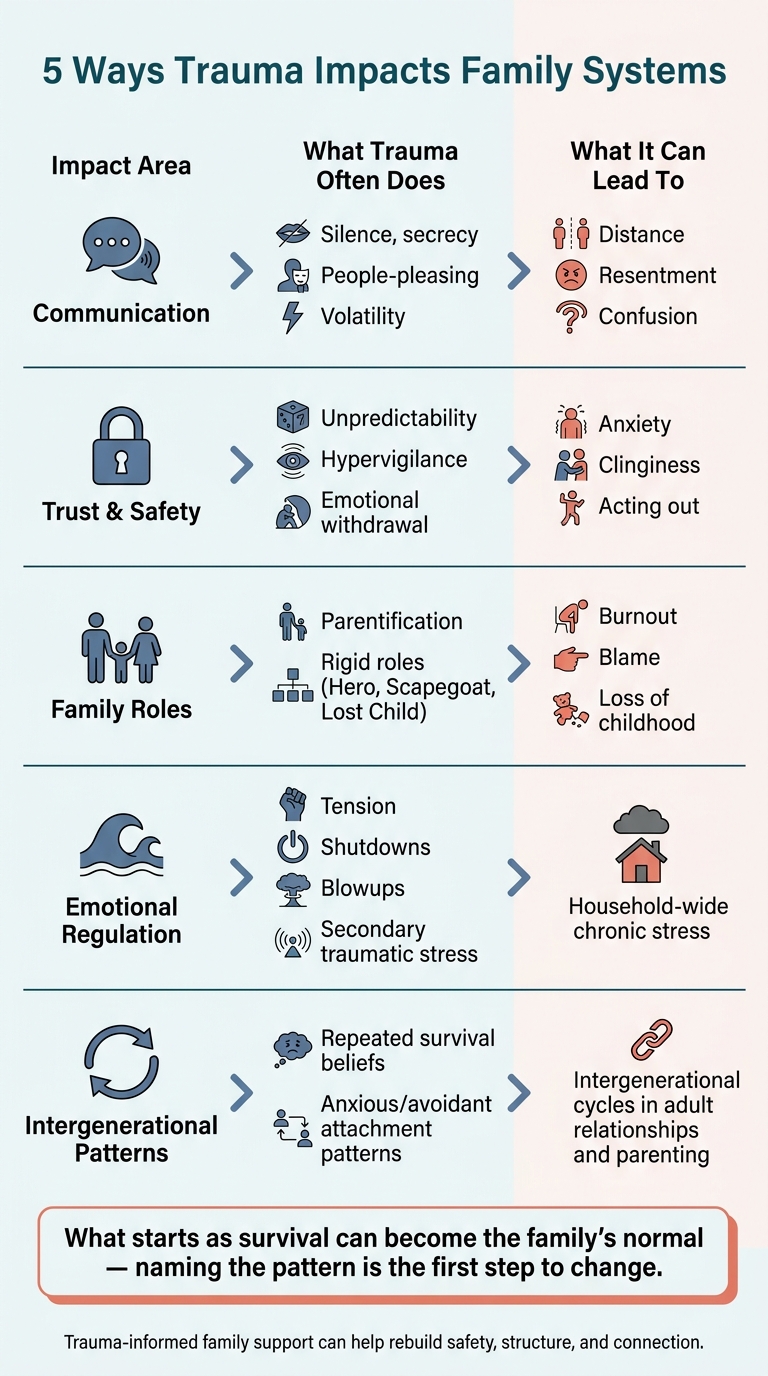
Here’s the short version: trauma often changes how people talk, how safe home feels, who carries what role, how emotions spread through the house, and which patterns get passed to the next generation. Research on adverse childhood experiences has also linked early family stress with later mental and physical health problems, which helps show why these patterns can last for years.
If you want the main takeaways fast, start here:
- Communication gets strained: people avoid topics, hide feelings, or blow up.
- Trust gets weaker: family members start scanning for danger instead of relaxing.
- Roles shift: kids may become caretakers, while adults pull back or over-control.
- Stress spreads: one person’s dysregulation can affect the whole household.
- Patterns repeat: children can carry these survival habits into adult relationships.
Quick Comparison
| Area | What Trauma Often Does | What It Can Lead To |
|---|---|---|
| Communication | Silence, secrecy, conflict, people-pleasing | Distance, resentment, confusion |
| Trust and safety | Unpredictability, emotional withdrawal | Anxiety, clinginess, acting out |
| Roles and boundaries | Parentification, rigid family roles | Burnout, blame, loss of childhood |
| Emotional regulation | Tension, shutdowns, blowups | Household stress, secondary trauma |
| Long-term patterns | Repeated beliefs and attachment wounds | Intergenerational cycles |
The core idea is simple: what starts as survival can become the family’s normal. And once you can name the pattern, you can start to change it.
5 Ways Trauma Impacts Family Systems: Patterns & Effects
Impact of Trauma on Families RECORDING
sbb-itb-596b85d
Why Trauma Affects the Whole Family
A family works like an interconnected system. When one person goes through trauma, the strain doesn’t stay with them alone. It moves through the whole household and changes how people talk, trust, and relate to each other.
Because family members are emotionally tied to one another, one person’s pain rarely stays contained. It spills into daily life. Other people in the home start adjusting, often without noticing it. A partner may become more careful. A child may get quiet. A parent may start overaccommodating. In the moment, those shifts can feel protective. Over time, though, they pile up.
Trauma can also be a relational injury. Irritability, emotional withdrawal, and hypervigilance don’t just affect the person dealing with them. They change how everyone else in the home responds, communicates, and feels safe [1]. Family members may also start showing symptoms of their own, such as anxiety, depression, sleep problems, or somatic complaints, simply because they’re part of the affected system [1].
The trouble starts when short-term coping hardens into a lasting rule. Avoiding a painful topic once may help people get through a hard moment. Doing it for years turns that habit into an unspoken family rule. What began as survival can slowly become the family’s normal way of living, and that’s often when the deepest harm sets in [3].
That’s why trauma needs to be seen as a family issue, not just an individual one. The effects usually show up first in communication, trust, roles, regulation, and long-term patterns. First, trauma disrupts communication.
1. Disrupted Communication Patterns
When trauma hits a family, conversation often gets tight and careful. People dodge certain topics, rehearse what they want to say, and watch their tone and timing so they don’t set off conflict. Over time, that walking-on-eggshells feeling teaches everyone in the home, especially kids, that honesty may come with risk. And when people no longer feel safe to speak plainly, trust and emotional safety start to wear down.
These are survival responses, not character flaws. They may shift from one day to the next, but they tend to lead to the same kind of damage:
| Trauma-Driven Pattern | How It Shows Up | Long-Term Impact |
|---|---|---|
| Stonewalling | Refusing to discuss certain events | Unresolved tension, emotional distance |
| People-pleasing | Over-functioning as a "peacekeeper" | Loss of self, resentment |
| Hypervigilance | Bracing for conflict or criticism | Chronic household stress |
| Secrecy | Maintaining taboo subjects or family rules | Erodes trust and confuses children |
| Volatility | Explosive or disproportionate reactions | Destroys emotional safety |
The point isn’t to blame anyone. It’s to change the pattern. Trauma-informed family support can give families a clear way to talk more safely and reset how communication works. Once trust starts to crack, the whole family system can feel more fragile in every single conversation.
2. Loss of Trust and Emotional Safety
When trauma makes home life feel unpredictable, trust can wear down fast. And once that starts, the whole household can begin to revolve around one person’s stress response. In day-to-day life, that often looks like constant scanning, long stretches of silence, and emotional distance.
People stop just living in the home. Instead, they start watching for the next outburst. A small change in tone, a slammed door, a long quiet pause – each one can feel like a warning sign. That kind of watchfulness is draining. Over time, closeness gives way to caution.
Children and partners often feel this most deeply. When a child no longer feels emotionally safe, they may regress, become clingy, or act out. If a parent’s distress goes unchecked, kids sometimes try to step into the gap. That’s parentification – when a child takes on the role of the adult’s emotional caretaker. Partners carry their own strain too, taking in the stress of living inside someone else’s trauma response day after day.
Trauma-informed repair usually starts with stabilization. That means building coping skills and bringing stress levels down at home before getting into anything deeper. The aim is simple: make the home safe enough for honest connection again. When safety starts to crack, family members often slip into new roles just to keep the peace.
3. Distorted Family Roles and Boundaries
When trust and safety start to fall apart, families often reshuffle roles just to get through the day. Trauma changes the way a home works: who takes charge, who soothes, who watches the room, and who stays quiet. At first, these shifts can look like short-term coping. But over time, they can turn into rigid family patterns.
One of the clearest examples is parentification. That’s when a child starts carrying adult duties and becomes the caretaker. Maybe they manage emotions, look after siblings, or try to keep the peace. Trauma may seem to show up in one person first, but the pattern usually lives in the whole family system.
Fixed roles can also take hold. The Hero tries to cover the dysfunction through overachievement. The Scapegoat ends up carrying the blame. The Lost Child fades into the background to avoid conflict. These roles don’t come out of nowhere. They’re often the family’s way of surviving pressure, even when that survival strategy hurts everyone involved.
Boundaries shift too. Some families become enmeshed, where emotional lines blur and everyone gets pulled into everyone else’s pain. Others swing the other way and grow cut off or distant. Neither pattern makes support easy to give or receive. And when roles and boundaries get twisted, the emotional temperature in the home climbs, which affects each person’s ability to regulate.
Trauma-informed repair works to put parents back in the leadership role so children can step out of caretaking and get back to being kids. Therapists may also use approaches like externalizing the trauma – giving it a name outside the person – so the family can stand together against the trauma instead of turning on each other.
4. Emotional Dysregulation Across the Household
When roles and boundaries shift, emotional regulation usually takes the next hit. If trauma throws one person’s nervous system off balance, the whole home often starts to revolve around that strain. People begin watching for mood changes, steering clear of triggers, and tensing up for the next argument.
Family members can also develop secondary traumatic stress from living in a high-stress home. That can show up as hypervigilance, emotional numbing, and intrusive thoughts. In other words, the strain doesn’t stay with one person. It spreads through the household.
Day to day, this tends to look familiar. A parent’s unexplained irritability keeps everyone on edge. One child starts people-pleasing to manage an adult’s mood. Another pulls back and says less and less. Conversations end in shutdowns or blowups, and problems stack up without getting worked through.
Trauma-informed repair starts with stabilizing the nervous system and building safety first. Therapists may use co-regulation practices, such as breathing together or setting up scheduled emotional check-ins, to bring the home’s stress level down. Adults are also coached to notice their own physical signs of stress and take a deliberate pause before responding during conflict. The first step in repair is lowering stress across the household.
When dysregulation becomes normal at home, children start to absorb it as the family’s template.
5. Intergenerational Trauma Patterns
These patterns often become a child’s template for adulthood. What gets learned early can shape adult relationships long after the first wound.
Trauma can move through a family in a few quiet ways: through modeling, through rules no one says out loud, and through stress-system changes tied to early adversity. You can often spot it in the same roles, rules, and attachment patterns a family keeps repeating.
Children who grow up in these systems often carry survival roles and core beliefs into adult relationships. Scripts like “We don’t talk about our problems” or “Showing emotion is weakness” can end up running the show in subtle ways. They shape how adults communicate, where they draw boundaries, and how they parent their own children. Attachment patterns formed in a traumatized home – anxious, avoidant, or disorganized – can keep repeating until something breaks the cycle.
For example, an adult who learned to people-please to manage a parent’s moods may do the same with a partner 20 or 30 years later. Then that same habit can shape how they respond to their own child, pushing the cycle forward without either generation fully seeing it. Trauma-informed repair often starts with one simple step: naming the pattern. A therapist may use a genogram to show recurring patterns across generations.
Quick-Reference Tables
Use these tables to scan the five patterns fast. Each one lines up with one of the five impacts covered above.
Communication: Before and After Trauma
| Feature | Pre-Trauma Pattern | Post-Trauma Pattern |
|---|---|---|
| Conflict Resolution | Direct discussion and problem-solving | Emotional explosions or total withdrawal |
| Emotional Safety | Open expression | Walking on eggshells; feelings are dismissed |
| Transparency | Open dialogue about family history and events | Secrets and cutoffs |
| Tone | Calm and collaborative | Volatile or tense |
| Rules | Flexible and based on mutual needs | Rigid, unspoken rules, such as don’t show emotion |
Trust: What Damages It vs. What Rebuilds It
| Trust-Damaging Behaviors | Trust-Rebuilding Actions |
|---|---|
| Constant invalidation and dismissive comments | Active listening and validating feelings |
| Secrecy and avoidance of difficult topics | Open, honest dialogue about family history |
| Blaming, criticism, and accusatory language | I-statements and prompt repair |
| Inconsistent or emotionally unavailable parenting | Calm, consistent, steady, regulated parenting |
| Emotional numbness or sudden withdrawal | Space to name the harm |
Family Roles: Trauma-Shaped vs. Healthier Adjustments
| Trauma-Shaped Role | Description | Healthier Adjustment |
|---|---|---|
| The Hero | Overachiever masking family dysfunction | Collaborative member |
| The Scapegoat | Blamed for all family problems | Healthy self-boundaries |
| The Lost Child | Emotionally neglected; stays invisible | Seen and heard |
| The Caretaker | Child managing adult emotions | Age-appropriate role |
| The Rescuer | Compulsively fixes others’ distress | Supportive partner |
Trauma narrows a family’s range. Recovery brings that range back. The next section looks at trauma-informed family support and how families can rebuild safety, structure, and repair.
How Trauma-Informed Family Support Can Help
Once a family sees the pattern, the next move is to change the system around it. Trauma doesn’t just affect one person. It reshapes the whole family. That’s why treating only one family member often doesn’t stick. If the home system stays the same, progress can slow down or stop.
Trauma-informed family support takes a systems-based approach instead of centering one "problem" person. When family roles have become fixed, this kind of support helps reframe reactions like numbness as threat responses, not a lack of care.[3] That shift matters. It gets the family ready for structured repair, not just awareness.
Treatment usually moves through three stages: safety, trauma processing, and rebuilding connection.[3] Before any deeper work starts, coping skills and safety plans need to be in place. Without them, the process can overwhelm the system instead of helping it.
This work often includes:
- Boundary work
- Role reassignment
- Co-regulation tools
Parents also learn to notice their own physical signs of dysregulation and take a regulated pause before responding to a child’s behavior.[3] And multigenerational patterns don’t get ignored. Therapists can use tools like genograms – three-generation maps that show inherited emotional cycles – to make those patterns easier to see and interrupt.[2]
For families ready to put this into practice, structured support can make a big difference. Growth and Change Counseling offers family therapy, parent coaching, trauma treatment, addiction support, and couples coaching through The Marriage Rescue Institute, with in-person care in Campbell, San Jose, Los Angeles, and Roseville, CA, plus telehealth across California.
Steps Toward Healing with Growth and Change Counseling
Trauma can shape the way a family speaks, trusts, handles emotion, and settles into certain roles. It can also pass patterns from one generation to the next. Once you can see those patterns clearly, change stops feeling so out of reach.
Naming what’s happening is the first step. It moves the focus away from blame and toward repair.
If any of this sounds familiar, that awareness matters. It can replace self-blame with a clearer understanding of the survival patterns a family learned over time. That’s where family patterns start to shift.
FAQs
How can I tell if trauma is affecting my family?
Signs of trauma in a family often show up in the way people talk to each other, handle emotions, and act day to day.
Some of the most common signs include:
- frequent conflict
- emotional numbing
- isolation
- sudden changes in a child’s behavior
- more tension or volatility at home
- unhealthy coping patterns
These patterns can sneak in slowly, then start shaping the whole family dynamic. Growth and Change Counseling offers family therapy and trauma support to help families spot what’s happening, rebuild trust, and restore healthy connections.
Can family trauma affect kids into adulthood?
Yes. Childhood trauma can keep affecting people well into adulthood, especially when it isn’t addressed. It can disrupt emotional and behavioral development and set patterns that stick around for years.
In adult life, that may show up as strained relationships, trouble regulating emotions, and patterns that can shape parenting or attachment styles in the next generation.
How do families rebuild safety after trauma?
Rebuilding safety after trauma starts with stability and a predictable, nonjudgmental setting. People need to know what to expect. That sense of steadiness can help lower tension and make it easier to reconnect.
Open, honest communication also matters. So does psychoeducation, which helps family members understand how trauma can shape behavior. When people see the "why" behind certain reactions, it becomes easier to move away from blame and toward empathy.
Regular check-ins can help families stay on the same page. Solution-focused scaling is also useful because it gives everyone a simple way to track progress and notice small steps toward trust.
Growth and Change Counseling offers family therapy, individual therapy, and parent coaching to support this process.
Related Blog Posts
- How Trauma Impacts Parent-Child Relationships
- How Family Therapy Improves Trauma Communication
- Trauma Recovery: Role of Family Systems
- Stress from Trauma: Effects on Family Health
