I’d look at what phone use interrupts – not just how many hours it takes. If it keeps disrupting conversations, sleep, or shared duties, start with one shared rule: put phones away during dinner, with exceptions for urgent needs.
A Pew survey found that 51% of partnered adults said their partner was often or sometimes distracted by a cellphone during conversation.[5] But distraction alone isn’t addiction. I’d watch for these 10 patterns:
- Checking the phone without a reason.
- Choosing the phone over time together.
- Repeatedly interrupting conversations to check it.
- Feeling anxious or irritable without it.
- Trying to cut back but failing repeatedly.
- Hiding or lying about phone use.
- Letting scrolling disrupt sleep and shared routines.
- Missing duties or breaking commitments because of it.
- Spending more time on the phone for the same relief.
- Having repeated arguments, less closeness, or less intimacy.
<u>These are warning signs, not a diagnosis.</u> “Smartphone addiction” is not a formal diagnosis in the DSM-5 or ICD-11. I’d focus on loss of control, distress, and harm – then agree on phone-free moments and review how they’re working. If the pattern persists despite repeated efforts, professional support may help.
Is Your Phone Coming Between You and Your Partner?
sbb-itb-596b85d
Normal Phone Use vs. Problematic Phone Use: A Quick Comparison
Not every phone glance is a red flag. What matters is purpose and control. A person can use their phone a lot and still have a healthy relationship with it. The bigger issue is whether they’re using it on purpose – and whether they can stop without a struggle.
Here’s the difference in plain English: normal use is tied to a task. A partner replies to a school message, checks directions, or takes an urgent call, then puts the phone down and comes back to the moment. Problematic use feels more automatic. The phone comes out for no clear reason, and a “quick check” quietly turns into scrolling for far longer than planned. And if the phone is lost, charging, or put away on purpose, the reaction goes past mild annoyance and turns into irritability, restlessness, or anxiety.
| Normal Phone Use | Problematic Phone Use |
|---|---|
| Has a clear purpose: work, navigation, caregiving, urgent communication | Automatic checking or scrolling without a specific purpose |
| Stops when the task is done | Continues well past the original task; expands into unrelated use |
| Can be paused during conversations, meals, or shared moments | Interrupts shared moments |
| Open and transparent; no need to hide it | Hidden, minimized, or accompanied by defensiveness when questioned |
| Phone being unavailable causes mild inconvenience at most | Phone being unavailable causes anxiety, irritability, or restlessness |
| Fits within agreed limits | Spills into sleep, responsibilities, and closeness |
| Repeated attempts to cut back succeed | Repeated attempts to cut back fail |
High screen time by itself doesn’t prove addiction. That’s the part people often miss. The stronger signs are whether the behavior is automatic, whether the person can stop when it counts, and whether it keeps hurting the relationship even after honest attempts to change. That move from purposeful use to automatic checking is where the warning signs start.
1. Compulsive Checking and Constant Phone Preoccupation
This is often the first sign that phone use is turning compulsive. Compulsive checking means repeated, unplanned phone use: picking it up, unlocking it, and opening apps again without a clear reason. This isn’t just a one-time glance. It’s a pattern that keeps dragging attention back.
In a relationship, it tends to show up in small, everyday moments. Someone checks their phone while their partner is telling a story. They refresh notifications during dinner. They may be physically there, but their attention keeps slipping elsewhere. In a 2025 observational study, participants used their phones during 27% of the time they were with a partner, and 86% used them at least once a day.[9][7] The main issue isn’t just distraction. It’s losing control over the habit.
What sets this apart from ordinary distraction is impaired control. A person using their phone on purpose can usually put it down when the moment calls for it. A person stuck in a compulsive pattern has a hard time waiting, even after agreeing to stop. That’s the red flag: the gap between what they mean to do and what they end up doing.
The focus should be on patterns, not a single slip. Pay attention if checking happens in almost every conversation, if the phone stays out in plain view, or if they go back to it right after being asked to set it aside. That repeated pull toward the phone – especially when it keeps breaking shared attention – is the part to watch.
2. Putting the Phone Before the Relationship
The next warning sign is hard to miss: smartphone and internet addiction where the phone starts coming first. This happens when screen time keeps beating out a partner’s bids for attention, conversation, affection, or help. Not as a one-off, but as a pattern that shows up during meals, evenings, and everyday talks.
This behavior has a name: partner phubbing. It means ignoring a partner in favor of a smartphone. A 2025 meta-analysis of 52 studies involving 19,698 participants found that partner phubbing was negatively associated with relationship satisfaction (r_z = -0.219) and marital satisfaction (r_z = -0.264).[11]
In day-to-day life, it often looks small at first. A phone stays face-up at dinner. A nonurgent text gets answered in the middle of a sentence. The device comes out the second a talk gets uncomfortable. Bit by bit, the message lands: the phone gets first dibs.
That feeling is common. A Pew survey found that 51% of partnered adults said their partner was often or sometimes distracted by a cellphone during conversation.[5] That doesn’t mean every glance at a screen is a problem. The issue is the setting and the pattern. If the phone keeps cutting into shared time, and the person keeps reaching for it even after being asked to put it away, the partner can start to feel like they’re coming in second place.
3. Repeated Phone Interruptions During Conversations
When phone use shifts from the occasional glance to repeated interruption, it gets much harder to brush off. This is more than simple distraction. Researchers call it technoference – when tech keeps cutting into face-to-face interaction, like checking a notification in the middle of someone’s sentence or scrolling while a partner is talking.
This pattern is common. In a 14-day study, most couples said technoference showed up on at least one day.[10]
Why does that matter? Because repeated interruptions split attention. And when that happens again and again, the other person can start to feel ignored, brushed aside, or less important. Research links partner phubbing with lower affection, less emotional closeness, weaker responsiveness, and lower relationship satisfaction.[12] After a while, the interrupted partner may start doing something pretty telling: talking less, cutting stories short, or stopping mid-thought because it no longer feels worth the effort.
The main thing is to tell the difference between a one-off distraction and a pattern. One urgent call during a conversation is normal. The red flag shows up when phone checks happen through most conversations, and the other person often has to repeat themselves – or just gives up talking.
A few signs can help make that pattern easier to spot:
- Interruptions happen often, not just once in a while
- One person has to repeat themselves during the same conversation
- The phone keeps pulling attention away from the discussion
- The other person starts shortening conversations or dropping topics
If setting the phone aside also sparks tension, the issue is no longer just distraction.
4. Irritability or Anxiety When the Phone Is Out of Reach
When a phone isn’t available, that constant pull can shift into distress. Most people get a little annoyed if their phone dies at the worst time. That’s normal. The concern here is different: a response that’s strong and out of proportion to what’s actually happening.
Research on problematic smartphone use describes withdrawal-like reactions such as anxiety, irritability, restlessness, and dysphoric mood that can show up after time away from the device.[13][4]
For partners, the main thing is knowing what this looks like in daily life. You might notice someone frantically checking pockets, bags, or rooms for their phone, asking to use another person’s device, or struggling to stay present in a conversation until the phone is back in hand. An even clearer sign is when the person leaves the activity – a meal, a walk, a conversation – to go get it, even when there’s no real emergency. The problem isn’t the phone by itself. It’s the repeated breaking of shared moments.
One frustrated reaction doesn’t mean much on its own, but persistent conflict may benefit from marriage counseling. What matters is a pattern that keeps interrupting time together. Research on cellphone separation has found increases in short-term anxiety after separation, though reactions differ from person to person and situation to situation.[15][16] It gets more concerning when this distress keeps showing up during ordinary, low-pressure moments. When it starts shaping routines and cutting into shared time, it’s no longer just simple frustration.
5. Repeated Failed Attempts to Cut Back
Another warning sign shows up when someone keeps trying to limit phone use and just can’t make it stick. A lot of people have made promises like "I’ll put my phone away during dinner" or "I’m deleting the app this weekend." The issue isn’t making the promise once. It’s when that same promise falls apart over and over.
Here’s how it often goes: a fight or serious talk about phone use leads to a promise, or even a decision to start couples therapy. Phone use drops for a short time. Then, little by little, it drifts right back to where it was before. A partner agrees to phone-free evenings, pulls it off once or twice, and then the device starts showing up at the table again. That loop – promise, short improvement, return – is the part to watch.
In a relationship, this hits hard because repeated broken commitments erode trust. After enough letdowns, the other person stops believing change is coming.
The key question is whether the person can reset after a slip. That’s often what separates a rough patch from impaired control. Specific rules tend to work better than fuzzy ones. A vague promise leaves too much room to wiggle. By contrast, "phones off the table during dinner from 6:30 to 7:00 p.m." gives both people something clear to check. Without that kind of detail, the same cycle usually keeps playing out, and nothing much changes.
When broken promises start turning into secrecy, the next sign is hiding or downplaying phone use.
6. Hiding, Downplaying, or Lying About Phone Use
When broken promises turn into hidden behavior, trust is usually the next thing to crack. This kind of concealment isn’t a one-time slip. It often shows the person knows the habit has gone too far, but keeps doing it anyway. That’s a core sign of lost control.
The pattern tends to look pretty familiar. A partner puts the screen face-down when you walk in. Apps suddenly close when someone passes by. Messages and browser history get deleted. The phone goes everywhere with them: the bathroom, the bedroom, even from room to room. Then, when you ask about it, you hear something like "I was only on it for a minute." But Screen Time data may show they spent longer on it than they admit.
Here’s the line that matters: privacy is keeping personal messages private. Deception is saying less than the truth about how much or when the phone is being used, especially when it crosses an agreed boundary, like a phone-free dinner or a bedtime cutoff. Once concealment enters the picture, honest agreements get harder to keep, and shared routines start to fall apart.
If the secrecy keeps growing and defensiveness shows up with it, that combination is the warning sign to watch.
When hidden phone use starts shaping evenings or pushing into bedtime, it isn’t just about secrecy anymore.
7. Phone Use Disrupting Sleep and Shared Daily Routines
When phone use spills into bedtime, it can throw off sleep and the couple’s day-to-day rhythm. Late-night scrolling in bed doesn’t just eat up time. It can also cut into closeness. And the problem isn’t only how long someone is on the phone. Timing, context, and repeated interruption matter too.
Research ties smartphone overuse to poorer sleep. A 2023 systematic review and meta-analysis of 17 studies with 36,485 participants found that smartphone overuse was associated with poor sleep quality at a pooled odds ratio of 2.28 [22]. One 2025 study found that each extra hour of screen use after bed was linked to more insomnia symptoms and less sleep [23]. When sleep drops, the fallout tends to show up fast: more fatigue, more irritability, and less emotional availability during the day.
This strain often shows up in shared routines too. Grabbing the phone before saying good morning, bringing it to the dinner table, or staying locked into an app during evening time together can leave the other person feeling ignored. Waking up, meals, and bedtime are often the small moments where couples stay connected, and repeated phone distraction during those times slowly wears that down [21].
Some signs are hard to miss. For example:
- Saying "I’ll stop after this" and then staying on for another hour
- Falling asleep with the phone in hand
- Waking up to check alerts
- Using the phone during almost every meal
If this keeps happening, start with three simple shared rules: charge phones outside the bedroom, use a separate alarm clock, and set a device-free window before bed. The CDC recommends turning off electronic devices at least 30 minutes before bed [20].
8. Neglecting Responsibilities and Relationship Commitments
Once phone use starts messing with shared routines, it often spills into missed responsibilities too. The red flag isn’t a one-off mistake. It’s a pattern: phone use keeps delaying agreed tasks, pushes more work onto the other partner, and still doesn’t stop even after direct talks about it.
That’s different from plain forgetfulness. When someone simply forgets, it tends to happen once in a while, they notice it fast, and they fix it. Phone-related neglect usually follows a more predictable script. A task gets missed after a long stretch of scrolling, gaming, browsing, or checking notifications. Then it happens again. Research backs this up: 42% of individuals acknowledge postponing work or chores specifically because of phone use [3], and 57% of people report that their partner or others complain about their being unavailable because of phone use [3].
This can show up almost anywhere – at home, at work, or in the relationship itself. A partner may say they’ll handle dinner, pay a bill, or do a school pickup, then stay on the phone until someone else has to step in.
What marks this as a warning sign is repetition. The phone use continues even as duties get missed and resentment starts to build. And the person left picking up the slack usually carries both: the extra workload and the frustration that comes with it. As this pattern grows, the next red flag is needing more time on the phone to get the same effect.
9. Needing More Screen Time to Get the Same Effect
What used to take 10 minutes now takes an hour. That’s slow escalation.
Someone who once checked their phone briefly after dinner may start picking it up again and again until stopping feels harder than it should. After a few failed tries to cut back, the pattern often turns into longer sessions, shorter breaks between checks, and a stronger pull toward the screen.
That’s what escalation looks like in daily life. The red flag is simple: more time, more often, with less control. And when one app stops keeping their attention, they jump to another just to keep scrolling.
This pattern doesn’t stay contained. Heavier use often goes along with more phubbing behavior[24]. A 2025 meta-analysis of 52 studies, 58 samples, and 19,698 participants found a strong association between problematic phone use and partner phubbing[11][6]. In plain terms, the habit often shows up as split attention and phone-driven interruptions during shared time. As it keeps growing, it tends to show up in the relationship too: more conflict, more distance, and less intimacy.
Ordinary use is brief and done for a reason. Escalating use lasts longer, feels less rewarding, and starts bleeding into partner time.
10. Ongoing Conflict, Emotional Distance, and Loss of Intimacy
As phone use grows, the damage often shows up as conflict and withdrawal. What starts as “you’re always on your phone” can turn into a loop: one partner feels ignored again and again, while the other brushes it off or gets defensive. Under that argument, there’s usually something more basic going on – a need for attention, respect, and consistency.
Repeated tech interruptions come with a clear cost to the relationship. On days with more phone interference than usual, couples report more conflict, worse face-to-face interactions, and lower relationship satisfaction and intimacy.[9][10][6]
From there, emotional distance can build quietly. Conversations get shorter. Bids for connection go nowhere. One partner may stop sharing updates, worries, or small daily moments because they expect not to be heard. At the same time, the partner using the phone may keep turning to the device to avoid stress or sidestep hard talks.
Physical intimacy can fade in much the same way. A couple may lie in bed together but spend that time scrolling on separate screens. Date nights get broken up by notifications. Affection gets interrupted by one quick look at the phone, then another. That repeated pattern is often the point where the issue stops feeling minor.
Before you label the problem, look at the pattern.
A Note Before You Self-Diagnose
Use these signs as a reality check, not a label. Looking at your phone during dinner, scrolling before sleep, or getting irritated when the battery dies does not automatically mean there’s a problem. "Smartphone addiction" is not a formal clinical diagnosis in the DSM-5 or ICD-11, and researchers still have not settled on one universal cutoff for harmful use.[25][26][27]
That’s the key distinction: these signs are self-checks, not a diagnosis. What matters is repeated loss of control, clear distress, and harm. A high daily screen-time number can still make sense if it comes from work, caregiving, telehealth visits, or other legitimate needs.
A better way to look at it is to ask a few plain questions:
- Can I stop when I choose?
- Have I tried to cut back and not been able to?
- Does my phone use keep hurting sleep, day-to-day duties, or the relationship, especially by taking away from time together?
If the answer is yes, the next move isn’t guilt. It’s a direct plan to change the pattern.
People often lean on phones to deal with stress, loneliness, or conflict. That makes sense. But even when phone use starts as a coping habit, it can still wear down connection. This often leads to emotional disconnection that requires intentional repair. That context matters, because the next step is to deal with both the behavior and the stress underneath it – which is exactly what the section below covers.
What Partners Can Do About Smartphone-Related Problems
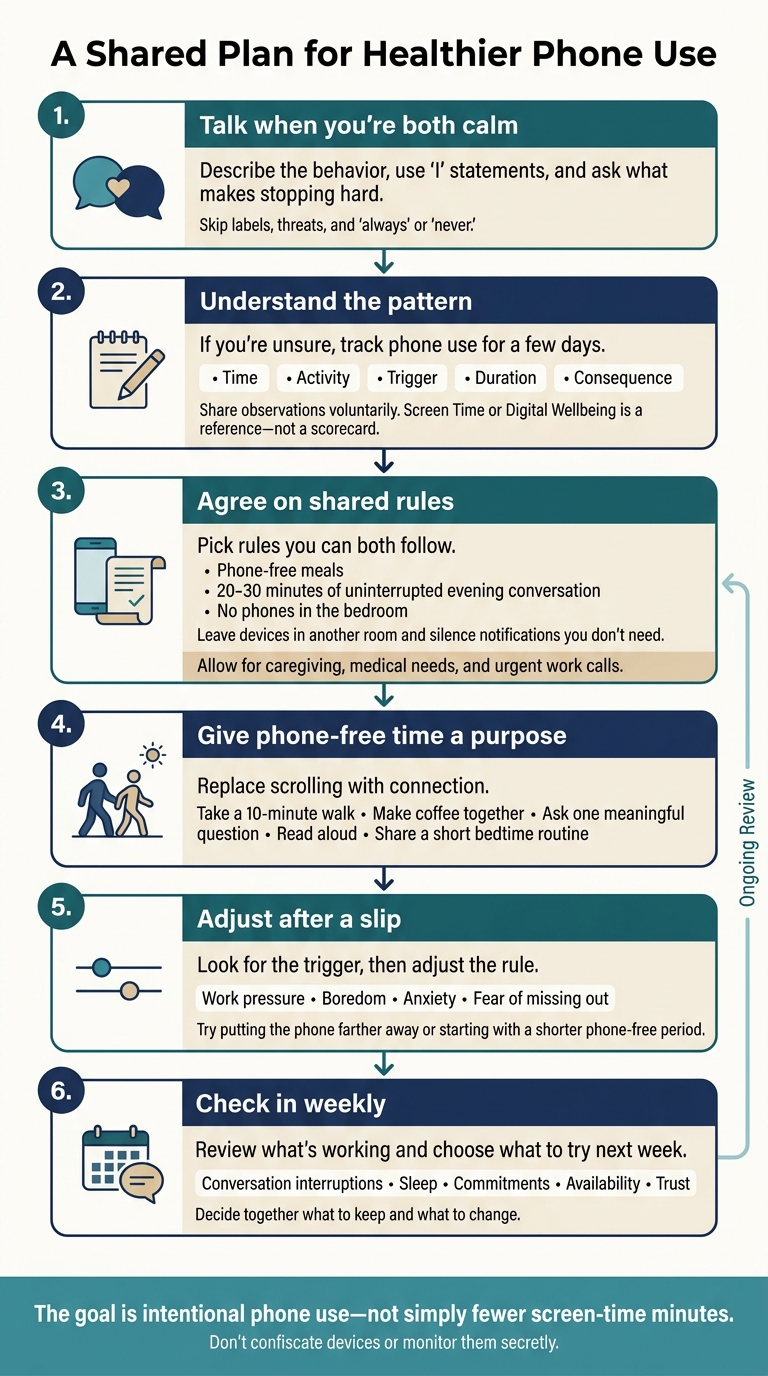
A Shared Plan for Healthier Phone Use
If phone use is hurting your relationship, turn that awareness into a shared plan. Talk when you’re both calm, rather than during an argument or while one of you is scrolling. Describe the behavior, use “I” statements, and ask what makes it hard to put the phone down before suggesting a rule. Skip labels, threats, and generalizations like “always” or “never.”[28][29][17]
If you’re unsure about the pattern, track phone use for a few days. Each partner can briefly note the time, activity, trigger, duration, and consequence. Treat Screen Time or Digital Wellbeing as a reference – not a scorecard – and share observations voluntarily. Use the notes to pick one or two priorities, not to police each other. Don’t confiscate devices or monitor them secretly.[31][17]
Once you understand the pattern, agree on rules you can both follow:
Phone-free meals, 20–30 minutes of uninterrupted evening conversation, or no phones in the bedroom.
Leave devices in another room and silence notifications you don’t need. Decide ahead of time on exceptions for caregiving, medical needs, or urgent work calls.[28][14][30][17] To support sleep, keep phones outside the bedroom and offline before bed.[19][18]
Give phone-free time a specific, shared purpose.
Take a 10-minute walk, make coffee together, ask one meaningful question, read aloud, or share a short bedtime routine.
If the plan slips, look for the trigger: work pressure, boredom, anxiety, or fear of missing out. Then adjust the rule. Try putting the phone farther away or starting with a shorter phone-free period.[14][17]
Have a brief weekly check-in to assess how the rules are working. Review conversation interruptions, sleep, commitments, availability, and trust. Screen-time reports can help guide the discussion, but fewer minutes don’t prove progress on their own; some phone use is necessary or helpful. Decide together what to keep, what to change, and what to try next week.[8][31]
When to Consider Professional Support
If these patterns keep repeating despite your efforts, outside help can help you break the cycle. Seek professional support when phone use remains hard to control after repeated attempts to cut back, or keeps harming trust, intimacy, sleep, work, or parenting. Screen time alone isn’t the main measure.
A clinician can assess whether anxiety, depression, trauma, substance use, or another compulsive pattern is driving the phone use. That helps treatment address what’s behind it. Bring details about attempts to cut back that haven’t worked, distress when disconnected, and responsibilities that have suffered.
When phone use affects both partners, treat it as a relationship issue – not just a habit. Couples counseling may fit when broken agreements, secrecy, or emotional withdrawal keep the conflict going. Individual therapy can help when one partner needs support first. Family therapy may fit when children or household dynamics are affected.
Growth and Change Counseling offers couples, individual, and family therapy in California and through telehealth, including intensive couples work through The Marriage Rescue Institute.
Threats, coercive control, abuse, or severe substance intoxication or withdrawal call for safety-focused support – not joint counseling as the first step. In the United States, call or text 988 for a suicidal or mental health crisis. Call 911 when immediate emergency assistance is needed.
Conclusion: Connection Should Come Before Compulsion
What matters is what your phone use crowds out.
For the next week, agree on one small rule that protects a shared moment:
Put phones away during dinner.
Allow exceptions for urgent work or family needs, and make sure the rule applies equally to both of you.
After a week, check in together. Were there fewer interruptions, calmer conversations, or a greater sense of closeness? Adjust the rule together rather than chase screen-time numbers. The goal is intentional phone use, not a phone-free relationship.
FAQs
What if my partner denies their phone use is a problem?
Denial can make it hard to address digital habits [1]. If phone use keeps causing tension, conflict, or emotional distance at home, consider professional support [2].
Growth and Change Counseling offers couples counseling through The Marriage Rescue Institute to help partners communicate again and rebuild their connection [2]. A counselor can help partners work through underlying issues and develop a healthier, more balanced relationship with technology [2][3].
How can we rebuild trust after hidden phone use?
Rebuilding trust takes transparency, consistent boundaries, and a deliberate effort to reconnect. Set screen-free zones, explain why you’re checking your phone, and put it away when you’re spending time with your partner. Make time for activities together that don’t involve screens to help rebuild your emotional bond.
If conflicts continue, individual or couples therapy can help you work through underlying issues, such as anxiety or isolation. Growth and Change Counseling offers both services to help you build healthier relationship patterns.
How can I tell whether phone use causes or avoids conflict?
Pay attention to whether you or your partner regularly reach for a phone to escape difficult feelings or unresolved tension. Phone use may signal avoidance when it numbs emotional pain, replaces needed conversations, or creates distance when a disagreement seems likely.
If screen time gets in the way of connecting in person or working through relationship problems, the phone may be acting as an unhealthy escape rather than a tool for communication.
Related Blog Posts
- Signs Screen Time Hurts Your Marriage
- How Couples Heal After Technology-Driven Conflicts
- Ultimate Guide to Digital Detox for Couples
- Ultimate Guide to Social Media Detox for Couples
