Parenting through marital conflict and mental health struggles is difficult, as children can be hurt by conflict even if parents stay together. Research cited in the article says the intensity of conflict is a better predictor of child harm than divorce itself, and repeated stress can affect learning, memory, and emotional control over time.
If I had to boil the article down, I’d say this: keep conflict private, keep kids out of adult problems, reassure them, keep both homes steady, and communicate in a calm way. Those five steps help lower stress and give children a stronger sense of safety.
Here’s the full list at a glance:
- Keep conflict away from children
- Stop using children as messengers
- Reassure children they are not to blame
- Create stability across both homes
- Communicate calmly with your co-parent
Quick Comparison
| Way | What it does for children | Simple example |
|---|---|---|
| Keep conflict away from children | Lowers stress and fear | Pause arguments until kids are not present |
| Stop using children as messengers | Keeps kids out of adult roles | Text the other parent directly instead of telling the child to pass a message |
| Reassure children they are not to blame | Eases guilt and worry | Say: “This is a grown-up problem, not your fault.” |
| Create stability across both homes | Makes daily life feel steady | Keep bedtime and homework routines close in both homes |
| Communicate calmly with your co-parent | Cuts down on tension kids can sense | Use short, neutral messages about schedules and school |
The main idea is simple: children do better when adults lower conflict and make daily life feel steady.
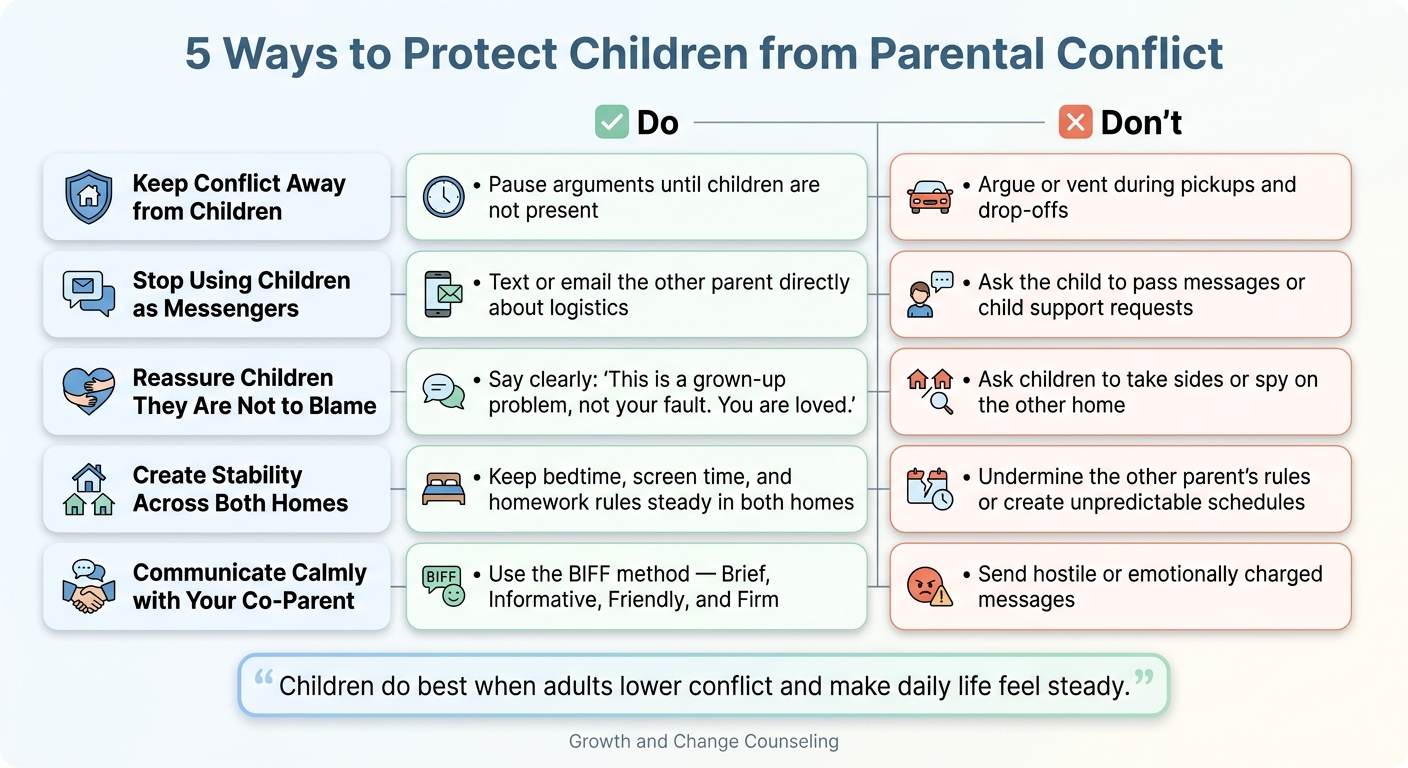
5 Ways to Protect Children from Parental Conflict: Do’s and Don’ts
Helping Parents Protect Children in Divorce: The Children in Between Program
sbb-itb-596b85d
1. Keep Conflict Away from Children
The first layer of protection is simple: children shouldn’t hear, carry, or manage adult conflict.
End Arguments Children Can Hear
Keep conflict private so children aren’t exposed to arguments or pushed into adult emotional roles. When kids hear repeated fighting, stress hormones like cortisol go up. Over time, that can interfere with memory, learning, and emotional regulation [1].
A simple move can help: agree with your co-parent to pause heated talks and pick them up when the children aren’t around. If direct communication keeps going off the rails, a written co-parenting app can make a big difference. It helps keep messages centered on child logistics and lowers the emotional tone of day-to-day communication [4].
Supports Emotional Security
Repeated arguing can make life feel shaky and unsafe to a child. After a while, that can lead to constant alertness. In plain English, the child starts watching adult distress instead of just being a kid and focusing on school, friends, and daily life [1][3].
As the American Psychological Association puts it:
"Children do best when parents minimize conflict, maintain routines, and prioritize emotional safety." [1]
Builds Predictable Daily Stability
Steady routines like meals, bedtime, homework, and school help lower anxiety in children [1]. In high-conflict situations, parallel parenting can cut down a child’s exposure by limiting direct contact between adults and making each parent’s role clear. The point of that structure is to protect the child by reducing exposure, not to force cooperation when that keeps breaking down [2][3].
Private conflict is the starting point. Just as important, communication needs to stay between adults instead of passing through the child.
2. Stop Using Children as Messengers
This next rule is straightforward: don’t ask children to carry messages between homes.
Keeps Children Out of Adult Roles
When a child has to pass messages between parents, they get pushed into problems that belong to adults, which is often a focus in marriage counseling. That’s a lot to put on a kid.
Over time, this can turn into parentification, when a child starts to feel responsible for a parent’s emotions or conflict [2]. And when they’re pulled back and forth between parents, they can feel stuck in a loyalty bind. They’re trying to manage tension they didn’t create and don’t know how to fix. Keeping them out of that role helps protect their sense of safety and emotional security [1].
Reduces Exposure to Arguments
When parents communicate directly with each other, children are less likely to get caught in the middle [7][5].
Tools like OurFamilyWizard, TalkingParents, and AppClose can make this easier. They put calendars, expenses, and messages in one place, with a written record of what was said [4].
A written parenting plan can help too. If it covers pickups, drop-offs, and holidays, there’s less room for last-minute conflict [5][6]. Direct adult communication helps keep kids out of adult disputes.
3. Reassure Children They Are Not to Blame
Children often take conflict personally. So it helps to say, in plain words, that the problem belongs to the adults. Keep that message short, calm, and repeat it often.
Separates Child Feelings from Adult Conflict
When kids are left to fill in the blanks, they may start thinking it’s their job to fix the tension or keep the peace. That’s a heavy load for a child. Say clearly that this is an adult issue.
One simple script is: "This is a grown-up problem, not your fault. You are loved."
Supports Emotional Security
Reassurance lands better when you pair it with validation. Instead of saying "everything is fine", name what your child may be feeling. Try: "I can see you’re worried. That makes sense."
That does two things at once. It helps your child feel heard, and it shows them that their feelings are okay.
After that, steady daily rhythms help the message sink in. Reassurance tends to work better when routines stay the same. Small habits, like a bedtime check-in, can help a lot. Use simple comfort for toddlers, clear reassurance for school-age children, and honest but limited answers for teens.
Once children understand the conflict is not their fault, the next step is keeping life predictable in both homes.
4. Create Stability Across Both Homes
Children don’t need homes that match in every detail. They need homes that feel steady and predictable.
Written Plans Keep Transitions Predictable
A written parenting plan cuts down on last-minute changes and makes transitions easier to follow. If pickup times, drop-off locations, and holiday schedules are laid out ahead of time, parents have less reason to negotiate in person.
Tools like OurFamilyWizard and TalkingParents can help keep communication in writing and centered on logistics. That kind of steadiness starts with written routines, not verbal back-and-forth.
Consistent Rules Keep Children from Adapting to Two Conflicting Systems
Consistent rules mean children don’t have to switch between two clashing systems. That matters more than many parents realize. If one home works one way and the other runs on a totally different set of expectations, kids can end up carrying stress that shouldn’t be theirs.
When both parents handle schedules and decisions directly through written plans or apps, children are kept out of the middle and freed from that pressure.
Predictable Routines Support Emotional Security
When kids know what to expect in both homes, they tend to stay less on edge. A small transition ritual, like a familiar meal or a short check-in, can make handoffs feel smoother.
It also helps to keep a few core routines in sync, such as:
- Bedtime
- Screen time
- Discipline
That gives children a steady framework wherever they are.
Parallel Parenting Preserves Structure When Cooperation Is Difficult
In high-conflict cases, parallel parenting can limit contact while still keeping structure in place for the child. The goal isn’t to force close teamwork when that’s not possible. It’s to make sure the child’s day-to-day life stays orderly even when adult communication is strained.
Once that structure is clear, the next step is keeping adult communication brief and calm.
Even with steady routines, children still need adults to speak calmly and directly.
5. Communicate Calmly with Your Co-Parent
Once routines are written down, calm communication helps keep everything on track. It sounds simple, but in practice, this is where many co-parenting plans either hold together or start to drift.
Structured tools can make a big difference. Email, a shared calendar, or a co-parenting app can keep exchanges brief and centered on the child. They also give you a little space to think before replying, which can stop a tense moment from getting worse. On top of that, they make day-to-day logistics easier to track [3][4].
A simple approach that often helps is the BIFF method: Brief, Informative, Friendly, and Firm. It keeps messages neutral and on point instead of turning them into arguments [3].
Keeps Children Out of Adult Roles
Direct communication between parents helps keep children out of the middle [1].
That matters more than people sometimes realize. Kids shouldn’t have to carry messages, explain one parent’s feelings to the other, or feel like they need to manage adult tension. When parents speak to each other directly, children are less likely to get pulled into roles they were never meant to take on.
Supports Emotional Security
Children pick up on tone just as much as words, so calm language can lower stress and show self-control. Using "I" statements, such as "I feel upset when plans change last minute", can lower blame and keep the tone steady [1].
Think of it this way: even if a child doesn’t hear every detail, they can still feel the temperature in the room. When adults handle conflict calmly, children tend to feel less on edge. That steady tone can help them feel safer.
Builds Predictable Daily Stability
Calm communication also makes it easier to follow the same plan for daily routines. When both parents coordinate in a steady way, children are more likely to know what to expect from one home to the other. That kind of consistency supports the structure children need across both homes [1][6].
Do’s and Don’ts for Parents: Quick Reference
Use this quick reference to keep adult conflict out of children’s day-to-day life.
| ✅ Do | ❌ Don’t |
|---|---|
| Discuss disagreements in private or through mediation | Argue or vent during pickups and drop-offs |
| Text or email the other parent directly about logistics | Use the child to pass along messages or child support requests |
| Reassure children that adult problems are not their fault | Ask children to take sides or "spy" on the other home |
| Keep bedtime and homework rules steady in both homes | Undermine the other parent’s rules or create unpredictable schedules |
| Follow the parenting plan for major decisions [3] | Make unilateral choices about school or medical care [3] |
| Keep messages Brief, Informative, Friendly, and Firm (BIFF) [3] | Send hostile or emotionally charged messages [3] |
If pickups or drop-offs stay tense, switch to a neutral location. You can also use school or daycare as the handoff point.
If these rules still don’t lower conflict, outside support may be needed.
When Outside Support May Help
If the steps above still aren’t enough, it’s smart to get outside help before stress starts shaping your child’s day-to-day life. Some conflict doesn’t fade on its own. And when it stays intense for months, extra support can help protect children.
Pay attention to changes that stick around for more than a few weeks. If your child shows anxiety, withdrawal, regression, sleep problems, stomachaches, or falling grades, a pediatrician or school counselor can help you figure out the next step [1].
Parent coaching, family therapy, or co-parenting counseling can help parents speak more calmly and keep children out of the middle. Parent coaching helps adults change the patterns that affect children most. That makes it one of the most direct ways to protect the emotional safety, steady routines, and lower conflict exposure that children need [1].
Conclusion
Children do best when parents make steady, everyday choices that help them feel safe. These five habits matter because they cut down on conflict and make home life feel more predictable.
That starts with a few clear actions: reduce your child’s exposure to conflict, keep routines steady, and speak with your co-parent in a calm, direct way. Privacy, adult-to-adult communication, reassurance, stability, and a calm tone give children the sense of safety they need.
If things keep getting more tense, outside support can make these steps easier to stick with. Growth and Change Counseling offers parent coaching and family therapy for families that need extra support.
FAQs
What if my child has already seen a lot of conflict?
If your child has already been exposed to parental conflict, the effects – like stress, anxiety, or changes in behavior – are serious. But they don’t have to last forever.
One of the best places to start is simple: stop arguments when your child is present. Just as important, keep daily routines steady and remind them often that they are loved and not responsible for what’s happening between adults.
If your child’s distress keeps showing up, help from a licensed therapist or parent coaching can make a big difference. Growth and Change Counseling is one option that can help rebuild a sense of safety and resilience.
How can we co-parent if calm talks always turn into arguments?
When calm talks keep sliding into arguments, it helps to put some structure around communication and keep the focus on your child.
Try using neutral co-parenting apps instead of text or email. Those tools can make conversations feel less personal and more organized. It can also help to use I-statements and take a time-out as soon as things start to heat up.
Clear written agreements can make a big difference too, especially around:
- how often you’ll communicate
- how fast each parent is expected to respond
That kind of clarity can cut down on mixed signals and avoid small issues turning into bigger fights. If conflict keeps showing up, co-parenting counseling may give both parents objective tools to protect your child’s emotional well-being.
When should I get outside help for my child or family?
Seek professional support if signs of stress stick around for weeks, get worse, or start showing up at school through lower grades or missed days. The same goes for behaviors like aggression, severe withdrawal, self-harm, or substance use.
When parental conflict keeps going, starts to intensify, or feels like too much to manage alone, family therapy, co-parenting counseling, or parent coaching can help bring back a sense of stability and support stronger family relationships. Growth and Change Counseling offers parent coaching, family therapy, and individual therapy for these challenges.
Related Blog Posts
- 5 Steps to De-Escalate Co-Parenting Arguments
- How to Communicate Effectively in High-Stress Co-Parenting
- Signs Kids Struggle in High-Stress Co-Parenting
- Ultimate Guide to Conflict Resolution for Co-Parents
