Parent coaching helps families handle stress, improve communication, and build stronger connections. It teaches parents how to manage emotions, respond calmly to challenges, and create a secure environment for children. Kids learn emotional skills by observing parents, making this approach impactful for long-term resilience.
Key takeaways:
- Family resilience is about staying connected and working through challenges together.
- Parent coaching focuses on replacing reactive habits with reflective practices.
- It strengthens trust, problem-solving, and conflict resolution within families.
- Parents learn active listening, emotional regulation, and positive discipline.
- Progress shows in smoother routines, fewer conflicts, and improved emotional safety.
With consistent effort, families can see improvements in just a few weeks, leading to lasting growth and stability.
Parenting Without Fixing: Dr. Becky Kennedy on Raising Resilient Kids | Dealing With Feelings
sbb-itb-596b85d
Why Family Resilience Matters
Family resilience plays a key role in supporting mental well-being. A meta-analysis of 48 studies revealed two important findings: families with higher resilience tend to experience better mental health outcomes, and they’re less likely to face challenges like depression or anxiety [7]. In short, stronger family bonds often mean fewer emotional struggles. This sets the stage for understanding the essential elements that help families build and maintain resilience.
What Family Resilience Means
At its core, family resilience is rooted in three main pillars: open communication, flexibility, and emotional connection. Unlike personal resilience, which focuses on individual traits, family resilience grows from the daily interactions and habits shared among family members. NeuroChild captures this idea beautifully:
"Resilience is built in the small recurring moments between crises – the daily habits, the way a parent responds when something goes wrong, the tone of conversations about difficulty, the rituals that say: we do this together." [3]
In essence, family resilience is all about relationships. It’s shaped by how family members support each other, especially during stressful times. When one person in the household feels overwhelmed, that stress often impacts everyone else. This interconnectedness highlights why building resilience as a family – rather than as separate individuals – is so important [7].
Common Challenges That Weaken Family Resilience
The benefits of resilience make it clear why addressing stressors is crucial. Many families face challenges like ongoing conflict, financial strain, major life changes, or the demands of raising children with complex needs. These stressors are widespread across U.S. households [7][3].
What truly matters is how parents respond to these difficulties. Aron Carlson, LCSW-C, explains the importance of supportive parenting:
"Children build resilience best when they experience stress with support. They don’t need parents to be perfect – they need parents who can notice when things are getting hard, slow things down, and face their own challenges." [8]
Parents who turn to unhelpful coping mechanisms, such as rumination, self-blame, or catastrophizing, can unintentionally disrupt family dynamics. These behaviors can lead to emotional instability and weaken the connections that hold families together [9]. The encouraging news? These patterns aren’t set in stone. Since they’re learned behaviors, they can be replaced with healthier, more constructive habits over time.
How Parent Coaching Works
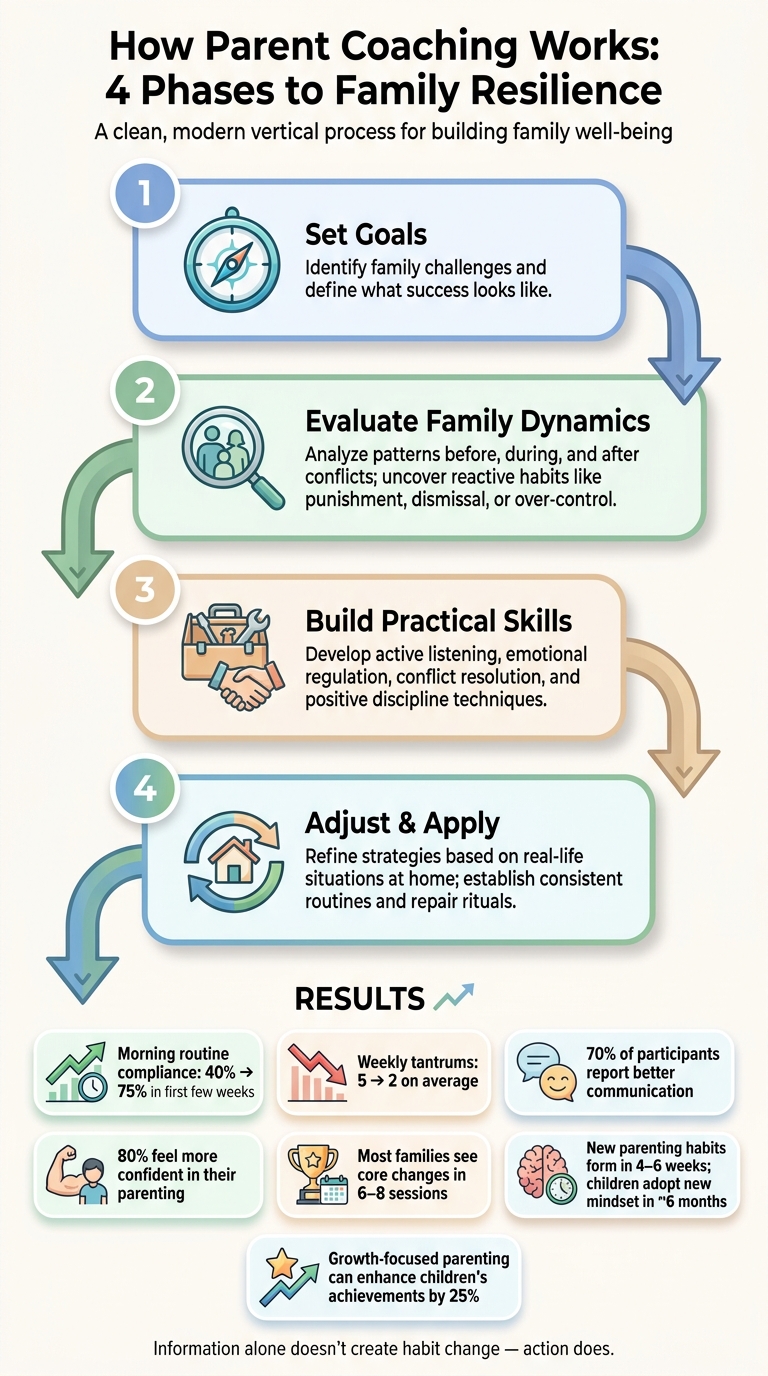
How Parent Coaching Builds Family Resilience: 4 Phases to Lasting Change
Parent coaching offers families a way to address challenges and replace reactive behaviors with more supportive, reflective practices. By focusing on tailored strategies, it helps families build stronger connections and resilience.
This process typically unfolds in four key phases: setting goals, evaluating family dynamics, building practical skills, and making adjustments based on real-life situations at home. Coaches often incorporate trauma-informed family therapy techniques to help parents move past these barriers. The emphasis is on turning knowledge into action, as Adriane, Founder of Raising Kids With Purpose, highlights:
"Information alone doesn’t create habit change, action does." [12]
Recognizing Unhelpful Parenting Patterns
One of the first steps in parent coaching is identifying patterns that may undermine trust and connection. Coaches work with parents to analyze what happens before, during, and after conflicts, uncovering habits like punishment, dismissal, or over-control – often referred to as "power-over" behaviors. These patterns, while sometimes inherited, can how trauma impacts parent-child relationships and quietly erode trust over time [2].
By challenging these ingrained habits, coaching encourages parents to adopt healthier approaches. As Finding Focus Therapy explains:
"Behavior is communication. Coaching focuses on understanding the why behind behavior before addressing the how of change." [1]
Improving Communication and Emotional Safety at Home
Parents set the emotional tone for their household. When a parent feels stressed, reactive, or overwhelmed, children often mirror these emotions. Coaches help parents recognize the physical signs of stress, like shallow breathing or chest tightness, so they can take a moment to pause and center themselves before responding [2]. This ability to regulate emotions fosters a calmer, more secure environment, which strengthens family bonds.
A key part of this process involves creating emotional safety. Tools like the SOOTHE framework guide parents through steps such as self-regulation, empathy, and listening for the underlying needs behind a child’s behavior [2]. The Jai Institute for Parenting emphasizes the importance of this:
"The quality of emotional safety in the parent-child relationship determines whether a child feels safe enough to explore feelings, tolerate discomfort, and integrate emotional awareness into daily life." [2]
Creating Consistent Routines and Responses
Predictability is a powerful yet often overlooked parenting tool. When children know what to expect, they tend to feel less anxious, cooperate more, and recover from stress more easily. Parent coaching helps families move from reactive "survival mode" to a more intentional approach, where actions and responses are thoughtfully planned [12] [6].
This includes setting clear consequences ahead of time and establishing simple repair routines to reconnect after challenging moments. Whether through a calm talk, a shared activity, or acknowledging a tough situation, these routines teach children that even difficult moments can be resolved [6]. Over time, consistent routines and responses lead to stronger, more positive parent-child interactions.
Key Skills Parents Build Through Coaching
Parent coaching provides a framework for developing essential interpersonal skills that strengthen family bonds and foster long-term resilience. These skills shape how families interact and grow together over time.
Active Listening and Empathy
Active listening is more than just hearing words – it’s about understanding the emotions and needs behind a child’s behavior. Coaching helps parents tune into these cues, teaching them to recognize and name feelings. For instance, using an "empathy guess", a parent might say, "Your face looks scrunched up – that seems like frustration." This simple acknowledgment not only helps children identify emotions but also deepens the parent-child connection.
Importantly, validating a child’s feelings doesn’t mean condoning their actions. It’s about showing understanding before setting boundaries. For example, a parent might say, "I know you want to keep playing, and it’s time for bed now." The Jai Institute for Parenting emphasizes:
"Children learn emotional intelligence through experience, not instruction." [2]
By practicing these listening techniques, parents create a foundation for resolving conflicts constructively.
Conflict Resolution and Positive Discipline
Parent coaching encourages a shift from punishment to proactive discipline. While punishment often relies on fear or control, discipline focuses on teaching and guiding while respecting a child’s dignity [10]. This approach not only resolves immediate conflicts but also strengthens the family’s overall ability to navigate challenges.
Coaches guide parents in implementing natural and logical consequences – responses that directly relate to the child’s behavior rather than imposing arbitrary penalties. Parents also learn de-escalation techniques, such as recognizing when emotions are escalating and taking a moment to pause before reacting. The effectiveness of this method is supported by research: 70% of coaching participants report better communication and relationships, while 80% feel more confident in their parenting abilities [13].
"Children do not need perfect parents. They need regulated adults who are willing to reflect, repair, and lead with steadiness." – Jenn Bruer, Parent Coach [11]
Self-Regulation and Emotional Modeling
Children often struggle to manage their emotions when overwhelmed, making it difficult for them to problem-solve or think logically [2]. Coaching emphasizes co-regulation, where a child relies on the calm presence of a regulated adult to regain emotional balance. This skill builds on earlier lessons in communication and emotional safety, helping parents focus on mastering their own self-regulation.
Parents are taught to recognize early signs of stress – like tight shoulders, a raised voice, or shallow breathing – and use this awareness to pause and choose a thoughtful response instead of reacting impulsively. Over time, this practice models an essential lesson for children: emotional storms are temporary and manageable. The ability to think, "I can feel this and still be okay", becomes a cornerstone of resilience for both parents and children [2].
How Families Can Track Progress
Progress often reveals itself in the little things – a peaceful morning, a quicker resolution after a disagreement, or a child expressing their emotions with words instead of actions. Spotting these moments can help families stay motivated.
Early Signs of Improvement
Initial signs of progress might include a parent pausing to take a breath and responding thoughtfully instead of reacting impulsively. Studies indicate that compliance with morning routines can increase from around 40% to 75% within the first few weeks of consistent coaching [1][15]. Similarly, weekly tantrums often drop from five to two [15]. Children may also begin using words to express their feelings, reflecting the emotional vocabulary work happening at home.
Another key indicator is how quickly a family can repair after a conflict. The goal isn’t to eliminate disagreements but to develop the ability to reconnect and move forward after they occur. As Ethan Caldwell, a parent coach and author, explains:
"Repair is more than saying ‘I’m sorry.’ It meant pausing to admit what happened, naming how my child felt, and letting them know what I would try next time." [16]
One practical way to track this is by keeping a simple journal. Each day, jot down the number of conflicts, how they were resolved, and how long it took to reconnect. This approach replaces guesswork with concrete data, making progress easier to see [14][15].
These small but meaningful changes lay the groundwork for lasting family growth.
Long-Term Outcomes
As these early improvements build, families often shift from merely surviving to thriving. Routines become smoother, decision-making feels more intentional, and challenges are less likely to disrupt the household. Research suggests it takes about 4 to 6 weeks to establish new parenting habits and roughly 6 months for children to adopt a new mindset [14].
Over time, the changes deepen. One of the most telling long-term signs is parental self-efficacy – a parent’s growing confidence in their ability to handle challenges without external help [10][15]. This increased confidence reduces stress at home, creating a more stable environment where children can flourish. Kids begin solving problems on their own, building stronger friendships, and tackling setbacks with resilience [14][15]. Growth-focused parenting can even enhance children’s achievements by 25% [14], underscoring how changes at home can have a lasting impact.
"The goal is not to become a perfect parent. The goal is to become a steadier, more connected leader in your family." – Tess Connolly, LCSW [5]
How Growth and Change Counseling Supports Families

Specialized support can make a world of difference for families looking to apply effective parenting strategies. For those in California, Growth and Change Counseling offers parent coaching rooted in the idea that the parent-child bond is central to a child’s well-being. This philosophy drives their approach, turning behavioral struggles into opportunities to strengthen relationships.
"Anything that goes from you to your child is way more meaningful and effective than anything that goes from any therapist to your child because you have the permanent relationship." – John Mark Kane, LMFT, Founder, Growth and Change Counseling [4]
Instead of viewing challenges like defiance, anxiety, or emotional outbursts as isolated issues, this coaching focuses on the deeper relationships that contribute to these behaviors. John Mark Kane, who brings years of experience in behavioral health, sums it up perfectly: "Relationally healthy children are behaviorally healthy children." [4]
The process is designed for efficiency, with most families mastering core concepts and tools within 6 to 8 sessions. These sessions provide practical strategies that parents can use independently.
To make support accessible, sessions are conducted via secure telehealth and are available weekdays from 7:00 a.m. to 10:00 p.m. – a helpful option for working parents in California [17].
Growth and Change Counseling is also in-network with major insurance providers like Aetna, Anthem Blue Cross, Cigna, United Health Care, and Kaiser NorCal. Each session costs $200 [17].
The practice addresses a wide range of family needs, including support for parents of children with ADHD, Autism Spectrum Disorder, or trauma histories, as well as families dealing with high-conflict transitions.
For families with children under 5, the focus shifts entirely to coaching the parents. This approach acknowledges that working with the adults often leads to the quickest and most lasting improvements [4]. It’s a targeted method that strengthens family bonds and reinforces the self-regulation tools discussed earlier.
Conclusion: Building Stronger Families Through Parent Coaching
Parent coaching takes everyday interactions and turns them into opportunities for resilience and growth within families.
At its core, family resilience is built through the daily connections between parents and children. Parent coaching provides caregivers with actionable tools to strengthen these connections, helping them move from reactive parenting to a more thoughtful and connected approach.
The impact of coaching is clear and meaningful. Instead of focusing on "fixing" behaviors, parents learn to understand the deeper messages behind them and use the parent-child relationship as a foundation for growth. As the Jai Institute for Parenting explains, "Children learn emotional intelligence through experience, not instruction." [2] Megan Larson, a coaching expert, highlights the broader purpose: "The ultimate goal of parent coaching is preserving families and creating self-sufficiency." [10] Remarkably, many families start to see significant changes within just 6 to 8 sessions [4].
Throughout the process, coaching not only enhances parenting strategies but also fosters an environment where the entire family can flourish.
Whether it’s handling emotional outbursts, setting consistent boundaries, or managing everyday challenges, parent coaching offers a practical path to a calmer, more connected home – laying the groundwork for strong, enduring family bonds.
Building Emotional Resilience with Growth and Change Counseling
Is parent coaching the same as family therapy?
Parent coaching and family therapy serve different purposes but work well together. Family therapy focuses on addressing emotional wounds, past experiences, and mental health concerns. On the other hand, parent coaching is more practical and action-driven, helping parents develop skills to handle daily challenges like improving communication and creating better routines. Growth and Change Counseling provides both options to meet the specific needs of your family.
How do I know if my family needs parent coaching?
Parent coaching is a great option if you’re feeling overwhelmed, unsure, or stuck when it comes to managing your child’s behavior. It’s not about being in crisis – it’s about taking a proactive step forward. This approach can be especially helpful during significant life changes, like a divorce, moving to a new home, or adding a new sibling to the family. It’s also valuable if you’re dealing with challenges such as inconsistent rules or constant power struggles. Growth and Change Counseling offers expert guidance to help you develop practical strategies and build a stronger, more connected family dynamic.
What should I do in the moment when I’m about to react?
When you feel yourself on the verge of reacting, take a moment to calm your nervous system and create space for a deliberate pause. Pay attention to physical signals like shallow breathing, a surge of heat, or muscle tightness – these can be your body’s way of signaling it’s time to stop. Techniques like deep breathing, taking a short break, or using grounding exercises can help you regain control. Growth and Change Counseling offers parent coaching and therapy designed to shift reactive habits into thoughtful, connection-driven responses.
Related Blog Posts
- Parent Coaching for Better Boundaries
- Therapy vs. Coaching for Neurodiverse Kids in Recovery
- ADHD Parenting: Emotional Regulation Strategies
- Parenting Styles: Trauma vs. Resilience
