When it comes to helping neurodiverse kids manage emotional regulation, parents often face a choice: therapy or coaching. Both approaches aim to support children with conditions like autism, ADHD, and sensory processing disorders, but they differ in focus and method.
- Therapy: Focuses on addressing emotional challenges, mental health conditions, and past experiences. Delivered by licensed professionals, therapy uses techniques like CBT or play therapy to help kids understand and manage emotions.
- Coaching: Centers on practical skills and daily routines. Coaches work with parents to implement strategies like behavior management and positive reinforcement at home.
Key Takeaway: Therapy is ideal for addressing deeper emotional issues, while coaching provides tools for everyday challenges. Many families benefit from combining both approaches.
Quick Comparison:
| Feature | Therapy | Coaching |
|---|---|---|
| Focus | Emotional health, past experiences | Practical skills, daily routines |
| Provider | Licensed therapists (e.g., LMFT) | Certified coaches |
| Insurance | Often covered | Rarely covered |
| Timeframe | Structured, limited sessions | Flexible, ongoing |
Choosing the right approach depends on your child’s needs. Therapy is best for severe challenges, while coaching works well for stable situations requiring consistent guidance. Combining both can often yield the best results.
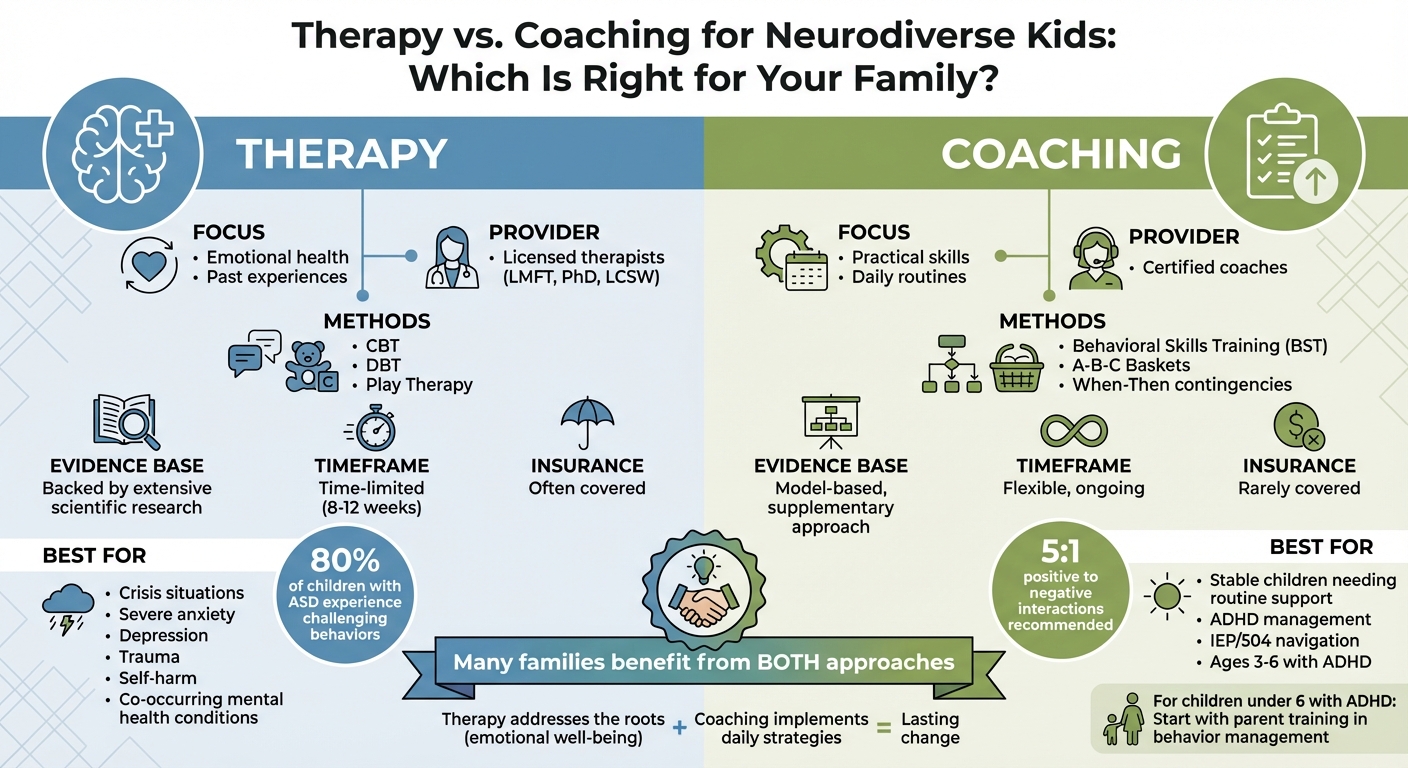
Therapy vs Coaching for Neurodiverse Children: Key Differences
Therapy for Neurodiverse Children in Recovery
What Therapy Is and Who Provides It
Therapy for neurodiverse children is delivered by licensed professionals such as LMFTs (Licensed Marriage and Family Therapists), child and adolescent psychiatrists, clinical psychologists, and LCSWs (Licensed Clinical Social Workers). These specialists are trained to diagnose and treat mental health conditions in children with neurodiverse needs [3][4]. Their work typically involves conducting thorough evaluations, providing formal diagnoses, and crafting tailored treatment plans to address specific clinical challenges.
Understanding the role of these professionals helps us see how therapy supports emotional regulation in children.
How Therapy Helps with Emotional Regulation
Neurodiverse children often face unique challenges when it comes to managing emotions. Therapy provides tools and strategies to help them recognize, understand, and adjust their emotional responses. Techniques like Cognitive Behavioral Therapy (CBT), Dialectical Behavior Therapy (DBT), and play therapy are commonly used to address these needs. Each method serves a different purpose:
- CBT is particularly effective for children with anxiety and IQs of 70 or higher, focusing on challenging distorted thoughts and developing healthier coping mechanisms [3][7].
- DBT teaches skills for managing distress and regulating emotions, often benefiting older children who struggle with impulsivity or self-harming behaviors [1].
- Play therapy allows younger children, who may have difficulty verbalizing their emotions, to express themselves through nonverbal means [3].
Clinical psychologist Joyce Cooper-Kahn, PhD, describes emotional regulation as the ability to gauge one’s emotional state and make intentional choices about how to respond:
"Emotional regulation is a process that allows us to take our own ’emotional temperature’ and make well-reasoned choices about how we want to respond to our feelings" [6].
Therapists also address what’s often called the "arousal bucket" – the accumulation of stress from emotions, sensory overload, and physical discomfort [6]. Research using brain imaging shows that labeling emotions, a technique sometimes summarized as "name it to tame it", can calm the brain regions responsible for automatic emotional reactions [6]. Additionally, therapy can guide parents to reduce harsh or emotionally charged interactions, which, in turn, helps lower a child’s physiological arousal and improves their behavior [6]. For families in recovery, these approaches not only address immediate behavioral concerns but also build long-term emotional resilience.
These strategies highlight situations where professional intervention becomes necessary.
When Therapy Is Needed
Therapy becomes crucial when a child’s behaviors or emotional challenges reach a level that requires clinical intervention. For instance, situations involving self-harm, suicidal thoughts, or extreme behavioral outbursts call for immediate professional support [3][5]. Research shows that up to 80% of children and adolescents with autism spectrum disorder experience challenging behaviors, making professional evaluation a critical first step [5].
Therapy is also essential for addressing co-occurring mental health conditions such as major depressive disorder, obsessive-compulsive disorder, eating disorders, or post-traumatic stress disorder [3]. In some cases, unresolved trauma, intense anger, or family dynamics may contribute to emotional dysregulation, requiring targeted therapeutic approaches [4]. If your child’s emotional outbursts are frequent and debilitating, or if symptoms are severe enough to warrant medication alongside therapy, a licensed mental health professional should conduct a comprehensive evaluation [3][8].
These evaluations ensure that children receive the right support to navigate their challenges effectively.
Coaching for Neurodiverse Children and Their Families
What Coaching Is and How It Works
Therapy often focuses on addressing clinical challenges, but coaching takes a different path by helping parents build everyday skills. It’s about equipping you to be the key player in your child’s daily development. Why? Because your child spends far more time with you than they ever will with a therapist – think about the difference between one hour a week versus countless hours at home [9][10].
Coaching typically uses Behavioral Skills Training (BST), a step-by-step approach designed to teach and refine skills. The process involves explaining a new skill, demonstrating it (either live or via video), guiding you as you practice, and providing feedback to improve your technique [9]. Studies show that this parent-led model creates lasting changes because it integrates directly into your family’s routines [9]. Unlike therapy, which often happens in isolated sessions, coaching focuses on skills you can practice daily, making it a seamless part of your life.
How Coaching Helps with Emotional Regulation
Coaching gives you practical tools to handle emotional challenges, making day-to-day life smoother. One widely used strategy is the A-B-C Baskets system, which organizes household rules into three categories:
- Basket A: Non-negotiable safety rules (e.g., wearing a seatbelt).
- Basket B: Important issues that allow for collaborative problem-solving (e.g., brushing teeth).
- Basket C: Low-priority matters left to your child’s choice (e.g., picking out clothes).
This method helps reduce power struggles and the emotional outbursts that often come with them [11].
Another effective tool is "When-Then" contingencies, which tie actions to outcomes. For example: "When you finish cleaning up, then you can have screen time" [11]. Coaches also emphasize the importance of timing discussions. For instance, waiting until hours after a meltdown – when emotions have cooled – helps children process corrective feedback more effectively [11].
Building a positive relationship is another cornerstone of emotional regulation. Coaches recommend maintaining at least a 5-to-1 ratio of positive interactions (like praise and encouragement) to negative ones (such as corrections or criticism). This balance fosters trust and cooperation, making it easier to guide your child through challenges [11].
When Coaching Works Best
Coaching is especially helpful when your child is relatively stable but needs consistent guidance with routines and behaviors. It’s a great fit for kids with conditions like ADHD, autism, ODD, or sensory sensitivities, particularly if they’re not yet ready for individual therapy, which requires a higher level of self-awareness [12][11]. For younger children, especially those aged 3–6 with ADHD, the American Academy of Pediatrics recommends starting with behavioral therapy and parent training before considering medication [2].
Coaching also works well alongside therapy, ensuring that strategies learned in sessions are applied consistently at home [9][10]. Many parents find coaching invaluable when navigating school systems, like obtaining IEPs or 504 Plans, to support their child’s educational needs [12]. As Pardis Khosravi, PsyD, Clinical Director at CHC, puts it:
"Think about the number of hours your child spends with you versus one hour per week spent with a therapist. As with any new skill, practice is key" [10].
These methods provide a foundation for understanding how coaching and therapy compare in supporting neurodiverse children and their families.
Therapy vs. Coaching: Side-by-Side Comparison
Comparison Table: Therapy vs. Coaching
Understanding the difference between therapy and coaching is crucial when deciding what best suits your family’s needs. While both approaches aim to support neurodiverse children, they have distinct roles and operate within different frameworks.
| Feature | Behavioral Parent Training (Therapy) | Parent/ADHD Coaching |
|---|---|---|
| Primary Focus | Treating mental health conditions and addressing unwanted behaviors [3][2] | Achieving specific goals and managing daily life [2] |
| Provider Credentials | Licensed mental health professionals (e.g., LMFT, PhD) [2] | Certified professionals or coaches [2] |
| Evidence Base | Backed by extensive scientific research [2] | Model-based; serves as a supplementary approach [2] |
| Prerequisites | None; offers foundational education about the disorder [2] | Assumes basic knowledge of the condition [2] |
| Timeframe | Typically time-limited (e.g., 8–12 weeks) with a structured curriculum [2][13] | Flexible and ongoing, tailored to the client’s needs [2] |
| Insurance Coverage | Often covered as a medical treatment [2] | Rarely covered by health insurance [2] |
| Methods | Techniques like CBT, DBT, and Parent-Child Interaction Therapy (PCIT) [3][2] | Focuses on accountability, feedback, and building practical systems [2] |
| Role in Recovery | Tackles root issues like trauma and emotional regulation [4] | Offers tools for managing day-to-day challenges [2] |
This table highlights the core differences between therapy and coaching. Let’s dive deeper into their respective strengths and limitations.
Strengths and Limitations of Each Approach
Each approach comes with its own set of advantages and challenges, which can help you determine which option aligns better with your family’s goals.
Therapy is often the go-to option for young children with ADHD. According to the CDC, parent-focused therapy is particularly critical for young kids, as they’re not developmentally ready to manage their behavior on their own [13]. Years of controlled studies have consistently shown that behavioral parent training is one of the most effective interventions [2].
That said, therapy is generally time-limited, often running for just a few months [2][13]. While it provides essential tools and strategies, it may not address new challenges that arise once the program ends. Families may find themselves needing additional support to stay consistent over time.
Coaching, on the other hand, steps in to bridge this gap. It works as a practical system for applying strategies in everyday situations [2]. Coaching assumes you already have a basic understanding of your child’s condition and focuses on helping you implement what you’ve learned. However, it’s important to note that coaching isn’t covered by insurance and doesn’t serve as a clinical treatment [2]. Instead, it complements therapy. As CHADD explains:
"Coaching has developed as a complementary approach to help parents of children with ADHD implement and stick with the goals and techniques learned in behavioral parent training" [2].
sbb-itb-596b85d
How to Choose the Right Approach for Your Family
Questions to Help Assess Your Family’s Needs
Start by asking yourself: Is your child in crisis? If they’re showing signs of depression, severe anxiety, episodes of rage, or trauma-related behaviors, therapy should be your first step [3].
Next, think about your child’s age. For children under six with ADHD, experts recommend starting with parent training in behavior management. George DuPaul, PhD, Professor of School Psychology, emphasizes:
"There is clear evidence based on a plethora of controlled studies that behavioral parent training should be the first choice for treating ADHD in young children" [2].
Consider whether you’re looking for foundational education or ongoing support. Therapy is ideal for learning science-backed strategies for new diagnoses [2]. On the other hand, coaching works well for families familiar with the basics but needing help during transitions or specific challenges [2].
Finally, check your insurance coverage. Therapy is often covered, while coaching services typically are not [2].
Answering these questions can help you decide whether therapy, coaching, or a combination of both is the right fit for your family.
When to Use Both Therapy and Coaching Together
Once you’ve assessed your family’s needs, you might find that combining therapy and coaching offers the best results. These two approaches complement each other beautifully, with therapy addressing the "roots" – like emotional well-being and safety – while coaching focuses on practical strategies for everyday life [4].
For example, therapy could help your child process trauma or manage anxiety, while coaching might assist you in creating consistent routines for homework or bedtime. As explained by CHADD:
"Coaching has developed as a complementary approach to help parents of children with ADHD implement and stick with the goals and techniques learned in behavioral parent training" [2].
A good starting point is therapy, especially if your family is dealing with new or severe challenges. After completing a structured program (often 8 or more sessions [13]), you can transition to coaching to keep up the progress [2]. This way, you’re tackling both the emotional hurdles and the practical steps needed for success at home.
Growth and Change Counseling: Combined Therapy and Coaching

For families looking for an integrated approach, Growth and Change Counseling in Campbell, CA, offers a unique model that blends therapy and parent coaching. Led by licensed therapist John Mark Kane, LMFT, this practice focuses on empowering parents to take charge while strengthening their bond with neurodiverse children [4]. Their philosophy centers on the idea that supporting parents directly results in more lasting improvements than focusing solely on the child [4].
They provide individual therapy sessions at $200 per 45 minutes with an LMFT or $150 with an AMFT, with sliding scale options starting at $100 [4]. Services are available in-office in Campbell, San Jose, Los Angeles, and Roseville, as well as through telehealth across California.
What makes this practice stand out is its focus on relational intelligence. They address challenges like ADHD, ODD, and ASD by equipping parents with the tools they need to create meaningful and lasting change [4]. Their coaching approach is described as:
"In coaching, we focus on your goals, helping you become the best version of yourself through research-based interventions" [4].
Play Therapy and Inclusion at Growth and Change Counseling
Conclusion
Deciding between therapy and coaching for your neurodiverse child isn’t about choosing a single "correct" path – it’s about finding the right fit for your family’s unique needs. Therapy can be a solid foundation for addressing emotional challenges and fostering healing [3]. On the other hand, coaching focuses on practical strategies for managing daily routines, improving organization, and addressing behavior with actionable tools and accountability [2].
As highlighted earlier, both approaches serve different purposes, and many families find that a combination works best. Therapy can address the emotional and relational roots of challenges, while coaching helps put coping strategies into practice on a day-to-day basis [2]. For neurodiverse children who experience behavioral difficulties, research supports the effectiveness of parent-led interventions in reducing these challenges [5].
For families looking for a blended approach, Growth and Change Counseling in Campbell, CA, offers a model that integrates therapy and coaching. They focus on building "relational intelligence", understanding that mental health often stems from relational dynamics within families [4]. As John Mark Kane, LMFT, explains:
"We believe in addressing the needs of the whole person, and that requires blending different viewpoints and creating a unique approach to therapy for each individual, couple, family, or parent."
- John Mark Kane, LMFT, Growth and Change Counseling [4]
Every neurodiverse child has their own way of navigating self-regulation [1]. What works well for one family might not suit another. The key is finding professionals who understand these differences and can customize their approach based on your child’s developmental needs, diagnosis, and specific challenges.
Whether you begin with therapy, coaching, or a mix of both, the most critical step is taking action. With the right support, your family can develop skills that create lasting, positive change.
FAQs
How can parents decide if therapy or coaching is the right fit for their neurodiverse child?
Choosing between therapy and coaching comes down to your child’s specific needs and goals. Therapy is the right choice when your child is dealing with emotional challenges, trauma, anxiety, or other mental health concerns. It offers structured, evidence-based treatments designed to address deeper emotional or behavioral issues. Therapy is also essential if a clinical diagnosis is needed or if symptoms are significantly affecting your child’s school performance, home life, or social interactions.
Coaching, on the other hand, focuses on building practical skills like organization, time management, and goal-setting. It’s action-focused and geared toward improving daily life without exploring past emotional struggles. Coaching works well for families looking for short-term, targeted strategies to boost executive functioning and help their child stay on track.
At Growth and Change Counseling, families have access to both therapy and parent coaching. Starting with an intake assessment can help identify which approach aligns best with your child’s needs and your family’s goals, ensuring they receive the right kind of support for their growth and well-being.
How can combining therapy and coaching benefit neurodiverse children during recovery?
Combining therapy with coaching creates a comprehensive support system for neurodiverse children. Therapy provides a safe environment for kids to explore their emotions, boost self-esteem, and learn strategies to handle challenges like anxiety or frustration. Coaching, on the other hand, focuses on building practical skills such as organization, time management, and setting achievable goals. Together, these approaches target both emotional well-being and everyday challenges, helping children better manage their emotions, reduce challenging behaviors, and improve daily functioning.
Families benefit from this blend as well. Parent coaching complements therapy by reinforcing strategies at home, ensuring caregivers can remain consistent and adjust to new situations effectively. At Growth and Change Counseling, we offer personalized individual therapy and parent coaching designed specifically for neurodiverse children and their families. These services are available in-person throughout California or via telehealth.
How can coaching help parents use strategies from therapy at home?
Coaching plays a key role in helping parents turn therapy strategies into practical actions. After therapists present techniques for managing emotions or behaviors, a coach steps in to help parents apply these tools in their daily lives. They work side by side with parents, breaking down complex ideas into simple, actionable steps. Along the way, coaches offer feedback, guide real-world practice, and address any challenges that come up.
By emphasizing the "why" behind each approach, coaching not only boosts parents’ confidence but also ensures they stay consistent. At Growth and Change Counseling, parent coaching serves as a valuable addition to therapy, helping families weave these strategies into their daily routines for better results with neurodiverse children.
Related Blog Posts
- Parenting Stress: Solutions for Neurodiverse Families
- Trauma vs. Neurodiversity: Key Counseling Differences
- Relational Intelligence in Parenting: Lessons from Trauma Recovery
- Parent Coaching vs. Family Therapy: Key Differences
