When neurodiverse and neurotypical partners navigate relationships, their emotional needs and communication styles often differ. Neurodiverse individuals, such as those with Autism or ADHD, may prefer direct communication and struggle with sensory overload or emotional regulation. Neurotypical partners often rely on non-verbal cues and expect intuitive emotional understanding. These differences can lead to misunderstandings but also offer opportunities to develop strategies for emotional growth and better support.
Key takeaways:
- Neurodiverse individuals may need explicit communication, time to process emotions, or sensory-friendly environments.
- Neurotypical partners might expect emotional validation and quick resolution but may misinterpret logical responses or withdrawal.
- The "double empathy problem" highlights how misunderstandings stem from differing neurological perspectives, not deficits.
- Tools like "Support or Strategy?" phrases, shared emotional cues, and sensory-safe spaces can improve understanding and reduce conflict.
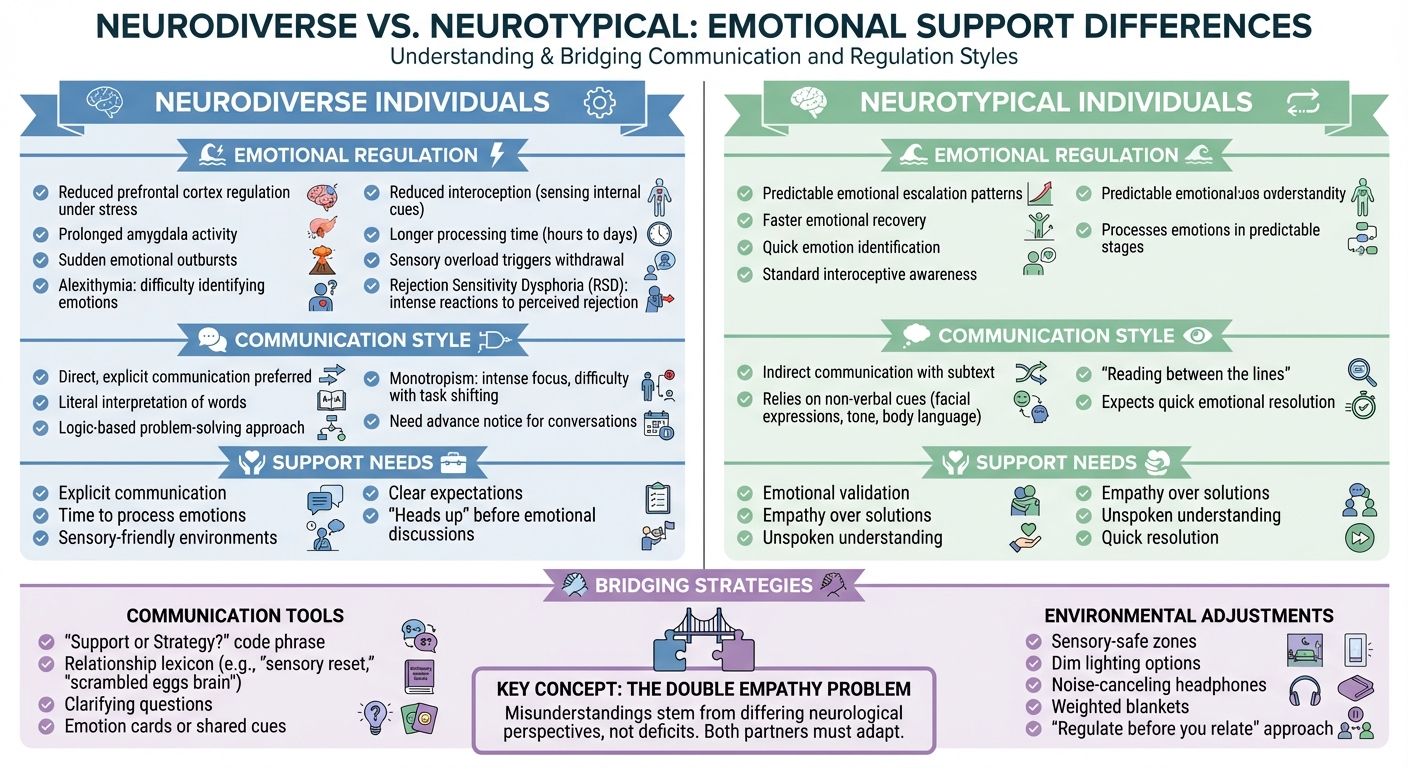
Neurodiverse vs Neurotypical Emotional Support and Communication Differences
Everyday Strategies That Strengthen Neurodiverse Relationships
sbb-itb-596b85d
How Neurodiverse and Neurotypical Partners Regulate Emotions Differently
When it comes to processing emotions, our brains don’t all operate the same way. For neurodiverse individuals – like those with ADHD – stress can lead to reduced regulation by the prefrontal cortex and prolonged activity in the amygdala, the brain’s emotional center [7]. This means that while neurotypical partners often follow more predictable patterns of emotional escalation and recovery, neurodiverse partners might experience sudden emotional outbursts, where emotions take over before logical thought can step in [7]. Let’s dive deeper into how these differences play out.
Brittany Carswell, Ph.D., a psychologist with expertise in ADHD, puts it this way:
"ADHD is a nervous system regulation disorder. Which means emotional regulation challenges aren’t a character flaw… they’re neurobiology." [7]
Emotional Regulation in Neurodiverse Individuals
For many neurodiverse people, recognizing and processing emotions can be particularly challenging. Conditions like alexithymia – difficulty identifying and naming emotions – and reduced interoception, or the ability to sense internal physical cues like hunger or heart rate, often play a role [6]. This makes it harder to recognize emotions before they become overwhelming. For example, autistic individuals may miss early emotional signals and respond more abruptly.
Dr. Lauren Breese, a clinical psychologist, explains:
"Emotional regulation is about noticing our emotions and then understanding the message they are bringing us, rather than ‘always staying calm’." [6]
In social-emotional situations, autistic individuals may also take longer to process what’s happening. It might take hours – or even days – for them to fully understand and articulate their feelings [8].
Sensory overload is another common challenge. For instance, if a partner steps away after a loud dinner party, it’s not about being antisocial – it’s a way to reset an overwhelmed nervous system.
For partners with ADHD, Rejection Sensitivity Dysphoria (RSD) adds another layer of complexity. Brittany Carswell, Ph.D., elaborates:
"The ADHD amygdala isn’t just reactive – it’s interpretive. It’s likely constantly scanning for: Failure, Criticism, Rejection, Disappointment." [7]
This means even something as small as a sigh or a slightly sharp tone can feel like intense rejection, leading to responses that might seem overly defensive or abrupt.
Emotional Regulation in Neurotypical Individuals
On the other hand, neurotypical partners often process emotions differently. They tend to identify emotions quickly and work through them in more predictable stages [8]. Their ability to pick up on subtle social cues often aligns with societal norms, allowing them to "read between the lines" with greater ease.
That said, neurotypical individuals aren’t immune to emotional challenges. They might expect their partner to pick up on unspoken signals about their feelings. When a neurodiverse partner responds with a logical solution instead of emotional validation, the neurotypical partner might feel dismissed – not because their partner doesn’t care, but because they’re approaching the issue from a more problem-solving perspective [2].
This disconnect often stems from differing expectations. Neurotypical partners might look for quick emotional resolution and unspoken understanding, while neurodiverse partners may need more explicit communication and additional time to process emotions [8]. Neither approach is inherently better – they’re simply different ways of experiencing and managing emotions. Recognizing these differences can help couples create tailored strategies for emotional support in their relationships.
Communication Styles: Neurodiverse vs. Neurotypical
When it comes to communication in neurodiverse relationships, the challenges aren’t about one partner being "better" at expressing themselves. Instead, it’s about two distinct communication systems trying to find common ground. The "double empathy problem" sheds light on this issue, emphasizing that the struggles arise from mutual misunderstandings of social cues and emotional expressions, rather than individual shortcomings. Let’s explore how these differences show up in everyday interactions.
Direct vs. Indirect Communication
Neurodiverse individuals, especially those on the autism spectrum, often prioritize clear and straightforward communication. They value direct speech, saying what they mean without relying on subtle hints or gestures [4]. On the other hand, neurotypical partners tend to lean on non-verbal cues – facial expressions, tone, and body language – to express their feelings. For instance, when a neurotypical partner says, "I’m fine", it might actually mean anything but fine, with the expectation that their partner will pick up on the underlying emotions. A neurodiverse partner, however, is likely to interpret "I’m fine" literally, missing the hidden layers.
This difference also plays out in how emotional support is offered. Neurodiverse partners often approach problems with logic, offering solutions, while neurotypical partners may be seeking empathy and emotional validation [2]. Leslie A. Sickels, LCSW, captures this dynamic perfectly:
"The goal of providing emotional support is not to agree but rather to identify that something is ‘a difficult situation’ for a partner." [2]
How to Bridge Communication Gaps
Despite these differences, finding harmony in communication is entirely possible with intentional strategies. One of the simplest and most effective methods is to be explicit about your needs. A practical tool for this is the "Support or Strategy?" code phrase [2]. Before diving into a discussion, one partner can ask, "Do you need emotional support or a practical solution?" This eliminates guesswork and helps both partners approach the conversation on the same page.
Another useful approach is creating a relationship lexicon – a set of shorthand phrases that quickly communicate complex feelings or states [4]. For example, saying "I need a sensory reset" might mean "I need a quiet, dimly lit space", while "My brain is scrambled eggs" signals overwhelm and the inability to process thoughts. These phrases simplify communication and reduce misunderstandings in the moment.
Task shifting is another critical consideration. Neurodiverse individuals often experience intense focus, known as monotropism, which can make sudden changes or interruptions challenging [2]. Giving a "heads up" before starting an important or emotional conversation allows them time to mentally transition. Instead of assuming your partner is ignoring you, understand that they may need a moment to shift their focus.
Lastly, ask clarifying questions rather than jumping to conclusions [3]. Silence doesn’t always mean disinterest, and a logical response isn’t necessarily dismissive. Questions like, "What does ‘support’ look like for you right now?" or "Do you want advice, or should I just listen?" can clear up confusion and create a space where both partners feel understood and valued. This approach replaces assumptions with genuine understanding, fostering stronger connections.
Sensory and Environmental Factors in Emotional Support
Sensory Overload and Emotional Withdrawal
When a neurodiverse partner suddenly becomes irritable or withdraws, it often signals that their nervous system is overwhelmed. Sensory overload happens when the brain struggles to process stimuli like lights, noise, or crowds. For neurodiverse individuals, these inputs can escalate to the point of causing physical discomfort or intense anxiety [5]. Couples therapist Daniel Dashnaw explains:
"Sensory overload is not a choice, and it can be highly disruptive if misunderstood." [5]
What might seem like minor background noise to a neurotypical partner – such as a buzzing fluorescent light or chatter in a restaurant – can feel unbearably intense to a neurodiverse partner [5]. When the sensory input exceeds their "window of tolerance", it can lead to emotional dysregulation [5][3]. This might look like irritability, shutting down, or an urgent need to leave the environment.
Unfortunately, these reactions are often misread by neurotypical partners as personal rejection or a lack of affection. In truth, they are simply the body’s way of coping with overstimulation [5][4]. Understanding this distinction is crucial: it’s not about rejecting the partner but about the nervous system’s need for relief. Adjusting the environment can help prevent these moments of overwhelm.
Creating Supportive Environments
Reducing sensory overload starts with making small but thoughtful changes to the environment. Begin by working together to identify sensory triggers – things like bright lights, strong smells, or certain textures – and also note what brings comfort, such as calming music, dim lighting, or weighted blankets [3][1]. The goal isn’t to eliminate all stimuli but to create a space where both partners can feel regulated.
Consider setting up a sensory-safe zone at home – a quiet, dimly lit area designed for relaxation [5][8]. Stock it with items like noise-canceling headphones, fidget tools, or a weighted blanket. These adjustments not only reduce sensory stress but also encourage more supportive and understanding interactions. As Yolanda Renteria, LPC, NCC, from The Gottman Institute, puts it:
"Honoring and meeting these basic needs for nervous system regulation can play a huge role in developing intimacy and bringing the relationship closer." [1]
Beyond physical changes, adopt a "regulate before you relate" approach. If one partner feels overwhelmed, pause the conversation and focus on grounding techniques, quiet time, or a quick walk before addressing emotional concerns. Even small environmental tweaks – like dimmable lights, adjusting the thermostat, or reducing background noise – can help both partners stay within their emotional comfort zone [3][8].
Rejection Sensitivity and Emotional Resilience
Understanding Rejection Sensitivity Dysphoria
Building on earlier discussions of sensory overload and communication challenges, let’s explore how rejection sensitivity adds another layer of complexity to emotional dynamics. For many neurodiverse individuals, rejection isn’t just emotionally painful – it can feel almost physical. Rejection Sensitive Dysphoria (RSD) describes the intense, often overwhelming reaction to real or perceived rejection. Even something as subtle as a sigh or a brief pause can be misinterpreted as rejection, triggering a cascade of emotions [9].
The Neurodiverse Couples Counseling Center refers to RSD as a "silent disruptor" in relationships:
"In a relationship, RSD can be a silent disruptor. When one partner has RSD, even neutral comments can feel loaded. A sigh sounds like disappointment. A pause feels like rejection." [9]
This heightened sensitivity often leads neurodiverse individuals to anticipate rejection, withdraw to avoid potential hurt, or react with intense emotions like shame or anger after receiving criticism [9] [2]. On the flip side, neurotypical partners may feel as though they’re constantly "walking on eggshells", unsure how their words will be received. Yolanda Renteria, LPC, NCC from The Gottman Institute, highlights this dynamic:
"It is also common for the neurodivergent partner to feel like they have to explain themselves constantly, which leads to hypervigilance, guilt, and shame." [1]
Recognizing these patterns is the first step toward creating strategies for supporting neurodiverse couples with mental health issues and improving communication.
Building Emotional Resilience
Dealing with RSD requires adjustments from both partners. A simple yet effective tool is the "Support or Strategy" code, which helps clarify whether validation or problem-solving is needed in the moment [2].
When emotions run high due to RSD, taking a pause can make a big difference. Grounding techniques – like a moment of silence or stepping away briefly – can help both partners regain control [4]. Discussing these "time-outs" ahead of time ensures that taking space isn’t misinterpreted as rejection [1]. These small but intentional steps not only address immediate emotional reactions but also contribute to building long-term resilience.
Creating a shared "relationship language" can also improve communication. For instance, phrases like "I need a sensory reset" or "My brain is scrambled eggs" offer a quick, blame-free way to express overwhelm [4]. Neurotypical partners can help by softening their approach during tough conversations. Instead of saying, "You always forget", try framing it as, "I feel frustrated when…" to lower defensiveness [1] [10]. Giving advance notice before starting an emotional discussion can also give neurodiverse partners time to mentally prepare, reducing the likelihood of feeling caught off guard [2].
Leslie A. Sickels, LCSW, emphasizes the importance of support in these moments:
"The goal of providing emotional support is not to agree but rather to identify that something is ‘a difficult situation’ for a partner." [2]
It’s crucial to remember that RSD is a nervous system response, not a personality flaw. As the Neurodiverse Couples Counseling Center puts it:
"Your brain is doing exactly what it was wired to do – and you deserve support that honors that reality." [9]
Tailored support can make all the difference. Resources like Growth and Change Counseling specialize in helping couples navigate these challenges by developing personalized strategies that strengthen emotional resilience and foster better communication in neurodiverse relationships.
Adapting Emotional Support Strategies
The Double Empathy Problem
When it comes to communication challenges in neurodiverse relationships, it’s not about one partner being "at fault." Instead, it’s a two-way dynamic. In 2012, Dr. Damian Milton introduced the concept of the "double empathy problem" to push back against the outdated belief that neurodivergent individuals lack empathy or social skills [11]. Studies show that autistic individuals communicate effectively within their own communities; the real challenge arises in interactions between neurodivergent and neurotypical individuals [11]. As Dr. Megan Anna Neff explains:
"The challenge wasn’t in our ability to connect; it was in navigating the differences between Autistic and allistic ways of relating." [12]
This highlights that the responsibility for adaptation shouldn’t rest solely on the neurodivergent partner. Neurotypical individuals can also benefit from learning to communicate more directly, respecting sensory preferences, and understanding that different styles of communication are not deficits. Dr. Damian Milton emphasizes this point:
"The emphasis is purely on the autistic person to change, a lot of the time. Evaluating the social situations surrounding autistic people and finding ways to facilitate their unique communication styles may be a more useful approach." [11]
By embracing this perspective, couples can explore practical strategies to bridge communication gaps.
Tailored Emotional Support Techniques
To address these communication challenges, couples can adopt strategies designed to meet their specific needs. One simple yet effective approach involves using clarifying questions and the "Support or Strategy" code to quickly identify what each partner requires [2][3]. As Leslie A. Sickels, LCSW, points out:
"The goal of providing emotional support is not to agree but rather to identify that something is ‘a difficult situation’ for a partner." [2]
Another helpful tactic is giving a "heads up" before diving into deep emotional conversations, which allows for smoother transitions. Additionally, creating shared emotional cues – like specific words, signals, or even "emotion cards" – can help clarify feelings when non-verbal communication isn’t clear [13].
For couples who find it challenging to implement these strategies on their own, seeking professional guidance can be transformative. Growth and Change Counseling offers therapy specifically tailored to neurodiverse relationships. Their neurodiversity-affirming approach focuses on leveraging each partner’s strengths to develop personalized communication tools and emotional support techniques that honor their unique neurological differences.
Understanding Emotional Regulation at Growth and Change Counseling
Supporting emotional well-being in neurodiverse relationships starts with acknowledging and appreciating the different ways partners process and communicate. Neurotypical individuals often rely on intuitive emotional cues, while neurodivergent partners may approach emotions through logic. While these differences can sometimes cause tension, they also present opportunities for growth when couples learn to embrace their contrasting styles. This mutual understanding creates a foundation for strategies that respect and address the needs of both partners.
The key lies in mutual effort. As Liz Zhou, Holistic Therapist, explains:
"Communication difficulties are not due to the deficits of either autistic or allistic people, but due to the differences in neurotype" [3].
Both partners play an active role in bridging these differences – whether by using tools like "Support or Strategy" codes, designing sensory-friendly spaces, or creating a shared language that reflects each partner’s unique way of experiencing the world. These approaches not only strengthen neurodiverse relationships but can also benefit any couple navigating communication challenges.
Professional guidance can also offer tailored solutions to meet each couple’s specific needs. With intentional adjustments, meaningful changes happen. For example, neurotypical partners can focus on direct communication and respecting sensory preferences, while neurodivergent partners can benefit from clear guidance on emotional expectations. These small but thoughtful shifts can transform frustration into deeper connection.
For couples seeking additional support, resources like Growth and Change Counseling provide expertise in neurodiverse relationships. Their neurodiversity-affirming approach helps couples develop customized communication strategies and emotional tools that honor each partner’s neurological differences.
The goal isn’t for one partner to change to fit the other’s mold. Instead, it’s about celebrating each other’s unique perspectives and seeing them as strengths rather than sources of stress.
FAQs
What are some effective ways for neurodiverse and neurotypical partners to improve communication?
Neurodiverse and neurotypical partners can strengthen their communication by creating a shared approach that respects each other’s unique needs and preferences. A good starting point is developing self-awareness – both partners should take time to identify their emotional triggers and preferred ways of expressing themselves. Simple tools like using "I" statements or mapping emotions visually can help keep conversations clear and productive.
Using direct and literal language can reduce misunderstandings, and allowing extra time for processing can make discussions smoother. Neurotypical partners should focus on avoiding assumptions based on subtle, nonverbal cues, while neurodiverse partners might find structured communication tools – like written notes or visual aids – especially helpful. Incorporating regular emotional check-ins and developing a shared vocabulary, such as specific code words or visual scales, can make it easier for both partners to express feelings of stress or sensory overload.
For those seeking additional guidance, couples counseling tailored to neurodiverse relationships can be a valuable resource. Growth and Change Counseling, for instance, specializes in therapy that helps partners improve communication and build stronger, more supportive connections.
How can sensory overload in neurodiverse individuals be managed effectively?
Managing sensory overload in neurodiverse individuals starts with recognizing what triggers discomfort. Sensitivities to things like loud noises, bright lights, or strong smells can vary widely, so understanding these specific triggers is key to preparing for overwhelming situations.
Using sensory tools can make a world of difference. Items like weighted blankets, noise-canceling headphones, or tinted glasses can help with sensory regulation. Making simple changes to the environment also helps – think dimmer lighting, minimizing background noise, or setting up a quiet, calming space for retreat when things get too intense.
It’s also important to build in regular sensory breaks and encourage open communication about needs and limits. This not only helps reduce stress but also fosters a sense of emotional balance in everyday interactions.
What is Rejection Sensitivity Dysphoria (RSD), and how can it impact relationships?
Rejection Sensitivity Dysphoria (RSD) is a condition where feelings of rejection or criticism – whether real or imagined – trigger an intense emotional response. For those experiencing it, these emotions can quickly become overwhelming, often leading to feelings of shame, anger, or even withdrawal. In relationships, RSD can complicate communication, sometimes resulting in misunderstandings, increased conflict, or emotional distance.
To support a partner with RSD, compassionate communication is key. Using "I" statements, rather than placing blame, can help create a safe space for dialogue. Another helpful approach is agreeing on pause signals to use during tense moments, giving the person with RSD time to process their emotions without escalating the situation. Validating their feelings is also crucial – acknowledging that RSD stems from a neurobiological reaction, not a personal failing, can make a significant difference. For tailored guidance, seeking professional support from experts, such as those at Growth and Change Counseling, can equip couples with strategies to navigate these challenges and strengthen their emotional bond.
Related Blog Posts
- 5 Ways to Support Your Neurodiverse Partner
- Understanding Emotional Cues in Neurodiverse Couples
- Ultimate Guide to Emotional Growth for Neurodiverse Couples
- Personality Disorders vs. Neurodivergence in Relationships
