When relationship challenges arise, it’s important to know whether they stem from personality disorders or neurodivergence. Although both can cause emotional struggles, communication issues, and conflict, their origins and solutions are vastly different:
- Personality Disorders: These involve rigid, maladaptive behavior patterns often shaped by trauma or early life experiences. They can lead to intense fears of abandonment, emotional instability, and recurring conflicts. Therapy like DBT or MBT is often necessary to address these patterns.
- Neurodivergence: This refers to natural differences in brain function (e.g., autism or ADHD). It’s not a disorder but a variation in how the brain processes information. Challenges often include sensory overload, impulsivity, or communication gaps. Support focuses on creating adjustments and understanding these differences.
Key Differences:
- Root Cause: Personality disorders are linked to trauma and maladaptive coping, while neurodivergence is present from birth.
- Emotional Triggers: Personality disorders are often driven by fear of rejection, while neurodivergence involves sensory or cognitive overload.
- Treatment: Personality disorders require therapy to reshape patterns, whereas neurodivergence benefits from adjustments and tailored strategies.
Understanding these distinctions helps couples address issues effectively and avoid misdiagnoses. Whether the focus is on therapy or support for neurological differences, professional guidance can make a big difference.
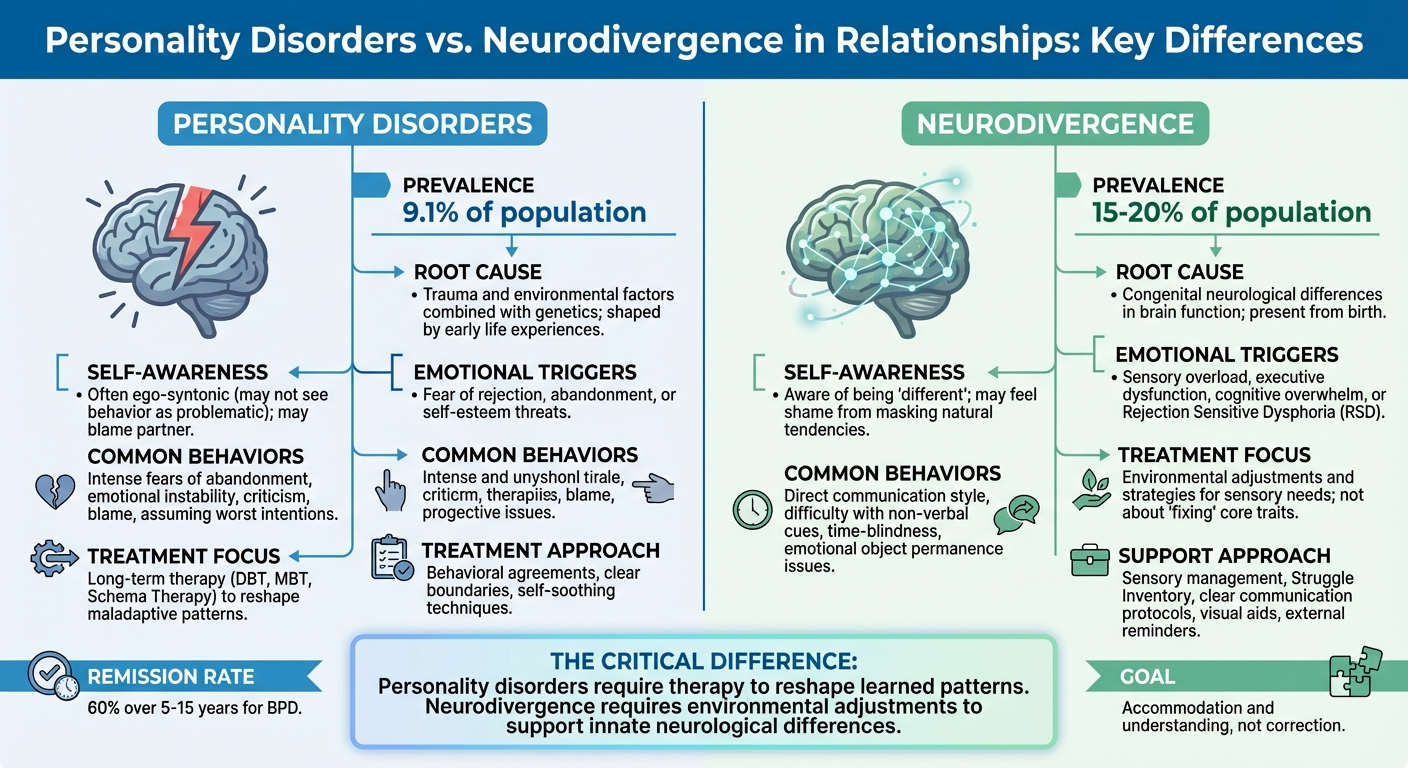
Personality Disorders vs Neurodivergence in Relationships: Key Differences
Personality Disorders in Relationships
Common Personality Disorders in Couples
Approximately 9.1% of the population is affected by some form of personality disorder, which can significantly shape relationship dynamics[4]. Borderline Personality Disorder (BPD) stands out due to intense fears of abandonment, feelings of emptiness, and rapid cycles of idealizing and devaluing a partner[4]. Narcissistic Personality Disorder (NPD) often creates tension through a constant need for admiration and difficulty empathizing with a partner’s emotions. Meanwhile, Antisocial Personality Disorder (ASPD) is characterized by manipulative tendencies and a disregard for others’ rights. Histrionic Personality Disorder, on the other hand, involves excessive emotional displays and attention-seeking behaviors[7].
Research highlights that many couples exhibit at least one BPD-related symptom, emphasizing its frequent impact on relationships[5]. These traits, while distinct, often bring unique emotional hurdles to partnerships, requiring careful navigation.
Emotional Regulation Problems in Personality Disorders
Personality disorders are often accompanied by ongoing difficulties with emotional regulation. For instance, individuals with BPD may experience sudden mood swings, frequently triggered by feelings of rejection or criticism[4]. During conflicts, they may dominate conversations through criticism, blame, or threats, often assuming the worst about their partner’s intentions[4].
Studies also link Cluster B personality disorders – which include Antisocial, Borderline, Histrionic, and Narcissistic types – to prolonged relationship conflict. Women with these disorders and their partners often report lower marital satisfaction and heightened attachment insecurity over time[4].
"Individuals with pathological personality features have a greater likelihood of being generally unhappy in their marriage, but more important, they may fail to recognize that the source of their unhappiness lies in their own way of processing and interacting with the world." – South et al. [4]
Complicating matters further, many personality disorders are ego-syntonic, meaning individuals may not see their behavior or perspective as problematic. Instead, they might blame their partner entirely for relationship struggles. Without professional intervention, this dynamic can be difficult to change, as it often requires addressing deeply ingrained behavioral patterns.
Treatment Approaches for Couples
Therapies designed for personality disorders can provide structured solutions for couples facing these challenges. Dialectical Behavior Therapy (DBT) has shown success in addressing the emotional instability and self-destructive tendencies common in BPD. It focuses on teaching distress tolerance and interpersonal skills[7]. Schema Therapy helps individuals identify and change deeply rooted maladaptive patterns, while Mentalization-Based Treatment (MBT) promotes understanding of one’s own and a partner’s mental states, reducing misunderstandings and reactivity[7].
Practical strategies also play a key role in improving communication and reducing conflict. These include:
- Behavioral agreements to create more constructive dialogues.
- Clear boundaries to address anger and prevent abusive interactions.
- Self-soothing techniques, like mindfulness and breathing exercises, to manage emotional intensity before difficult discussions[4].
Couples can seek specialized counseling, such as the services offered at Growth and Change Counseling, to address these challenges. Tailored interventions are essential, as they differ significantly from approaches used in neurodivergent relationship dynamics, underscoring the need for an accurate diagnosis.
Neurodivergence in Relationships
Main Features of Neurodivergence
Neurodivergence refers to natural differences in brain development that influence how individuals process information and engage with the world. Unlike personality disorders, which are categorized as mental health conditions, neurodivergence stems from variations in brain structure and function that are present from birth. Two common forms of neurodivergence that can shape relationship dynamics are autism and ADHD.
For autistic individuals, social communication differences can sometimes lead to misunderstandings. They may prefer clear, direct language and find it challenging to pick up on subtle emotional cues. On the other hand, ADHD brings its own set of challenges, such as impulsivity, difficulty maintaining focus during conversations, and a concept known as "emotional object permanence." This can cause a partner to unintentionally lose sight of the other’s emotional needs during periods of intense focus. These traits aren’t flaws but rather reflect unique ways of processing information. These differences also play a role in how neurodivergent individuals handle emotional stress.
Emotional Regulation in Neurodivergent Partners
Emotional regulation in neurodivergent individuals differs significantly from what is observed in personality disorders. Sensory overload often plays a major role for neurodivergent people, as overwhelming environments can drain their emotional reserves. For example, autistic individuals might react strongly to changes in routine or unexpected sensory experiences, while those with ADHD may experience Rejection Sensitive Dysphoria (RSD), an intense emotional response to perceived criticism.
Psychologist Crystal I. Lee explains:
"This emotional volatility isn’t intentional or manipulative; it reflects differences in brain chemistry and processing that affect emotional control" [3].
For individuals with ADHD, emotional escalation can happen rapidly due to their brain’s unique processing patterns. In contrast, emotional dysregulation in personality disorders often stems from challenges with self-image and relationships. Outbursts in neurodivergent individuals might take the form of yelling or slamming doors, while others may respond by withdrawing or shutting down emotionally.
Support Strategies for Neurodivergent Couples
Addressing the emotional challenges in neurodivergent relationships requires focused and intentional strategies. Making practical adjustments can have a significant impact on how these couples navigate their interactions. For instance, sensory management is a key starting point. Identifying and minimizing triggers – such as bright lights, loud noises, or chaotic environments – can help reduce emotional overwhelm. Simple changes like dim lighting, quieter spaces, or noise-canceling tools can make a big difference [1].
Another helpful approach is creating a "Struggle Inventory", a shared list of specific triggers (e.g., interrupting, jumping to conclusions, or shutting down) paired with agreed-upon solutions. This proactive method helps couples address challenges before they escalate [1].
Clear communication is also essential. Many neurodivergent individuals benefit from direct and unambiguous language. Some couples find that writing things down – whether in texts or letters – eases the pressure of processing emotions in real time. Establishing routines, such as scheduled emotional check-ins or using visual aids, can also provide the structure needed to reduce anxiety during spontaneous interactions [3]. For ADHD partners, external reminders like phone alerts or timers can help manage "time-blindness" and ensure they remain mindful of their partner’s needs [3].
Specialized counseling, like that offered by Growth and Change Counseling, can provide tailored support for neurodiverse couples. Therapist Yolanda Renteria, LPC, emphasizes:
"Honoring and meeting these basic needs for nervous system regulation can play a huge role in developing intimacy and bringing the relationship closer" [1].
The focus should shift from seeing neurodivergent traits as shortcomings to recognizing them as differences that require mutual understanding and adaptation. With the right tools and accommodations, these relationships can thrive.
Personality Disorders vs. Neurodivergence: A Direct Comparison
Overlapping Behaviors and Misdiagnosis Risks
Personality disorders and neurodivergence often share certain outward behaviors, which can create confusion, especially in close relationships. Traits like emotional dysregulation, impulsivity, and struggles with non-verbal communication are common in both conditions, making it easy to misinterpret one for the other[1][2].
For example, a neurotypical partner might perceive a neurodivergent partner’s straightforward feedback as harsh or overly critical, a reaction often associated with personality disorders. Meanwhile, the neurodivergent partner may feel rejected when their need for connection is met with a request for personal space. These misunderstandings often arise from differing communication styles and needs[1][4]. Additionally, neurodivergent individuals often feel compelled to over-explain themselves, which can lead to a heightened sense of vigilance and shame, sometimes mistaken for defensiveness[1][2].
Emotional meltdowns further illustrate the overlap. For neurodivergent individuals, these episodes are frequently triggered by sensory overload – things like bright lights, loud sounds, or unexpected touch. In contrast, meltdowns in personality disorders are more likely rooted in interpersonal stress or a fear of abandonment[1][4]. Research highlights that individuals with Borderline Personality Disorder are more prone to misinterpreting neutral facial expressions as negative emotions like fear or anger, reflecting a distinct perception of social interactions[2]. These nuanced differences provide a clearer lens for understanding their unique origins.
Different Origins and Motivations
The key distinction lies in the root causes of these behaviors. Personality disorders are often shaped by trauma and the development of maladaptive coping mechanisms[4][7]. Neurodivergence, on the other hand, is a result of innate neurological differences present from birth[1]. Approximately 9.1% of the general population is estimated to have a personality disorder, while neurodivergence affects a broader range, estimated at 15–20%[1][4].
Unlike learned behaviors, neurodivergent traits are hardwired. Many neurodivergent individuals are aware of their differences but may struggle with feelings of shame when attempting to "mask" their natural tendencies to fit societal expectations[1]. As South et al. point out:
"Individuals with pathological personality features have a greater likelihood of being generally unhappy in their marriage, but more important, they may fail to recognize that the source of their unhappiness lies in their own way of processing and interacting with the world"[4].
The motivations behind emotional responses also differ. In personality disorders, emotional instability often stems from an intense fear of rejection, an unstable self-image, or the need for validation[7][4]. For neurodivergent individuals, reactions are more likely tied to sensory overload, cognitive overwhelm, or Rejection Sensitive Dysphoria (RSD) – a heightened sensitivity to perceived criticism caused by brain chemistry rather than relational trauma[1].
Different Treatment Needs
Recognizing these distinctions is crucial for effective treatment. Personality disorders often require long-term therapy to address deep-rooted defense mechanisms and emotional wounds. Approaches like Dialectical Behavior Therapy (DBT) or Mentalization-Based Treatment (MBT) are designed to help individuals reshape unhealthy patterns and improve their relationships[7][2]. Studies show that remission rates for Borderline Personality Disorder can reach 60% over 5 to 15 years, though some psychosocial challenges may persist[2].
For neurodivergent individuals and couples, the focus shifts to creating supportive environments and managing sensory sensitivities rather than altering core traits. Strategies like environmental adjustments, coaching, and understanding sensory triggers are more effective than traditional psychotherapy[1]. Yolanda Renteria, LPC, explains:
"The biggest conflicts in neurodiverse relationships boil down to the difficulty individuals have in understanding the differences in how each partner processes information"[1].
| Feature | Personality Disorders | Neurodivergence |
|---|---|---|
| Primary Basis | Trauma and environmental factors combined with genetics[7][2] | Congenital neurological differences in brain function[1] |
| Self-Awareness | Often ego-syntonic; may not see behavior as problematic[4] | Aware of being "different"; may feel shame from masking[1] |
| Emotional Trigger | Fear of rejection, abandonment, or self-esteem threats[7][4] | Sensory overload, executive dysfunction, or communication gaps[1] |
| Treatment Focus | Long-term therapy (DBT, MBT) to address maladaptive patterns[7][2] | Environmental adjustments and strategies for sensory needs[1] |
For couples navigating personality disorders, setting clear boundaries can help reduce anxiety and prevent unhealthy dependency. In neurodiverse relationships, tools like sensory audits and direct, non-defensive communication can prevent misunderstandings caused by differing thought processes[1]. Growth and Change Counseling offers resources specifically designed for neurodiverse couples, helping them recognize their unique dynamics and build strategies that honor their neurological differences.
sbb-itb-596b85d
Conclusion
What Couples Need to Know
Understanding whether relationship challenges stem from personality disorders or neurodivergence is crucial for choosing the right strategies. These two issues have very different roots. Personality disorders often arise from early developmental or attachment issues and typically require long-term therapy to address deeply ingrained patterns. On the other hand, neurodivergence is tied to innate neurological differences, which benefit from environmental adjustments and sensory accommodations rather than attempts to "correct" core traits.
This distinction can help shift the focus from blame to understanding. Instead of seeing your partner’s actions as personal attacks, you might recognize them as responses to sensory overload or differences in how they process the world.
Statistics highlight the importance of accurate assessment. While 9.1% of the population is estimated to have a personality disorder, 15–20% are neurodivergent [1][4]. Research also shows that Cluster B personality disorders, in particular, lead to the most persistent relationship conflicts over a 10-year period [4]. A correct diagnosis can be transformative, guiding couples toward the right interventions – whether it’s reshaping unhealthy patterns or providing the necessary support for neurological differences.
Professional guidance is essential to navigate these challenges effectively.
Getting Professional Help
Once you have a clear understanding of the underlying issues, professional support becomes a critical step in addressing them. Growth and Change Counseling specializes in helping couples manage these complex dynamics. They offer tailored services for neurodiverse relationships, including support for couples where one partner has Asperger’s or High-Functioning Autism Spectrum Disorder. They also provide treatment for personality disorders and co-occurring conditions such as anxiety, depression, addiction, and trauma.
For couples facing serious crises, The Marriage Rescue Institute provides a 12-week intensive coaching program designed to help rebuild relationships. Their solutions-focused approach addresses both individual behaviors and the dynamics between partners. This method recognizes that unresolved conflicts often worsen psychiatric symptoms [6]. Whether you’re working to distinguish between personality-driven behaviors and neurodivergent traits or seeking strategies to improve emotional regulation, a professional assessment ensures that you’re targeting the root of the problem – not just addressing surface-level issues.
Services are available in Campbell, San Jose, Los Angeles, and Roseville, CA, with telehealth options throughout California.
Autism Spectrum Disorder vs Borderline Personality Disorder
Finding Clarity With Growth and Change Counseling
How can I tell if relationship challenges are caused by a personality disorder or neurodivergence?
Personality disorders can often strain relationships due to long-standing, rigid patterns of thinking and behavior that touch nearly every aspect of life – not just romantic connections. These patterns might include difficulty understanding others’ emotions, impulsive decisions, or controlling and inflexible interaction styles. For instance, if a partner frequently shifts blame, lacks remorse, or responds with extreme anger to situations most couples handle more calmly, these behaviors could point to a personality disorder.
On the other hand, neurodivergence – such as autism, ADHD, OCD, or dyslexia – can introduce unique challenges in relationships because of differences in how emotions, sensory input, and social cues are processed. Signs might include struggles with recognizing emotions, feeling overwhelmed by sensory input, rapid mood shifts, or favoring straightforward, literal communication. These dynamics are often specific to certain situations, like moments of high stress or overstimulation, and can improve with better communication strategies and mutual understanding.
To gain clarity about what might be affecting your relationship, think about whether the behaviors occur consistently across all areas of life or are tied to specific neurological traits. Seeking a professional assessment can provide valuable insight. Growth and Change Counseling offers tailored support for couples navigating personality disorders or neurodivergent dynamics, focusing on building stronger communication and emotional regulation skills.
How do treatment approaches differ for personality disorders and neurodivergence in relationships?
Addressing personality disorders in relationships often requires long-term, intensive psychotherapy to tackle rigid and maladaptive behavior patterns. Therapies such as schema therapy and mentalization-based therapy are frequently used to help individuals and couples manage ongoing interpersonal challenges, including those linked to borderline or narcissistic personality disorders. These therapeutic approaches work on reshaping deeply entrenched relational patterns and demand the expertise of trained professionals.
On the other hand, treatment for neurodivergence focuses on skill-building, environmental adjustments, and clear communication techniques. The goal isn’t to "fix" the brain but rather to provide practical tools that make interactions smoother. Strategies like emotion mapping, sensory regulation techniques, and structured communication aids help reduce misunderstandings. For neurodiverse couples, therapy often adopts a strengths-based approach, using methods like the Gottman Method or Emotionally Focused Therapy, which are tailored to honor and accommodate neurological differences.
Growth and Change Counseling offers customized support for couples navigating challenges related to personality disorders or neurodivergence. Using evidence-based strategies and solutions-focused therapy, they help foster healthier and more connected relationships.
How can couples improve communication when one partner is neurodivergent?
Improving communication in a neurodivergent relationship starts with recognizing that neurodivergent partners may experience emotions, process information, and respond to sensory input in ways that differ from neurotypical patterns. These differences can sometimes lead to misunderstandings unless both partners emphasize patience and clear communication.
One of the most effective strategies is using clear and direct language. Avoid sarcasm or idiomatic expressions that might be confusing. Instead, try using “I” statements, like, “I feel ___ when ___ happens,” to express emotions in a way that doesn’t place blame. For more complex discussions, consider incorporating written notes, visual aids, or shared documents. These tools can give both partners the time and space they need to process the conversation fully.
Another helpful approach is scheduling regular, low-pressure check-ins. These moments can be used to discuss needs, set boundaries, and even agree on a shared “pause signal” to use during emotionally charged situations. After difficult conversations, allowing extra time for emotional regulation can significantly reduce tension and foster trust. If communication remains challenging, seeking guidance from a therapist can offer personalized tools and strategies to strengthen connection and understanding.
Related Blog Posts
- OCD and Emotional Intimacy in Neurodiverse Couples
- Trauma, Addiction, and Neurodiverse Relationships
- Understanding Emotional Cues in Neurodiverse Couples
- Trauma vs. Neurodiversity: Key Counseling Differences
