If your co-parenting problem is about the plan, mediation usually fits. If it’s about the pattern, counseling usually fits.
I’d break it down like this: mediation helps parents make decisions, while counseling helps parents change how they deal with each other. In recovery cases, that difference matters because conflict is often tied to custody terms, trust issues, relapse fears, communication problems, and child stress.
Here’s the short version:
- Choose mediation for schedules, holidays, testing rules, relapse plans, and handoff details
- Choose counseling for repeated arguments, hostile texts, mistrust, resentment, and child distress
- Use both when you need a parenting plan and help sticking to it
- Do not start with mediation if there is active substance use, threats, coercive behavior, or safety concerns
- Costs and timing differ: mediation often runs about $3,000 to $8,000 total and may finish in 2 to 4 months, while court fights can last 1 to 3 years and cost $15,000 to $30,000 per spouse
- Counseling often runs 6 to 12 sessions at about $100 to $250 per session
The main point: I’d match the support to the problem in front of me. A written agreement can settle logistics. It will not fix grief, anger, or fear. And therapy can improve communication, but it does not create a legal custody order.
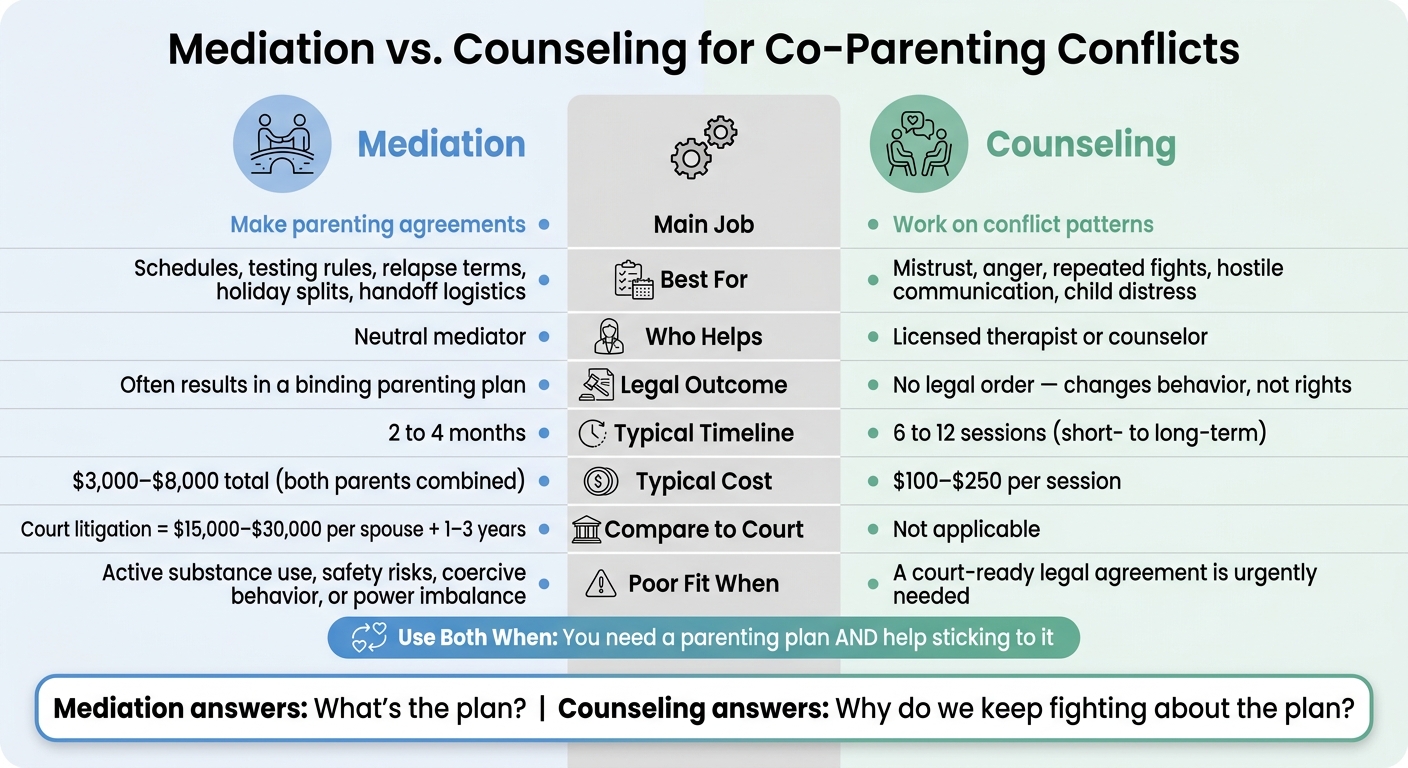
Mediation vs. Counseling for Co-Parenting: Side-by-Side Comparison
Mediation and Counseling – How do They Work Together?
sbb-itb-596b85d
Mediation vs. Counseling: A Quick Guide from Growth and Change
| What to compare | Mediation | Counseling |
|---|---|---|
| Main job | Make parenting agreements | Work on conflict patterns |
| Best for | Schedules, testing, relapse terms, decision rules | Mistrust, anger, repeat fights, poor communication |
| Who helps | Neutral mediator | Licensed therapist or counselor |
| Legal result | Often part of a binding plan | No legal order |
| Time frame | Short-term | Short- or longer-term |
| Typical cost | $3,000 to $8,000 total | $100 to $250 per session |
| Poor fit when | Safety risks or active use are present | You need a court-ready agreement now |
In plain English: mediation answers “What’s the plan?” Counseling answers “Why do we keep fighting about the plan?”
If I were choosing between them, I’d start with the child’s stability and safety first, then pick the kind of help that deals with the actual problem.
Mediation for Co-Parenting Disputes
Mediation is a cooperative process where a third party helps parents work out specific, day-to-day agreements. It works best for practical decisions, not unresolved resentment.
Instead of having a court impose a parenting plan, parents can build one themselves through mediation.
What Mediation Can Resolve
Mediation deals with the nuts and bolts of co-parenting. That includes parenting schedules, holiday rotations, school decisions, medical care, transportation, and extracurricular costs [7].
In recovery cases, it can also cover issues like:
- random alcohol or drug testing
- step-down visitation tied to sobriety milestones
- contingency plans for relapse or changes in treatment [1]
That gets at the agreement side of co-parenting conflict.
It also helps to work with a mediator who understands addiction. A standard mediator may miss how relapse risk, therapy sessions, or treatment schedules shape a parenting plan. A specialist can build those factors directly into the agreement [1].
Benefits and Limits of Mediation During Recovery
The practical upsides are hard to ignore. Mediation cases usually wrap up in 2 to 4 months, while litigated disputes often take 1 to 3 years [6]. Total costs for mediation tend to fall between $3,000 and $8,000 for both parents combined. Litigation, by contrast, can cost $15,000 to $30,000 per spouse in attorney fees alone [6].
Mediation is also private and confidential. What gets said there does not become part of a public court record [6].
Still, mediation has limits. It cannot treat addiction, and it is not meant to replace counseling or long-term communication work. It also depends on both parents being willing to cooperate. If one parent is actively using substances in a way that puts safety at risk, mediation is not the right place to start [1][4]. The same goes for coercive control, a major power imbalance, or domestic violence.
When the same conflict keeps coming back, or the issue turns emotional instead of practical, counseling can address the pattern that mediation cannot fix.
Counseling for Co-Parenting Conflict
Where mediation deals with logistics, counseling goes after the patterns underneath. If resentment, mistrust, or emotional reactivity are driving the conflict, a parenting schedule alone usually won’t fix it.
What Counseling Addresses
Counseling focuses on the issues that cause agreements to fall apart: poor communication, resentment, shame, and relapse-related anxiety. In recovery cases, deep mistrust can shape every exchange. That tends to matter most when the schedule itself is workable, but the same fights keep coming back.
Therapists also help parents see the direct effect their conflict has on their children. Children tend to do better when parental conflict stays low. Repeated hostility can leave them anxious and dysregulated.
Counseling can happen one-on-one or with both parents in the room. And sometimes, even if only one parent changes, that can still lower the temperature in future exchanges [8][3].
Benefits and Limits of Counseling During Recovery
The main upside of counseling is skill-building that lasts beyond a single agreement. Parents learn concrete tools like the BIFF method – keeping communication Brief, Informative, Firm, and Friendly – to take the emotional bait out of hard exchanges [3]. They can also walk through recent blowups with a therapist and turn those moments into calmer, more useful conversations.
When direct cooperation keeps falling apart, counseling may move from teamwork to damage control. In high-conflict situations where direct cooperation still doesn’t work, counselors may suggest parallel parenting: separate households, clear rules, and very little direct contact [2][3].
There is a trade-off: time and cost. A typical course runs 6 to 12 sessions and costs $100 to $250 per session [8][2]. Therapy may include individual counseling, family therapy, or parent coaching focused on communication, addiction recovery, and trauma. Unlike mediation, counseling does not create a binding legal document. It changes behavior, not legal rights or obligations.
The next step is choosing the approach that fits the problem.
Mediation vs. Counseling: Key Differences for Parents in Recovery
Mediation helps parents sort out the practical parts of parenting. Counseling deals with the emotional patterns that keep the conflict going.
That’s the clearest way to separate the two.
Side-by-Side Comparison: Goals, Process, and Outcomes
| Feature | Mediation | Co-Parenting Counseling |
|---|---|---|
| Primary Purpose | Reach practical, legally binding agreements | Improve communication and emotional healing |
| Professional Involved | Neutral mediator | Licensed therapist or counselor |
| Conflict Focus | Focuses on the "what" of the agreement | Focuses on the "why" of the conflict |
| Legal Outcome | Often results in a binding parenting plan | Therapeutic progress, not legal orders |
| Timeline | Short-term; usually a few sessions | Short- to long-term |
| Best Use in Recovery | Best for setting immediate parenting terms | Best for changing conflict patterns |
| Common Limitations | Requires good faith and willingness to compromise | Does not resolve legal disputes or finalize custody |
When Using Both Approaches Makes Sense
Some families need both. One helps set the plan. The other helps parents stick to it without falling into the same arguments.
Start with counseling when conflict feels volatile and communication keeps breaking down. In that situation, trying to settle parenting terms before the tension cools can backfire.
Start with mediation when a custody or scheduling decision needs to be made now. It gives parents a way to work through immediate terms and put a plan in place.
The next step is choosing the first kind of support that fits the conflict in front of you.
How to Choose the Right Support and Next Steps
The best choice depends on the kind of problem you’re dealing with. If the issue is mostly practical, mediation usually makes more sense. If the same blowups keep happening, counseling is often the better move.
Choose Mediation When the Problem Is Mainly Practical
Mediation works best for day-to-day parenting issues like schedule disputes, holiday splits, handoff logistics, or parenting-time changes linked to sobriety milestones. It’s a good fit when both parents can negotiate safely and in good faith.
A mediated agreement can also spell out flexibility tied to recovery progress. For example, it may allow expanded visitation once a parent completes treatment or shows steady negative drug tests [5]. That kind of structure gives both parents something clear to follow, instead of leaving big decisions up in the air.
Mediation is usually a poor fit when one parent is in active addiction, there has been a recent relapse, or there’s a history of intimidation or safety concerns. In those cases, trying to work out a parenting plan can turn into an uneven and unsafe process.
Choose Counseling When Conflict Keeps Repeating
Sometimes the issue isn’t the plan itself. It’s the pattern underneath it.
If the same conflict keeps coming back, it may be time to stop tweaking the schedule and start working on how the conflict happens. Common signs include repeated hostile texts, a child showing distress around transitions, or decisions being driven by fear instead of the child’s needs [3].
Counseling can help one or both parents lower reactivity and communicate with more consistency. And even if only one parent takes part, that shift can still change the dynamic across both households [3].
Conclusion: Child Stability, Recovery, and Finding the Right Fit
Mediation sets the plan. Counseling helps parents stick to it. Many families end up needing both, just at different times. Mediation can help put terms in place, while counseling can help make those terms workable over time.
The key is to look at current safety and stability. If safety is in doubt – active relapse, threats, or coercive behavior – the first job is protection, not negotiation. California parents in that situation can contact the National Domestic Violence Hotline at 1-800-799-7233 or speak with a family law attorney about a Domestic Violence Restraining Order (DVRO) [3][5].
Pick the path that protects the child and supports recovery right now.
FAQs
Can mediation and counseling happen at the same time?
Yes. Many families use both at the same time because each one does a different job.
Counseling helps with emotional well-being, communication, and relationship patterns. Mediation focuses on settling specific disputes and putting custody agreements in place.
Used together, they can lower tension and help parents build a more cooperative co-parenting arrangement.
Who should I contact first if safety is a concern?
If a child’s safety is at risk because of substance abuse or another serious threat, act fast. Contact local authorities or a lawyer right away to pursue emergency custody.
Safety comes first. When there’s major risk, coercive control, or active danger, you’ll usually need legal help and court protection before turning to professional support such as Growth and Change Counseling.
How do I know if my conflict is about the plan or the pattern?
Look closely at what the disagreement is actually about.
If it centers on specific issues like custody schedules, financial responsibilities, or holiday arrangements, it’s probably a plan-based conflict. In that case, mediation can help you work toward a clear agreement.
If you keep getting pulled into the same unproductive arguments, especially around communication or emotions, that usually points to a pattern. Co-parenting counseling or conflict coaching can help you build better long-term habits.
Related Blog Posts
- Ultimate Guide to Co-Parenting in Recovery
- Mental Health and Co-Parenting: Problem-Solving Strategies
- Parenting Strategies For Addiction Recovery Support
- Addiction Recovery and Co-Parenting: Comparison
