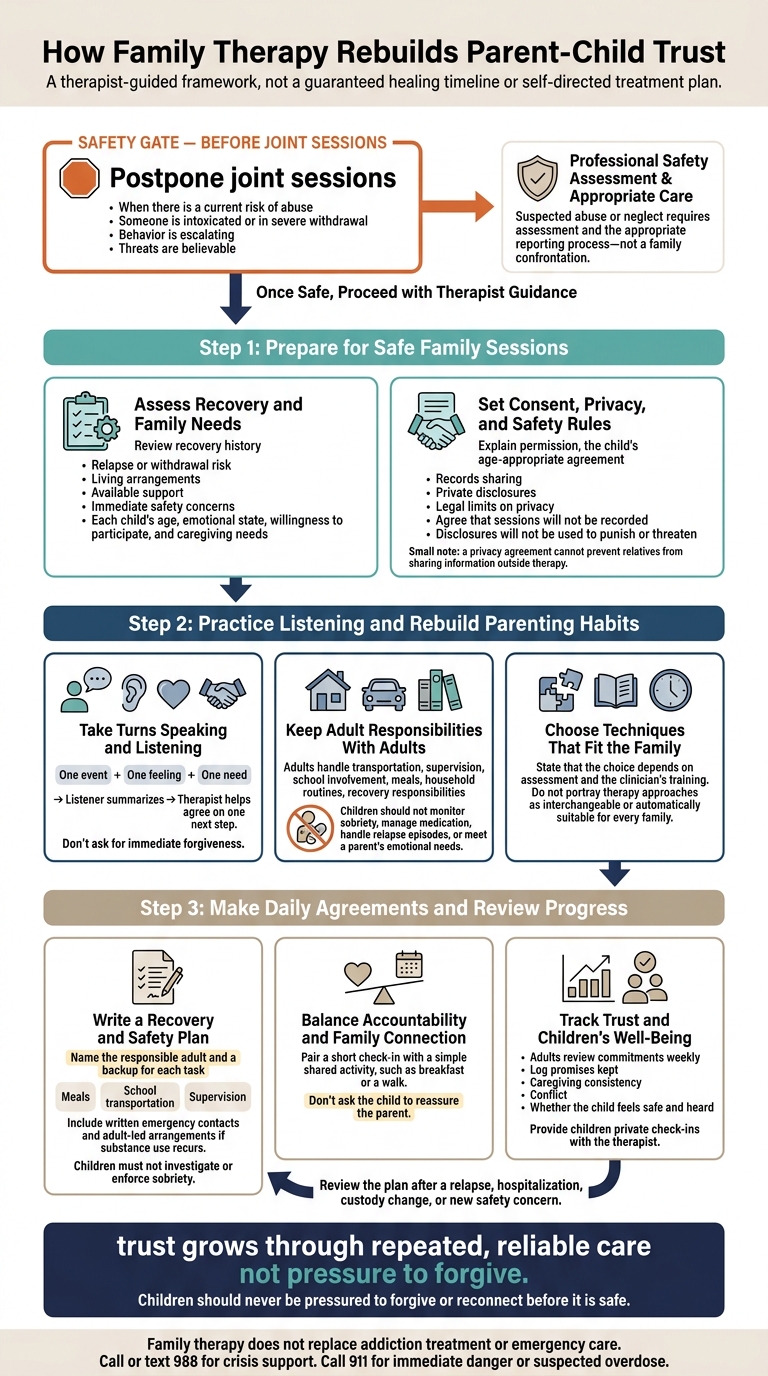
Stopping substance use is a start – not a repair plan. I’d start with 3 steps: check whether joint sessions are safe, practice listening without blame, and put daily caregiving promises in writing.
Here’s what I’d focus on with your therapist:
- Safety first: Review each child’s needs, consent, and privacy rules. Joint sessions should wait when abuse, threats, intoxication, or severe withdrawal makes them unsafe.
- ### Family systems and adult roles: Listen to the child’s feelings, take responsibility for harm, and choose therapy tools that fit the family. Children should never manage a parent’s recovery.
- Reliable follow-through: Name an adult and a backup for meals, rides, and supervision. Review commitments weekly and give children private time with the therapist.
My main takeaway: <u>trust grows through repeated, reliable care</u> – not pressure to forgive. Family therapy supports that work; it does not replace addiction treatment or emergency care. In the U.S., call or text 988 for crisis support, or call 911 for immediate danger or suspected overdose.
How Family Therapy Rebuilds Parent-Child Trust
Parenting & Family Therapy | What is Family Therapy with Stacie Marlow Badgett, LMFT
sbb-itb-596b85d
Step 1: Prepare for Safe Family Sessions
Once safety is established, check whether the family is ready to meet together and set rules for joint work.
Assess Recovery and Family Needs
Use intake to assess whether joint sessions can safely help repair trust. Before meeting together, review recovery history, relapse triggers or withdrawal risk, living arrangements, available support, and immediate safety concerns. Discuss how substance use has affected supervision, transportation, finances, housing, and caregiving.
Assess each child’s age, emotional state, understanding, willingness to participate, and relationship with each caregiver. Watch for parentified roles – adult responsibilities a child has taken on. Therapy should return those duties to adults and help rebuild trust. Match the session to each child’s needs and the parent’s ability to provide steady care.
Ask:
“What does each family member hope will change, and what would make participation feel safe?”
This assessment helps the therapist decide what the family can handle. Once readiness is clear, set privacy and safety rules before discussing sensitive topics.
Set Consent, Privacy, and Safety Rules
Before anyone shares sensitive details, explain who can give permission, how the therapist seeks the child’s age-appropriate agreement, which records are shared, and how private disclosures are handled. Explain required reporting of suspected child abuse or neglect and other legal limits on privacy. Some federally funded addiction treatment records have extra privacy protections under 42 CFR Part 2. Clear rules can reduce fear, protect children from pressure, and help family members speak honestly.
Agree that sessions will not be recorded and that disclosures will not be used to punish, threaten, or recruit relatives to take sides. Decide how to handle escalating behavior, protect privacy during video sessions, and get everyone home safely. A privacy agreement sets expectations, but it cannot stop relatives from sharing information outside therapy.
Postpone joint sessions when there is a current risk of abuse, someone is intoxicated or in severe withdrawal, behavior is escalating, or threats are believable. Address suspected abuse or neglect through assessment and the appropriate reporting process – not a family confrontation.
For a crisis, call or text 988. For immediate danger or overdose, call 911. Do not wait for the next appointment.
Step 2: Practice Listening and Rebuild Parenting Habits
Once safety is in place, the next step is to rebuild everyday communication.
Take Turns Speaking and Listening
Use the session to practice listening clearly and repairing harm.
In a therapist-guided speaker-listener exercise, one person describes one event, one feeling, and one need. The other summarizes what they heard. Then the therapist helps both agree on one next step.[6]
A hypothetical child’s statement: “I felt afraid when you missed pickup.”
The parent’s response: “You were scared and unsure whether I was coming, and that made it hard to trust me. Did I understand?”
Validate the feeling without having to agree on every detail. When apologizing, name the harm, take responsibility, and explain what you’ll change. Don’t ask for immediate forgiveness.
Keep Adult Responsibilities With Adults
Children should not monitor sobriety, manage medication, handle relapse episodes, or meet a parent’s emotional needs. Adults are responsible for restoring reliable transportation, supervision, school involvement, meals, and household routines.
Practice clear instructions, specific praise, and calm, age-appropriate consequences for behavior, not feelings. Respect the child’s privacy. Make time for regular positive attention that isn’t about recovery or school performance.
With those roles clear, choose techniques that fit the family’s needs.
Choose Techniques That Fit the Family
These approaches share communication tools, but each has a different focus. FFT, BSFT, and MDFT primarily serve adolescents. That means they aren’t automatic choices when the parent – not the child – is in recovery.[7][8]
- Functional Family Therapy (FFT): Practices respectful listening, conflict resolution, and consistent parenting responses.
- Family Behavior Therapy (FBT): Uses behavioral agreements and reinforcement to strengthen routines and help caregivers follow through.
- Brief Strategic Family Therapy (BSFT): Changes unhelpful parent-child interactions to support clearer roles and communication.
- Multidimensional Family Therapy (MDFT): Combines separate and joint sessions to address trust, parenting, and school or peer concerns.
For a parent in recovery, the therapist can use problem-solving and behavioral agreements to turn broad promises into caregiving actions the family can see. The choice of model depends on the assessment and the clinician’s training.
As these skills start working, put them into written daily agreements and use weekly check-ins to track follow-through.
Step 3: Make Daily Agreements and Review Progress
As listening improves and roles become clearer, put those gains into written daily agreements.
Write a Recovery and Safety Plan
Work with the therapist to draft a co-parenting agreement that fits the child’s age and the parent’s treatment needs. For a younger child, that might mean a predictable bedtime. For a teen, it might mean advance notice. Name the responsible adult and a backup for each task so children know what to expect. SAMHSA recommends written family resilience and emergency planning with recovery supports.
Hypothetical family agreement – not an individualized clinical or safety plan: The parent manages treatment appointments and medication storage. An adult caregiver handles meals, school transportation, and supervision when the parent is unavailable. The parent will be home by 6:00 p.m. or call the backup adult by 5:30 p.m. During rising conflict, family members use a neutral pause phrase and resume only when calm and safe. The child’s money and accounts are off-limits. The written contact sheet includes the backup caregiver, treatment team, recovery supports, and emergency services. Adults review the agreement weekly with the therapist.
If substance use recurs, adults arrange sober supervision, safe transportation, and an approved place for the child to stay. They also contact the treatment team and secure medications or substances when it’s safe to do so. A child can go to a trusted adult or an agreed safe place, but must not investigate or enforce sobriety. Follow the emergency plan immediately if anyone is in immediate danger.
Review the plan after a relapse, hospitalization, custody change, or new safety concern. Once it’s written, use brief check-ins to keep accountability separate from family connection.
Balance Accountability and Family Connection
Schedule a short check-in and one simple shared activity, like breakfast or a walk. Ask what felt good, what felt hard, and what an adult needs to handle. Don’t ask the child to reassure the parent.
Planning examples:
Situation Supportive accountability Overfunctioning or rescuing Treatment appointment is missed Parent contacts the provider and arranges the next step with adult support. Child checks attendance or makes excuses to the provider. Parent cannot drive safely Designated sober adult handles transportation and supervision. Child rides with an impaired parent or conceals the problem. School pickup is missed Adults activate the backup arrangement and correct the problem. Child covers the missed responsibility or assumes ongoing household duties.
Track Trust and Children’s Well-Being
Keep a weekly adult log of promises kept, caregiving consistency, conflict, and whether the child feels safe and heard. Write down specific observations rather than general impressions.
When a commitment is broken, the adult acknowledges its impact, fixes the problem, and updates the agreement. Steadier care and fewer conflicts don’t require immediate trust or forgiveness. Track how the family is doing and the child’s well-being – not just substance use.
Arrange private check-ins with the therapist so children can share concerns without the parent present. Persistent anxiety, nightmares, withdrawal, or school difficulties may call for an individual assessment or changes to treatment.
Conclusion: Keep Safety and Reliable Care First
The earlier steps depend on safety and steady follow-through. Keep sessions safe and private, and follow through on commitments between visits. Trust grows through repeated, reliable care – not one good session. Children should never feel pressured to forgive or reconnect before it’s safe.[6][4][5]
Family therapy does not replace emergency care, medical care, supervised withdrawal management, or addiction treatment. Active violence, coercion, intoxication, or serious child-safety concerns make joint sessions unsafe.[9][3][4][5] For immediate danger or suspected overdose, call 911.[10][11]
Ask Growth and Change Counseling About Family Therapy
For help putting these steps into practice, Growth and Change Counseling offers family therapy, parent coaching, and treatment for addiction and trauma in Campbell, San Jose, Los Angeles, and Roseville, CA. Telehealth is also available across California.[1][2]
Before scheduling, ask about the provider’s experience with addiction-related parent-child concerns, safety assessment and planning, privacy, session format, coordination with treatment, and fees. Use these questions to find an approach that fits your family’s needs.
FAQs
How long does rebuilding trust take?
Rebuilding trust has no set timeline. It takes time, patience, and steady effort from everyone involved – not grand gestures. Trust grows one interaction at a time, when honest, reliable actions match your words. That means keeping promises and communicating openly.
Growth and Change Counseling offers professional guidance through integrative, solutions-focused therapy to help families work through this healing process.
What if my child refuses family therapy?
If your child refuses family therapy, you can still move forward by working with a professional yourself. At Growth and Change Counseling, we focus on working with parents because your influence and lasting relationship with your child can help bring about change.
Parent coaching or individual sessions can help you support your child, set healthy boundaries, and build a stronger connection – even before they’re ready to join therapy.
How can we coordinate family therapy with addiction treatment?
Coordinating family therapy with addiction treatment means supporting the whole family, not just the person in recovery. At Growth and Change Counseling, parents start by sharing their concerns and laying the groundwork for support. Individual assessments for the child may follow, helping shape a treatment plan that fits the family’s needs.
Therapists blend evidence-based methods, such as Cognitive Behavioral Therapy, with spiritual principles to work through challenges, rebuild trust, and develop relational intelligence.
Related Blog Posts
- How Family Therapy Restores Trust After Addiction
- Parenting Strategies For Addiction Recovery Support
- Parenting in Recovery: Balancing Trust and Healing
- Relapse vs. Recovery: Parenting Challenges Explained
