My starting point for family conflict: agree with your spouse before saying yes to relatives. Set clear rules for visits, money, privacy, household tasks, and parenting – for example, asking for 24–48 hours’ notice before visits.
Here’s the approach I recommend:
- Understand the meaning behind each custom. Decide together what to keep, limit, or decline.
- Share the workload and the message. Agree on chores, caregiving, holidays, and religious practices. Each spouse can explain your joint decisions to their own family.
- Follow through, then check in. Discuss what worked and what needs to change.
- Get help when conflict keeps returning, such as through intensive therapy for couples in crisis. Counseling or parent coaching may help; the article also outlines California services and a 12-week couples coaching option.
Respect does not mean accepting abuse. <u>Safety comes before joint counseling</u> when threats, coercion, or violence prevent either partner from speaking freely.
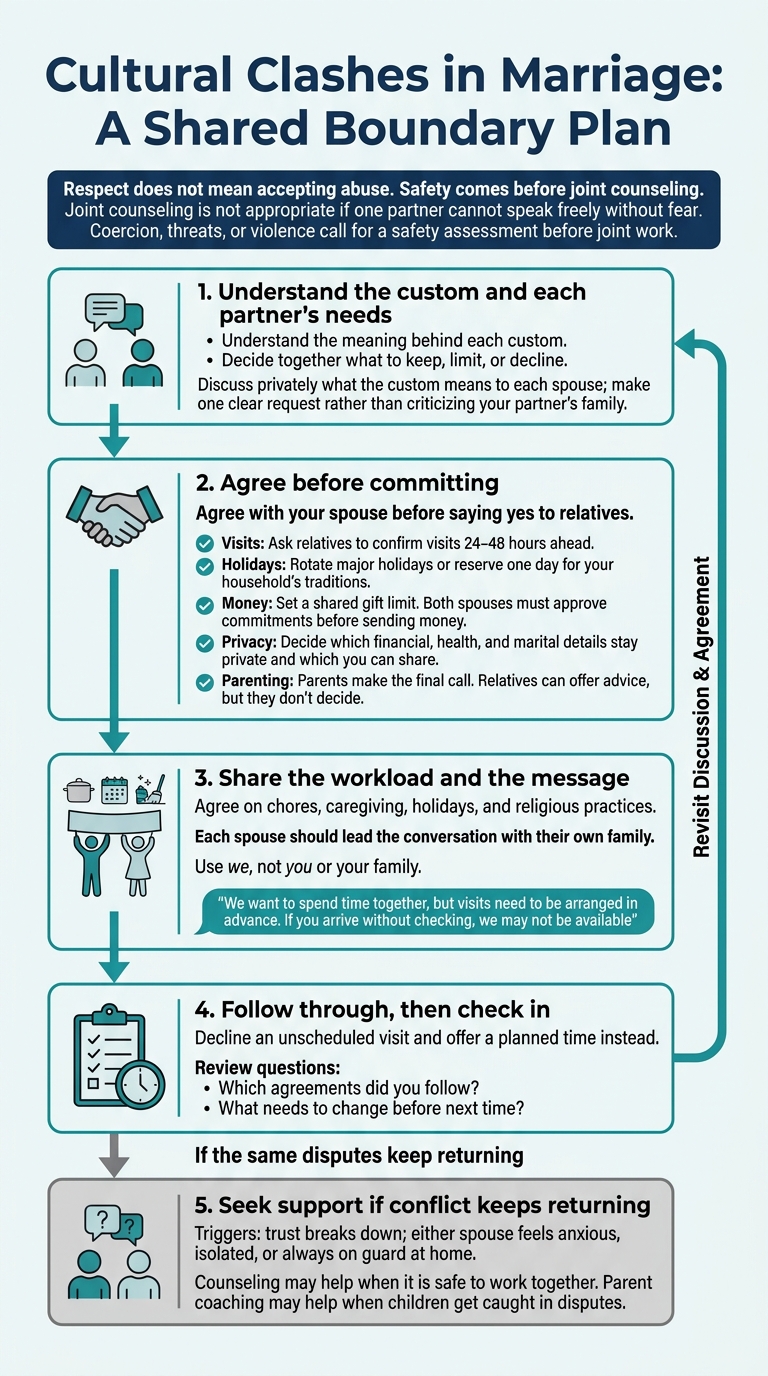
Cultural Clashes in Marriage: A Shared Boundary Plan
Boundaries, Culture, and Family: Finding Unity in Marriage
sbb-itb-596b85d
Common Conflicts With Extended Family
Treat these as possible motives, not facts. What matters is whether the couple makes decisions together. Even relatives in the same family may have different expectations.
| Conflict | Possible motive | Risk to the marriage |
|---|---|---|
| Unannounced visits or overnight guests | Closeness | Lost privacy |
| Requests for financial support | Loyalty or obligation | Financial strain |
| Sharing private marital details | Seeking wisdom | Broken trust |
Once you know where the pressure comes from, decide which issues need joint approval.
Family Involvement, Privacy, and Money
Talk about visits, privacy, and financial support before either spouse commits shared time or money. A request doesn’t require an immediate yes. Agree with each other before offering household space, funds, or private marital details. Apply the same rule to chores, caregiving, and hosting.
Communication and Household Responsibilities
Different communication styles can lead to unclear expectations about chores, caregiving, and hosting. Make the full workload visible: cooking, cleanup, scheduling, and preparing for guests.
Agree on who will take each responsibility rather than assuming certain roles are automatic obligations. Speaking with one voice makes outside pressure easier to handle.
Parenting, Religion, and Family Customs
Grandparents may have expectations that clash with your parenting choices, worship, holidays, or religious rites. Discuss each decision on its own. Liking a tradition doesn’t mean both spouses must follow it.
Agree as a couple first. Set out the parents’ decision, then communicate it to relatives with a shared message.
Set Shared Agreements and Family Boundaries
Once you’ve identified the pressure points, turn them into clear rules both spouses can follow.
Understand Each Partner’s Needs and Relational Intelligence
Give each spouse a voice while keeping the marriage’s priorities in view. Talk privately about what the custom means to each of you and the need it meets. Make one clear request rather than criticizing your partner’s family. Then decide together what to keep, limit, or decline.
Agree on Visits, Holidays, Money, and Parenting
Set specific rules instead of making general promises. Write them down so you can give relatives the same answer.
| Common conflict | Practical agreement |
|---|---|
| Unannounced visits | Ask relatives to confirm visits 24–48 hours ahead. |
| Holiday conflicts | Rotate major holidays or reserve one day for your household’s traditions. |
| Money requests | Set a shared gift limit. Both spouses must approve commitments before sending money. |
| Private information | Decide which financial, health, and marital details stay private and which you can share. |
| Parenting pressure | Parents make the final call. Relatives can offer advice, but they don’t decide. |
Explain and Uphold In-Law Boundaries
Once you agree on a rule, present it as a shared decision. Each spouse should lead the conversation with their own family. Use we, not you or your family, and state the arrangement warmly and directly:
We want to spend time together, but visits need to be arranged in advance. If you arrive without checking, we may not be available [2]
Follow through: decline an unscheduled visit and offer a planned time instead.
When to Seek Professional Support
When clear boundaries don’t stop the conflict, outside support can help change the pattern. Seek help if the same disputes keep coming back, trust breaks down, or either spouse feels anxious, isolated, or always on guard at home. If pressure is keeping you in the marriage – or you’re already considering separation – don’t wait for another crisis to ask for help.
When coercion, threats, or violence are involved, a safety assessment comes first. Joint counseling is not appropriate if one partner cannot speak freely without fear.
Counseling for Family Differences
When it’s safe to work together, counseling can help each spouse explain their needs without turning differences in family background into a fight. With guidance, partners can clarify what respect, duty, independence, and intimacy mean to them. They can then make specific agreements about visits, parenting, finances, and family boundaries.
Ask about practical homework that helps you use communication skills in daily life. Parent coaching can also help when children get caught in disputes.
For couples facing persistent family pressure, structured support can help protect the marriage while they work through conflict with the extended family.
Growth and Change Counseling in California
Growth and Change Counseling specializes in couples counseling and supports spouses from different cultures and couples dealing with extended-family conflict. The Marriage Rescue Institute offers an intensive, directive 12-week couples coaching process for serious marital conflict. Outcomes are not guaranteed.[3]
Family therapy and parent coaching are also available in Campbell, San Jose, Los Angeles, and Roseville, CA, with telehealth across California.[1][2] Contact the practice to confirm current services and discuss whether couples counseling or The Marriage Rescue Institute fits your situation.
Conclusion: Respect Differences and Decide Together
Once you’ve set shared agreements, put them to work in daily life and adjust as needed. Name the conflict that keeps coming up, discuss how each partner’s background shapes it, and choose a response you both support.
Set a boundary you can enforce, and agree ahead of time on what you’ll do if it’s crossed. A good compromise protects both partners and leaves room for family contact without accepting disrespect or unsafe behavior.
After visits, holidays, money requests, or parenting decisions, talk through what happened. Which agreements did you follow? What needs to change before next time? You don’t need identical views of family life – you need a shared response you can both stick to.
FAQs
What if my spouse won’t set boundaries with family?
Setting boundaries with extended family can be hard when loyalty, respect for elders, or family duty run deep. Talk openly and calmly about your shared goals, including how to balance family obligations with your priorities as a couple.
If you’re stuck, Growth and Change Counseling’s Marriage Rescue Institute offers intensive 12-week coaching to help restore your relationship, rebuild its base, and develop relational intelligence so you can handle family dynamics together.
How can we handle guilt over declining family requests?
Boundaries protect your relationship’s independence and health. Family pressure is common – it isn’t a personal failing. Work with your partner to set shared goals and make a clear plan for balancing family obligations with what matters to you both. Think of boundaries as protective doors, not walls: you can honor your heritage without letting harmful patterns in.
If setting those limits feels hard, Growth and Change Counseling offers couples coaching and therapy to help you establish boundaries and restore balance.
How do we explain conflicting traditions to our children?
Work as a team, balancing compassion with clear boundaries. Bring meaningful parts of both heritages into shared meals, storytelling, or holiday celebrations. These moments give you a chance to talk openly about your values and show children that customs from both backgrounds can coexist.
Growth and Change Counseling offers integrative, solutions-focused therapy to help couples work through differences between their backgrounds, agree on a shared parenting vision, and strengthen family bonds.
Related Blog Posts
- Strategies for Multicultural Parenting Challenges
- Study: Impact of Cultural Awareness on Marriage Counseling
- Marriage Therapy for Indian Families
- Managing Cultural Differences in Marriage
