If a crisis has shaken your relationship, the best next step depends on what is hurt most: daily communication, one partner’s mental health, the pattern between you, or the need for more intensive support.
Here’s the short version: start with safety and stability first. If there is abuse, active addiction, severe trauma symptoms, or fear at home, relationship repair should wait until there is proper assessment and support in place. After that, most couples fit into one of four paths:
- Structured communication and shared planning for couples who need clearer talks and a plan
- Individual therapy when one partner’s trauma, substance use, ADHD, or other symptoms are driving the strain
- Evidence-based couples therapy when the relationship pattern itself needs repair
- Intensive couples coaching when weekly sessions have not been enough or the couple needs a set process with close follow-through
A few facts stand out from the article:
- Individual and couples sessions are often about 45 minutes
- One coaching option mentioned is a 12-week format with homework between meetings
- Short-term gains can fade without follow-up
- Crisis stress can change how people react, making normal conflict tools stop working
My takeaway: don’t ask, “What is the best option for every couple?” Ask, “What problem needs attention first?”
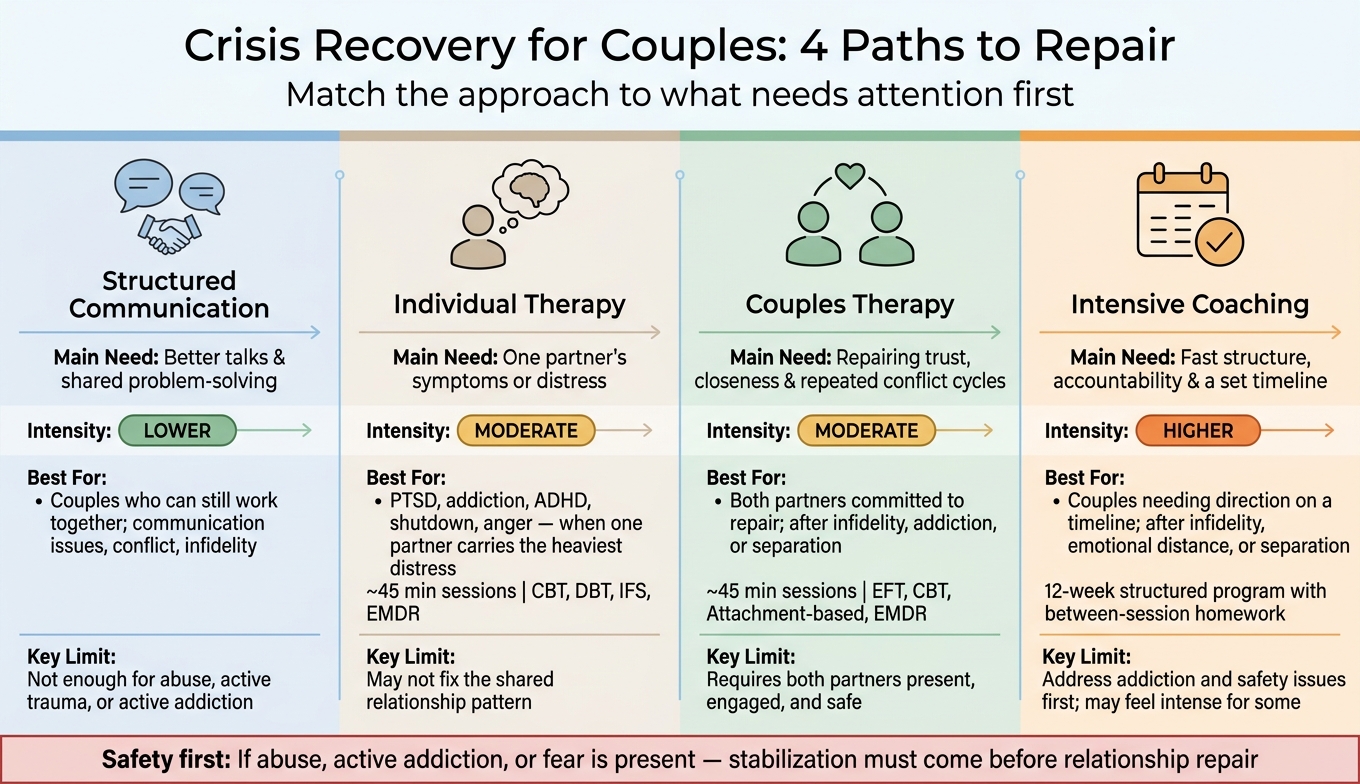
Crisis Recovery for Couples: 4 Paths to Repair
Counseling Couples in Crisis: Perspectives & Interventions from Two Different Models, Ep. 136
sbb-itb-596b85d
Navigating Crisis Recovery Options with Growth and Change Counseling
| Option | Main need | Intensity | Best fit | Main limit |
|---|---|---|---|---|
| Structured communication | Better talks and shared problem-solving | Lower | Couples who can still work together | Not enough for abuse, major trauma symptoms, or active addiction |
| Individual therapy | One partner’s symptoms or distress | Moderate | PTSD, addiction, ADHD, shutdown, anger | May not fix the relationship pattern |
| Couples therapy | Repairing trust, closeness, and repeated conflict cycles | Moderate | Both partners want repair | Needs both people present, engaged, and safe |
| Intensive coaching | Fast structure and accountability | Higher | Couples needing direction on a timeline | Can be too much if safety or addiction is not addressed first |
What this article shows, in plain terms, is simple: some couples need solution-focused tools, some need treatment, and some need both at the same time.
1. Structured Communication and Shared Crisis Planning
This approach helps couples learn clear communication, shared problem-solving, and crisis planning so they can function when stress hits. It’s the least intensive option in this set, and it’s often the first move when the relationship still has something to work with.
Primary Need Addressed
The main focus here is practical relationship skills: how to connect, handle conflict, and build a shared sense of direction. John Kane, LMFT, describes this as rebuilding practical relationship skills that support connection, conflict management, and shared purpose. [2]
Instead of treating conflict like a sign that the relationship is falling apart, this method treats it as a moment to repair connection.
Support Intensity
This is a directive approach. Sessions usually include clear exercises and homework for couples to practice between appointments. [2][3] That matters because the work tends to go best when both people can keep using the new habits outside the therapy room.
Best-Fit Couple Profile
This approach can work well for couples under crisis pressure, including neurodiverse couples, along with couples dealing with:
- communication problems
- conflict
- infidelity
- addiction
It gives both partners a shared framework for handling relationship strain. [2]
Limits and Safety
This approach has limits. If abuse, active trauma symptoms, dissociation, or severe anger are in the picture, couples usually need specialized care first before this kind of work can help. [2] And if distress stays high even after communication structure improves, individual therapy is the next step.
2. Individual Therapy for Crisis-Related Distress
Crisis strain doesn’t always hit both partners the same way. One person may be dealing with PTSD. The other may be misusing alcohol. Sometimes one partner shuts down and pulls away. When the core issue sits more with one person than with the relationship itself, individual therapy goes straight at that source.
Put simply: if one partner is carrying the heaviest distress, helping that person get steady can take pressure off the marriage and the partner supporting them.
Primary Need Addressed
Individual therapy focuses on the root of the distress, not just the fallout. Problems like addiction, ADHD, PTSD, or unresolved anger often spill into the relationship. They shape arguments, distance, and day-to-day tension. Individual therapy works on those issues so they stop running the show.
Support Intensity
Sessions are usually 45 minutes. Depending on the need, therapy may use CBT, DBT, IFS, or EMDR.[1]
Best-Fit Couple Profile
This path tends to fit best when one partner’s mental health or trauma history is driving the crisis.[4] That’s often the case when PTSD, complex trauma, addiction, or ADHD/autism sit at the center of the conflict.
Here’s the key difference: structured communication helps when a couple can still work together well enough to use it. Individual therapy helps when one partner’s distress gets in the way of that work.
Limits and Safety
On its own, individual therapy may help one partner get more stable without fixing the pattern between the two people.[2] It can also give someone a private, supportive place to speak openly when they feel unsafe at home.[4]
In more layered cases, a team-based approach is often the better move. Individual treatment can handle the personal issues, while couples work addresses the shared pattern through a common framework.[4] When both the symptoms and the relationship dynamic need repair, couples therapy is usually the next step.
3. Evidence-Based Couples Therapy
When the crisis stops being only personal and starts shaping the relationship itself, couples therapy looks at the pattern between both people. If both partners are willing to do the work, evidence-based couples therapy focuses on the shared cycle driving the crisis, not just each person’s symptoms.
Primary Need Addressed
This approach tends to fit best when a crisis has shaken trust, intimacy, or a shared sense of direction. That often happens after betrayal, addiction, or repeated conflict that keeps pulling the couple into the same fight.
Because the focus is shared, the work is practical and structured.
Support Intensity
Sessions are usually 45 minutes long. The therapist often takes a direct role, and there’s usually homework between sessions. The work may draw from EFT, CBT, attachment-based therapy, and EMDR. [2][1]
Best-Fit Couple Profile
This path fits couples who are both committed to repair, especially after infidelity, addiction, or separation when reconciliation is still the goal. [2]
Limits and Safety
This approach works best when both partners can stay present, engaged, and safe in the room. If one or both partners are dealing with PTSD, complex trauma, or other individual issues, individual therapy may need to happen alongside couples work. [4]
If active addiction or domestic abuse is part of the picture, couples therapy alone usually isn’t enough. In those cases, the work calls for specialized treatment models and careful safety planning. [4]
4. Intensive, Directive Couples Coaching
When weekly sessions just aren’t doing enough – or when a couple has already separated – intensive couples coaching can add more structure and accountability. It follows a clear process, includes specific homework, and works within a set timeline for change. Put simply, it’s built for couples who need more direction than weekly therapy can give.
Primary Need Addressed
This model targets the shared relationship pattern behind the crisis, not just the surface symptoms.
Support Intensity
Growth and Change Counseling‘s Marriage Rescue Institute uses a structured 12-week couples coaching program with between-session homework to build accountability and help couples use new skills in day-to-day life. [1][3]
Best-Fit Couple Profile
This format works best for couples who need direct accountability rather than open-ended discussion. It’s often a good match when fast structure is needed after infidelity, addiction, or emotional distance. In those moments, the pressure of the crisis can push past a couple’s usual coping skills.
The Marriage Rescue Institute also works with neurodiverse couples, including couples where one partner has ASD or Asperger’s. This often requires understanding emotional cues that differ between partners. [2]
Limits and Safety
Active addiction needs to be addressed first. Unresolved trauma or PTSD may call for individual therapy alongside coaching. The program is tailored to the couple’s needs. [2][3] Those tradeoffs set up the comparison below.
Pros and Cons of Each Recovery Approach
No single approach works for every couple. The right fit depends on the crisis itself, how safe the relationship feels, how much time people have, and whether both partners are ready to do the work. Some options are simple and fast to start. Others ask for more time, more emotional effort, or added support.
The table below shows where each approach tends to help most, where it can fall short, and when safety needs to come first.
| Recovery Approach | Advantages | Drawbacks | Safety Notes |
|---|---|---|---|
| Structured Communication & Shared Crisis Planning | Fastest, least complex entry point | May feel too rigid for couples who want a less structured style; can fall short when conflict is deeply entrenched or complex trauma is driving the pattern | Not enough for abuse, active addiction, or fear-based dynamics [4] |
| Individual Therapy | Targets one partner’s distress at the source | Does not repair the shared relationship pattern; can deepen distance if one partner disengages | Important when dissociation, acute stress, or complex trauma is present [2] |
| Evidence-Based Couples Therapy (EFT/CBT) | Best-supported option for shared repair | Can take longer and requires both partners to be willing to sit with discomfort | Trauma-informed couples work can support emotional safety when trauma is present; abuse and active addiction require separate safety planning [2] [4] |
| Intensive, Directive Couples Coaching | Fast, directive, deadline-driven | May feel intense for couples who prefer a slower, more exploratory style | Best after addiction is stabilized; severe crises need separate treatment [3] [4] |
A simple way to think about it: some approaches help a couple talk better, some help one person get steadier, and some help both people repair the pattern together. But once fear, abuse, active addiction, or severe crisis enters the picture, safety has to come before relationship repair [2] [4].
Conclusion
Sequence matters. If a couple is in the middle of an immediate crisis – disaster, displacement, grief, or job loss – stabilization needs to come first [3].
Once that crisis is under control, the next move is to deal with the issues keeping the couple stuck. In some cases, individual therapy should run alongside the relationship work so the couple has a steady base for repair.
After stabilization, shift into focused repair through evidence-based couples therapy or a structured program like The Marriage Rescue Institute. That order keeps the process practical instead of overwhelming.
Start with stabilization, then match the next step to the couple’s level of distress.
FAQs
How do we know which recovery path to start with?
Start with a candid conversation about your relationship’s history, what’s going wrong now, and where you both hope to end up. That gives you a clearer way forward based on your situation instead of forcing your relationship into a generic plan.
If your relationship feels like it’s in crisis, Growth and Change Counseling’s 12-week Marriage Rescue Institute offers a structured, personal plan to spot conflict patterns and support emotional and relational recovery.
Can we do individual and couples support at the same time?
Yes. You can get individual support and couples support at the same time.
Growth and Change Counseling offers individual therapy, and The Marriage Rescue Institute offers couples coaching. That means your care can work on two tracks at once: your own needs as an individual, and the work you and your partner are doing together to rebuild communication and trust.
When is couples work unsafe to begin?
Couples work isn’t always the right starting point. If one or both partners haven’t reached enough emotional stability or personal healing, jumping in too soon can do more harm than good.
This shows up a lot in cases involving addiction or deep relationship wounds. In those situations, individual therapy may need to come first. The goal is to build safety, help each person manage emotional reactions, and get clear guidance from a trained professional before starting conjoint work.
Related Blog Posts
- How to Create a Crisis Recovery Plan for Your Marriage
- Top Strategies for Couples in Recovery
- Addiction Recovery and Marriage: What Works
- Assertiveness and Empathy in Couples Therapy
