If one parent is in early recovery, the parenting plan should be specific, fact-based, and centered on child safety from day one.
I’d boil the article down to this: a workable plan ties parenting time to documented sobriety, treatment follow-through, safe exchanges, and clear relapse steps. It should also spell out who makes school and medical decisions, how parents communicate, and when the plan gets reviewed. In many family court settings, records matter more than promises.
Here’s the short version:
- Match parenting time to current recovery stability
- Write hard safety rules: no use before or during visits, no impaired driving, no unsafe people around the child
- Set step-up terms tied to proof, like negative tests and treatment attendance
- Plan for setbacks in writing so no one is arguing during a crisis
- Use written communication like email or a co-parenting app
- Review the plan every 30, 60, or 90 days, or after a relapse, treatment change, move, or school/health change
- Keep records such as test results, attendance logs, and visitation notes
One point stands out: many courts treat a missed drug test like a failed test, and parents coming out of inpatient care often start with supervised visits and no overnights. That makes the first draft of the agreement less about convenience and more about stability, proof, and safety.
| Area | What the plan should say |
|---|---|
| Parenting time | Exact days, times, exchange place, and backup plan |
| Recovery proof | Testing method, treatment records, and milestones |
| Safety | No-use rules, exchange rules, and what happens if a parent seems impaired |
| Setbacks | Whether visits pause, become supervised, or lose overnights |
| Decision-making | Who decides school, medical, and therapy issues |
| Communication | App or email, child-only topics, and response time |
| Reviews | Next review date and what events trigger a change |
If I were writing or reviewing this kind of agreement, I’d want one thing above all: no vague language. The more exact the plan is, the less room there is for conflict, missed visits, and child safety problems.
Assess Stability and Child Safety Before Drafting the Agreement
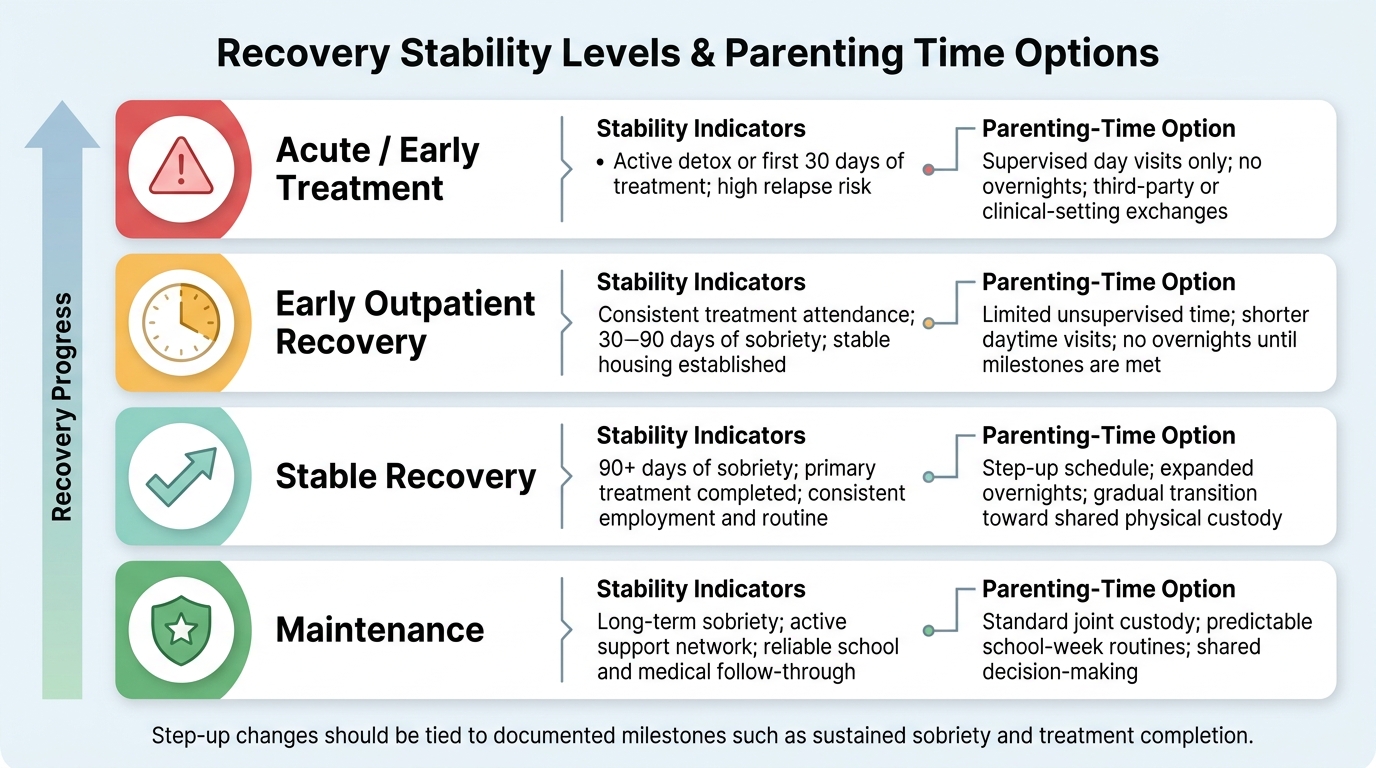
Recovery Stability Levels & Parenting Time: A Visual Guide
Before you draft the plan, look at recovery, safety risks, and day-to-day stability as they stand right now. The agreement needs to match actual conditions, not best-case hopes. That means lining up parenting time with the parent’s present stage of recovery.
Recovery Markers That Affect Parenting Time
Courts and co-parents focus on proof, not promises. Good intentions matter on a personal level, but they don’t carry much weight without records behind them. The signs that matter most are concrete and documented: verified negative drug tests, steady treatment attendance, stable housing, reliable transportation, and regular employment.
Daily parenting habits matter just as much. A parent who arrives on time for each visit, school pickup, and medical appointment – without reminders or last-minute scrambling – shows the kind of consistency a child depends on.
Courts also look beyond simple enrollment in treatment. They want to see treatment that leads to better parenting, smoother family life, and more stable daily routines.
To back up that progress, keep records such as:
- Intake forms
- Attendance logs
- Drug test results
- Counselor letters
Child Safety Rules and Clear Red Flags
Some rules aren’t up for debate. Every recovery-sensitive agreement should state them plainly: no substance use before or during parenting time, no impaired driving with a child in the car, no unsecured alcohol or drugs in the home, and no unsafe people brought into the child’s space. These need to be written into the parenting plan as firm terms.
Some actions should set off an immediate review of the plan. A positive drug test is one. A missed required test is another, since courts often treat that as a failed test. A parent taking the child without notice is also a major warning sign. The same goes for a pattern of missed treatment sessions or repeated breaches of current custody orders.
When you document concerns, stick to facts. Write down dates, times, and what you directly observed. That works far better than broad labels like “unstable.”
The agreement should also say exactly what happens if a parent appears impaired at an exchange. A clear no-exchange rule and immediate notice to legal or clinical support should be written into the parenting plan as direct triggers.
Recovery Stability Levels and Parenting-Time Options: A Comparison
As recovery shifts, parenting time should shift too. This table turns recovery stage into plain parenting-time terms. [1][4]
| Recovery Situation | Stability Indicators | Typical Parenting-Time Option |
|---|---|---|
| Acute / Early Treatment | Active detox or first 30 days of treatment; high relapse risk | Supervised day visits only; no overnights; third-party or clinical-setting exchanges |
| Early Outpatient Recovery | Consistent treatment attendance; 30–90 days of sobriety; stable housing established | Limited unsupervised time; shorter daytime visits; no overnights until milestones are met |
| Stable Recovery | 90+ days of sobriety; primary treatment completed; consistent employment and routine | Step-up schedule; expanded overnights; gradual transition toward shared physical custody |
| Maintenance | Long-term sobriety; active support network; reliable school and medical follow-through | Standard joint custody; predictable school-week routines; shared decision-making |
Step-up changes should be tied to clear milestones, such as sustained sobriety and treatment completion.
sbb-itb-596b85d
Build the Core Terms of a Recovery-Sensitive Co-Parenting Agreement
Use the recovery markers from the previous section to turn each term into a rule you can enforce. The goal is simple: say exactly what happens, when it happens, and what changes it. That means each term should include a specific action, a measurable condition, and a set timeline. Clear clauses protect the child and leave less room for arguments.
Parenting Schedule, Exchanges, and Step-Up Visitation
Start with the base parenting schedule. Put the regular days, pickup and drop-off times, and exchange locations in writing. Then add step-up visitation terms tied to named milestones, not general progress. For example: "After 90 days of documented negative testing and consistent attendance at outpatient sessions, daytime visits expand to include one overnight per week." [1] That clause works because the trigger is easy to check.
Write exchange logistics as a separate paragraph. State who handles transportation, where the main exchange takes place, what backup location will be used if needed, and whether a neutral third-party exchange site is required. When these details are fixed in advance, parenting time is less likely to fall apart over last-minute conflict.
Once the exchange terms are set, add the sobriety and response rules that determine whether parenting time continues as scheduled.
Sobriety Clauses, Monitoring, and Relapse Response
State the sobriety requirement before parenting time in direct language. Then name the testing or monitoring method the parents will use.
| Monitoring Method | Reliability | Intrusiveness | Common Use Case |
|---|---|---|---|
| Urinalysis (UA) | High (Recent use) | Moderate | Regular, random monitoring for recent sobriety |
| Hair Testing | High (Long-term) | Low | Proving sustained abstinence |
| Supervised Visits | Very High | High | Early recovery or cases with high safety risks |
| Trusted Adult Supervision | Moderate | Low | Transitioning to more frequent, less formal visits |
Write the relapse-response section in plain, non-judgmental language. If a parent has a positive test or misses a test, the agreement should say what happens next, such as a shift to supervised visits or a pause in overnights. Then state the return criteria ahead of time. That way, the path back to the regular schedule is already written down instead of being argued in the middle of a crisis.
Decision-Making, Household Rules, and Communication Methods
After safety and scheduling, spell out who decides medical, school, and therapy issues. Decision-making authority – who has the final say on school enrollment, medical treatment, and mental health services – should be stated directly. Vague wording often leads to stalemates. While the agreement sets the rules, family therapy restores trust by addressing the underlying emotional damage caused by addiction. When recovery is unstable, clear decision rules help avoid delayed care and repeat conflict.
Household rules should be specific enough that both homes follow the same basic expectations for the child. Emergency procedures should also be written down so neither parent is making it up on the spot.
Written communication rules should reduce conflict and leave a record.
| Method | Documentation Value | Conflict Risk | Ease of Use |
|---|---|---|---|
| Co-Parenting Apps | Excellent (court-admissible logs) | Low | High (Centralized) |
| Good | Moderate | High | |
| Text Messaging | Moderate | High | High (Too immediate) |
| Face-to-Face | Poor | Very High | Low (In recovery) |
Use co-parenting apps or email for written communication and limit exchanges to child-related topics only. [1] Set a response window and a no-nonurgent-messages cutoff, such as 8:00 PM. [1]
Use Legal and Clinical Support to Make the Plan Work
Once the schedule, sobriety terms, and communication rules are on paper, legal review and clinical support help the plan work in day-to-day life. A parenting plan needs both. The legal side sets the limits. Therapy and coaching help parents stay within those limits when things get hard.
What Courts and Attorneys Typically Need to See
Courts look for a paper trail, not just proof that someone signed up for treatment. Treatment records, drug test results, visitation logs, and proof of housing or income all help support the parenting schedule, sobriety terms, and step-up changes already built into the plan. When setbacks happen, records matter more than explanations. A notice showing a rescheduled appointment or a re-entry plan from a treatment provider usually carries more weight with the court than trying to explain it later.
Documentation helps in court. Therapy helps parents follow the plan at home.
How Therapy, Family Work, and Parent Coaching Can Help
A family therapist can work on the emotional patterns and family resilience in addiction recovery that make it harder to follow the plan. A parent coach can help build steady routines and cut down conflict during exchanges, decision-making, and rule enforcement [6]. They may also provide brief progress letters for court [4].
Growth and Change Counseling offers family therapy, parent coaching, and addiction-related support, with telehealth available across California. These services can also make later updates smoother when a child’s needs shift or a parent’s recovery changes.
Review, Revise, and Maintain the Agreement Over Time
Once the plan is in place, compare it against the same records used to build it. In early recovery, a parenting plan isn’t something you write once and forget. It’s a working document that should change as sobriety, parenting demands, and a child’s needs shift.
When to Update the Agreement
In early recovery, review the plan every 30, 60, or 90 days, or sooner after a major change. A neutral mediator or parenting coordinator can help keep those check-ins calm and on track [1][5].
Review the agreement right away if any of the following happens:
| Trigger Category | Specific Event |
|---|---|
| Recovery | Relapse, completion of rehab, or missed counseling or therapy sessions [3][7] |
| Parenting | Relocation, change in work hours, or inability to follow the current schedule [5] |
| Child Well-being | New school, change in health status, or signs of emotional distress [5][6] |
| Safety | Substance use in the home, domestic violence, or neglect [2] |
Use the same records behind the plan to decide whether parenting time should increase, stay the same, or scale back for a period. Treatment records, drug test results, and communication logs matter here. They show patterns, not guesses.
If a parent’s stability improves, those records can support more parenting time. If there’s a setback, they can also guide a measured response, such as a temporary move to daytime-only or supervised visits [1][4].
After each update, put the change in writing and set the next review date. Email or a co-parenting app can help keep the record clear and time-stamped [1][3]. If parenting time changes in a major way, file it for court approval so it remains legally enforceable [1][5].
Conclusion: Keep the Plan Specific, Safe, and Child-Centered
Strong early-recovery agreements do four things. They set clear parenting schedules, match parenting time to documented recovery stability, spell out sobriety and relapse-response terms in writing, and keep a steady paper trail. Therapeutic support through family therapy, parent coaching, or addiction-focused care can help parents stick with the plan when things get tough.
No agreement covers every situation. But a plan built around a specific schedule, clear safety rules, and a regular review cycle gives both parents a practical path forward. Trust can grow alongside recovery, one documented step at a time.
FAQs
How do I prove sobriety in a parenting plan?
Prove sobriety with objective, verifiable records that show a steady pattern of safe behavior. In most cases, courts want more than personal statements about recovery.
That proof can include:
- formal drug or alcohol testing
- treatment records
- support group attendance
- mental health compliance
- proof of stable housing or employment
- records showing reliable visitation and proper caregiving
Step-up provisions can also link more parenting time to documented sobriety milestones.
What happens after a missed drug test?
A missed drug test is often treated as a serious issue because it leaves a big question mark around a parent’s sobriety. In some jurisdictions, refusing a court-ordered test may even be treated as an admission of substance abuse.
If you miss a test for a legitimate reason, document it right away, ask about other testing arrangements, and keep thorough records. Also stay in close contact with your legal counsel and the relevant authorities.
When can supervised visits become overnights?
Supervised visits can shift to overnights when a parent in recovery shows steady stability over time. In most cases, that change doesn’t happen all at once. It tends to move in stages, starting with supervised visits in neutral places and then moving into unsupervised parenting time.
These changes are often tied to documented stability, agreement between both parents, and court approval when needed. In some cases, a parent also has to ask the court to formally update the visitation schedule.
Related Blog Posts
- Ultimate Guide to Co-Parenting in Recovery
- How Relapse Impacts Co-Parenting Dynamics
- Balancing Sobriety Goals with Parenting Duties
- Addiction Recovery and Co-Parenting: Comparison
