Parenting during recovery is challenging but not impossible. The Bible provides guidance to help rebuild trust, heal emotional wounds, and create a nurturing home. Here are seven principles that can help families navigate this journey:
- Rely on God’s Strength: Trust in God’s guidance through prayer and faith, rather than relying solely on your own efforts.
- Practice Forgiveness: Let go of past hurts and embrace forgiveness as a step toward healing.
- Rebuild Trust with Honesty: Be transparent and accountable to restore trust over time.
- Show Unconditional Love: Love without conditions, echoing the grace God shows us.
- Set Healthy Boundaries: Establish clear, loving boundaries to create a structured and safe environment.
- Engage in Family Prayer: Strengthen bonds through shared prayer and spiritual growth.
- Seek Faith-Based Support: Lean on church communities and Christian counseling for guidance and encouragement.
These principles focus on transformation through faith, honesty, and love, offering a path to recovery for both parents and children.
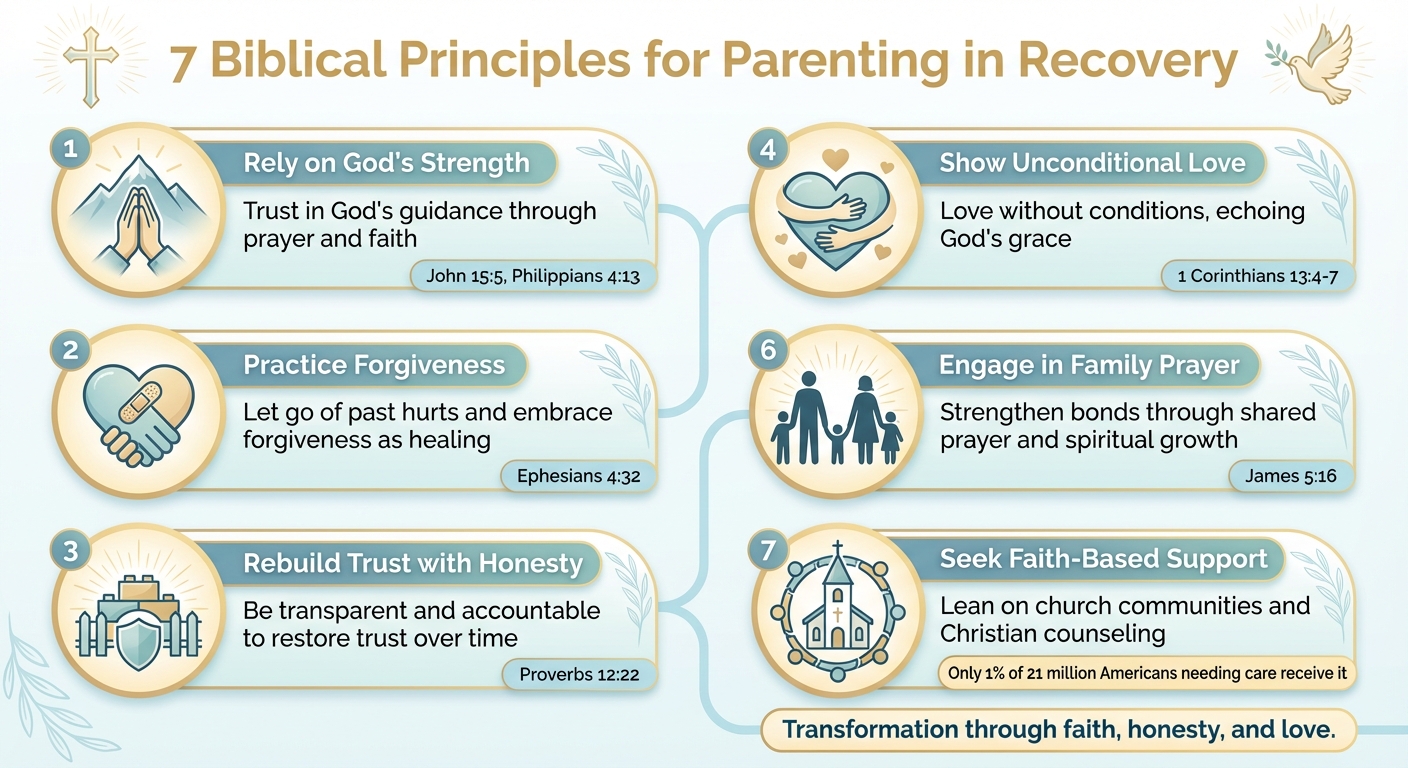
7 Biblical Principles for Parenting in Recovery
There Is No Recovery Without Prayer with Rick Warren
1. Rely on God’s Strength and Guidance
Recovery is no small task, and it demands more than sheer willpower. The daily challenge of rebuilding trust while tending to your children’s emotional needs can quickly reveal the limits of human strength. Bryan Gaines from the Center for Biblical Counseling & Discipleship puts it beautifully:
"Apart from Christ, we can do nothing (John 15:5), but in and through Christ we can do all things (Philippians 4:13), which includes parenting with all its joys and difficulties." [7]
This perspective shifts the focus from self-reliance to leaning on God’s strength. It’s not about achieving perfection – it’s about recognizing the true source of your power. Your worth isn’t tied to your child’s behavior or achievements; it’s rooted in God’s unwavering acceptance. While you are called to teach, guide, and model faith, the ultimate outcome rests between your child and God.
To tap into this divine strength, make prayer a daily habit. Prayer isn’t just a fallback for emergencies – it’s a lifeline. In moments of stress, exhaustion, or tough decisions, take a pause. Acknowledge God’s presence and invite Him into the moment. This simple act can calm your heart and refocus your mind.
Incorporating faith into daily life can also strengthen your reliance on God. Family worship – whether through prayer, reading Scripture together, or singing – helps weave faith into the fabric of your home. Likewise, staying connected to a local church community provides accountability and support. This isn’t about projecting an image of perfection; it’s about demonstrating humility and a reliance on God’s grace.
2. Practice Forgiveness as a Foundation for Healing
Forgiveness plays a vital role in rebuilding trust and mending relationships within families, especially when addiction has caused deep emotional wounds. It’s a cornerstone of recovery, rooted in biblical principles. When addiction disrupts a family, guilt and hurt often linger – parents may carry the weight of regret, while children may struggle with pain. Yet, the Bible offers a powerful reminder in Ephesians 4:32: "Be kind and compassionate to one another, forgiving each other, just as in Christ God forgave you." This verse serves as a guide, encouraging families to embrace forgiveness as a path to healing.
In biblical terms, forgiveness means canceling a debt – letting go of what others "owe" you, just as God has done for us through Christ. This doesn’t mean ignoring the hurt or pretending it never happened. Instead, it’s about releasing the grip of past wrongs. As Christian life coach Sunshyne Gray explains:
"Choosing to forgive someone and release them into God’s hands is the most healing thing we can do and gives us personal freedom from the offense." [8]
It’s important to note that forgiveness and reconciliation are not the same. Forgiveness is a personal act of obedience to God, while reconciliation is a two-way process that takes time and mutual effort.
Studies have shown that forgiveness has tangible benefits, not just spiritually but emotionally. It can strengthen relationships, improve mental well-being, and bring a sense of peace. On the flip side, holding onto resentment can be toxic, affecting both the mind and soul. [9][11]
However, forgiving doesn’t mean immediately restoring trust. Healthy boundaries are essential for protection and growth. By practicing forgiveness while maintaining these boundaries, you reflect the grace God has shown you and set an example for your children. This act of grace can help break cycles of dysfunction, offering hope for future generations. [10]
3. Rebuild Trust Through Honesty and Accountability
When addiction has damaged trust within a family, repairing it takes more than words – it requires consistent, honest actions. Proverbs 12:22 offers a clear perspective: "Lying lips are an abomination to the Lord, but those who act faithfully are his delight." This verse emphasizes that honesty isn’t just a virtue; it’s a necessity for rebuilding what’s been broken. It’s the cornerstone of any effort to restore trust.
Trust isn’t rebuilt overnight or with dramatic gestures. As the Baltimore Therapy Center explains, "Trust is built with consistent actions – brick by brick – not with grand gestures." It’s the small, everyday displays of honesty that truly matter. Being truthful, even in uncomfortable or seemingly insignificant situations, shows your family that they can rely on you again. Avoiding "lies of omission" is equally important – concealing the truth, no matter how small, can undermine progress and reopen wounds.
Accountability goes hand-in-hand with honesty. This means acknowledging past mistakes without excuses and taking steps to be transparent moving forward. Practical measures like sharing your location, providing access to your phone or email, or being open about finances can help eliminate secrecy. It might also involve confessing past wrongs to your family, seeking their forgiveness, and demonstrating a sincere commitment to change. Jill Savage, author and speaker, wisely notes, "You can be honest without being mean", reminding us that honesty should come with humility and respect.
Restoring trust is a gradual process, built on repeated actions that align with your words. It’s normal for your family to feel skeptical at first – acknowledge their feelings instead of becoming defensive. Regular check-ins, using "I" statements to calmly express emotions and progress, can help rebuild the connection. Trust takes time, but consistent honesty and accountability can lay the groundwork for healing.
4. Show Unconditional Love and Grace
Unconditional love is the cornerstone of healing and recovery within a family. While recovery tests every relationship, love that knows no conditions serves as the unshakable foundation that keeps everything intact. First Corinthians 13:4-7 offers a timeless guide to this kind of love: "Love is patient, love is kind. It does not envy, it does not boast, it is not proud. It does not dishonor others, it is not self-seeking, it is not easily angered, it keeps no record of wrongs. Love does not delight in evil but rejoices with the truth. It always protects, always trusts, always hopes, always perseveres." These words provide a framework for navigating parenting during tough times.
Tim Brown, Executive Director of His Steps Ministries, offers a simple yet profound reminder: "I’ve found it beneficial to lower our expectations and increase our love" [1]. This doesn’t mean excusing harmful behavior but rather affirming your child’s inherent worth as a child of God. Their identity is rooted in God’s love, not in their actions. Parenting from this perspective aligns with what Tim Kimmel calls "grace-based parenting", which allows children the freedom to be themselves – flaws and all – without fear of losing your love [5]. This kind of love creates a foundation for daily acts of grace that can transform your relationship.
So, how can unconditional love show up in everyday life? Start with compassionate curiosity instead of rushing to judgment when your child misbehaves. Ask thoughtful questions to uncover what might be driving their actions – stress, fear, or even pain [12]. Take time to learn how your child uniquely feels loved [5]. Use ordinary moments to remind them of God’s presence and their immense value in His eyes [6][7].
Equally important is modeling grace in your own life. Be honest about your struggles – whether it’s admitting anger or seeking forgiveness – and show how God’s mercy applies to everyone, including yourself [12]. Paul Tripp captures this beautifully: "Parenting is not first about what we want for our children or from our children, but about what God in grace has planned to do through us in our children" [6]. When your children see you living out the gospel – handling setbacks, asking for forgiveness, and extending grace – they begin to understand what unconditional love truly means.
Unconditional love doesn’t just heal; it transforms. It creates a sense of emotional safety that allows family bonds to grow stronger. This kind of love moves beyond "earned affection" and mirrors the compassion Christ showed us, even at our lowest points [12]. By embodying this grace-filled presence, you reassure your children that no matter the challenges recovery brings, they are cherished, valued, and never alone.
If you’re looking for additional guidance in applying these principles, Growth and Change Counseling offers parent coaching and family therapy. Services are available in Campbell, CA; San Jose, CA; Los Angeles, CA; Roseville, CA; and through telehealth across California. They’re here to help you build a home grounded in love and grace.
sbb-itb-596b85d
5. Teach and Model Healthy Boundaries
After trust is rebuilt, setting clear boundaries becomes essential for strengthening the family’s renewed foundation. Boundaries play a key role in the recovery process, offering structure and clarity for everyone involved. Galatians 6:5 reminds us that "each will have to bear his own load," emphasizing the importance of distinguishing between a parent’s responsibility to guide and a child’s accountability for their responses.
"As parents, we are responsible for the training; the child is responsible for his response to the training."
– Sherry Allchin, Founder, Biblical Counseling Center [4]
Boundaries create a safe, structured environment that fosters spiritual growth. Dr. Ron Allchin explains it well: "It is a loving decision to set Biblical boundaries for the addict. Certain behaviors are unacceptable and must be addressed graciously and firmly. Standards for living in the home are for all." [3] These boundaries aren’t just for children – they apply to everyone in the household, including parents who are also in recovery. When parents model obedience to God’s authority, children see firsthand how boundaries are a natural and necessary part of living a godly life.
Putting boundaries into practice requires intentional steps. For example, consider drafting a written agreement that outlines expectations for accountability, household contributions, and acceptable behavior. Financial boundaries are also important. These might include restricting access to shared accounts or setting a fixed cash allowance. These "fences" help the family rebuild spiritual and emotional strength. If boundaries are crossed, consequences should be enforced with love and a focus on growth, rather than out of frustration or anger.
The goal isn’t to control your child’s every move indefinitely. Instead, as Sherry Allchin notes, "Children who feel safe and protected within structured boundaries are free to develop as God designed each of them in all spheres of their life." [4] Healthy boundaries provide the foundation for moral growth, helping children learn to distinguish right from wrong and make better choices. Over time, as your child demonstrates responsibility, you can begin to loosen those controls. Ultimately, while you guide your child’s spiritual journey, their relationship with God is a personal one.
If you’re looking for additional guidance in setting boundaries or navigating the complexities of parenting during recovery, consider connecting with Growth and Change Counseling for family therapy and parent coaching services tailored to your needs.
6. Engage in Prayer and Spiritual Growth as a Family
Prayer can be a powerful tool for families navigating recovery, acting as a means to address deep-rooted issues like pride and bitterness while fostering healing and restoration[14]. With over 18.5 million Americans struggling with addiction[15], families often need strength that goes beyond their own capabilities. The focus should shift from seeking "horizontal" peace – dependent on the behavior of the person in recovery – to "vertical" peace that relies on a connection with God[3]. As James 5:16 reminds us, "The prayer of a righteous person is powerful and effective."[36] This perspective encourages families to embrace daily spiritual practices.
To cultivate this spiritual connection, incorporate both situational prayer and structured worship[7]. Situational prayer involves acknowledging God’s presence in everyday moments – whether during decisions, moments of anxiety, or times of gratitude. Structured worship, on the other hand, includes scheduled family devotions that combine prayer, reading Scripture, and singing worship songs[7]. Jonathan Edwards beautifully described this idea:
"Every Christian family ought to be as it were a little church, consecrated to Christ, and wholly influenced and governed by His rules."[7]
Keep things manageable by introducing a daily prayer focus. For instance, dedicate Sundays to praying for "Overflowing Love" or Fridays to "Righteous Character."[13] Bedtime can also become a consistent moment for Bible reading and prayer, offering children a sense of spiritual comfort and security[5]. Reading about 3.25 chapters each day will allow your family to complete the Bible in a year[7]. You might also consider incorporating physical expressions of humility, like kneeling during family prayer, as a way to symbolize submission to God’s authority[13].
Praying Scripture over your family helps shift attention from life’s chaos to God’s promises, creating a sense of peace and purpose[13]. Instead of general prayers, use specific verses to guide your requests. For example, Philippians 1:9–11 can inspire prayers for your family’s love to “overflow more and more.” Focus on recovery-related virtues, such as forgiveness (Colossians 3:13), wisdom in conflict (James 1:5), and humility (Proverbs 16:18)[14]. This practice brings a “peace that surpasses understanding,” helping guard hearts and minds against the stress often present in recovery[14]. Over time, these intentional prayers can strengthen family bonds and build resilience for the journey ahead.
7. Seek Support from Faith-Based Resources
No one should face recovery alone. The church community can be a source of both spiritual and emotional strength during challenging times. As Robert Jones, Professor and Chair of Biblical Counseling at The Southern Baptist Theological Seminary, emphasizes:
"You need the spiritual and emotional support the Lord wants to give you through His body, through brothers and sisters who ‘rejoice with those who rejoice; mourn with those who mourn.’"[2]
Reaching out for help isn’t just wise – it aligns with biblical principles for navigating crises. Start by turning to your church community for guidance.
Share your struggles with church leadership. Pastors, elders, and deacons can offer prayer, biblical wisdom, and practical advice[16]. Many churches are also connected to recovery programs like Celebrate Recovery[18], which provide a safe and supportive environment for spiritual growth and accountability. These programs are often free and bring together people who understand the challenges of addiction.
For more in-depth support, consider working with a Christian counselor who focuses on the spiritual aspects of addiction. In California, Growth and Change Counseling offers family therapy and parent coaching that blends Christian faith with evidence-based psychological approaches. Led by John Mark Kane, LMFT, this practice provides services both in-person and via telehealth across the state, with offices in Campbell, San Jose, Los Angeles, and Roseville. They even offer a free initial consultation to discuss your family’s specific needs, ensuring a tailored approach to healing.
It’s a sobering fact that only about 1% of the 21 million Americans who need specialized care actually receive it[18]. Don’t let your family be part of that statistic. Whether through free church-based programs, reduced-cost services from organizations like Catholic Charities and The Salvation Army[18], or professional Christian counseling, there are resources available to support your family on this journey to recovery.
Conclusion
Recovery parenting is about transformation through God’s grace, not achieving perfection. The principles we’ve explored – leaning on God’s strength, practicing forgiveness, fostering honesty, offering unconditional love, setting healthy boundaries, prioritizing family prayer, and seeking faith-based support – lay a strong foundation for healing and resilience in the face of life’s challenges.
At its core, addiction is a spiritual struggle. Dr. Ron Allchin emphasizes this truth:
"Any addiction is loving and worshipping that substance or behavior more than he loves God. An addiction must be replaced with a genuine, growing love and obedience to God if the change is to be lasting." [3]
This perspective reminds us to keep God at the center of our lives, paving the way for meaningful recovery through both spiritual and communal support.
In addition to faith, community and professional guidance are essential. Your church, pastors, and small groups can offer spiritual encouragement and accountability. Programs like Celebrate Recovery provide a welcoming space where others truly understand your journey. For deeper healing, professional Christian counseling can help you uncover and address underlying issues. As John Kane, LMFT, explains:
"The more relationally healthy people are, the less anxious, addicted, and depressed they are." [17]
For families in California, Growth and Change Counseling offers parent coaching and family therapy that blends Christian principles with evidence-based methods. Services are available in Campbell, San Jose, Los Angeles, Roseville, and statewide via telehealth.
Don’t wait for a crisis to seek support. Whether through your church, a recovery program, or professional counseling, taking that first step is an act of faith and courage – one that honors both God and your family’s well-being.
Your Path to Healing with Growth and Change Counseling
How can I include prayer in my family’s daily life in a meaningful way?
Incorporating prayer into your family’s daily life can deepen faith and create a stronger bond among family members. One way to begin is by dedicating a specific time each day for prayer – whether it’s during meals, at bedtime, or as part of family devotions. Making it a consistent practice helps integrate prayer into your routine naturally.
To make these moments more meaningful, consider tailoring prayers to your family’s unique needs by including Scripture. For instance, you might pray Psalm 4:8 to seek peace or Philippians 1:9–11 to encourage love and personal growth. This approach not only strengthens faith but also provides a comforting space to seek God’s guidance during challenges. By demonstrating prayer as a heartfelt and regular practice, you can cultivate a spiritually centered and connected family environment.
How can I rebuild trust with my children while in recovery?
Rebuilding trust with your children during recovery is a journey that calls for patience, consistency, and a strong commitment to principles rooted in faith. It’s important to recognize that trust isn’t something that can be mended overnight – it requires time and steady effort. A key step in this process is forgiveness. While forgiveness doesn’t automatically restore trust, it lays the groundwork for healing and reconciliation to begin.
Another essential part of rebuilding trust is establishing healthy boundaries. This means being clear about expectations and consistently demonstrating accountability in your actions. Trust grows when your words and actions align over time. It’s also important to be patient – not just with your children but with yourself as well. Healing and growth take time, and creating space for that process is crucial.
Throughout this journey, lean on prayer and seek guidance from God. Faith can provide the strength and hope you need as you and your family work together to rebuild the trust that binds you.
Why are healthy boundaries important for families during recovery?
Healthy boundaries play a crucial role for families navigating recovery, offering a foundation for trust and healing. They establish a safe and supportive space, helping to avoid destructive patterns like enabling, codependency, or emotional detachment – behaviors that can hinder progress. Clear boundaries encourage mutual respect, minimize conflicts, and create a sense of stability that’s essential during this process.
Beyond that, boundaries support personal growth by fostering self-awareness and independence while preserving dignity and self-respect. They also enhance communication and accountability, both of which are vital for long-term recovery and stronger family connections. In essence, healthy boundaries provide the framework families need to rebuild trust and move forward together.
Related Blog Posts
- Parent Coaching with Faith in Addiction Recovery
- Ultimate Guide to Co-Parenting in Recovery
- What the Bible Says About Discipline and Boundaries
- Biblical Solutions for Addiction in Marriage
