I’d focus on respect and clear agreements – not on changing my spouse’s beliefs. Start with one faith-related conflict, agree on household boundaries, and set aside 20 minutes each week to check in.
Here’s the approach I recommend:
- Talk without pressure. Explain what matters to you, listen, and accept that your spouse may disagree.
- Write down shared decisions. Cover children’s religious education, worship, holidays, and household duties while leaving room for private faith practices.
- Protect time together. Make space for your marriage, not just church commitments.
- Get help when needed. Seek counseling for repeated conflict, but choose confidential safety support if there are threats, control, or fear.
My bottom line: agreement on every belief isn’t the goal. Freedom of belief, shared responsibility, and safety come first.
When You’re on Different Spiritual Levels in Marriage – How to Grow Together
sbb-itb-596b85d
Talk About Faith Without Criticism
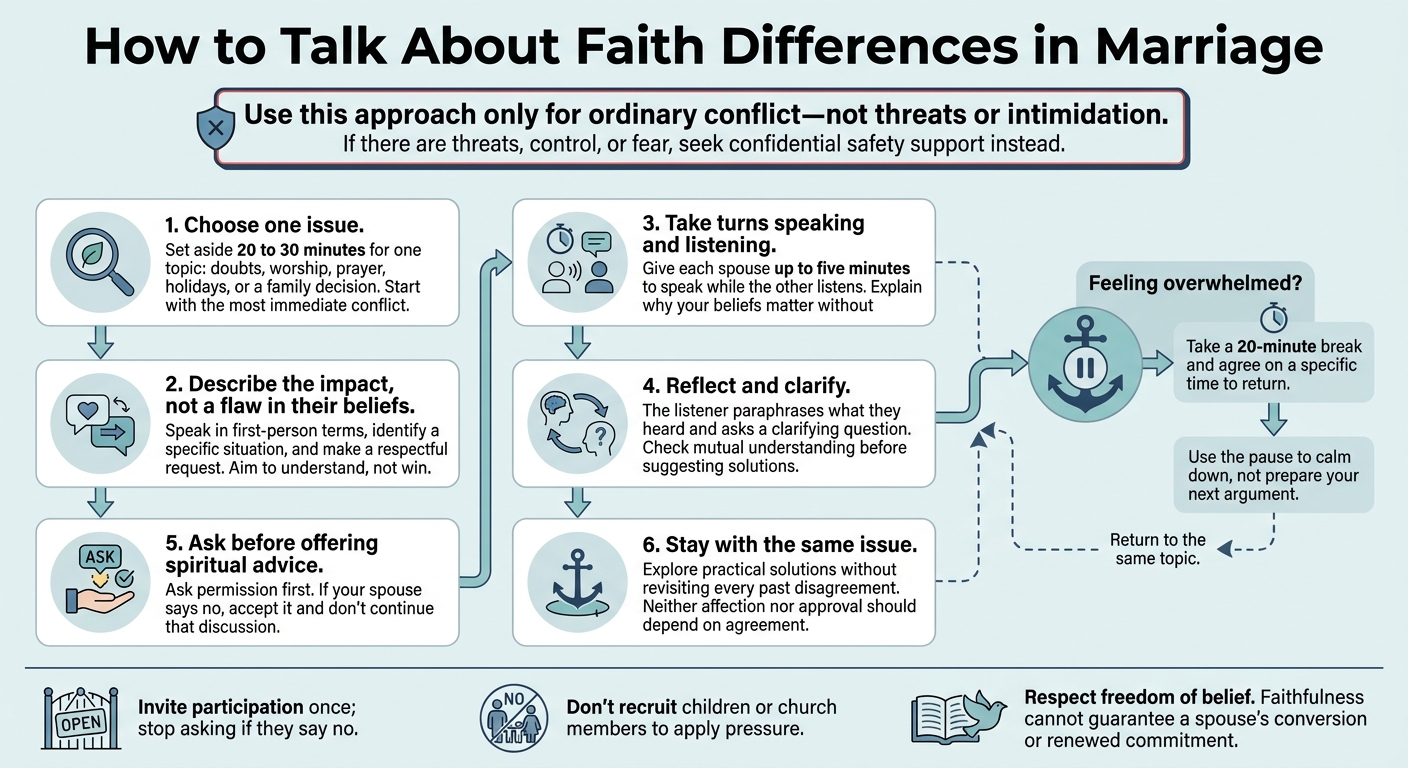
How to Talk About Faith Differences in Marriage
Address a specific behavior or its impact rather than judging your spouse’s faith. Describe what affects you, not what you think is wrong with their beliefs. Speak in first-person terms, point to a specific situation, and make a respectful request. Aim to understand each other, not win an argument. Keep that respectful tone as you work through one issue at a time.
Share Your Beliefs Without Pressure
Explain why your beliefs matter to you. Invite your spouse to participate once, and stop asking if they say no. Don’t recruit children or church members to pressure them. Humility means looking at your own words and actions while respecting your spouse’s freedom of belief. Focus on what you can control, and leave the rest to God.
You can choose kindness, integrity, and consistency in practicing your faith. Your faithfulness cannot guarantee your spouse’s conversion or renewed commitment. Accepting that limit doesn’t mean hiding your convictions. It means sharing them without making affection or approval depend on agreement. This leaves room to discuss practical agreements without turning them into a test of belief.
Discuss One Faith Issue at a Time
Set aside 20 to 30 minutes for one topic, such as doubts, worship, prayer, holidays, or a family decision. Start with whatever is causing the most immediate conflict. Give each spouse up to five minutes to speak while the other listens. The listener then paraphrases what they heard and asks a clarifying question. Check that you understand each other before suggesting solutions. Ask permission before offering spiritual advice. If your spouse says no, accept it and don’t continue that discussion.
If either of you feels overwhelmed, take a 20-minute break and agree on a specific time to return. Use the pause to calm down, not prepare your next argument. When you return, stay with the same topic instead of revisiting every past disagreement. Use this approach only for ordinary conflict—not for situations requiring professional marriage counseling – not threats or intimidation.
Agree on Parenting, Worship, and Time Together
After naming the disagreement, work out what it means for daily routines, household rules, and your calendar.
Put Parenting and Faith Agreements in Writing
Turn the main conflict into a one-page household agreement. Separate core convictions from flexible preferences. Baptism may be a core conviction; choosing a congregation may be a preference. Name shared goals, such as bringing up honest, compassionate children.
Spell out which decisions require both parents’ consent, including religious schooling, children’s regular worship attendance, and baptism or another faith milestone. Cover transportation, costs, and who will explain boundaries to relatives.
Keep children out of adult disagreements. Don’t criticize the other parent’s beliefs, ask children to take sides, or make them carry messages.
The examples below show how to turn broad disagreements into agreements you can follow at home.
Hypothetical examples – not universal rules
Marriage decision Possible agreement Boundary Children’s worship attendance Children attend one service twice a month; either parent may opt out. Revisit after three months. Neither parent takes the children without the other’s consent. Prayer at home The believing parent may pray and invite participation without pressure. Children must not be threatened with divine punishment for declining. Religious education Compare programs together and require mutual consent before enrollment. A parent enrolls the child without consent or shuts down discussion.
Review the plan every six months and as children mature. Leave room for their questions and changing preferences. Give your time as a couple the same care you give these written agreements.
Balance Church Commitments and Couple Time
Put church duties, childcare, meals, and housework on the same calendar. Church commitments shouldn’t automatically leave the other spouse carrying the household load. Agree on responsibilities before accepting new roles, and review the workload monthly. Keep individual devotional habits separate from shared commitments unless you both agree otherwise.
Schedule one phone-free meal each week and one shared outing twice a month. Pick something you both enjoy, such as walking, cooking, or playing a board game. Protect that time before adding optional church activities.
Check In With Each Other Weekly
Set aside 20 minutes each week to address small issues before they turn into resentment. Talk about rebuilding emotional intimacy, whether household duties are shared equitably, and any spiritual stress. Each spouse should also name one quality they appreciated in the other.
End with one measurable action, such as arranging childcare for an upcoming commitment or protecting a shared evening. Measure progress by honesty, compassion, fidelity, service, and shared responsibility – not by pretending your differences are gone.
Know When to Seek Counseling or Safety Support
When respectful conversations and weekly check-ins stop helping, it’s time for outside support. Seek professional help if arguments about faith keep returning, resentment builds, or either spouse avoids important conversations. Don’t wait for conflict to affect parenting, intimacy, finances, or daily life. [3][4]
Match Help to the Problem
Couples counseling can help with communication, emotional wounds, parenting, and boundaries – when both spouses can speak freely. It should never be used to pressure either spouse to convert. If your spouse won’t participate, individual therapy can help you manage distress, set clear boundaries, and decide what to do next.
Match the support to the problem and the level of risk.
| Situation | Appropriate support | First step |
|---|---|---|
| Repeated communication breakdowns, resentment, or avoidance | Couples counseling | Check whether both partners can speak without retaliation |
| Addiction, trauma-related conflict, severe anxiety, or depression | Individual therapy, specialized treatment, and couples work when safe | Address health and safety needs first |
| Coercive behavior or suspected abuse | Confidential individual support and domestic-violence advocacy | Complete a safety assessment before joint counseling |
| Immediate danger, threats of serious harm, physical violence, or inability to stay safe | Emergency services and a domestic-violence crisis advocate | Call 911 if it’s safe to do so; move to a safer location and take children, needed medication, identification, and necessary documents when possible |
Recognize Religious Coercion and Abuse
Religious threats, humiliation, isolation, blocked access to worship, and using children or money as leverage can signal abuse. The key test is control: can you disagree without punishment or fear? Joint counseling may be unsafe if a partner uses what you share to intimidate or retaliate. Keeping a marriage together never comes before a spouse’s or child’s safety.
Seek confidential individual support. If your phone or email may be monitored, use a safer device. A domestic-violence advocate can help you plan a safe destination, transportation, and access to medication and documents. Don’t share that plan if doing so could increase danger. Call 911 for immediate danger if it’s safe to do so. [3][4]
If you’re in California, the next step is confidential counseling or safety support – not more pressure to reconcile.
Find Marriage Counseling in California
Growth and Change Counseling offers Christian counseling, individual therapy, and couples counseling in Campbell, San Jose, Los Angeles, and Roseville, plus telehealth across California. Before enrolling, ask about credentials, confidentiality, separate safety screening, and whether the service is psychotherapy or coaching. If coercion or abuse is present, confidential safety support comes first. [2]
Conclusion: Respect Beliefs and Keep Clear Boundaries
The goal isn’t to agree on everything. It’s to build a marriage that stays respectful and stable. Spiritual differences don’t prevent a healthy marriage. Honesty, compassion, fidelity, and commitment can guide daily decisions, even when spouses disagree on spiritual questions.[1][6]
Be clear about those differences, discuss them without criticism or pressure, and write down the household agreements that matter most. Protect time together and each person’s faith practices. Set aside a weekly check-in to review agreements as needs change.
When conversations and boundaries aren’t enough, seek outside help – especially if harmful patterns persist. Neither spouse controls the other’s conscience. Reconciliation must never come before safety. Keeping up the appearance of a happy marriage isn’t worth a spouse’s dignity or freedom from fear.[3][5]
FAQs
What if my spouse loses faith after we marry?
Choose patience and consistency over pressure. Continue your own spiritual walk, offer gentle invitations instead of nagging, and listen to your spouse’s perspective without pushing back.
If you feel stuck, faith-based counseling may help you work through differences and strengthen your bond. Growth and Change Counseling offers solutions-focused support, including The Marriage Rescue Institute’s intensive 12-week process for couples in crisis. Services are available in California and via telehealth.
How do we handle a deadlock over our children’s faith?
Agree on core beliefs and Scripture as the final authority. When disagreements come up, stay humble. Use “I feel” statements and listen closely to understand your spouse’s perspective rather than preparing a rebuttal.
If you’re feeling stuck, seek support through Growth and Change Counseling. The Marriage Rescue Institute offers intensive 12-week couples coaching to help you address serious challenges, rebuild your connection, and set a shared direction for your family’s spiritual life.
Can Christian counseling help if my spouse isn’t religious?
Yes, Christian counseling can help even if your spouse isn’t religious or interested in spiritual growth. Growth and Change Counseling pairs evidence-based practices with relational intelligence to support couples of any religious background. Counselors can help you focus on how you respond, stay consistent, and gently invite your spouse to take part – without pressure.
For couples in crisis, its Marriage Rescue Institute offers a 12-week coaching process to help rebuild their relationship.
Related Blog Posts
- How to Use Scripture for Conflict Resolution in Marriage
- How Shared Faith Builds Marital Resilience
- Managing Cultural Differences in Marriage
- Cultural Clashes in Marriage: Problem-Solution Guide
