Rebuilding trust in neurodiverse relationships requires a clear understanding of how neurological differences impact communication, behavior, and emotional connection. Common challenges – like missed commitments, sensory overload, or blunt communication – often stem from processing differences rather than a lack of care. This article outlines practical strategies to address these challenges and strengthen trust, including:
- Recognizing Intent vs. Impact: Understand how actions tied to ADHD or autism may be misinterpreted.
- Defining Trust Clearly: Create specific, actionable agreements to meet each partner’s needs.
- Using Tools for Consistency: Shared calendars, task apps, and written agreements help reduce misunderstandings.
- Managing Conflict Safely: Set sensory-friendly rules, take breaks during arguments, and practice emotional regulation.
- Building Emotional Closeness: Use small rituals, validation, and clear communication frameworks to reconnect.
For deeper issues, neurodiversity-informed counseling can provide tailored support. Trust repair takes time, but with consistent effort, couples can create a stronger, more connected partnership.
Rebuilding Trust in your Neurodiverse Marriage
sbb-itb-596b85d
Building a Shared Definition of Trust
In neurodiverse relationships, trust can mean very different things to each partner. For one, trust might hinge on emotional connection and availability, while for the other, it could be tied to following through on commitments.
Identifying Past Trust Injuries
Pinpointing specific instances of broken trust is more effective than relying on vague accusations. For example, instead of saying, "You always let me down", try something more precise, like: "When you missed our appointment, I felt like I couldn’t rely on you to show up." This approach highlights the event and its impact, fostering clearer communication and emotional growth.
A unique challenge in neurodiverse relationships is that partners often recall shared events differently. Dr. Stephanie Holmes, a Certified Autism Specialist, explains:
"A marriage is not one story told two ways. It is two partial stories that must be woven together to become clear." [6]
For instance, an autistic partner may recall the exact sequence of events but overlook the emotional significance, while a neurotypical partner might remember the emotions vividly but lose track of the details. Instead of debating whose version is "right", combining these perspectives can help both partners understand the full picture. Once specific trust injuries are identified, couples can focus on rebuilding trust through actionable behaviors.
Defining What Builds and Breaks Trust
After addressing past trust issues, the next step is defining what trust looks like in everyday life. Specificity is key here. Broad goals like "communicate better" often crumble under pressure. Instead, focus on clear, actionable steps, such as:
- "I will text you when I’m leaving work."
- "I will check with you before making plans for us."
For partners with ADHD, tools like calendars or reminders can support consistency. For autistic partners, recognizing and respecting sensory needs can strengthen trust [1]. By collaboratively defining these actions, couples create a shared understanding of trust, leaving less room for miscommunication. These specific behaviors also lay the groundwork for formalizing trust agreements.
Using Tools to Document Trust Agreements
Talking about trust is vital, but writing it down takes things a step further. A simple, informal agreement can cover topics like communication habits, personal boundaries, and conflict resolution. This ensures both partners are on the same page [7].
For neurodiverse couples, external tools can make a big difference. Shared calendars, task management apps, or collaborative note-taking tools help minimize the risk of forgetting commitments. Licensed marriage and family therapist May Han emphasizes:
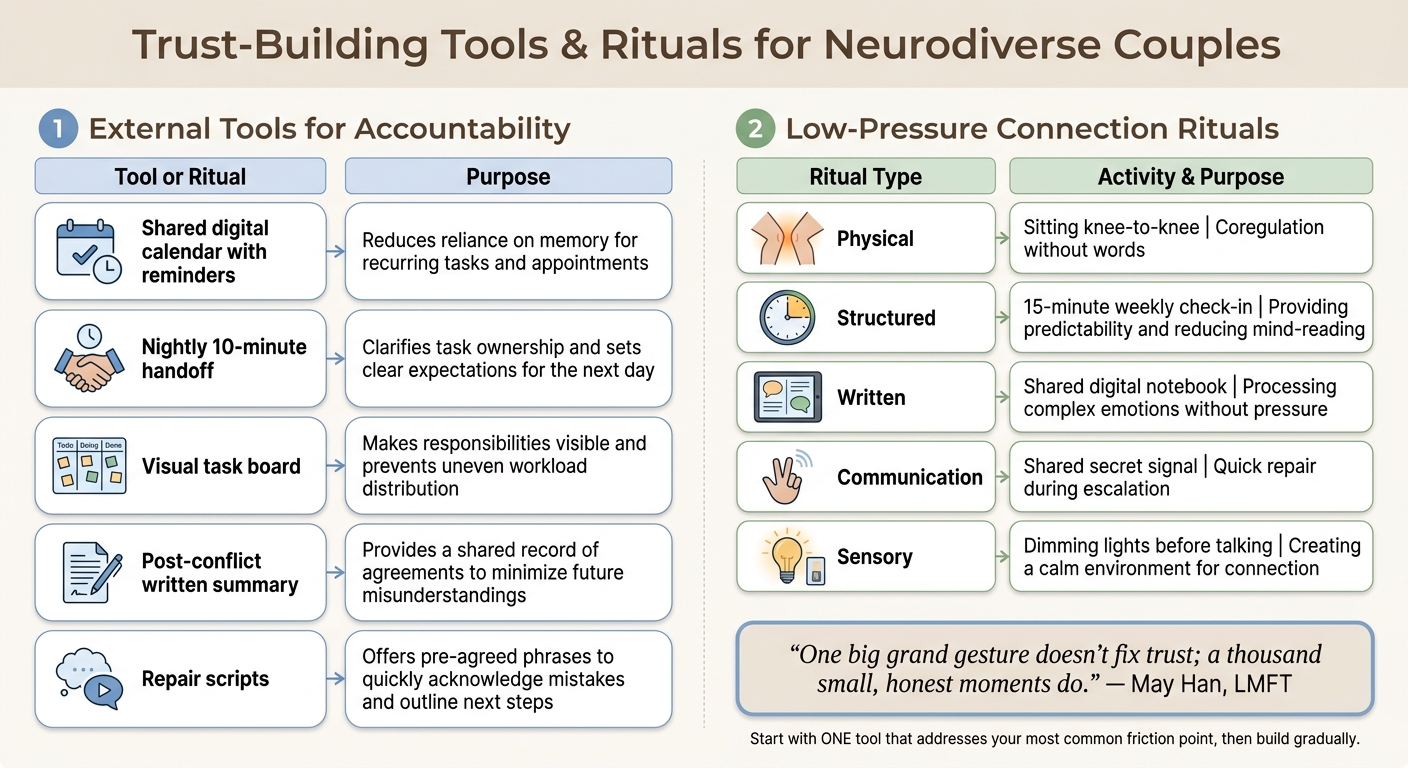
"One big grand gesture doesn’t fix trust; a thousand small, honest moments do." [7]
Creating Predictability and Consistency
Trust-Building Tools & Rituals for Neurodiverse Couples
When trust falters, consistency becomes the bridge to repair it. In neurodiverse relationships, inconsistency often stems from executive function challenges rather than a lack of care. As ScienceWorks Health explains:
"Missed follow-through is not always low caring. In many cases, it reflects executive function strain, not a lack of care." [1]
Recognizing this doesn’t excuse broken commitments, but it does shift how couples approach resolving these issues. This understanding opens the door to strategies that help create stability and predictability.
How Inconsistent Behavior Damages Trust
Trust thrives on consistency, so repeated inconsistencies can disrupt relationship dynamics. When commitments are frequently missed – whether it’s forgetting plans, arriving late, or neglecting responsibilities – the other partner may begin to see the relationship as unreliable. Over time, isolated incidents might feel like a pattern. For neurotypical partners, this unpredictability can lead to feelings of being overburdened with managing household details. On the other hand, neurodivergent partners might feel criticized or micromanaged, further straining the balance of responsibilities [2]. Breaking this cycle is key to rebuilding trust and connection.
Building Routines and Repair Rituals
One effective way to address inconsistency is by creating structured routines. A simple yet impactful habit is a 10-minute nightly "handoff" ritual. During this time, one partner lists the top three priorities for the following day, the other repeats them back, and both decide who will handle each task [8]. This practice minimizes ambiguity, reduces missed commitments, and fosters a sense of teamwork.
Equally important are repair rituals, which are small, predictable actions designed to restore safety after conflicts or missed commitments. For example, couples can agree on a short phrase that acknowledges mistakes and outlines the next steps. These rituals help interrupt negative cycles before they escalate.
"Consistency builds credibility. Over time, these rituals feel less like forced rules and more like natural rhythms of the relationship." – Sagebrush Counseling [3]
These routines lay the groundwork for leveraging external tools to maintain accountability.
Using External Tools for Accountability
Shifting responsibilities from memory to external tools can ease the cognitive load for both partners. Shared digital calendars with automated reminders, visual task boards, and collaborative apps make tasks visible and less prone to being forgotten – especially during moments of conflict or routine follow-ups [1][8].
Another helpful practice is creating a shared written summary after resolving conflicts. This ensures both partners have a clear record of agreements, reducing the chances of miscommunication – a frequent source of tension in neurodiverse relationships. The table below highlights tools and their specific purposes:
| Tool or Ritual | Purpose |
|---|---|
| Shared digital calendar with reminders | Reduces reliance on memory for recurring tasks and appointments |
| Nightly 10-minute handoff | Clarifies task ownership and sets clear expectations for the next day |
| Visual task board | Makes responsibilities visible and prevents uneven workload distribution |
| Post-conflict written summary | Provides a shared record of agreements to minimize future misunderstandings |
| Repair scripts | Offers pre-agreed phrases to quickly acknowledge mistakes and outline next steps |
To avoid feeling overwhelmed, start with just one tool that addresses the most common source of friction in your relationship. Once it becomes part of your routine, gradually introduce additional tools [9].
Managing Emotional and Sensory Differences
Effectively managing emotional and sensory differences is crucial for creating stability and rebuilding trust in relationships. While external tools and routines are important, the real challenge often lies in navigating what happens internally during a conflict – when emotional and sensory differences can turn minor disagreements into major breakdowns.
How Conflict Escalates in Neurodiverse Relationships
In neurodiverse relationships, conflicts often escalate due to mismatched stress responses. Each person’s nervous system reacts differently to stress, noise, emotional intensity, and sensory input. What may seem like avoidance or shutting down is often a nervous system overload – not a deliberate attempt to ignore or stonewall. When these sensory responses are misunderstood, it can lead to deeper feelings of disconnection and mistrust, as both partners may feel unseen or invalidated.
Recognizing these internal responses is the first step toward creating strategies that prevent misunderstandings and foster a safer environment for communication.
Setting Sensory-Safe Rules for Conflict
Sensory-safe rules can help manage conflict more effectively, but they work best when established during calm moments – not in the heat of an argument [10]. Start by identifying triggers that push each of you out of regulation, such as loud voices, interruptions, or physical clutter. Once identified, agree on a shared "pause" signal, like saying "Red Light" or using a simple hand gesture to indicate, "I’m feeling overwhelmed and need a break" [10][11].
When a pause is called, give yourselves at least 20 minutes apart to allow your nervous systems to calm down. During this time, focus on sensory resets – like using noise-canceling headphones, wrapping up in a weighted blanket, or taking a short walk – instead of ruminating on the argument [11]. The purpose of the break isn’t to avoid the issue but to return to the conversation with a clearer mind and the ability to work toward resolution.
"The goal isn’t to solve everything in one conversation. It’s to get through the storm without losing the relationship." – Yuxin Sun, Psychologist [10]
By managing triggers and creating a sensory-safe space, you can approach conflict with less tension and more clarity. The next step is to focus on emotional regulation – both individually and together.
Practicing Co-Regulation and Self-Regulation
Emotional regulation is essential in any relationship, but it’s especially critical in neurodiverse partnerships. This involves two approaches: self-regulation (managing your own emotions) and co-regulation (working together to calm and support each other).
For self-regulation, simple techniques like box breathing can be highly effective. This involves inhaling for 4 counts, holding for 4, exhaling for 4, and holding for another 4. Repeat until you notice your heart rate slowing. Another quick method is the 5-4-3-2-1 grounding technique, where you identify 5 things you can see, 4 you can touch, 3 you can hear, 2 you can smell, and 1 you can taste. These tools can help interrupt emotional spirals and restore focus [11].
Co-regulation, on the other hand, involves calming each other through non-verbal closeness. Simply sitting side-by-side, holding hands, or engaging in a shared activity like walking can help settle both partners’ nervous systems before diving back into the discussion [9][10]. As Barbara (Blaze) Lazarony, LMFT, explains:
"Regulation is not calm. Regulation is capacity. It’s the size of the container your nervous system can hold before the system either floods or shuts down." [12]
Rebuilding Emotional Closeness and Communication
In addition to routines and sensory management, effective communication plays a crucial role in rebuilding trust and restoring the emotional bonds that form the foundation of a strong relationship.
Using Clear Frameworks to Improve Communication
When trust has been damaged, clear communication becomes a key tool for repair. Even small adjustments can strengthen your connection. One effective method is the Listen, Pause, and Clarify framework. It works like this: focus on your partner’s message, pause to process what they’ve said, and then repeat it back before responding. This approach is especially helpful when one partner needs extra time to process, as it removes the pressure to reply immediately.
Another valuable tool is the "I" statement. For partners with ADHD, these statements help keep conversations focused, while for autistic partners, they offer a way to express thoughts directly without appearing overly blunt. A simple script combining an opening line, a key "I" statement, and a desired outcome can be a lifesaver during challenging discussions, especially when emotions are high, or words are hard to find.
"The point is not to avoid the frustration. The point is to have a plan for what to do with it when it arrives." – Robin Brannan, LCMFT[9]
This type of structured communication fosters validation and empathetic understanding, opening the door to deeper emotional connection.
Practicing Validation and Empathy
Validation isn’t about agreeing with everything your partner says – it’s about showing you understand their feelings. For instance, saying something like, "What I’m hearing is that when I decline invitations, it feels to you like I don’t value your friends – is that what you mean?" demonstrates that you’re truly listening without necessarily conceding the point.
For partners who find it hard to identify or express emotions – common among those with alexithymia – empathy can start with describing physical sensations. Statements like, "My chest feels tight" or "I have a knot in my stomach" make internal experiences more tangible. Therapist Allison Kalivas explains this dynamic perfectly:
"You’re not fighting each other – you’re navigating different nervous systems." – Allison Kalivas, Therapist[13]
This kind of empathy naturally leads to rituals that strengthen non-verbal connection, creating a safe space to reconnect.
Creating Low-Pressure Connection Rituals
Small, recurring rituals can do wonders for building emotional closeness. Research indicates that trust develops in the small, everyday moments of connection rather than through grand gestures[4]. These rituals don’t have to be elaborate to be meaningful.
Consider incorporating word-free connection rituals into your routine. A simple touch on the shoulder, sitting knee-to-knee, or using a shared signal can serve as a quiet reassurance that "we’re okay"[9]. Another idea is a 15-minute weekly check-in – structured and predictable, it makes connecting feel manageable rather than overwhelming. For heavier topics, tools like a shared digital notebook or written messages can provide the space to process emotions and respond thoughtfully.
| Ritual Type | Activity Example | Purpose |
|---|---|---|
| Physical | Sitting knee-to-knee | Co-regulation techniques without words |
| Structured | 15-minute weekly check-in | Providing predictability and reducing mind-reading |
| Written | Shared digital notebook | Processing complex emotions without pressure |
| Communication | Shared "secret" signal | Quick repair during escalation |
| Sensory | Dimming lights before talking | Creating a calm environment for connection |
These small, intentional actions create a framework for rebuilding emotional closeness, one moment at a time.
Getting Professional Help for Trust Repair
While self-help strategies can set the stage for rebuilding trust, some situations call for the expertise of a professional. Once daily strategies are in place, deeper issues may still linger, making professional intervention essential for meaningful progress.
Signs You May Need Professional Support
Certain patterns in a relationship suggest it’s time to seek outside help. For instance, if minor disagreements consistently spiral into accusations of neglect or indifference, breaking that cycle on your own can feel impossible. Similarly, when one partner takes on the role of household manager while the other feels micromanaged, intimacy often suffers, and professional guidance may be necessary.
Other red flags include emotional shutdowns that may seem like stonewalling but are actually signs of nervous-system overwhelm, or reassurance-seeking behaviors that fail to provide lasting comfort. Research highlights that 30–40% of neurodivergent adults report that traditional couples therapy worsened their relationship, often because these therapies rely on communication styles geared toward neurotypical individuals [2].
| Sign Support Is Needed | What It Looks Like |
|---|---|
| Repeated trust breakdowns | Broken promises feel like permanent character flaws |
| Parent-child dynamic | One partner manages everything; the other feels controlled |
| Chronic shutdown | Conflict ends in silence or emotional collapse, not resolution |
| High-conflict "survival mode" | Arguments escalate rapidly with no clear off-ramp |
How Growth and Change Counseling Can Help
Growth and Change Counseling, led by John Mark Kane, LMFT, offers tailored support for neurodiverse couples. With over ten years of experience in marriage and family therapy, Kane and his team specialize in addressing ADHD, high-functioning autism, and trauma as interconnected factors influencing relationships [14].
For couples facing significant challenges, the Marriage Rescue Institute provides a structured 12-week coaching program designed to create a clear path forward. John Mark Kane emphasizes:
"Conflict is not the enemy; it is the road map to intimacy if done correctly." – John Mark Kane, LMFT, Marriage Rescue Institute [14]
The program unfolds in three distinct phases: stabilization (weeks 1–2), rebuilding emotional and relational skills (weeks 3–8), and applying these skills to real-life issues (weeks 9–12) [14]. For couples not in crisis, the practice also offers a foundational program that typically requires 6 to 8 sessions to establish effective communication habits.
Sessions are available in Campbell, San Jose, Los Angeles, and Roseville, CA, as well as through telehealth across California. A free 15-minute consultation is offered to help determine the level of support that best suits your needs [14]. When self-help isn’t enough, professional support can provide the tools and guidance needed to repair and strengthen your relationship.
Conclusion: Moving Forward and Rebuilding Trust
Rebuilding trust in a neurodiverse relationship takes time – typically 18–24 months of steady, intentional actions – before the nervous system can truly relax and stop anticipating the next hurt [4]. This timeline serves as a realistic guide, encouraging couples to remain patient as progress often unfolds in small, subtle ways. The consistent actions outlined earlier lay the groundwork for trust that lasts.
The strategies discussed – creating shared definitions of trust, establishing repair rituals, addressing sensory differences, and improving communication – all aim to create a fundamental shift in how partners understand each other. Therapist Mati Sicherer explains it best:
"Relationships don’t improve because we eliminate behaviors, they improve because we understand them differently." [5]
This shift in understanding opens the door to steady, meaningful progress. It’s a reminder that behaviors rooted in neurological differences aren’t acts of neglect but opportunities to grow together.
Signs of progress often appear in the form of shorter arguments, quicker repair attempts, and fewer shutdowns – small but important indicators of change, rather than dramatic moments or grand gestures [1]. Focusing on these incremental improvements helps keep motivation alive through the journey.
The ultimate goal isn’t to recreate what once was but to build something stronger and more intentional. By defining trust, practicing repair rituals, and navigating sensory challenges, couples can reinforce the strategies discussed throughout this article. Many who commit to this process describe achieving a deeper honesty and connection than they ever had before – a "Version 2.0" relationship built on clarity, consistency, and compassion, and one that is entirely attainable [4].
Common Questions for Growth and Change Counseling
How do we tell intent from impact?
In relationships where partners have different neurological processing styles, intent and impact can sometimes feel mismatched. For instance, what one partner sees as a thoughtful or practical action might come across as distant or overly direct to the other. To navigate this, it’s crucial to prioritize addressing the impact of actions first, without assigning blame. Asking clarifying questions can help uncover your partner’s intent, while also recognizing that both viewpoints are influenced by each person’s unique way of processing and perceiving the world.
What’s the fastest trust tool to start with?
The fastest way to start mending trust is to focus on emotional regulation before diving into explanations or apologies. When emotions are running high, a distressed partner’s nervous system isn’t equipped to handle detailed conversations, which makes resolving issues nearly impossible. By first calming emotions, couples can create a safe space for open and honest communication. For those facing serious challenges, intensive therapy can offer a structured and immediate way to stabilize the relationship and begin the process of rebuilding trust.
When should we get professional help?
You don’t have to wait for things to hit rock bottom before seeking support. Addressing issues early can make a big difference in strengthening your relationship. Therapy can be helpful if you’re facing recurring challenges like constant criticism, defensiveness, or lingering conflicts. It’s also worth considering during major life changes, such as moving, taking on new responsibilities, or other transitions.
For more serious issues, like infidelity, addiction, or abuse, professional guidance becomes essential. Growth and Change Counseling offers tailored services for couples, including those in neurodiverse relationships, available to clients in California and through telehealth options.
Related Blog Posts
- Trauma, Addiction, and Neurodiverse Relationships
- ADHD and Autism: Conflict Resolution Strategies
- Study: Trust Dynamics in Neurodiverse Relationships
- 5 Strategies for Healthy Conflict in Neurodiverse Couples
