Neurodiverse relationships often thrive on understanding and communication, but they face unique challenges. Key takeaways from recent studies include:
- Communication struggles: 82% of neurodiverse couples report communication as their biggest challenge. Differences in verbal and nonverbal styles often lead to misunderstandings.
- Relationship statistics: Only 5% of autistic adults are married, compared to 50% of neurotypical adults. Divorce rates are 80% higher in autistic-neurotypical marriages.
- Relationship strengths: Neurodiverse couples excel in emotional honesty and shared interests, fostering deeper connections through mutual respect.
- Therapeutic approaches: The Double Empathy Model and Solution-Focused Brief Therapy help bridge communication gaps without pressuring partners to mask neurodivergent traits. Finding a specialized neurodiverse couples therapist is often the first step in implementing these models effectively.
Understanding and addressing these dynamics can lead to healthier, more fulfilling relationships.
Sharing some Insight from our Research on NeuroDiverse Couples
This video explores how partners can better understand emotional cues to bridge communication gaps.
sbb-itb-596b85d
Communication Challenges in Neurodiverse Relationships
Research shows that communication differences play a major role in the dynamics of neurodiverse relationships. In fact, 82% of neurodiverse couples cite communication differences as their biggest challenge [5]. Considering that about 30% of committed relationships involve at least one neurodivergent partner [5], understanding these unique communication patterns is essential.
Studies reveal a clear trend: couples with mixed neurotypes often experience lower rapport during interactions compared to those where both partners share the same neurotype (p = .023) [4]. This highlights the distinct communication styles tied to neurotypes. As researchers Morgan Jameson and Allison Bean explain, "neurotype-matching is associated with stronger rapport development and greater communication success, suggesting that autistic and non-autistic communication styles differ" [4]. These differences in communication styles also extend to interpreting nonverbal cues.
Misreading Nonverbal Cues
Nonverbal communication – like eye contact, gestures, and nodding – can be a significant source of misunderstanding in neurodiverse relationships. Autistic partners often process these cues differently, which can lead neurotypical partners to misinterpret their behavior as emotional distance or lack of interest [5]. However, these differences reflect alternative ways of processing social information rather than any shortcoming on either side.
This disconnect can create a mutual sense of misunderstanding, which adds strain to the relationship. When communication consistently falters, couples may find themselves in what John Kane, LMFT, describes as an "exhausting mental load", where both partners feel stuck in "silent survival" mode [3]. The emotional toll of constantly trying to decode each other’s signals without a shared framework can be overwhelming. These challenges aren’t limited to nonverbal communication but show up in verbal exchanges as well, where the differences in communication styles become even more apparent.
Explicit vs. Implicit Communication Styles
Autistic and neurotypical individuals often approach verbal communication in fundamentally different ways. Research shows that autistic pairs tend to communicate with greater accuracy but less efficiency (p = .037 and p = .047, respectively) [4]. Autistic partners prioritize precision, while neurotypical partners often lean toward brevity.
This mismatch can cause friction in mixed-neurotype relationships. For example, vague statements like "We need to talk" might cause significant anxiety for a neurodivergent partner, who thrives on clear, explicit communication [5]. While one partner might assume the other can "read between the lines", the autistic partner often processes information more literally and benefits from direct, detailed communication.
The key isn’t about forcing one partner to change their natural style but about recognizing that both precision and efficiency have value. A healthy relationship can embrace these differences, finding ways to honor and integrate both communication approaches.
Relationship Outcomes and Statistics
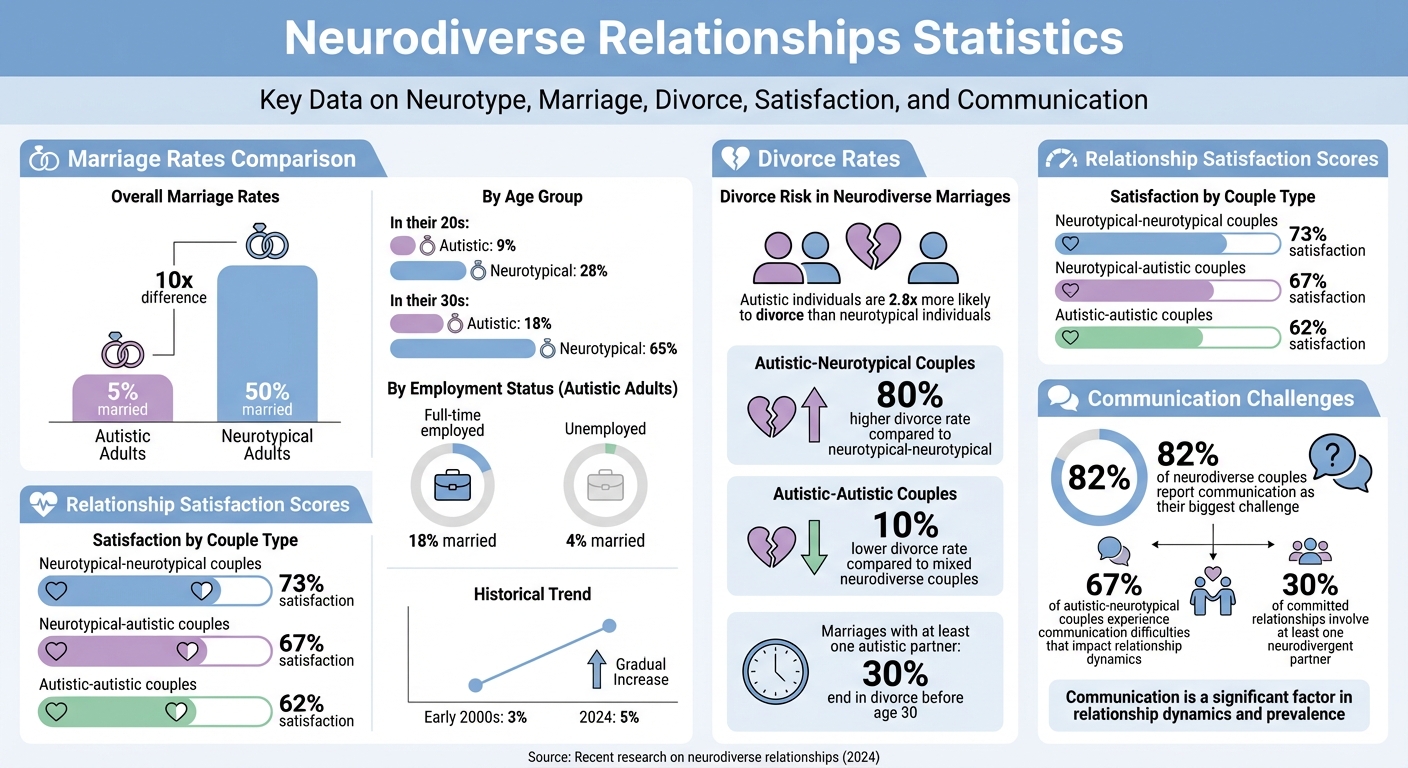
Neurodiverse Relationships Statistics: Marriage Rates, Divorce Rates, and Satisfaction Scores
The numbers surrounding neurodiverse relationships highlight the impact of communication barriers and differing dynamics on marital outcomes. Only about 5% of autistic adults are married, compared to 50% of neurotypical adults [7]. This stark difference points to the unique hurdles autistic individuals face in building and sustaining long-term relationships. By age, 9% of autistic adults in their 20s and 18% in their 30s are married, while the rates for neurotypical adults are significantly higher – 28% and 65%, respectively [7].
Interestingly, marriage rates among autistic adults have shown slow but steady growth, rising from around 3% in the early 2000s to 5% in 2024 [7]. This progress hints that earlier diagnoses and interventions might be helping younger autistic individuals navigate relationships more effectively. Employment also plays a role: autistic adults with full-time jobs have an 18% marriage rate, compared to just 4% for those who are unemployed [7]. These figures underline how life circumstances and relationship challenges shape the differences in marriage and divorce rates, as well as overall satisfaction.
Marriage and Divorce Rates
Neurodiverse marriages often face additional hurdles when it comes to stability. Autistic individuals are 2.8 times more likely to experience divorce than neurotypical individuals [7]. For autistic-neurotypical couples, the divorce rate is 80% higher compared to neurotypical-neurotypical marriages [7]. However, marriages between two autistic partners show a 10% lower divorce rate than mixed neurodiverse couples, suggesting that shared experiences and understanding may play a role in fostering stronger bonds [7].
Approximately 30% of marriages involving at least one autistic partner end in divorce before the age of 30 [7]. As Crown Counseling explains:
Communication difficulties affect approximately 67% of autistic-neurotypical couples, impacting relationship dynamics significantly [7].
These early divorces often stem from the combined strain of communication challenges and navigating life transitions together.
Relationship Satisfaction Scores
Satisfaction levels in neurodiverse relationships vary greatly. Beyond marital status, the ability to improve emotional intelligence and communication has a major influence on happiness. Studies show that neurotypical-neurotypical couples report 73% satisfaction, while neurotypical-autistic couples report 67%, and autistic-autistic couples report 62% [7]. These differences highlight struggles with expressing affection and resolving conflicts [8].
Sexual satisfaction is also often lower in neurodiverse relationships, largely due to sensory sensitivities and communication challenges [8]. However, there is a silver lining: partner responsiveness – how supported, cared for, and validated someone feels – has been shown to be a stronger predictor of relationship satisfaction than the presence of autistic traits [8]. Researcher Rui Ying Yew from Deakin University emphasizes:
Partner responsiveness significantly predicted relationship satisfaction for both autistic and non-autistic partners [8].
This finding suggests that fostering mutual understanding and support can be far more effective than attempting to "fix" autism within a relationship.
Strengths in Neurodiverse Relationships
While much of the research on neurodiverse relationships focuses on challenges, it’s equally important to recognize the strengths that these couples bring to the table. Neurodiverse couples often excel in building authenticity and connection by embracing their cognitive differences. In fact, studies suggest that mixed-neurotype couples who openly discuss their differences tend to report higher levels of satisfaction in their relationships compared to those who avoid the topic [9]. This positive approach highlights how shared interests and a deeper understanding of each other can create stronger bonds.
Shared Interests and Mutual Respect
One of the standout qualities in neurodiverse relationships is the emotional honesty and authenticity that neurodivergent partners often bring. They tend to prioritize sincerity over superficial social norms, creating a foundation of trust that strengthens their connection. Neurodivergent individuals often excel in areas like attention to detail and fairness, while neurotypical partners may contribute social intuition and flexibility. Together, these complementary traits allow the couple to navigate a broader spectrum of relational dynamics. For instance, traits like systemizing and pattern recognition, common among neurodivergent individuals, can help couples resolve conflicts with greater clarity [9].
Another key strength lies in shared interests and specialized passions. When partners take the time to engage in each other’s hobbies or deep interests, they create opportunities for meaningful bonding. These shared activities not only foster connection but also build mutual respect and understanding.
Benefits of Education and Partner Appreciation
Learning about neurodivergence can be transformative for relationships. Education allows partners to move away from seeing neurodivergence as a "deficit" and instead view it as a source of unique strengths. For example, when neurotypical partners learn about traits like "black and white thinking", they can better understand behaviors that might otherwise seem puzzling or even hurtful [2].
Research published in SN Social Sciences supports this, showing that understanding autism can significantly improve communication between partners [2]. This understanding promotes patience and acceptance, which are crucial for addressing both partners’ needs. Simple accommodations, such as creating sensory-friendly environments with adjusted lighting, quiet zones, or designated decompression times, can reduce stress and enhance intimacy for both partners [9]. These thoughtful adjustments become powerful acts of care and consideration.
As couples therapist Daniel Dashnaw puts it:
"Neurodiverse love… teaches both partners that ‘normal’ was never the goal; connection was" [9].
Neurodiverse couples often develop a deep awareness of each other’s inner worlds. By using clear communication and offering explicit reassurance, they build a level of understanding and attunement that strengthens their bond [9].
Counseling Approaches for Neurodiverse Couples
Specialized counseling techniques are designed to address the unique communication challenges that can arise in neurodiverse relationships. Instead of focusing on individual shortcomings, effective therapy emphasizes the differences in how each partner processes information and expresses emotions. This shift in perspective helps couples better understand and navigate their relational dynamics[10].
The Double Empathy Model
The Double Empathy Model offers a fresh lens for understanding communication struggles in neurodiverse relationships. It highlights that both partners may face challenges in interpreting each other’s emotions and social cues. Rather than framing this as a one-sided issue, the model views it as a relational gap. The goal is for both individuals to learn and adapt to each other’s "emotional language." Therapists play a key role by guiding couples to decode and understand one another’s emotions[10]. This approach creates a foundation for more empathetic and effective communication.
Specialized Counseling Techniques
Counselors often incorporate direct communication training to help neurotypical partners articulate their thoughts more explicitly, which can reduce misunderstandings[10]. By focusing on bridging relational gaps, these techniques not only address communication challenges but also enhance the unique strengths that neurodiverse couples bring to their relationships.
Applying Research to Counseling Practice
Counseling practices have evolved to focus on the relationship itself as the "client", especially when working with neurodiverse couples. This approach avoids pressuring neurodivergent partners to suppress or "mask" their natural traits, which can lead to stress and communication breakdowns [1]. One effective method is Solution-Focused Brief Therapy (SFBT), which shifts conversations from "problem talk" to "solution talk." This approach emphasizes neurodiversity as a difference rather than a deficit. Research shows that partners with ASD often engage in more "problem talk" and less supportive dialogue [11], and SFBT directly addresses this communication pattern [1].
Therapists often incorporate visual aids and structured exercises to encourage perspective-taking and enhance understanding between partners. These tools help reinforce a neuroaffirming approach that prioritizes authenticity over masking behaviors. By tackling miscommunication and building on the strengths of neurodiverse individuals, these strategies bridge the gap between research and practical therapy.
Neurodiverse Couples Services at Growth and Change Counseling
These evidence-based techniques form the foundation of services offered by Growth and Change Counseling, which specializes in supporting neurodiverse couples. Their solution-focused therapy for couples is tailored to each relationship, emphasizing a strengths-based perspective and relationship-centered care. For couples dealing with severe challenges, The Marriage Rescue Institute provides an intensive 12-week coaching program. This process uses directive strategies to help partners in crisis rebuild and strengthen their marriages.
Services are available across California, with locations in Campbell, San Jose, Los Angeles, and Roseville, along with telehealth options for statewide accessibility. Rates begin at $150 per session for associate therapists and $200 for licensed therapists, ensuring specialized care is within reach for many couples.
Conclusion
Research indicates that neurodiverse relationships often develop in ways similar to neurotypical ones but come with their own set of challenges, particularly in communication and emotional understanding [6]. Recognizing behaviors like sensory sensitivities, alexithymia, rejection sensitivity dysphoria, and a need for predictability as neurological rather than personal can shift interactions from blame to curiosity and compassion [10].
One study on solution-focused brief therapy with a neurodiverse couple revealed significant improvements: communication-related discomfort dropped by 50% for the autistic partner and 20% for the neurotypical partner after just 12 sessions [12]. Emotional awareness also improved, with a 60% reduction in discomfort for the autistic partner [12]. These outcomes highlight the importance of neurodiversity-affirming care. Generic therapeutic approaches can overlook key differences or even cause harm by promoting masking behaviors [1]. Such findings emphasize the need for tailored strategies to foster meaningful connections.
"Rather than viewing autistic traits as inherently disordered, these affirming viewpoints emphasize the context and dynamics of two-way communication and recognise that actions originate from different embodied experiences." – Andrea Stafford, GradDipCouns, Psychotherapy and Counselling Journal of Australia [12]
This perspective challenges the idea of deficits, instead framing neurodiverse traits as differences. Moving away from deficit-based models to recognizing neurodiversity as a difference rather than a disorder creates opportunities for authentic connection. Focusing on autistic strengths lays a foundation for mutual respect and growth [12]. When couples engage with therapists trained in neurodiverse-affirming practices and use tools that account for different processing styles, they often experience improved wellbeing, heightened self-esteem, and lower levels of anxiety and depression [12]. These approaches help bridge the double-empathy gap – a recurring theme throughout this discussion.
FAQs
How can we stop misreading each other’s signals?
Understanding and respecting communication differences is key to minimizing misunderstandings in neurodiverse couples. Instead of making assumptions about your partner’s intentions, focus on practicing clear and direct communication.
Here are some ways to strengthen understanding:
- State your needs explicitly: Avoid leaving things open to interpretation. Be specific about what you need or expect.
- Check in regularly: Make it a habit to touch base and ensure both partners feel heard and understood.
- Learn together: Engage in psychoeducation to better understand each other’s perspectives and communication styles.
Seeking therapy with a neurodiversity-affirming professional can also be incredibly helpful. These therapists specialize in addressing the unique dynamics of neurodiverse relationships and can offer strategies tailored to your specific needs. With the right tools, couples can build clarity and deepen their connection.
What is the Double Empathy Model in plain terms?
The Double Empathy Model suggests that communication difficulties between neurodiverse and non-neurodiverse individuals occur because they perceive and empathize with the world differently. It emphasizes that these misunderstandings are reciprocal – neither side is inherently "lacking." Instead, the challenges arise from contrasting cognitive and emotional approaches.
When should a neurodiverse couple seek specialized counseling?
Neurodiverse couples might benefit from specialized counseling when ongoing issues with communication, intimacy, sensory sensitivities, or daily routines start to strain their relationship. This becomes even more crucial if such difficulties result in repeated misunderstandings or conflicts. Through counseling, couples can explore strategies specifically designed to navigate these challenges, helping them build a more supportive and harmonious connection.
Related Blog Posts
- Understanding Emotional Cues in Neurodiverse Couples
- Study: Trust Dynamics in Neurodiverse Relationships
- Q&A: Common Challenges in Neurodiverse Partnerships
- Research: Communication in Mixed-Neurotype Families
