Parenting in neurodiverse families often comes with unique challenges, especially when traditional methods don’t work. Collaborative Problem-Solving (CPS), developed by Dr. Ross Greene, offers a solution by focusing on understanding behaviors as signs of unmet needs or skill gaps – not defiance. This approach helps families address issues like communication breakdowns, sensory overload, and differing parenting expectations.
Here’s what CPS offers:
- Empathy First: Understand the root causes of behaviors by asking, “What’s making this hard for you?”
- Skill Building: Identify and address lagging skills like emotional regulation, flexibility, and problem-solving.
- Collaborative Solutions: Work together to create solutions that respect everyone’s needs without relying on rewards or punishments.
Neurodiverse parents may face additional hurdles, such as managing cognitive overload, fluctuating daily capacity, and communication differences. CPS provides a structured way to tackle these challenges while improving relationships and reducing stress. For extra support, professional guidance for neurodiverse couples can make applying CPS more effective.
Whether you’re navigating mixed-neurotype dynamics or looking for a better way to handle daily struggles, CPS offers a practical framework to create a more peaceful and understanding family environment.
Parents Need THIS: Collaborative Problem Solving with Dr. Ross Greene
sbb-itb-596b85d
Common Challenges for Neurodiverse Parents
Building on the earlier discussion of proactive problem-solving, let’s dive into the specific hurdles neurodiverse parents face and why tailored strategies are so important.
Neurodiverse families often encounter unique challenges that typical parenting advice doesn’t account for. These obstacles arise not from a lack of effort but from differences in how brains process emotions and communicate needs differently. What might seem routine in one household can become a significant source of friction in another.
Communication Differences in Mixed-Neurotype Families
Miscommunication is a frequent issue in mixed-neurotype families. For example, a neurotypical parent might misread a neurodivergent partner’s difficulty with transitions as stubbornness, rather than recognizing it as a skill deficit. This misunderstanding can lead to blame and defensiveness, creating a cycle of escalating tension.
Stress often amplifies these interactions. One parent’s stress response can trigger the other’s, turning a simple conversation – like planning bedtime – into a heated argument. It’s a chain reaction of emotional dysregulation.
Masking adds another layer of difficulty. Neurodivergent individuals often mask their traits in professional or social settings, which can leave them drained by the time they get home. This can confuse their partner, who might wonder, “If you can manage at work, why not here?” Without understanding the toll masking takes, these moments can lead to frustration and resentment [3].
Managing Different Parenting Expectations
Discipline is a common source of conflict in neurodiverse partnerships. One parent may favor traditional techniques like time-outs or reward charts, while the other views these methods as ineffective – or even harmful – for their neurodivergent child.
"View challenging behavior as a signal that your child is struggling with specific skills, such as emotional regulation, problem-solving, or flexibility, rather than as intentional misbehavior." – Matt Hall, White Bear Psychiatric Services [1]
Parenting roles can also become unbalanced. When one partner steps in to compensate for the other’s struggles with executive function or emotional regulation, they may take on an overly “helpful” role. This dynamic can lead to burnout for the over-functioning partner and feelings of resentment or infantilization for the other [4]. Over time, this pattern becomes entrenched unless actively addressed.
Daily capacity varies significantly for neurodivergent parents. What feels manageable one day might be overwhelming the next, depending on factors like sleep, sensory input, or overall cognitive load. When a neurotypical partner expects consistent performance, it can lead to disappointment and conflict [4]. These fluctuations aren’t about effort – they’re a reflection of the genuine variability in energy and processing ability.
Handling Cognitive and Emotional Overload
Beyond communication and parenting differences, neurodiverse parents face immense cognitive and emotional demands.
Many neurodiverse parents operate at their limit. Balancing sensory sensitivities, challenges like time blindness, and their child’s needs can feel overwhelming. Add work, household responsibilities, and maintaining a relationship to the mix, and it’s easy to see why so many feel stretched thin [3].
"Resilience is not ‘pushing through,’ but a lifestyle: managing your stress response daily so you can ride the waves of homework battles, morning chaos, and dysregulated kids." – Dr. Kate Lund, Clinical Psychologist [3]
Physical factors, like blood sugar dips, can also play a role. Skipping meals or eating irregularly can lead to irritability or “hangry” meltdowns. These moments may seem like emotional dysregulation but are actually tied to basic physiological needs [3]. Recognizing these patterns can help parents avoid unnecessary self-blame or misattributing the cause of their mood shifts.
Focusing on just three unsolved problems at a time is crucial [1]. Trying to tackle everything at once leads to frustration and burnout. By prioritizing the most pressing issues and temporarily setting aside others (using a strategy called “Plan C”), families can reduce stress and create space for meaningful problem-solving instead of constant crisis management.
Addressing these challenges calls for a structured, thoughtful approach like Collaborative Problem-Solving to help families navigate these complexities more effectively.
How Collaborative Problem-Solving Works
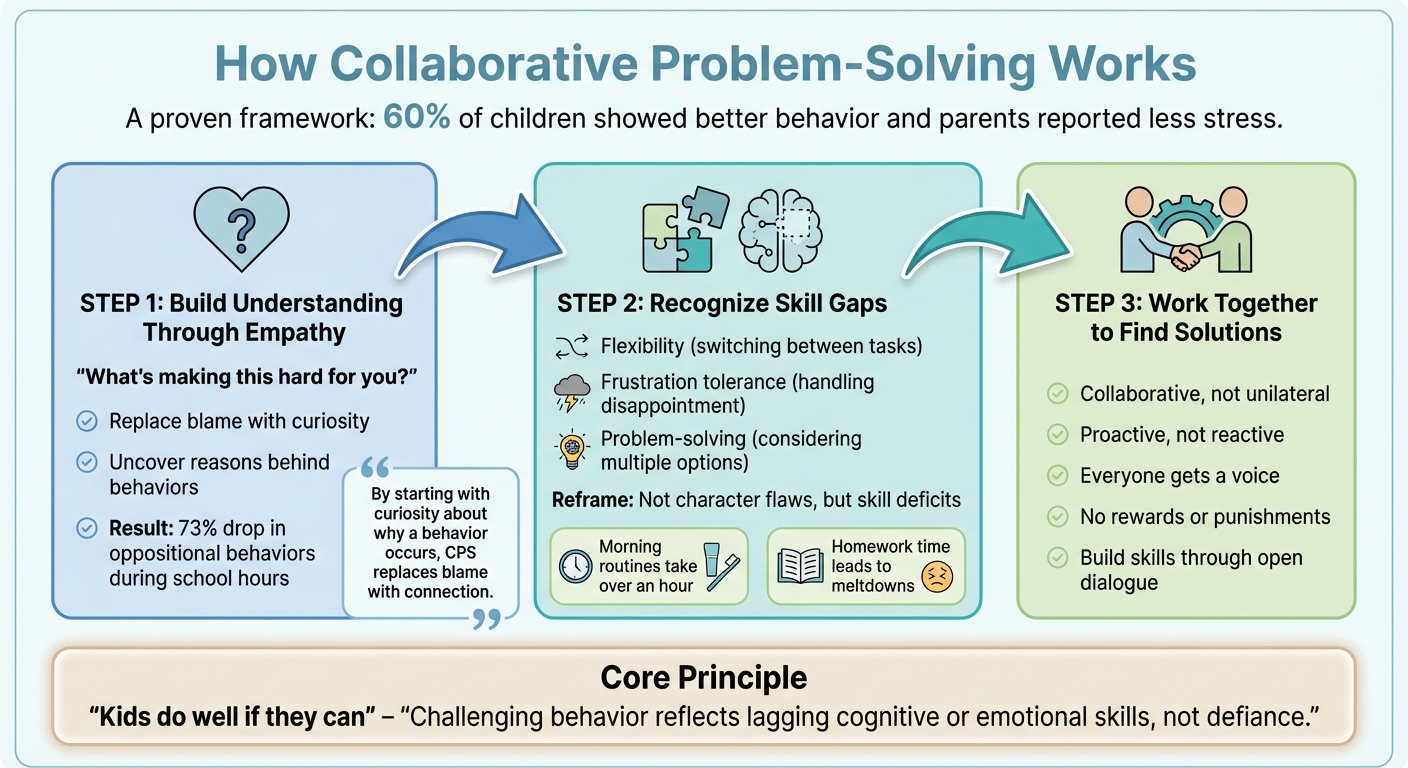
The Three-Step Collaborative Problem-Solving Framework for Neurodiverse Families
Collaborative Problem-Solving (CPS) offers a different way of approaching parenting challenges. At its core is the belief that "kids do well if they can," shifting the focus from blame to curiosity. Instead of asking, "Why won’t they behave?" CPS encourages families to ask, "What’s making this hard for you?" Research backs this method: 60% of children showed better behavior after families adopted CPS, and parents reported feeling less stressed themselves [5]. This mindset paves the way for empathy and stronger connections in neurodiverse relationships.
Building Understanding Through Empathy
Empathy is the heart of CPS. It’s about approaching conflicts with genuine curiosity. For instance, when a child refuses to get ready for school or a partner snaps during dinner prep, the goal isn’t immediate correction – it’s understanding.
This approach encourages families to uncover the reasons behind behaviors. Maybe a child struggles with transitions because they lack flexibility skills. Or perhaps a parent’s irritability stems from sensory overload after a tough day. By identifying these underlying causes, families can address the real issues rather than just the surface-level behaviors.
"By starting with curiosity about why a behavior occurs, CPS replaces blame with connection. This approach helps both sides feel heard and understood, reducing tension and defensiveness." – Core Psychology [6]
The results are striking. One study found a 73% drop in oppositional behaviors during school hours when CPS was used [5]. Parents also report that their relationships with their children feel less combative and more cooperative.
Recognizing Skill Gaps and Unresolved Issues
Once empathy is established, CPS shifts to identifying specific skill deficits. It views challenging behavior not as a lack of motivation but as a sign of lagging skills. This perspective is especially important for neurodiverse families. For example, when a parent struggles with time management or emotional regulation, the focus isn’t on trying harder – it’s about building the right skills.
Instead of labeling someone as "difficult" or "unmotivated", families look at specific scenarios like, "Morning routines take over an hour, leaving everyone frustrated," or, "Homework time consistently leads to meltdowns." Breaking problems down into clear, manageable pieces makes them easier to solve.
CPS targets areas like flexibility (switching between tasks), frustration tolerance (handling disappointment or unexpected changes), and problem-solving (considering multiple options). Viewing these as skill gaps instead of character flaws removes shame and creates space for growth.
"Challenging behavior isn’t usually driven by defiance or poor motivation. More often, it reflects lagging cognitive or emotional skills." – Core Psychology [6]
Working Together to Find Solutions
After understanding the problem and identifying skill gaps, families work together to find solutions. This step is about collaboration, not control. Everyone involved gets a voice in crafting solutions that work for the whole family.
This process fosters mutual respect. When children or partners feel heard and included, they’re more likely to commit to the solutions. CPS avoids traditional rewards and punishments, which often fail with neurodiverse individuals and can strain relationships. Instead, it focuses on building skills like planning, perspective-taking, and emotional regulation through open dialogue.
"The problem solving is collaborative (not unilateral) and proactive (not reactive)." – CPS Connection [2]
Tailoring CPS for Neurodiverse Parents
Collaborative Problem Solving (CPS) offers a flexible framework for families, but neurodiverse parents may need to adapt it to suit their unique needs. Communication, organization, and emotional regulation can look different in these families, and that’s perfectly okay. The goal is to create approaches that align with neurodivergent ways of thinking while staying true to CPS principles. These adjustments make CPS more accessible and effective for neurodiverse parents, helping them navigate challenges with greater clarity and connection.
Adapting Listening Methods for Different Communication Styles
In neurodiverse families, effective listening often means being direct and clear. For example, using a visual scale – like Green for "ready", Yellow for "limited", and Red for "overwhelmed" – can help communicate capacity at any given moment [4]. This simple tool can prevent misunderstandings, especially when someone is too drained to engage in problem-solving.
"Capacity and levels of ability will naturally shift day to day, and it can be highly supportive for the partners to develop skills to clearly communicating what each person can and cannot take on in that moment." – Sakura Counseling [4]
Direct communication can also reduce misinterpretations. Studies show that neurodiverse parents and educators often believe they are incorporating problem-solving elements into conversations more than they actually are, which highlights the need for intentionality [7].
Once communication is clear, the next step is aligning parenting goals to avoid unnecessary friction.
Aligning Parenting Goals Between Partners
When partners in mixed-neurotype relationships face executive function challenges, it’s easy for one partner to take on too much, creating a "parent-child dynamic." This imbalance can lead to burnout and resentment [4]. To avoid this, set up regular check-ins at predictable times – like Sunday evenings or midweek mornings – to discuss parenting goals and boundaries.
During these check-ins, focus on the most urgent priorities to prevent overwhelm. Break down tasks into manageable steps. For instance, instead of saying "handle the morning routine", break it into specific actions like "lay out clothes the night before", "wake the kids at 7:00 AM", and "serve breakfast by 7:30 AM."
"When couples practice sharing capacity without judgment and responding with respect rather than negotiation or pressure, boundaries become a tool for care rather than conflict." – Sakura Counseling [4]
This structured approach ensures that both partners feel supported and avoids overloading either person.
Using Visual Aids and Structured Frameworks
Visual tools can be lifesavers for neurodiverse families. Shared digital calendars, task boards, or apps with color-coded priorities help reduce mental strain by offering clear, easy-to-follow reminders [4].
The Plan B framework – Empathy, Define Concerns, Brainstorm Solutions – can also be adapted into a visual format. Writing these steps on a whiteboard or keeping a printed guide visible during discussions helps everyone stay on track. For individuals with ADHD or dyslexia, tools that allow for text customization, like syllabication or font adjustments, can make reading easier [3].
Before diving into problem-solving, take a moment to reset. Quick regulation techniques – like slow breathing, progressive muscle relaxation, or splashing cold water on your face – can make a big difference. These brief practices help ensure both partners are calm and ready to engage constructively. As the saying goes: regulate first, reflect second [3]. For those needing immediate support, an anxiety coping strategies calculator can provide personalized tools to manage stress in the moment.
Implementing CPS with Professional Guidance
Once you’ve started adapting CPS (Collaborative & Proactive Solutions) techniques at home, working with a professional can take your efforts to the next level. While the strategies mentioned earlier are a great foundation, professional guidance helps turn CPS concepts into practical, everyday tools. A trained therapist can help shift your perspective – from seeing challenging behaviors as defiance to understanding them as signs of unmet needs[1]. This mindset shift is essential but often difficult to achieve without expert support.
Therapists also help families prioritize what to tackle first. Experts suggest focusing on no more than three unresolved problems at a time to avoid overwhelming everyone involved[1]. A counselor can guide you in determining which issues need immediate attention and which can be temporarily set aside using Plan C (removing certain expectations to ease pressure). This kind of strategic focus prevents burnout and ensures that each challenge gets the attention it requires.
Combining CPS with Counseling Services
Parent coaching and family therapy offer a structured environment to practice CPS techniques. For example, therapists often teach parents about mirror neurons – how their own agitation can escalate a child’s distress[3]. By maintaining a calm and steady demeanor, parents can help de-escalate conflicts instead of unintentionally intensifying them. Dr. Blaise Aguirre, who has worked with thousands of children and teens, emphasizes:
"Regulate before you can reflect."[3]
In therapy, families work through real-life scenarios, gaining confidence in applying CPS strategies. This hands-on support not only builds skills but also sets the stage for more specialized services tailored to neurodiverse families.
Growth and Change Counseling Services for Neurodiverse Families

Growth and Change Counseling specializes in supporting neurodiverse families through parent coaching, family therapy, and neurodiverse relationship counseling. They serve clients in Campbell, CA; San Jose, CA; Los Angeles, CA; and Roseville, CA. Telehealth options are also available across California, making their services accessible statewide. Rates start at $150 per 45-minute session with Associate Marriage and Family Therapists and $200 per 45-minute session with Licensed Marriage and Family Therapists. Sliding scale options are offered for families facing financial challenges.
For couples managing the complexities of mixed-neurotype parenting, the Marriage Rescue Institute provides an intensive 12-week couples coaching program. This process is designed to help rebuild relationships in crisis. With telehealth services available, families across California can access professional guidance without the added burden of travel, making it easier than ever to get the support they need.
Conclusion
Collaborative Problem-Solving (CPS) offers neurodiverse parents a way to move past outdated and often ineffective discipline techniques. Instead of focusing on compliance, CPS prioritizes skill development, working from the understanding that kids do well if they can. The approach recognizes that challenging behavior stems not from a lack of motivation but from missing skills like flexibility, frustration tolerance, and executive functioning [5]. Research highlights that CPS not only improves child behavior but also helps reduce parental stress [5]. Many families notice better interactions and fewer oppositional behaviors as a result.
By identifying triggers and addressing issues early, CPS strengthens relationships and teaches constructive ways to resolve conflicts. This method emphasizes meeting unmet needs rather than simply managing emotional outbursts. As Dr. Ross Greene puts it:
"The best thing you can do to help kids with concerning behavior is to stop focusing on their concerning behavior. Start solving the problems that are causing that behavior." [2]
For families looking to deepen their progress, professional guidance can make a big difference. Growth and Change Counseling provides parent coaching, family therapy, and support for neurodiverse relationships. With offices in Campbell, San Jose, Los Angeles, and Roseville – and telehealth options throughout California – getting help is convenient. Sessions with Associate Marriage and Family Therapists start at $150 for 45 minutes, and sliding-scale rates are available for those facing financial difficulties.
Whether you’re just starting with CPS or already using its techniques, expert support can help you navigate challenges more effectively. It ensures you focus on the most pressing issues, practice self-regulation strategies, and build lasting skills that benefit the entire family. Combining CPS with professional help creates meaningful, long-term improvements for neurodiverse families.
Start Your Path Forward with Growth and Change Counseling
What’s the quickest way to start CPS at home?
To get started with Collaborative Problem Solving (CPS) at home, the key is to shift your focus from reacting to challenging behaviors to understanding what’s driving them. The goal is to address the underlying issues rather than just the surface-level actions.
Here’s how you can begin:
- Identify the root problems: Look beyond the behavior to figure out what’s causing it. What specific challenges or unmet needs might be at play?
- Listen to your child’s perspective: Have an open and respectful conversation to understand their concerns. This helps them feel heard and valued.
- Work together on solutions: Partner with your child to brainstorm ways to address the problem. Implement these solutions together to reduce conflict and help them build important skills over time.
This approach not only resolves immediate issues but also strengthens your relationship and equips your child to handle future challenges more effectively.
How can I use CPS when my partner and I have different capacity levels?
Ross Greene’s collaborative parenting approach emphasizes mutual understanding and shared problem-solving. Instead of jumping to conclusions or assigning blame, this method starts with recognizing each other’s current capacities – without judgment.
The goal is to work together to uncover the root causes of challenges. By doing so, you can create flexible solutions that take into account the needs and abilities of everyone involved. This approach not only promotes mutual respect but also ensures that the solutions are practical and achievable for all parties.
What should we do if CPS talks keep turning into arguments?
If conversations with CPS become heated, aim for collaborative problem-solving to steer clear of conflict. Work together to pinpoint the root issues and brainstorm solutions that meet everyone’s needs. Keep a calm demeanor, listen actively, and acknowledge their concerns. If the discussion becomes too tense, propose taking a break and reconvening later to keep the conversation productive. This strategy encourages teamwork and helps diffuse tension.
Related Blog Posts
- ADHD and Autism: Conflict Resolution Strategies
- Parenting Stress: Solutions for Neurodiverse Families
- How ADHD and Autism Impact Emotional Regulation in Relationships
- Q&A: Common Challenges in Neurodiverse Partnerships
