Clergy play a key role in addiction recovery by offering accessible, trusted support that addresses mental, emotional, physical, and spiritual needs. With over half of individuals seeking help for addiction turning to clergy rather than healthcare providers, they fill critical gaps in recovery resources. Here’s how clergy contribute:
- Safe Spaces for Recovery: Churches provide judgment-free environments for recovery meetings, helping reduce stigma and isolation.
- Spiritual Guidance: Prayer and spiritual support help individuals find purpose and inner peace, addressing the root causes of addiction.
- Personalized Counseling: Clergy offer one-on-one guidance, addressing addiction triggers while reinforcing self-worth and faith.
- Peer Support Networks: Congregations create community-based support systems where individuals can share experiences and celebrate progress.
- Reliance on a Higher Power: Clergy encourage individuals to draw strength from faith, fostering resilience and hope.
With addiction affecting millions, clergy serve as a vital bridge to recovery, offering free, stigma-free support and referrals to additional resources when needed. Their approach combines spiritual care with practical assistance, making recovery more accessible and meaningful.
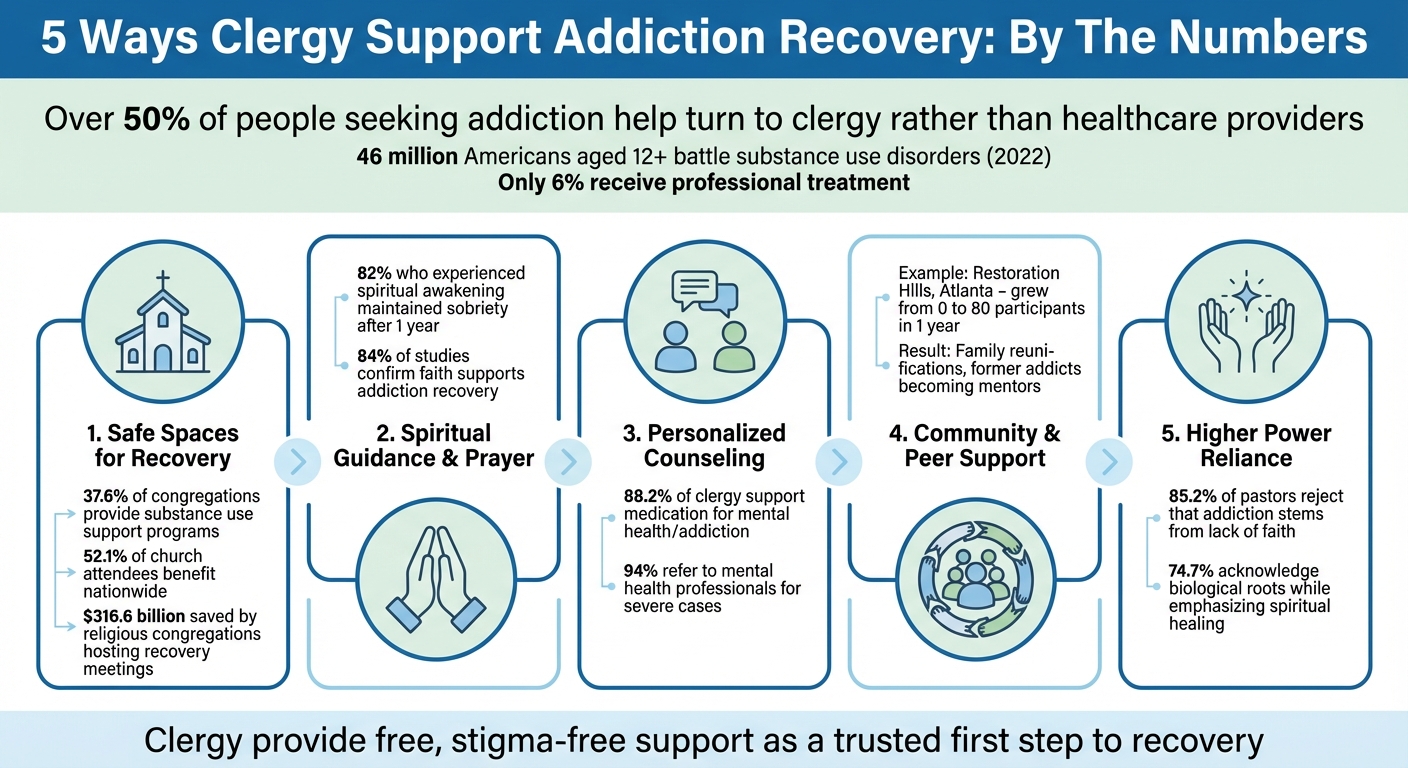
How Clergy Support Addiction Recovery: Key Statistics and Impact
What EVERY PASTOR needs to know about ADDICTION | Recovery In Christ
1. Creating Safe Spaces for Recovery Meetings
Churches play a crucial role in offering free, judgment-free spaces for those battling addiction. Curtis J. VanderWaal, PhD, Chair and Professor of Social Work at Andrews University, highlights this unique role:
Pastors are in a position to help diminish the stigma and discrimination surrounding mental health and addictions issues. In addition, they can provide a welcoming space for individuals and families to share their struggles and victories. [1]
By hosting recovery meetings, congregations address two key challenges of addiction – denial and isolation – through the power of peer support [4]. Dale S. Ryan, CEO of the National Association for Christian Recovery, emphasizes the importance of this supportive approach:
Even without formal recovery programs, a congregation that practices grace over shame deeply supports recovery. [7]
The impact of these spaces extends beyond emotional support. U.S. religious congregations collectively save the government approximately $316.6 billion by hosting recovery meetings [3]. Additionally, 37.6% of congregations provide substance use support programs, benefiting about 52.1% of church attendees nationwide [3]. While these financial savings are striking, the deeper value lies in the intentional creation of environments that foster healing.
Clergy play a key role in shaping these welcoming spaces. Simple actions, like adjusting welcome messages during services to acknowledge those who are "hurting, broken, and struggling", send a powerful signal that progress is what truly matters [7]. Sharing information about local recovery resources further reinforces the idea that help is always within reach.
The most effective recovery spaces prioritize inclusivity and connection. Reducing hierarchy and using terms like "group members" or "participants" helps create an atmosphere of equality [9]. When meetings are led by individuals who are themselves in recovery and familiar with 12-step principles, they set a powerful example of honesty and vulnerability, fostering meaningful peer-to-peer connections [9].
2. Providing Spiritual Guidance and Prayer Support
Creating safe physical spaces is just the beginning – true recovery often requires addressing the inner struggles that fuel addiction. This is where spiritual guidance and prayer play a transformative role.
Prayer and spiritual support tackle addiction at its core, addressing the spiritual void that often underlies destructive behaviors. Stephanie Hayes, an Associate Marriage and Family Therapist, explains this idea powerfully:
"Even if my body is broken, my spirit can still thrive with satisfaction and fulfillment. But if my spirit is broken, my physical health becomes far less significant."
The impact of spirituality on recovery is well-documented. Research shows that 82% of individuals who experienced a spiritual awakening maintained their sobriety after one year, and 84% of studies confirm that faith plays a consistent role in supporting addiction recovery [10].
Clergy often guide individuals in reshaping their "thought life", a concept theologian AW Tozer describes as the beliefs that drive behavior. Tozer famously said, "What you believe about the world determines the way you live your life!" By shifting these beliefs, individuals can move away from destructive cravings and instead embrace healthier relationships, self-acceptance, and a sense of purpose. Prayer becomes a powerful tool in this process, reinforcing the idea that redemption is always possible, even for those who feel irreparably broken.
This shift in perspective helps individuals move beyond the pursuit of fleeting pleasures to discover deeper meaning in life. As John Kane insightfully noted, "Meaninglessness comes from being tired of pleasure, not pain." Addressing these deeper spiritual roots is essential for lasting recovery.
Charles Stanley offers another perspective: "It is not the trials in your life that develop or destroy you, but rather your response to those hardships." Clergy use prayer not only to strengthen resilience but also to foster an environment where individuals feel safe enough to share openly. This combination of spiritual guidance and emotional honesty helps repair broken relationships – with God, with others, and within oneself – laying the groundwork for true healing.
3. Integrating Faith into Personalized Counseling
One-on-one counseling brings faith into the heart of recovery by addressing addiction and emotional needs on a deeply personal level. This approach complements the communal safe spaces discussed earlier, offering a tailored path to healing.
Clergy follow established guidelines [11], using a framework centered on love, active listening, truth, and faith. They ask thoughtful, targeted questions to uncover the root causes of addictive behaviors and identify the triggers that fuel them. This process helps shape recovery strategies that are specific to each individual’s journey.
A core teaching emphasized in these sessions is that addiction does not alter a person’s eternal identity as a child of God [11]. This message works to counter feelings of shame, replacing them with hope and a renewed sense of self-worth. By focusing on this eternal identity, the counseling reinforces the role of faith in the healing process, as highlighted in earlier discussions.
To build on the progress made in individual counseling, clergy introduce practical tools to foster trust and openness. These include creating written vulnerability plans and promoting radical honesty with trusted individuals. For couples, this level of transparency can be a turning point in rebuilding trust and repairing strained relationships.
Interestingly, 88.2% of clergy support the use of medication for mental health and addiction-related challenges, and 94% report they would refer individuals to mental health professionals for more severe cases [1]. This willingness to combine spiritual guidance with professional care creates a well-rounded support system, addressing the physical, emotional, and spiritual dimensions of recovery.
sbb-itb-596b85d
4. Building Community and Peer Support Networks
Recovery from addiction thrives when people feel genuinely connected to others who understand their struggles. Peer networks, alongside safe spaces and personalized counseling, play a key role in this process. Clergy often take the lead in creating these networks within their congregations, fostering environments where individuals can share their experiences, hold each other accountable, and celebrate progress together. It’s worth noting that over half of those who turn to clergy for help with addiction challenges do not seek assistance from other healthcare providers [1]. This reliance highlights the vital role church-based networks play in supporting recovery efforts. These peer connections complement one-on-one faith-based counseling by offering consistent, group-based accountability.
These networks work because they provide accessible and genuine relationships. As Curtis J. VanderWaal, PhD, Chair and Professor of Social Work at Andrews University, explains:
Pastors are perceived as trustworthy and caring helpers… [they] are able to build valuable long-term relationships with individuals and families, which builds trust [1].
This trust fosters a space where individuals feel safe moving from denial to honesty, surrounded by peers who truly understand and support them.
Take the example of Restoration Hills, a church in Atlanta, Georgia. In 2022, they launched weekly Celebrate Recovery meetings. Within just a year, attendance grew to 80 participants, leading to family reunifications and even inspiring a former addict to become a youth mentor [8]. It’s a powerful testament to what community-based efforts can achieve.
Clergy also ensure these networks remain strong by choosing facilitators who are in recovery themselves and familiar with twelve-step programs. They encourage practical support within the congregation, such as offering rides to meetings, childcare, job assistance, or donations for sober living expenses. Celebrating recovery milestones – much like birthdays or baptisms – emphasizes that recovery is a journey worth honoring. By blending practical help with spiritual guidance, clergy create spaces where individuals can form meaningful connections and find ongoing encouragement. These efforts seamlessly integrate community support into a broader faith-based recovery approach, making the path to lasting recovery more attainable.
5. Promoting Reliance on a Higher Power for Long-Term Sobriety
Turning to a higher power serves as a crucial foundation for lasting recovery. Clergy play a key role in addressing the spiritual aspects of addiction, which are often more pronounced compared to other challenges. As the Center of Addiction & Faith explains, "Addiction contains a spiritual dimension that must be integrated into treatment more than other disorders" [6].
Clergy emphasize that relying on a higher power provides strength that goes beyond sheer willpower. They teach that every individual is deserving of love as a child of God, directly countering the shame and isolation that often drive addiction [4][5]. Dr. Ryan Sultan, a psychiatrist at Integrative Psych, highlights this idea:
Spirituality can be a powerful tool in recovery… helping them find meaning and purpose beyond their addiction. This spiritual support can enhance resilience and provide a sense of hope and direction [2].
This spiritual perspective offers individuals a source of strength greater than themselves, especially during challenging times.
Practical spiritual guidance is woven into various aspects of recovery. Clergy often use scripture, prayer, and reflective questions like, "How can the Lord help you overcome your addiction?" to encourage individuals to shift their dependence from substances to divine support [11]. Personal testimonies from church members during worship services also provide inspiration, while sermon series on twelve-step principles show how faith and God’s guidance can lead to healing [9].
The effectiveness of this approach is further supported by insights from faith leaders. A survey of 215 pastors revealed that 85.2% rejected the idea that addiction stems from a lack of faith [1]. Additionally, 74.7% of clergy acknowledged the biological roots of addiction while still emphasizing the importance of spiritual healing and finding deeper meaning [1]. By blending faith with practical support, this approach creates a holistic recovery path that addresses both the physical and spiritual needs of individuals. It aligns seamlessly with the broader faith-based recovery framework outlined earlier.
Conclusion
Clergy play a vital role in addiction recovery by offering spiritual guidance, fostering community connections, and providing practical support. They often serve as trusted confidants, approached more frequently than psychiatrists or general doctors. In fact, over half of those who seek help from clergy never reach out to other healthcare providers [1].
One of the key advantages of clergy support is its accessibility. Their assistance is typically free and carries less stigma compared to visiting a mental health clinic [1]. With over 46 million Americans aged 12 and older battling substance use disorders in 2022 – and only about 6% receiving professional treatment [8] – clergy help bridge this gap by being a welcoming first step toward recovery.
If you or someone you know is struggling with addiction, consider reaching out to clergy as a starting point. Local church offices can provide pastoral counseling or prayer support. Programs like Celebrate Recovery or other church-hosted support groups are excellent resources. Many clergy also offer referrals to faith-based counselors who align with your values. As Andrew Lancaster, LPC, MAC, puts it:
The church was never meant to be a museum for the perfect – it’s a hospital for the hurting [8].
For those seeking a blend of faith and clinical care, Growth and Change Counseling (https://johnmarkkane.com) offers specialized addiction treatment, along with individual, couples, and family therapy. Services are available in Campbell, CA, San Jose, CA, Los Angeles, CA, Roseville, CA, and via telehealth throughout California.
Recovery is most effective when supported by both spiritual strength and a caring community. You don’t have to face addiction alone – clergy and faith-based counselors are here to walk with you on the journey to healing.
Bridging Spiritual Care with Growth and Change Counseling
How can clergy provide a supportive environment for addiction recovery?
Clergy hold a key position in fostering a welcoming and supportive atmosphere for those navigating addiction recovery. By building trust and showing genuine compassion, they can offer spiritual guidance that helps individuals feel seen and valued, rather than judged. This encouragement of open communication within the faith community can make a world of difference, giving people a safe place to share their struggles without the fear of stigma. In turn, this reduces feelings of isolation and empowers individuals to take steps toward healing.
Additionally, clergy can play an important role in guiding individuals toward professional treatment when it’s necessary. They can offer spiritual reassurance, highlighting the strength that faith can provide during the recovery process. By recognizing the signs of addiction and connecting people with the right resources, clergy help strengthen a network of healing and support. Through empathy and understanding, they can cultivate an environment where recovery feels not just possible, but within reach.
How can spiritual guidance help in addiction recovery?
Spiritual guidance can be a powerful ally in addiction recovery, offering individuals a renewed sense of hope, purpose, and connection to something beyond themselves. Many faith-based approaches see recovery not just as a physical and emotional process but as a deeply personal spiritual journey. This perspective helps individuals draw strength, find comfort, and experience renewal through their faith.
Practices such as prayer, studying scripture, or leaning on a higher power can play a key role in building resilience and fostering self-acceptance. These spiritual tools often help individuals heal emotionally and feel less isolated. They also encourage forgiveness – both of oneself and others – which can create a strong foundation for long-term recovery. Additionally, faith-based counseling and supportive communities provide encouragement and accountability, helping individuals stay on track throughout their healing process.
How can peer support in faith communities help with addiction recovery?
Peer support networks in faith communities play a key role in addiction recovery by offering connection, understanding, and encouragement. These groups provide a safe and welcoming space where individuals can openly share their challenges and celebrate their progress, helping to ease feelings of isolation and stigma.
Faith-based peer support often takes the form of recovery groups, mentorship programs, and prayer gatherings. These activities blend spiritual guidance with practical accountability, creating a supportive environment where individuals can find both purpose and belonging. Through this combination of faith and mutual support, people are empowered to rebuild their lives with renewed hope and strength.
Related Blog Posts
- Parent Coaching with Faith in Addiction Recovery
- How Faith Helps Rebuild Trust After Addiction
- How Faith Helps Couples Overcome Addiction Together
- Christian Counseling for Addiction Recovery
