Christian counseling addresses addiction by combining faith-based principles with clinical methods to heal individuals and relationships. Addiction impacts marriages, families, and spiritual well-being, often leading to betrayal, isolation, and broken trust. This approach integrates biblical teachings like forgiveness and repentance with evidence-based therapies such as Cognitive Behavioral Therapy (CBT) and Emotionally Focused Therapy (EFT). It aims to restore emotional and spiritual health while rebuilding trust and connection in relationships.
Key Takeaways:
- Addiction damages trust, communication, and emotional bonds in marriages.
- Christian counseling merges faith (e.g., the Prodigal Son parable) with clinical tools to address addiction’s root causes.
- Techniques like CBT, EMDR, and structured relationship frameworks support recovery.
- Programs like Growth and Change Counseling and The Marriage Rescue Institute offer tailored support for individuals and couples.
- Recovery is a long-term process, often taking 1-3 years to rebuild stability and trust.
This faith-centered approach provides a path to healing that nurtures the mind, body, and spirit, creating lasting change for individuals and their relationships.
Biblical Principles for Overcoming Addiction
Forgiveness, Repentance, and Restoration in Recovery
Repentance, as described in the Bible, is the driving force behind true change [6]. It’s not just about feeling sorry for past actions but about a deep, intentional shift – turning away from addiction and moving toward God’s grace. This transformation goes beyond surface-level regret, offering mercy that shields us from the consequences we might deserve and grace that reshapes our desires to align with God’s purpose. Unlike the shame-based approach that often tries to control behavior through guilt, God offers acceptance and joy instead of condemnation [7]. For couples, healing doesn’t come from trying to earn trust through perfection but through humility and an authentic commitment to change.
The connection between confession and healing is emphasized in Scripture. James 5:16 highlights the power of transparency in fostering restoration and wholeness [2].
Repentance also brings renewal to the mind, helping believers take control of their thoughts and align them with Christ [4]. Tools like Palmer’s "Stop, Get Away, Pray, Obey" method [6] and the practice of uncovering deceptive desires are practical ways to replace unhealthy habits with the truths found in Scripture.
This process of transformation lays a foundation for seeing recovery through the lens of biblical stories.
The Prodigal Son and Finding Identity in Christ
The parable of the Prodigal Son offers a powerful picture of recovery through God’s mercy. Despite squandering everything, the son is welcomed back with open arms, his identity as a beloved family member fully restored [7]. This story reminds us that recovery isn’t about proving our worth through perfect behavior but about rediscovering our identity in Christ.
In God’s eyes, those in recovery are seen as new creations, carrying immense value [3][8]. By anchoring our identity in Christ, we can break free from the idolatry of addiction. As Brent Woods puts it:
Grace is what makes the truth bearable. Truth is what makes grace meaningful [2].
When we place our worth in Christ, our desires naturally shift toward the purpose God has for us.
The journey to restoration is not instantaneous – it often takes one to three years for couples to feel a strong sense of stability [2]. Much like the father’s joyful welcome in the Prodigal Son’s story, God’s response to those in recovery is one of celebration and readiness to restore. This grace-filled reception provides the emotional and spiritual strength needed for the challenging road ahead, transforming individuals and their relationships along the way [7].
Combining Christian Counseling with Evidence-Based Therapies
Pairing Faith with Clinical Methods
Christian counseling weaves together biblical teachings, clinical expertise, and spiritual growth to tackle the multifaceted challenges of addiction recovery [9]. This approach blends faith and science, offering a path that addresses both spiritual and psychological needs.
By combining clinical tools like Cognitive Behavioral Therapy (CBT) and Eye Movement Desensitization and Reprocessing (EMDR) with spiritual practices, counselors can offer a more personalized healing process. For instance, CBT thought records might be paired with the encouragement found in Philippians 4:6–7 to help individuals manage anxiety during recovery [9]. Similarly, trauma-focused EMDR sessions can be complemented by the reassurance of Psalm 34:18, providing comfort for deep emotional wounds often linked to addiction [9].
"Christian counseling helps bridge this gap by using DSM-5–aligned, evidence-based approaches alongside biblical theology, offering a holistic path to healing rooted in Scripture and clinical best practices." – Nathaniel, Christian Counselor [9]
Research from the American Association of Christian Counselors (AACC) highlights that integrating Scripture into therapy improves treatment adherence [9]. Additionally, studies reveal that faith-based care significantly reduces the risk of relapse during addiction recovery [11]. For couples, this approach not only addresses the addiction itself but also tackles the feelings of spiritual disconnection and shame that frequently accompany it.
Couples counseling, building on this integrated framework, employs structured methods to rebuild emotional bonds and restore trust.
Rebuilding Relationships with Proven Counseling Methods
When it comes to couples facing the strain of addiction, combining clinical and spiritual approaches can be transformative. Structured relationship frameworks provide a roadmap for healing and reconnection. The Gottman Sound Relationship House framework, for example, has been adapted by Robert Navarra for addiction recovery. This method focuses on three key elements: the addicted partner, the non-addicted partner, and the relationship as a whole [1]. This is critical, as traditional Behavioral Couples Therapy (BCT) has only a 30% success rate in addressing addiction and marital dissatisfaction [1].
The process helps couples rebuild their shared identity by addressing the effects of substance abuse, repairing emotional damage, and creating new rituals of connection [1]. A major focus is eliminating the "Four Horsemen" – criticism, contempt, defensiveness, and stonewalling – which are particularly harmful during recovery [1]. Couples also develop "love maps", which deepen their understanding of each other’s inner worlds, and establish substance-free activities to symbolize their renewed commitment [12].
"The substance comes between them as an affair partner does in infidelity. Before recovery, the substance was placed higher than the relationship." – John Lakvold, Licensed Mental Health Counselor [1]
Therapies like Emotionally Focused Therapy (EFT) play a key role in restoring emotional connections by addressing attachment wounds. Meanwhile, Dialectical Behavior Therapy (DBT) and Motivational Interviewing offer practical strategies for managing triggers and maintaining sobriety [1][3]. When these evidence-based methods are combined with biblical principles of forgiveness and restoration, they create a comprehensive approach that addresses the mind, body, soul, and relationships all at once [5].
Integrating Faith and Recovery at Growth and Change Counseling
Services at Growth and Change Counseling
At Growth and Change Counseling, we combine Christian counseling principles with proven therapeutic techniques to help individuals and couples find healing and restoration.
Addiction Recovery Treatment Options
Our team addresses a variety of addictions while also working to strengthen marital relationships. We focus on substance abuse (chemical dependency), media addiction (like internet and video games), and sex or pornography addiction. Recognizing that addiction often stems from deeper issues – such as unresolved trauma, anxiety, depression, or anger – we use an integrative approach that blends Emotionally Focused Therapy (EFT) with Christian Psychology. This allows us to address both emotional and spiritual needs. Additionally, we provide specialized support for neurodiverse couples navigating unique relational challenges.
"At Growth and Change Counseling, we have a foundational process that we take couples, individuals, addicts, and parents through… this process is tailored to the situation that you are dealing with and helps you develop the relational intelligence to put your relationships and mental health back together." – Karin Wiese, LMFT
The Marriage Rescue Institute‘s 12-Week Program
For couples facing serious challenges, including those on the verge of separation, The Marriage Rescue Institute offers a 12-week intensive program. This structured program is designed to tackle severe issues such as addiction, infidelity, and destructive conflict. Through practical skill-building and guided homework, couples are taught to develop "relational intelligence", turning conflict into an opportunity for deeper connection. Even for couples who have already separated, this program provides tools to rebuild trust and repair relationships.
"The Marriage Rescue Institute, our 12-week marriage program is in the habit of putting marriages in dire circumstances back together!" – John Kane, LMFT and Founder
Telehealth and In-Person Counseling Availability
We provide both in-person counseling and telehealth services to ensure accessibility. In-person sessions are available in Campbell, San Jose, Los Angeles, and Roseville, CA, while telehealth services cover the entire state. Our main office is located at 1875 S Bascom Ave, Suite 2400, Campbell, CA 95008.
- Individual therapy rates: $200 per 45-minute session with a Licensed Marriage and Family Therapist (LMFT) or $150 with an Associate Marriage and Family Therapist (AMFT). Sliding scale options start at $100 for those with financial needs.
- The Marriage Rescue Institute program: Pricing details are customized and discussed during a free initial consultation.
These flexible options make it possible for couples and individuals to access faith-based care tailored to their recovery and growth journey.
sbb-itb-596b85d
Steps for Couples in Addiction Recovery
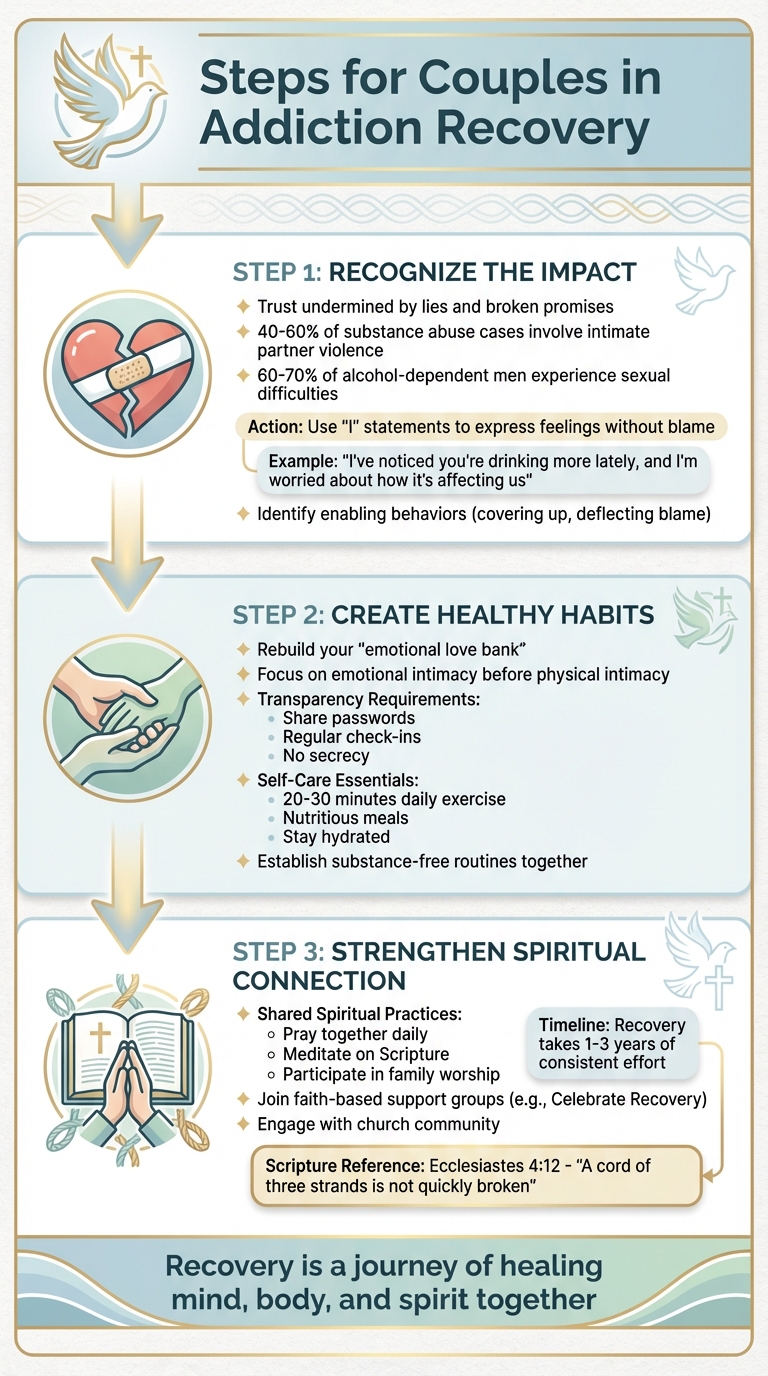
Christian Counseling Addiction Recovery: 3-Step Process for Couples
Recognizing Addiction’s Impact on Your Relationship
Addiction can deeply affect a marriage, often undermining trust through lies, broken promises, and prioritizing substances over the relationship itself [16]. It’s also linked to serious issues like intimate partner violence, which occurs in 40% to 60% of cases involving substance abuse. Furthermore, men dependent on alcohol face a 60% to 70% likelihood of experiencing sexual difficulties [15].
Start by identifying the ways addiction has hurt your relationship. Open and honest communication is key – use "I" statements to express your feelings without sounding accusatory. For instance, you could say, "I’ve noticed you’re drinking more lately, and I’m worried about how it’s affecting us" [13]. Reflect on whether you’ve unintentionally enabled the addiction by covering up behaviors, deflecting blame, or managing its consequences [14]. Moving forward in recovery means shifting from an individual focus to a shared perspective as a couple. This includes placing your recovery journey within the context of your relationship and making amends for any harm caused in the past [1].
Creating New Healthy Habits and Emotional Connections
Once you’ve acknowledged the impact of addiction, the next step is to rebuild your bond by establishing substance-free routines. These new habits can help repair what some experts call your "emotional love bank" [1]. Start by focusing on emotional intimacy – show kindness, be present, and remain curious about each other – before attempting to rebuild physical intimacy [2].
Transparency is non-negotiable. Share passwords, hold regular check-ins, and avoid secrecy to rebuild trust [2]. The partner in recovery can demonstrate their commitment by being honest, reliable, and transparent [1]. Keep check-ins brief and focused on progress and boundaries to create connection rather than conflict [2].
It’s also important for both partners to prioritize self-care. This includes maintaining physical health with daily exercise (20–30 minutes), eating nutritious meals, and staying hydrated to prevent caregiver burnout [17]. Alongside these efforts, nurturing your shared faith can provide a strong foundation for lasting recovery.
Strengthening Your Spiritual Connection as a Couple
Recovery isn’t just about stopping harmful behaviors – it’s about healing emotional wounds and restoring a deeper spiritual connection [2]. Emotional challenges like anxiety and depression can often stem from spiritual struggles, such as questioning God’s plan or experiencing a crisis of faith. These issues can be addressed through biblical principles [10].
Strengthen your spiritual bond by engaging in shared practices like praying together, meditating on scripture, and participating in family worship. These rituals can nourish your souls and bring you closer as a couple [10][2]. Consider joining faith-based support groups like Celebrate Recovery, a Christian 12-step program that integrates biblical teachings with the recovery process [18]. Being part of a church community can also provide a supportive environment where you can align your recovery work with shared values and daily life [10]. Keep in mind that recovery is a long-term journey – it often takes 1 to 3 years of consistent effort before your relationship feels stable again [2].
Maintaining Recovery Through Faith and Boundaries
Building Trust and Transparency in Your Relationship
Rebuilding trust after betrayal is no small feat – it’s a process that demands time, patience, and consistent effort. Experts suggest it can take one to three years of steady work before a relationship feels stable again [2]. The key lies in consistent, observable actions. Words alone won’t suffice; your spouse needs to see tangible changes over time, not just hear promises [19]. Transparency plays a vital role here. Addiction thrives in secrecy, but openness can weaken its grip [2].
A practical tool for fostering trust is the FANOS Model, which encourages daily conversations around five areas: Feelings, Affirmation, Needs, Owning actions, Sobriety, and Spiritual growth [20]. These check-ins should remain brief and focused, emphasizing progress rather than turning into interrogations. It’s worth remembering that confession is about more than seeking forgiveness – it’s about achieving wholeness. As James 5:16 advises, "Confess your sins to one another and pray for one another, that you may be healed" [2].
This foundation of accountability sets the stage for creating healthy boundaries that support recovery.
Setting Healthy Boundaries with Grace
Boundaries are essential for protecting your emotional and spiritual well-being while fostering a safe environment for healing [20]. From a Christian perspective, setting boundaries is part of your responsibility to safeguard your spiritual health [22][23]. Proverbs 25:28 illustrates this wisdom: "A man without self-control is like a city broken into and left without walls" [22].
Start by clearly defining what you are responsible for – your faith, health, and reactions – and what falls under your spouse’s responsibility, such as their sobriety, employment, and hygiene [22]. Establish firm, non-negotiable boundaries around behaviors that compromise safety or core values, like substance use in the home or verbal abuse. If these boundaries are crossed, it’s crucial to enforce pre-determined consequences consistently [21]. For instance, many counselors recommend a 45- to 90-day period of intentional sexual abstinence during early recovery. This allows space for emotional healing and rebuilding intimacy beyond the physical [20].
Practicing compassionate detachment is another critical step. This means allowing your spouse to face the natural consequences of their actions rather than shielding them through enabling behaviors [21]. As Henry Cloud and John Townsend explain, "Since you cannot get them to change, you must change yourself so that their destructive patterns no longer work on you" [22]. Communicate your needs with clarity and directness, avoiding blame [24]. This approach strikes a balance between grace and truth – grace softens the hard truths, while truth gives grace its depth [2].
Once emotional safety is established, couples can begin nurturing a deeper spiritual bond.
Finding Shared Spiritual Meaning Together
With trust being rebuilt and boundaries firmly in place, the next step is to deepen your connection through shared spiritual practices. Recovery isn’t just about stopping harmful behaviors – it’s about shifting from managing sin to nurturing the soul [2]. Your relationship can develop a new identity that honors your recovery journey while embracing fresh rituals of connection [1]. Ecclesiastes 4:12 offers encouragement: "Though one may be overpowered, two can defend themselves. A cord of three strands is not quickly broken" [5].
Engage in activities that strengthen your bond without relying on substances. This could include shared prayer, scripture meditation, or volunteering together within your church community. These practices not only nourish your spiritual lives but also symbolize your commitment to a healthier path [1]. It’s important to distinguish between shame and conviction during this journey. As Licensed Professional Counselor Brent Woods explains, "Shame says, ‘I’m unworthy of love.’ Conviction says, ‘I’m loved too much to stay stuck’" [2]. Recovery is about embracing God’s unconditional love and finding fulfillment in your relationship with Him rather than in any substance [3].
Be patient with the process. While behavioral couples therapy for addiction has shown only 30% success in resolving marital dissatisfaction [1], combining clinical methods with genuine spiritual renewal offers hope for lasting change. Psalm 34:18 reassures us: "The Lord is close to the brokenhearted and saves those who are crushed in spirit" [2]. Your shared faith isn’t just an added layer to recovery – it’s the foundation that will sustain both your sobriety and your marriage through the challenges ahead.
Conclusion
Recovering from addiction is about much more than just stopping harmful behaviors – it’s a journey that involves healing the mind, body, and spirit. Traditional therapies often miss the mark when it comes to addressing the deep emotional and spiritual needs that fuel addiction, leaving couples to rebuild on an unstable foundation [25]. By blending evidence-based clinical practices with the transformative power of faith, a path to true restoration becomes possible.
The numbers highlight the critical need for an approach that heals both the physical and the spiritual. Christian counseling steps into this space by focusing on "soul care" rather than merely managing behavior [2]. This method goes deeper, tackling the root causes like trauma, grief, and unresolved anger – issues that often keep individuals stuck in cycles of shame and self-destruction [25].
"Grace is what makes the truth bearable. Truth is what makes grace meaningful." – Brent Woods, LPC, Woods Counseling Services [2]
At Growth and Change Counseling, we understand that repairing a marriage impacted by addiction requires specialized care. Our programs, including The Marriage Rescue Institute’s 12-week intensive coaching process, combine clinical expertise with spiritual guidance to help couples rebuild their relationship identity. We offer services in Campbell, San Jose, Los Angeles, and Roseville, CA, as well as telehealth options for clients across the state.
Recovery is not a quick fix; it’s a long-term journey, and when faith and proven counseling methods come together, that journey becomes stronger. Your marriage doesn’t have to be another statistic. With the right tools, honesty, and spiritual commitment, healing is within reach. Take the first step toward a future where faith and science work hand in hand to restore your relationship.
FAQs
How does Christian counseling combine faith and therapy to support addiction recovery?
Christian counseling combines biblical teachings with established therapeutic strategies to address addiction in a comprehensive way – encompassing the mind, body, and spirit. Counselors work with clients to surrender their challenges to God, using tools like Scripture, prayer, and spiritual reflection to encourage healing, forgiveness, and a renewed sense of purpose.
Alongside these spiritual elements, clinical techniques such as cognitive-behavioral therapy, relapse prevention strategies, and trauma-informed care are applied, all within a Christian perspective. This dual approach equips clients with practical coping skills while nurturing spiritual growth, laying the groundwork for lasting recovery.
Organizations like Growth and Change Counseling excel at merging faith-based care with evidence-based practices. Their dedicated team provides individuals and families with resources like thought restructuring, emotional healing, and spiritual support to help clients overcome addiction and rebuild relationships.
How do forgiveness and repentance contribute to addiction recovery in Christian counseling?
In Christian counseling, forgiveness and repentance are central to the journey of addiction recovery, addressing both the heart and soul of the healing process. Repentance means recognizing harmful behaviors, making a conscious decision to turn away from them, and leaning on God’s grace for transformation. This spiritual shift empowers individuals to break free from addiction’s hold and rebuild their lives with a renewed focus on their relationship with God.
Forgiveness – whether it’s accepting God’s forgiveness, forgiving oneself, or offering forgiveness to others – eases the burden of guilt and shame that often fuel addictive behaviors. By blending faith-based practices like prayer and Scripture with practical therapeutic methods, Christian counseling offers a compassionate and effective path toward recovery and stronger, healthier connections with others.
How can couples rebuild trust and strengthen their relationship after addiction?
Rebuilding trust after addiction is no small feat – it demands honest communication, patience, and a shared commitment to openness. Both partners need to express their feelings honestly, listen without jumping to conclusions, and work together to set clear boundaries and expectations. Being transparent about things like daily routines, finances, and schedules can go a long way in restoring confidence over time.
Incorporating faith-based practices, such as prayer and Scripture, can offer a shared sense of hope and purpose throughout the healing journey. Structured counseling programs can also play a crucial role. For example, Growth and Change Counseling offers a 12-week couples coaching program through The Marriage Rescue Institute. This program blends biblical principles with proven strategies to help couples strengthen their connection and rebuild trust.
Some practical steps to consider include setting aside time for daily check-ins, embracing forgiveness rooted in grace, and seeking professional guidance to tackle tough moments. With consistent effort and spiritual grounding, couples can work toward rebuilding trust and creating a relationship that feels healthier and more meaningful.
Related Blog Posts
- Overcoming Addiction and Anxiety in Christian Marriages
- How Faith Helps Rebuild Trust After Addiction
- How Faith Helps Couples Overcome Addiction Together
- How Christian Counseling Supports Family Healing
