Storytelling is a powerful tool for helping neurodiverse children understand and manage emotions. By using relatable characters and scenarios, stories simplify complex feelings, making them easier to identify and express. This approach is especially helpful for children with autism or ADHD, who may struggle with recognizing emotions, interpreting social cues, or regulating their feelings.
Key takeaways:
- Emotional Vocabulary: Stories help children learn words for nuanced emotions like frustration or anxiety.
- Empathy and Perspective: Observing characters fosters understanding of others’ feelings.
- Emotional Regulation: Stories model coping strategies and problem-solving in a safe, structured way.
Parents can create personalized stories or use tools like Social Stories to address specific challenges, while professional guidance can enhance these efforts. Combining storytelling with expert support equips families to build stronger emotional connections and skills.
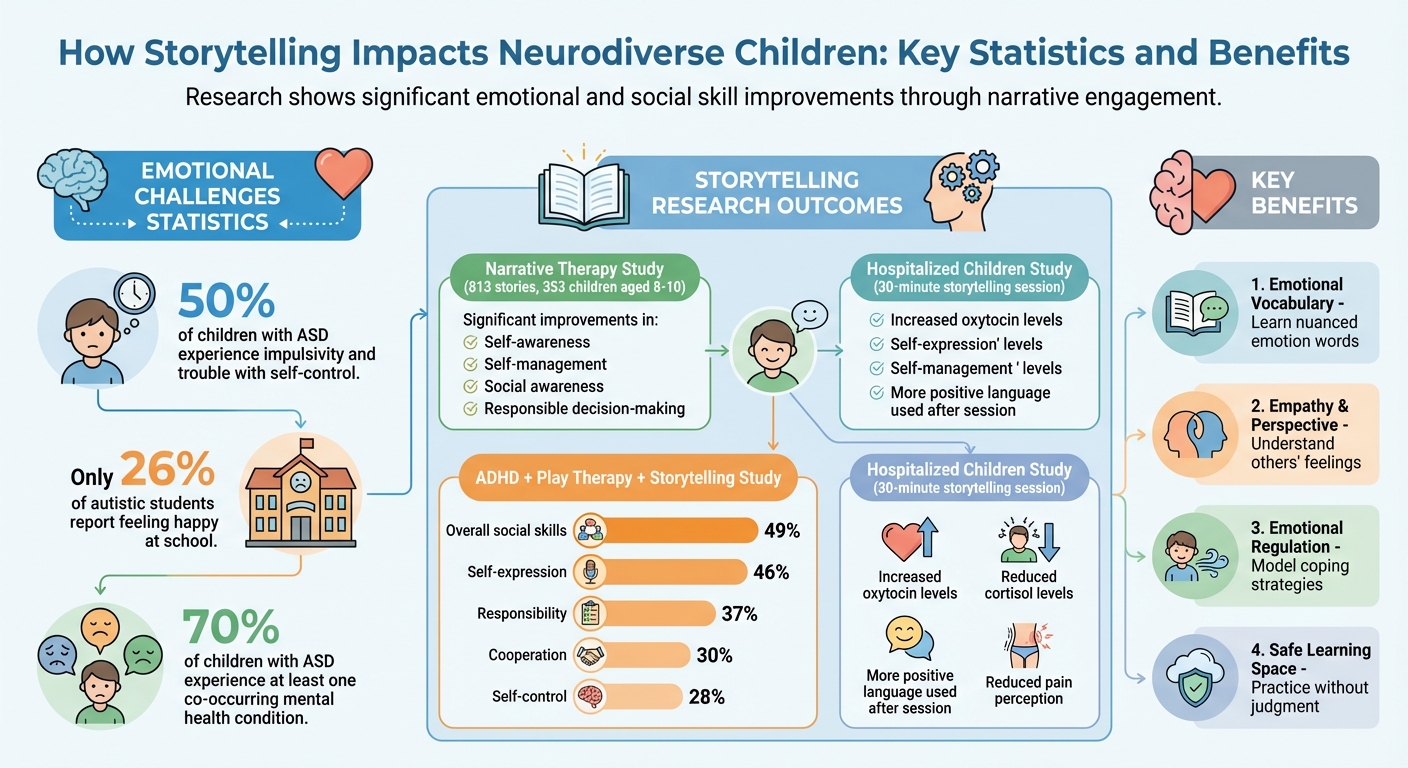
How Storytelling Impacts Neurodiverse Children: Key Statistics and Benefits
Emotional Challenges Neurodiverse Children Face
Difficulty Recognizing Emotions
Many neurodiverse children face challenges with alexithymia, which makes it difficult to identify and describe their own emotions. Additionally, deficits in Theory of Mind (ToM) can make it hard for them to understand that others may have different thoughts, feelings, and perspectives [5][6]. Without these skills, they often struggle to communicate their needs or empathize with others’ emotions.
Interpreting nonverbal cues – like facial expressions, tone of voice, gestures, and body language – can also be a significant hurdle. While neurotypical children naturally pick up on these signals, neurodiverse children may miss them altogether [6]. They might recognize basic emotions like happiness or sadness but find it much harder to understand more nuanced or mixed emotions [6].
Executive function issues compound these difficulties. For instance, about 50% of children with ASD experience impulsivity and trouble with self-control, making it hard to pause and think before reacting emotionally [5]. As Dr. Carla A. Mazefsky from the University of Pittsburgh School of Medicine explains:
Labeling of one’s emotion has been proposed as critical to successful ER, and being able to communicate to others about your emotional state is also involved in interpersonal ER aspects [5].
These challenges often ripple into their social and academic lives, creating additional obstacles.
Effects on Daily Life and Relationships
The inability to recognize and regulate emotions has a tangible impact on daily interactions. Social isolation is a common experience for neurodiverse children. Many children with ASD describe feeling like "outsiders" and find unstructured times, like school breaks, particularly difficult. In fact, only 26% of autistic students report feeling happy at school [7]. This emotional struggle often disrupts academic performance, leading to lower achievement, frequent absences, and disengagement from school activities [4][7].
At home, these challenges can place significant stress on families. Parents often need to provide high levels of emotional support, referred to as extrinsic regulation, to help their children manage emotions. While typically developing children outgrow this need, neurodiverse children may require such support for much longer [4]. Emotional outbursts or meltdowns are frequently misunderstood as defiance, when they are actually signs of difficulty with emotional regulation [5].
Another layer of complexity comes with masking, where children suppress or hide their emotions to fit in socially. While masking might help them navigate certain situations, it can lead to psychological harm over time [7]. With approximately 70% of children with ASD experiencing at least one co-occurring mental health condition [4], providing effective emotional support is not just helpful – it’s essential.
How Storytelling Helps Children Learn About Emotions
Turning Abstract Emotions Into Clear Examples
For many neurodiverse children, understanding and naming emotions can be a real challenge, requiring specific strategies for emotional growth. This is where storytelling steps in, providing a way to turn complex feelings into relatable, everyday situations. Emotions like frustration, loneliness, or disappointment might feel overwhelming when it’s hard to put them into words. But through storytelling, these abstract emotions become easier to grasp. For example, when kids hear about a character who feels left out during recess or gets upset after losing a game, they can often see a reflection of their own emotions. It’s like holding up a mirror but in a way that feels safe and nonjudgmental.
For children with autism, tools like Social Stories are especially helpful. These short, structured narratives break down tricky social situations, showing expected feelings and responses step by step. This makes emotions more concrete and manageable. On top of that, regular storytelling routines create a sense of safety, giving children a secure space to explore and practice handling emotions without fear of judgment.
Creating Predictable and Safe Learning Spaces
Storytelling’s structured and repetitive nature can be incredibly calming. By creating a predictable routine, it helps reduce anxiety and gives children a sense of control – they know what’s coming next. Hearing the same story repeatedly also allows them to practice recognizing and managing emotions in a low-stress environment.
Interestingly, storytelling doesn’t just help emotionally; it has physical effects too. A June 2021 study published in the Proceedings of the National Academy of Sciences found that a 30-minute storytelling session with hospitalized children led to increased oxytocin levels and reduced cortisol. This means kids felt less pain and used more positive language after hearing a story. Plus, research using near-infrared spectroscopy revealed that oral storytelling keeps the prefrontal areas of the brain more active compared to reading from picture books – even when the story is already familiar. This heightened engagement supports both cognitive growth and emotional learning.
Ep 102: Stories are Emotional Learning for Complex Kids
Benefits of Storytelling for Neurodiverse Children
Storytelling provides neurodiverse children with a structured way to grow emotionally and socially. It starts by expanding their emotional vocabulary, progresses to building empathy, and ultimately helps them develop better emotional regulation skills.
Building Emotional Vocabulary
Storytelling helps neurodiverse children move beyond basic feelings like "happy" or "sad" to more nuanced emotions such as "anxious" or "melancholy." This deeper understanding makes it easier for them to identify and manage their feelings.
Picture books are particularly effective for this. They pair visual elements – like facial expressions and body language – with words, helping children link what they see to what they feel. Between 2014 and 2016, Marie-Nathalie Beaudoin and her team at Skills for Kids, Parents & Schools (SKIPS) analyzed 813 problem-solving stories shared by 353 children aged 8 to 10. Their narrative therapy approach led to notable improvements in self-awareness and social awareness compared to a control group [9]. As Maria Nikolajeva, a professor and author, explains:
Verbal description of emotions and moods are used as a pedagogical device that ostensibly helps young children to articulate the emotion to recognize it later, but perhaps also as a step in language acquisition: from the basic ‘sad’ toward a wider range of emotions [12].
With a richer emotional vocabulary, children are better equipped to understand and empathize with others.
Teaching Empathy and Perspective-Taking
Storytelling creates a safe space for neurodiverse children to explore emotions and social scenarios without fear or pressure. By observing characters in stories, they can practice empathy and perspective-taking.
Stories featuring characters who are different from the child are especially impactful. Natalia Kucirkova from the Institute of Education at University College London highlights this:
Identification with characters who are dissimilar from the readers is the most valuable contribution of children’s storybooks to cognitive empathy [13].
This kind of low-stakes practice helps children build cognitive empathy, even if they already have emotional empathy. Understanding others’ feelings more clearly prepares them to handle social situations and adopt effective coping strategies.
Teaching Emotional Regulation and Coping Methods
Storytelling also plays a key role in teaching emotional regulation. A study conducted in May 2021 by Brockington revealed that just a 30-minute storytelling session increased oxytocin levels, reduced cortisol, and encouraged more positive language among hospitalized children [11].
Stories often model coping strategies in action. When characters face challenges like frustration, disappointment, or conflict, children see examples of resilience and problem-solving. Techniques from narrative therapy, such as "externalizing" – where problems are viewed as separate from the child – help kids develop self-management and make better decisions [9]. These tools give children practical ways to navigate their own emotional hurdles.
sbb-itb-596b85d
How to Use Storytelling at Home
Storytelling can be a powerful tool at home, especially when it’s tailored to your child’s experiences and needs. By weaving personalized and engaging narratives into everyday routines, you can help reinforce emotional lessons and build stronger connections. Here’s how to bring storytelling into your daily life.
Writing Personalized Social Stories
A social story is a short, customized narrative designed to help children understand specific situations in a way that’s clear and relatable for them [15]. These narratives are particularly helpful in reducing anxiety and teaching social cues. Erin Vollmer MS, CCC-SLP, Co-founder of TherapyWorks, highlights their value:
Social stories are an easy, effective tool that parents can use to help children learn to adjust their behavior and emotions according to the situation they’re in [14].
Start by identifying a specific challenge your child is facing, such as sharing, managing frustration, or transitioning between activities. Then, craft a short story that incorporates personal details, making it easier for your child to connect with the scenario. Following Carol Gray’s guidelines, use a mix of descriptive, perspective, and directive sentences to outline the situation in a positive tone [15]. Adjust the story’s complexity to suit your child’s age and attention span. As noted by HeadStart.gov:
The ability to name a feeling allows children to discuss and reflect with others about their personal experience of the world [16].
Adding Visual Aids and Interactive Elements
Visual aids can make stories more engaging and easier to understand, especially for neurodiverse children. Consider adding photographs, simple drawings, or even comic strips to illustrate emotions and dialogue [17]. For physical stories, laminating the pages or using sheet protectors can keep them durable for repeated use [14]. If you prefer digital options, tools like the Social Story Creator & Library app let you create stories with personalized images.
To deepen the experience, use role-playing with toys or puppets to act out the stories. Pause during the story to ask questions like, "What do you think the character is feeling here?" or "How could the story end differently?" This not only reinforces emotional lessons but also gives your child a sense of control and involvement [2].
Maintaining Consistency and Repetition
Repetition is key when it comes to emotional learning. Reading the same story multiple times helps solidify understanding and encourages behavior change. Kylie Rymanowicz from Michigan State University Extension explains:
It takes several tries and hard work to understand and change behaviors, so it is important to read and reread the story [18].
Use stories to prepare your child for upcoming events, like a doctor’s visit or their first day of school. Introduce these stories a week or two in advance to allow time for repetition [14]. Keep them accessible – on a bedside table or in a reading nook – so they’re easy to revisit. When a challenge arises, refer back to the story by saying something like, "Remember how the character handled this?" [18].
To reinforce these lessons, coordinate with other caregivers – such as teachers, grandparents, or babysitters – so everyone uses the same stories and language. Establishing regular "feelings talk" times ensures consistency and strengthens the emotional learning process [8].
These storytelling techniques can create a nurturing environment at home, setting the stage for more structured approaches discussed in the next section.
Combining Storytelling with Professional Parent Coaching
While home-based storytelling sets the stage for emotional learning, professional guidance can take it to the next level. By incorporating expert techniques, parents can better address the unique challenges faced by neurodiverse children. These tailored strategies help bridge the gap between understanding emotional concepts and applying them in real-life situations.
Neurodiverse children may grasp social rules in theory but often struggle to put them into practice during emotionally charged moments. Pamela Cole, PhD, a psychologist at Penn State University, explains:
In a highly stressful situation, children need more adult support… Kids learn from people they trust [8].
Professional coaching provides that essential support, helping parents create structured storytelling sessions where children can safely explore and practice emotional strategies.
Parent-Led vs. Therapist-Guided Methods
Parent-led and therapist-guided storytelling each offer unique benefits, and combining the two often yields the best results. Parent-led storytelling takes place naturally during daily routines, fostering trust and secure attachment. Parents are there during key moments – like meltdowns, bedtime worries, or morning transitions – when emotional lessons can have the greatest impact. However, without guidance, it can be difficult for parents to identify specific behaviors or implement effective strategies.
Therapist-guided storytelling, on the other hand, introduces clinical expertise and proven techniques like externalizing (e.g., giving emotions a character, such as "The Anger Monster") and re-authoring stories to help children reshape their self-perception [9]. Research involving 813 problem-solving stories found that children receiving narrative therapy showed marked improvements in self-awareness, self-management, and empathy compared to control groups [9]. The challenge, however, is that therapist sessions are typically limited to once a week, while emotional learning requires daily reinforcement.
| Feature | Parent-Led Storytelling | Therapist-Guided/Coached Storytelling |
|---|---|---|
| Environment | Natural, part of daily routines [8] | Structured, clinical, or targeted intervention sessions [19] |
| Primary Benefit | Builds trust and secure attachment [8] | Employs expert strategies like externalizing and re-authoring [9] |
| Challenges | May lack specific tools for complex needs [8] | Limited to infrequent sessions [19] |
| Best Use Case | Emotional bonding and everyday regulation [8] | Addressing developmental delays or ongoing behavioral concerns [19] |
The most effective approach combines these methods. Professional coaching equips parents with expert techniques, which they can then apply consistently at home, creating a seamless blend of clinical expertise and everyday practice.
How Growth and Change Counseling Supports Families

Growth and Change Counseling tailors storytelling techniques to meet each child’s emotional and developmental needs. Offering services in Campbell, San Jose, Los Angeles, Roseville, and through telehealth across California, their therapists collaborate with parents to set therapeutic goals and design narratives that align with each child’s preferred communication style – whether visual, video-based, or written [1].
Through structured storytelling and play sessions, coaches provide hands-on training and real-time feedback [20]. This approach shifts the therapist’s role to that of a coach, empowering parents to take the lead in their child’s emotional development. Instead of reacting to meltdowns with punishment, parents learn to use stories that model the desired behavior. Alan Kazdin, PhD, Director of the Yale Parenting Center, emphasizes:
Instead of punishing a child for an unwanted behavior, praise the behavior you’d like to see in its place [8].
Studies show that for every negative reprimand, children need four to five positive interactions to effectively learn emotional regulation [8].
The coaching process also incorporates DIR/Floortime techniques, encouraging parents to join their child’s play in ways that nurture emotional growth [20]. By weaving a child’s favorite interests – like trains or beloved characters – into personalized stories, parents create narratives that feel engaging rather than directive. Coaches may also suggest adding sensory elements, such as textures, sound effects, or movement, to make the stories even more immersive [20][21].
This collaborative approach brings parents, teachers, and therapists together, which is especially important for children who struggle with self-regulation [8]. With professional guidance, storytelling becomes more than just a bedtime ritual – it’s a powerful tool for fostering emotional development and resilience.
Conclusion
As discussed earlier, personalized storytelling turns abstract emotions into relatable experiences for neurodiverse children. By weaving characters and narratives into complex emotional concepts, stories create a safe, judgment-free space for kids to explore their feelings. The National Storytelling Network describes storytelling as "the interactive art of using words and actions to reveal the elements and images of a story while encouraging the listener’s imagination" [10]. This interactive process keeps the brain actively engaged, even with repeated exposure.
Research involving 353 children found that narrative-based approaches significantly improved skills like self-awareness, self-management, social awareness, and responsible decision-making [9]. Another study focusing on children with ADHD revealed that combining play therapy with storytelling led to a 49% boost in social skills, with notable improvements in self-expression (46%), responsibility (37%), cooperation (30%), and self-control (28%) [3]. Over time, repeated storytelling helps kids internalize coping strategies, easing chronic anxiety and fostering emotional regulation [1][3]. These benefits lay the groundwork for long-term emotional development.
One of storytelling’s greatest strengths is its accessibility. Parents can create personalized narratives using simple tools like PowerPoint slides, puppets, or even handmade props, tailoring stories to address their child’s unique challenges and interests [1]. This home-based practice works seamlessly alongside professional guidance. By combining structured storytelling at home with expert support – such as parent coaching or family therapy – families can reinforce emotional lessons and create a bridge between clinical insights and everyday life.
For families seeking additional guidance, Growth and Change Counseling provides parent coaching and family therapy services in Campbell, San Jose, Los Angeles, Roseville, and statewide through telehealth in California. Their therapists collaborate with parents to design storytelling strategies that meet each child’s developmental needs, transforming daily interactions into opportunities for emotional growth and connection.
How We Support Families at Growth and Change Counseling
How does storytelling help neurodiverse children understand emotions?
Storytelling plays a crucial role in helping neurodiverse children navigate emotions by breaking down social and emotional concepts into a format that feels approachable and relatable. Tools like social stories – short, straightforward narratives that describe social situations and guide appropriate emotional responses – are particularly effective. These stories take complex interactions and simplify them into smaller, more understandable steps, making it easier for children with autism or other developmental differences to process and engage with social cues.
Beyond simplifying interactions, storytelling encourages empathy and helps children practice seeing the world through someone else’s eyes. By exploring characters’ thoughts and feelings, children can develop emotional awareness and learn to regulate their own emotions more effectively. It also provides a safe and engaging space for kids to explore different emotions, fostering connection and creating a sense of comfort, which can help reduce stress.
What are Social Stories, and how can they help neurodiverse kids with emotional regulation?
Social Stories are brief, tailored narratives designed to assist children – particularly those on the autism spectrum – in understanding social situations, behaviors, and expectations. Written in straightforward, easy-to-grasp language, these stories often include visuals to enhance comprehension. They focus on specific scenarios from the child’s point of view, helping them identify social cues and learn appropriate responses.
By providing clarity and reducing uncertainty, Social Stories empower children to better regulate their emotions and navigate social settings with greater confidence. This method helps ease anxiety, build emotional resilience, and encourage positive behavior, making social interactions feel more manageable and less intimidating for neurodiverse children.
How can parents use storytelling to help neurodiverse kids understand emotions?
Storytelling offers parents a meaningful way to help neurodiverse children navigate emotions. Through stories featuring characters who face and manage various feelings, kids can begin to recognize and understand their own emotions in a safe, relatable context. Talking about the characters’ actions and emotions during or after the story also encourages empathy and expands their emotional vocabulary.
Sharing personal or family stories adds another layer of connection. These narratives can help children build a stronger sense of self and develop emotional resilience. By linking their own experiences to the emotions and lessons in the stories, kids gain valuable insights and a deeper understanding of their feelings. Incorporating storytelling into daily routines not only supports emotional growth but also strengthens the bond between parent and child.
Related Blog Posts
- Understanding Emotional Cues in Neurodiverse Couples
- Parenting Stress: Solutions for Neurodiverse Families
- How ADHD and Autism Impact Emotional Regulation in Relationships
- Therapy vs. Coaching for Neurodiverse Kids in Recovery
