Parenting after separation can be challenging, especially when emotions run high or communication breaks down. High-conflict co-parenting can negatively impact children, increasing risks of anxiety, depression, or behavioral issues. But there are effective strategies to reduce tension and create a stable environment for your child.
Key Takeaways:
- Detailed Parenting Plans: Outline custody schedules, roles, and responsibilities to avoid disputes.
- Effective Communication: Use co-parenting apps and neutral, professional language to stay focused on your child’s needs.
- Consistent Routines: Align key activities like mealtimes and bedtimes across households for stability.
- Smooth Transitions: Plan handoffs in neutral locations and keep exchanges predictable.
- Seek Professional Help: Therapists or parent coaches can guide you through high-stress situations.
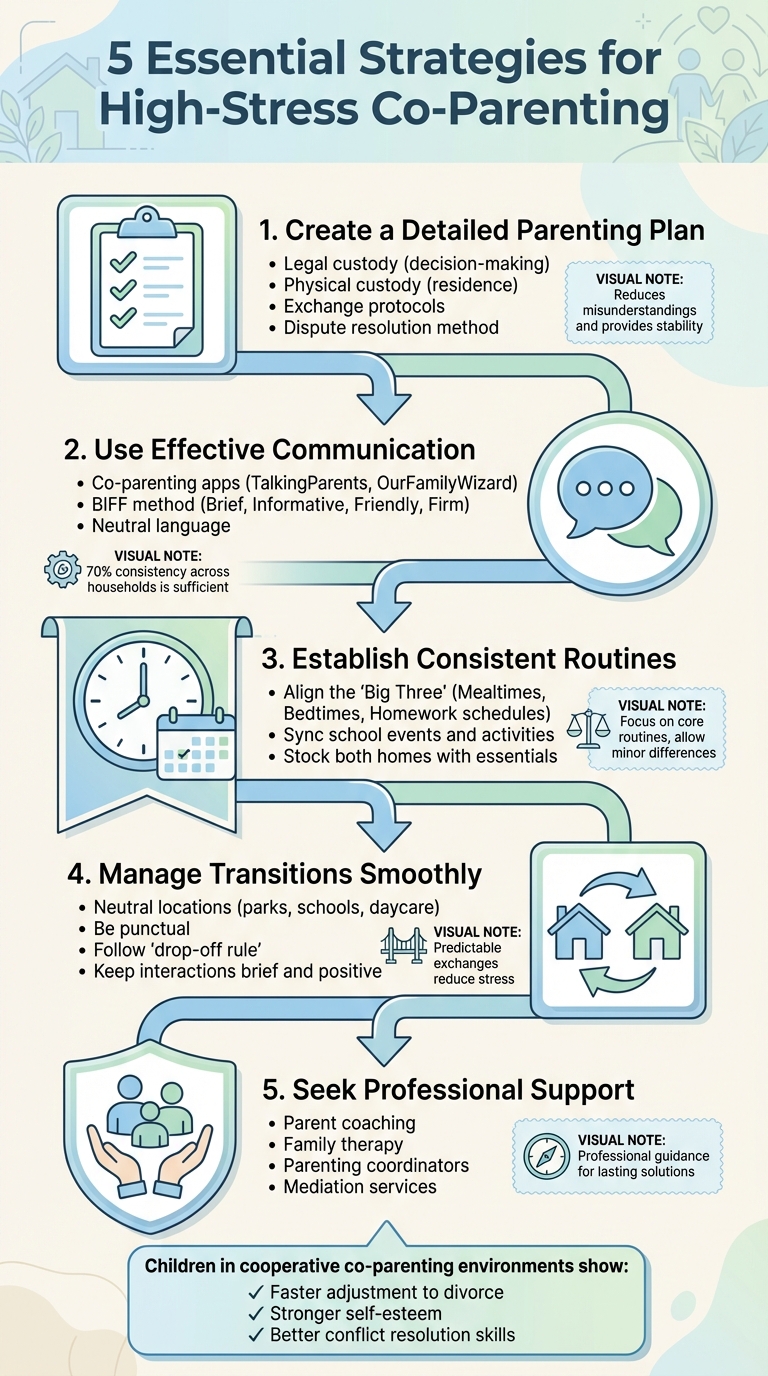
5 Essential Strategies for Successful High-Stress Co-Parenting
High-Conflict Co-Parenting: How to Protect Your Kids and Your Peace
Creating a Detailed Parenting Plan
A well-thought-out parenting plan helps reduce misunderstandings and disputes [10]. Instead of vague visitation agreements, a detailed schedule provides your child with stability and minimizes the need for constant negotiations with your co-parent.
"The court believes that parents should make their own plans for their child since parents know their child and their child’s needs" [10].
Clearly outline both legal custody (decision-making authority for education, healthcare, and welfare) and physical custody (residence and visitation arrangements) to avoid potential confusion during disagreements [10][11]. Be specific about details like exchange times and locations, how long one parent should wait in case of delays, and whether you’ll interact during handoffs. You might also include a right of first refusal clause, which means if one parent needs childcare for a certain period, they must first offer the other parent the opportunity to care for the child before seeking outside help [9].
Plan for common disruptions, like illness, by including protocols for making up missed visits [9]. Additionally, agree on a dispute resolution method – such as working with a designated mediator – so you can resolve disagreements without repeatedly going back to court [9]. Once you’ve established the logistics, the next step is defining each parent’s roles to streamline co-parenting.
Defining Roles and Responsibilities
Clearly outlining each parent’s responsibilities for education, healthcare, and day-to-day logistics can help prevent conflicts [1][11]. For example, decide who will attend parent-teacher conferences, assist with homework, and choose extracurricular activities. For healthcare, determine who will schedule doctor appointments, accompany the child to visits, and make emergency medical decisions. When it comes to logistics, specify who handles school drop-offs, transportation to activities, and packing for overnight stays [1][11].
When it comes to decision-making, clarify how authority will be divided. Will one parent have the final say in specific areas, or will decisions require mutual agreement? For instance, you might alternate years for choosing summer camps or require both parents’ approval for major medical procedures. These arrangements prevent stalemates in time-sensitive situations. Think of your co-parenting dynamic as a professional partnership, with your shared "business" being your child’s well-being [1]. Use respectful and collaborative language when assigning tasks [1].
Planning for Special Events and Holidays
Planning ahead for special occasions can help avoid unnecessary disputes [12]. Many families alternate major holidays like Thanksgiving and Christmas every other year, while assigning specific days like Mother’s Day and Father’s Day to the respective parent [12].
If you live near each other, you could split the holiday into morning and afternoon shifts. Alternatively, for a less hectic approach, consider celebrating twice – your child could enjoy two Thanksgivings or birthday parties with each side of the family [12]. For parents who live far apart, include provisions for virtual visits using platforms like FaceTime or Zoom. This allows the other parent to participate in moments like opening presents or other celebrations remotely [12].
Building on the defined roles, establish clear timelines for events to avoid last-minute confusion. Specify exact exchange times for special occasions rather than leaving them open-ended [12]. Also, plan for scenarios like a child falling ill right before a holiday visit. Children of divorced parents often feel anxious about events where both parents are present, such as graduations or weddings [9]. A well-prepared plan can ease these worries by addressing potential scenarios in advance, ensuring smoother transitions and a sense of stability for your child.
Communication Strategies for Co-Parents
Just like a solid parenting plan, clear and respectful communication forms the backbone of successful co-parenting. Keeping the focus on professionalism and your child’s well-being is key to effective collaboration [5].
"Focusing on respectful, intentional communication and interactions with your ex can help you collaborate better to accomplish a shared goal." – TalkingParents [5]
Sometimes, written communication works better than phone calls or face-to-face conversations. Writing things down gives you time to reflect and creates a record, which can be useful for legal purposes. Studies show that cooperative co-parenting helps kids thrive, while high-conflict situations can lead to anxiety, depression, or ADHD [4][7]. By combining a detailed parenting plan with thoughtful communication strategies, you can create a more stable environment for your child.
Using Neutral Communication Platforms
Co-parenting apps like TalkingParents, OurFamilyWizard, and Custody X Change are game-changers. They centralize schedules, expenses, and messages, offering court-admissible records of all interactions [3]. Some apps even have features like hostility monitors, which flag aggressive language before messages are sent, encouraging more civil communication [3].
When messaging, try the BIFF method – keep it Brief, Informative, Friendly, and Firm [6]. For instance, instead of writing, "You never tell me about doctor appointments and it’s so frustrating", you could say, "Please share the date and time of Jamie’s next dentist appointment by Friday at 5:00 PM."
If digital communication feels overwhelming, set specific times for non-emergency contact. For example, agree on phone calls only on Tuesday evenings to avoid unnecessary disruptions while ensuring important updates are shared [6]. In high-conflict situations, parallel parenting might be a better option. This approach minimizes interaction, with each parent managing their household independently [3].
Setting and Respecting Boundaries
Beyond structured communication, setting clear boundaries is crucial. Keep discussions strictly about your child – focus on topics like education, health, schedules, and activities [3]. Avoid rehashing past personal issues or grievances. If a conversation veers off-topic, use the "Grey Rock" method by responding with brief, neutral messages. For example, if you receive a message criticizing your new partner, simply reply, "I’ll pick up the kids at 3:00 PM on Friday as planned."
"Co-parenting after separation or divorce is complicated. Both parents must figure out how to be consistent with rules and boundaries with children in two homes and establish/adhere to boundaries between the parents." – Minkyung Chung, MS, LMHC [15]
When addressing concerns, use "I" statements instead of "You" statements to avoid sounding accusatory. For instance, say, "I feel concerned when pickup times change without notice", rather than, "You always change plans at the last minute" [7]. Also, keep your kids out of the middle – don’t use them as messengers. Instead, communicate directly through email or a co-parenting app [14].
Lastly, consider keeping a custody journal. Document parenting schedules, any deviations, interactions, and how household privacy is respected. This can be invaluable if legal mediation is ever needed [15].
Establishing Consistent Routines Across Households
Children feel more at ease when their lives have a sense of predictability, especially during the challenges of separation or divorce. Keeping routines consistent across both homes helps reduce their anxiety and provides a sense of stability during transitions [1][20]. Studies indicate that maintaining about 70% consistency is enough to meet a child’s emotional and developmental needs [8].
"Consistency doesn’t mean rigidity – it means creating a sense of safety and predictability in their world." – Empowered Therapy [8]
Focus on aligning the big three: meal times, bedtimes, and homework schedules. These routines form a solid foundation, giving kids a sense of familiarity no matter which parent they are with [16][18][19]. For younger children, it’s important to coordinate around developmental milestones, like potty training or transitioning away from pacifiers, to avoid sending mixed signals [20]. Older kids benefit from uniform expectations for curfews, screen time, and completing homework.
Aligning Key Activities and Schedules
To ensure smooth coordination, start by syncing schedules for school events, extracurricular activities, and medical appointments. Tools like co-parenting apps or a shared Google Calendar are excellent for staying organized without the need for constant back-and-forth messages [16][17][20]. A weekly check-in, such as a Sunday evening call, can help confirm plans, update schedules, and address upcoming needs like permission slips or sports gear.
Set up similar homework spaces in both homes – quiet desks with good lighting and necessary supplies – to help kids focus, regardless of where they are [16]. Make sure each home is stocked with essentials like toothbrushes, pajamas, and other daily items, so transitions are seamless [18]. Reviewing the day’s plan with your child each morning can also ease any uncertainty they might feel [20].
When it comes to discipline, it’s crucial to support each other’s decisions. For example, if one parent grounds the child from electronics for the weekend, the other parent should uphold that consequence [18]. Presenting a united front teaches children that they can’t manipulate one parent against the other.
"When children see their parents as partners, whether on the calendar or through shared expectations, it fosters a sense of security that allows for confidence in their long-term growth and development." – Bright Horizons [20]
While maintaining consistency in major routines is key, some differences between households are perfectly fine.
Allowing for Household-Specific Differences
It’s unrealistic – and unnecessary – to expect perfect alignment between two households. Each parent can and should manage smaller daily decisions, like chore assignments, meal choices, or slight differences in bedtime routines, within their own home [6]. Children can adapt to these variations without confusion, as long as the core routines remain steady [1].
"Each parent should have sole decision-making authority in his or her home regarding rules and responsibilities, bedtimes and chores, during his or her parenting time… children also need to learn that there is more than one way of doing things." – Bill Eddy, LCSW, Esq., High-Conflict Institute [6]
Minor differences, such as one parent serving dinner at 6:00 PM while the other serves it at 6:30 PM, won’t harm your child [1]. Focus your energy on the bigger issues – like their safety, education, health, and emotional well-being. Avoid interrogating your child about what happens at the other house, as this can increase their stress and put them in an awkward position [6].
sbb-itb-596b85d
Managing Transitions and Reducing Tension During Exchanges
Managing transitions effectively is a key part of reducing tension during co-parenting exchanges. These moments often involve both reunions and separations, which can make them emotionally charged for everyone involved, especially children [1]. By planning ahead, you can turn potentially stressful transitions into smoother, predictable routines that prioritize your child’s emotional well-being.
Choosing Neutral Locations for Exchanges
Where exchanges happen can make a big difference. Public spaces like parks, coffee shops, or daycare centers naturally encourage polite interactions due to the presence of others [21][22]. On the other hand, using the former family home for exchanges can stir up emotional memories or anxiety for your child and is best avoided [22].
In situations where direct interaction between parents might lead to conflict, indirect exchanges can be a smart alternative. For instance, one parent could drop the child off at school in the morning, and the other could pick them up later. Other neutral locations – like daycare centers, a babysitter’s home, or a grandparent’s house – can also work well as handoff points [21].
"In contentious situations, the more you see your ex, the more potential there is for friction and conflict. Sometimes it’s simply best not to see each other if you can avoid it." – Goldberg Jones [21]
For cases involving serious safety concerns, police stations or supervised visitation centers provide monitored environments that ensure both compliance and your child’s safety [21][23]. Once a neutral location is chosen, the next step is to create a predictable handoff process.
Creating Predictable Handoff Protocols
Being punctual during exchanges is a simple yet powerful way to build trust. Agree on specific handoff times, and if you’re running late, send a quick text to let the other parent know [13].
A helpful strategy is to follow the "drop-off rule", where the parent currently with the child delivers them to the other parent’s location. This avoids the impression of "taking" the child away and helps maintain a positive tone. To make transitions smoother, have all essential items – like medications, homework, or favorite comfort objects – ready in advance [21].
"Approach the relationship with your ex as a business partnership where your ‘business’ is your children’s well-being. Speak or write to your ex as you would a colleague – with cordiality, respect, and neutrality." – HelpGuide [1]
For logistical planning, tools like co-parenting apps or simple text messages can help streamline communication. Keep the focus strictly on the transition itself. When meeting in person, keep interactions brief and upbeat – a quick "See you next week" can be enough to set the right tone. These steps help create a consistent, child-focused environment, making transitions easier for everyone.
Getting Professional Support for High-Stress Co-Parenting
While maintaining consistent routines is critical, sometimes high-stress co-parenting situations call for outside help. Professional support can provide the tools and perspective needed to manage conflict and keep the focus on your child’s well-being. Counselors, therapists, or parent coaches can guide you through challenges and help you develop strategies that work for your unique situation.
Benefits of Parent Coaching
Parent coaching is a practical, hands-on way to build skills tailored to your specific needs. Unlike traditional therapy, which often delves into past experiences, coaching focuses on actionable strategies you can use right away. These skills include expressing love, managing stress, and modeling healthy relationship behaviors. With professional guidance, you can strengthen these essential parenting tools.
Growth and Change Counseling offers parent coaching and family therapy designed for high-stress situations, including high-conflict co-parenting. Their approach is solutions-focused, addressing challenges like neurodiversity, trauma, and communication breakdowns. Services are available in Campbell, CA; San Jose, CA; Los Angeles, CA; and Roseville, CA, as well as through telehealth across California. Individual therapy sessions with an Associate Marriage and Family Therapist (AMFT) start at $150 for a 45-minute session, with sliding scale options starting at $100 for those with financial need.
Coaches often teach strategies like the "Press Pause" method, where you take a 15-minute break when conversations become heated. They also encourage using "I" statements – such as saying, "I feel overwhelmed when schedules change" instead of "You always change the schedule" – to reduce conflict and model healthy communication for your children [7][24][25].
"Engaging in professional family therapy sessions can help you understand what boundaries are and to have clear communication with one another, despite the feelings surrounding the divorce." – Minkyung Chung, MS, LMHC, Talkspace [15]
In Alameda County, a fatherhood program showed that role-playing and communication scripts can significantly boost fathers’ confidence and reduce co-parenting tension [25]. These types of immediate techniques create a foundation for lasting improvements, which more in-depth therapy can continue to build upon.
Finding Solutions for Long-Term Success
For lasting progress, professional therapy or coaching can address deeper issues like unresolved resentment or unclear boundaries, helping you stay focused on your child’s needs. Professionals provide a neutral, supportive space to release frustrations without projecting them onto your children [18]. They also teach strategies for setting and maintaining clear boundaries around communication, parenting styles, and household rules [15].
When looking for the right professional, consider Licensed Marriage and Family Therapists (LMFT) or Licensed Clinical Social Workers (LCSW) who specialize in high-conflict family dynamics or complex co-parenting scenarios [26][15]. For particularly difficult situations – such as those involving high-conflict personalities – you might benefit from working with a Parenting Coordinator, who acts as a neutral mediator, or a Parent Coach, who focuses on practical skill-building and regaining parental authority [26][3].
Many practices, including Growth and Change Counseling, offer free consultations to help you determine if their approach aligns with your needs. You can also ask about specialized training in areas like trauma-informed care, addiction, or neurodiversity, which can further ease co-parenting stress. Seeking professional help now can prevent long-term conflict and create a healthier, more stable environment for your children.
Conclusion
Co-parenting during high-stress situations requires unwavering attention to your children’s well-being. Setting aside personal conflicts and maintaining steady household routines can provide the stability kids need. Studies highlight that children in cooperative co-parenting setups tend to adjust more quickly to divorce, develop stronger self-esteem, and gain a better understanding of peaceful conflict resolution [18][7].
The strategies discussed in this guide – crafting detailed parenting plans, using neutral communication tools, establishing steady routines, and handling transitions thoughtfully – are all designed to reduce tension and shield your children from unnecessary stress. Keeping communication respectful and focused on parenting isn’t just about avoiding disputes; it’s about actively protecting your children’s mental and emotional health.
"Your marriage may be over, but your family is not; acting in your kids’ best interest is your most important priority." – HelpGuide.org [18]
This perspective underscores the importance of seeking professional assistance when navigating high-conflict situations.
If open communication breaks down, professional support can make a significant difference. Parent coaching, family therapy, or mediation can provide the neutral guidance and practical tools needed to handle challenging circumstances. Growth and Change Counseling offers specialized parent coaching and family therapy for high-conflict co-parenting, with services available across California.
Your children are always observing how you handle co-parenting challenges. They learn more from your actions than your words [2]. By focusing on their needs, maintaining consistency, and seeking help when required, you’re teaching them invaluable lessons in resilience, respect, and problem-solving.
Moving Forward Together with Growth and Change Counseling
How can co-parenting apps help improve communication during stressful situations?
Co-parenting apps are incredibly helpful when it comes to easing communication in challenging circumstances. They offer structured, neutral platforms that allow parents to share essential information like calendars, expenses, and messages securely. This setup helps cut down on misunderstandings while keeping both parties organized and focused on what matters most – their children.
Some apps even go a step further with features like tone management or message filtering, which promote respectful conversations, even when emotions are running high. By providing a transparent way to document interactions and decisions, these tools can reduce conflict and encourage a more collaborative co-parenting dynamic.
How can co-parents create consistent routines for their children across two households?
Establishing consistent routines across two households is crucial for giving kids a sense of stability and lowering their stress levels. Start by putting together a well-thought-out parenting plan that clearly lays out daily schedules, responsibilities, and expectations. This plan should include key elements like bedtimes, meal routines, homework guidelines, and transitions between homes. As your child grows and their needs evolve, make sure to revisit and adjust the plan accordingly.
Good communication is just as important. Keep discussions respectful and stay focused on what’s best for your child. Work together to agree on shared values and consistent rules for both households. Predictable routines can provide kids with a sense of security, so try to avoid unnecessary disruptions. Show them how to handle stress and communicate in healthy ways. By collaborating, co-parents can create a nurturing environment that puts their child’s well-being first.
When is it a good idea for co-parents to seek professional help to resolve conflicts?
When co-parenting conflicts become frequent, heated, or hard to resolve, it might be time to seek professional assistance – especially if the tension is impacting your child’s well-being or creating a stressful home environment. Ongoing disagreements can make it tough to co-parent effectively and add unnecessary strain to everyone involved.
If communication has broken down, arguments are escalating, or attempts to establish a stable routine for your child aren’t working, reaching out to a professional could make a big difference. Mediators, therapists, or parenting coaches can step in to help. They can guide you in improving communication, addressing deeper issues, and developing practical strategies that promote a healthier co-parenting relationship – benefiting not just you, but the entire family.
Related Blog Posts
- Ultimate Guide to Co-Parenting in Recovery
- Mental Health and Co-Parenting: Problem-Solving Strategies
- 5 Steps to De-Escalate Co-Parenting Arguments
- How to Communicate Effectively in High-Stress Co-Parenting
