Trauma-informed family therapy focuses on helping families recover from the emotional and relational effects of trauma. Setting clear, actionable goals is a critical part of this process, ensuring every family member understands their role in healing. This approach prioritizes safety, collaboration, and building on strengths to create a supportive environment for progress.
Key Highlights:
- Safety first: Therapy spaces must feel emotionally and physically secure to encourage open participation.
- Collaborative goal-setting: Every family member contributes, ensuring shared understanding and commitment.
- Strengths-based focus: Goals are framed around existing family strengths, promoting confidence and sustained progress.
- SMART goals: Objectives should be Specific, Measurable, Achievable, Relevant, and Time-bound for clarity and accountability.
By addressing safety, emotional regulation, and relationship dynamics, families can work toward both short-term improvements and long-term healing. Regular check-ins, flexibility, and celebrating milestones keep the process on track and motivate continued growth.
Trauma-Informed Therapy: Finding the Right Fit for Your Family
Core Principles of Trauma-Informed Goal-Setting
Trauma-informed goal-setting is built on three key principles: safety, collaboration, and a strengths-based approach. These principles ensure therapy supports healing rather than unintentionally causing further harm. By embedding trauma-awareness into every stage of therapy – from initial assessments to regular sessions – therapists create an environment where families can make meaningful progress [7]. These foundational ideas guide the practical steps for setting effective goals in trauma-informed family therapy.
Safety and Trust as the Foundation
Establishing physical and emotional safety is the first step in any goal-setting process. For families to engage openly, they need to feel secure – both physically and psychologically – within the therapy space. Therapists must actively avoid practices that could trigger traumatic memories and ensure transparency in their clinical decisions [7]. John Mark Kane, LMFT, captures this sentiment perfectly:
"I believe that therapy is a safe space for people to be whoever they are right now, no matter how bad they feel about themselves or their lives." [8]
Building trust is equally important. Families are more likely to engage when they feel their experiences are respected and their voices matter. This means therapists should avoid imposing solutions and instead work to balance the power dynamic between themselves and the family members [7].
Collaboration and Family Involvement
Goal-setting works best when every family member has a voice. Open discussions that allow each person to feel heard foster a shared understanding of the challenges at hand and the steps needed to move forward [4][5]. As Influence Therapy explains:
"Each family member’s involvement nurtures growth and fosters trust, while the SMART framework provides structure to guarantee those seeds flourish." [5]
Structured tools, like a Statement of Need, can help align the family’s priorities with the therapist’s observations and any external requirements from referring parties [9]. This collaborative approach ensures that the goals are both meaningful and actionable.
Strengths-Based Approach
Every family has strengths, even in the face of trauma, that can support recovery. A strengths-based approach focuses on what’s working rather than solely on what’s broken. This perspective helps families build confidence by setting achievable targets and celebrating small victories along the way [1][8][10].
During initial assessments, therapists should identify the family’s past efforts to overcome challenges and the unique strengths they bring to the process [10]. These strengths might include close family bonds, problem-solving skills in other areas of life, or values that promote healing. Framing goals around these existing strengths encourages emotional investment and sustained progress [5]. Regular check-ins to review progress also help highlight successes and adjust strategies as needed [5][9].
| Principle | Application in Goal-Setting |
|---|---|
| Safety | Creating an environment where all family members feel physically and emotionally secure [7]. |
| Trustworthiness | Making decisions transparently to maintain family engagement and confidence [7]. |
| Collaboration | Ensuring the family leads the goal-setting process by leveling power dynamics [7]. |
| Empowerment | Highlighting family strengths to build confidence and motivate progress [7]. |
Steps for Setting Trauma-Informed Family Goals
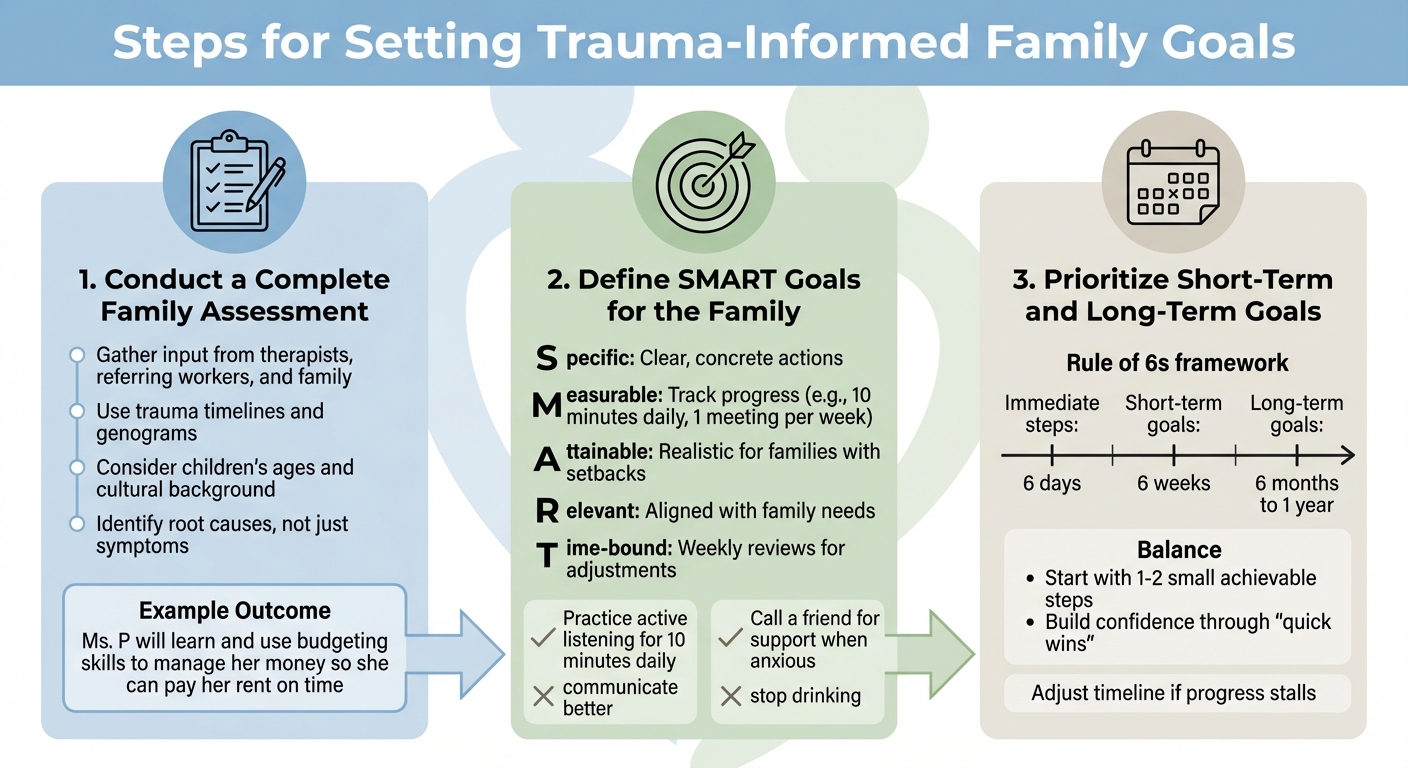
3-Step Process for Setting Trauma-Informed Family Therapy Goals
Creating trauma-informed goals involves a thoughtful, step-by-step process tailored to each family’s unique experiences. The following steps outline a clear path for setting meaningful and achievable goals.
Step 1: Conduct a Complete Family Assessment
A detailed assessment is the foundation of effective goal-setting. This involves gathering input from therapists, referring workers, and the family itself [9]. Instead of just listing symptoms, use tools like trauma timelines and genograms to uncover the root causes of challenges and map out how traumatic events have shaped the family over time [12][8].
It’s also essential to consider factors like the ages of the children and the family’s cultural background, as these play a role in how they process and recover from trauma [1].
Take, for example, a case from Intensive Family Preservation Services. A therapist worked with Ms. P, a mother of three children – Larry, Curly, and Moe. The referring worker highlighted financial struggles, citing $900 rent versus $1,500 in SSI income. However, Ms. P’s perspective revealed a different focus: she needed help budgeting for school clothes and small treats for her kids. By combining these perspectives, they set a clear and actionable goal: "Ms. P will learn and use budgeting skills to manage her money so she can pay her rent on time." This goal included a measurable objective: using a budgeting sheet daily by Week 2 [9].
This thorough assessment naturally leads to the next step: crafting specific and actionable objectives.
Step 2: Define SMART Goals for the Family
Once the assessment is complete, families can translate insights into SMART goals – Specific, Measurable, Attainable, Relevant, and Time-bound. These goals should focus on clear, concrete actions rather than vague aspirations. For instance, instead of saying "communicate better", a SMART goal might be "practice active listening for 10 minutes daily" [9][11]. Adding measurable elements, like holding one family meeting per week, helps track progress [3].
Attainability is especially important for families who have faced repeated setbacks. As Julie Rohovit, PhD, Director at the University of Minnesota, explains:
"In life, as in foot-ball, you won’t go far unless you know where the goalposts are. Swap out ‘life’ for recovery and the adage holds equally true." [11]
Goals should be framed positively. For example, instead of "stop drinking alcohol when anxious", reframe it as "call a specific friend for support when feeling anxious." This approach provides a clear, constructive path forward [11].
Time-bound goals add structure and urgency. Weekly reviews allow therapists and families to evaluate progress and make adjustments based on the family’s capacity, motivation, and circumstances [9].
Step 3: Prioritize Short-Term and Long-Term Goals
After defining SMART goals, it’s important to balance immediate needs with long-term aspirations. This prevents families from feeling overwhelmed and helps maintain focus. Short-term goals often address immediate behavioral changes or relational dynamics, offering "quick wins" to build confidence and momentum [4]. Long-term goals, on the other hand, aim for deeper, lasting changes that guide the family toward sustained growth [4].
A useful framework is the "Rule of 6s": set long-term goals for 6 months to 1 year, short-term goals for 6 weeks, and immediate steps for 6 days [11]. For families with a history of trauma, starting with one or two small, achievable steps can make a big difference [11]. For example, a complex goal like rebuilding relationships can be broken into smaller, manageable actions to help the family build confidence and feel a sense of progress.
If progress stalls, the steps can be simplified or the timeline adjusted [9]. This flexible approach ensures goals remain attainable and keeps families motivated, even as circumstances evolve.
sbb-itb-596b85d
Types of Trauma-Informed Goals in Family Therapy
When families approach therapy with a focus on recovery, their goals often align with key principles like safety, collaboration, and building on strengths. These goals can be grouped into three main categories, each addressing different aspects of healing. By understanding these categories, families and therapists can work together to create a plan that addresses both immediate concerns and long-term growth.
Safety Goals
Safety goals lay the groundwork for effective therapy by prioritizing both physical and emotional security. These goals might include establishing consistent routines, setting clear boundaries, and identifying potential triggers. For example, families dealing with financial challenges might focus on practical steps like creating a budget to ensure housing stability. These foundational goals help create a secure environment where healing can begin.
Emotional Regulation Goals
Emotional regulation goals focus on helping family members manage the intense emotions that often accompany trauma, such as anger, anxiety, or depression. These goals aim to equip individuals with tools to navigate trauma-related survival responses like fight, flight, or freeze. For instance, a practitioner at the University of Minnesota worked with a client who wanted to "feel better." Together, they developed a plan involving regular exercise: the client chose a walking route and committed to inviting a friend for 2–3 walks per week. They tracked anxiety levels before and after each walk to measure progress [11]. These kinds of goals not only improve emotional well-being but also lay the groundwork for stronger interpersonal relationships.
Relationship Goals
Trauma often disrupts family dynamics, making relationship goals a critical part of the healing process. These goals focus on rebuilding trust, improving communication, and strengthening connections. For example, a family might aim to enhance active listening and clarify roles within the household. One approach could involve scheduling regular family check-ins where everyone has a chance to share and feel heard. In another instance, a family set specific strategies to deepen emotional bonds and reduce conflict over a four-month period [3]. By fostering collaboration and understanding, these goals help families rebuild their relationships and move forward together.
Monitoring Progress and Adjusting Goals
After setting clear goals, it’s important to keep an eye on progress to ensure the family stays on track with their recovery journey.
Using Feedback from Family Members
Encouraging families to take an active role in tracking their progress fosters a sense of ownership and self-determination. Regular check-ins provide a natural chance for everyone to share what’s working and what might need adjustment. These conversations should be open and judgment-free, creating a safe space for family members to express themselves honestly. One helpful tool is scaling questions – asking someone to rate their emotional state on a scale of 1 to 10 can offer a clear starting point for discussion [2]. The goal is to create a balanced feedback loop, ensuring therapy adapts to the family’s changing needs. From here, challenges can be reframed as opportunities for growth.
Addressing Challenges and Setbacks
Recovery is never a straight path. As MHA National explains:
"The road to recovery is not linear. At times it may feel like your loved one is taking one step forward and two steps back, but even slow progress is progress" [13].
When setbacks occur, therapists can help families by breaking larger goals into smaller, achievable steps. Exception questions – which explore moments when the issue wasn’t present – can uncover strategies that have worked before [2]. Scheduling reviews every 4–8 weeks allows families to reassess and adjust their goals as needed [6]. The focus should always be on steady, incremental progress rather than striving for perfection. Alongside addressing setbacks, it’s equally important to recognize milestones to sustain motivation.
Celebrating Progress and Building Resilience
Acknowledging even the smallest victories reinforces positive changes [14]. Studies indicate that 50–66% of trauma survivors experience personal growth, making milestone celebrations a vital part of recovery [14][15]. Goldy from Kids First highlights:
"Celebrating milestones is not just a matter of pleasure; it’s an essential component of personal growth and emotional well-being" [14].
Families might keep a milestone journal to document their achievements or use progress charts as visual reminders of how far they’ve come. Celebrating these moments fosters a sense of shared purpose and helps reduce the stigma surrounding mental health. Recognizing progress not only builds resilience but also keeps families motivated to continue their healing journey.
Conclusion
Trauma-informed goal-setting emphasizes safety, collaboration, and adaptability. At its core, it ensures that every family member feels heard and valued. As Influence Therapy puts it:
"In family therapy, establishing clear goals is like planting seeds in a garden. Each family member’s involvement nurtures growth and fosters trust" [5].
By working together, families create goals that arise naturally from their shared commitment to healing, rather than having them imposed by outside forces.
Using the SMART framework – Specific, Measurable, Achievable, Realistic, and Timely – provides a practical way to set clear objectives while maintaining the flexibility essential for trauma recovery [9]. Weekly 30-minute check-ins offer a chance to stay on track and make adjustments as needed.
Growth and Change Counseling builds on these principles with trauma-informed techniques designed to address deep-seated issues and foster long-term resilience. Serving families in Campbell, San Jose, Los Angeles, Roseville, and throughout California via telehealth, their approach focuses on tackling the root causes of trauma instead of just managing symptoms [8].
With over 13 years of experience, they specialize in helping families navigate complex trauma, neurodiverse relationships, teen behavior challenges, and parent coaching. Their evidence-based treatments – such as EMDR, somatic therapy, and CBT – are paired with practical assignments to help integrate progress into daily life. By offering a safe, judgment-free space, they empower families to take control of their healing journey and move forward with renewed confidence.
Moving Forward with Growth and Change Counseling
How does trauma-informed family therapy create a safe space for everyone involved?
Trauma-informed family therapy prioritizes creating a safe and supportive environment by acknowledging that each family member experiences and processes trauma in their own way. Factors like age, personal history, and the nature of their exposure to trauma all play a role in shaping their responses. This approach is rooted in empathy, respect, and a commitment to making every individual feel understood and valued.
Therapists work to build trust and encourage open communication, ensuring that family members feel emotionally supported throughout the process. By setting clear, manageable goals, therapy helps restore a sense of control and stability within the family dynamic. The focus is on healing, strengthening relationships, and laying the groundwork for recovery and growth together.
How do SMART goals support trauma-informed family therapy?
SMART goals – specific, measurable, achievable, relevant, and time-bound – play a key role in trauma-informed family therapy. They offer a clear framework, helping families concentrate on practical steps and realistic changes, while giving a sense of purpose and direction. When therapists involve all family members in setting these goals, it fosters teamwork and ensures the objectives reflect the family’s unique circumstances and dynamics.
Another advantage of SMART goals is their ability to simplify progress tracking, keeping the focus on positive and manageable outcomes. In the context of trauma-informed care, where trust and emotional safety are paramount, these goals empower families to take steady, meaningful strides toward healing and growth.
What are the benefits of using a strengths-based approach in trauma-informed family therapy?
A strengths-based approach in trauma-informed family therapy shifts the focus toward the family’s existing abilities and resilience, steering away from just concentrating on their struggles. By highlighting what families already do well, this perspective nurtures a sense of hope and empowers them to tap into their own resources and coping skills. This can boost confidence and motivation, making it easier to set and work toward meaningful goals for healing and growth.
Focusing on strengths also encourages positive emotions and productive problem-solving within the family unit. It helps foster a sense of control and resilience, both of which are crucial for overcoming trauma and achieving lasting progress. This method allows families to see their potential and work together toward recovery in a way that feels empowering and achievable.
Related Blog Posts
- Trauma-Informed Family Therapy Techniques
- Family Therapy for Trauma Recovery: What Works
- Trauma-Informed Family Therapy for Attachment Issues
- How Family Therapy Improves Trauma Communication
