When one partner has Obsessive-Compulsive Personality Disorder (OCPD) and the other is neurodivergent (e.g., autistic or ADHD), relationships can feel like navigating two very different worlds. OCPD’s rigid need for order and control often clashes with neurodivergent traits like spontaneity or sensory sensitivities. Miscommunication, emotional distance, and cycles of criticism are common challenges.
Here’s what you need to know:
- OCPD partners often struggle with flexibility and may prioritize being “right” over emotional connection.
- Neurodivergent partners may feel judged or unsupported due to differing communication styles or needs.
- Both partners can feel misunderstood, leading to resentment and emotional withdrawal.
The good news? With clear communication, empathy, and realistic expectations, these relationships can thrive. Focus on understanding each other’s needs, using “I” statements, and creating emotional safety. Professional therapy, especially with a specialist, can also help bridge the gap between differing perspectives.
This guide explores practical strategies to build connection and reduce conflict in OCPD-neurodivergent relationships.
10 Ways to Talk to Someone with OCPD
How OCPD and Neurodivergence Interact in Relationships
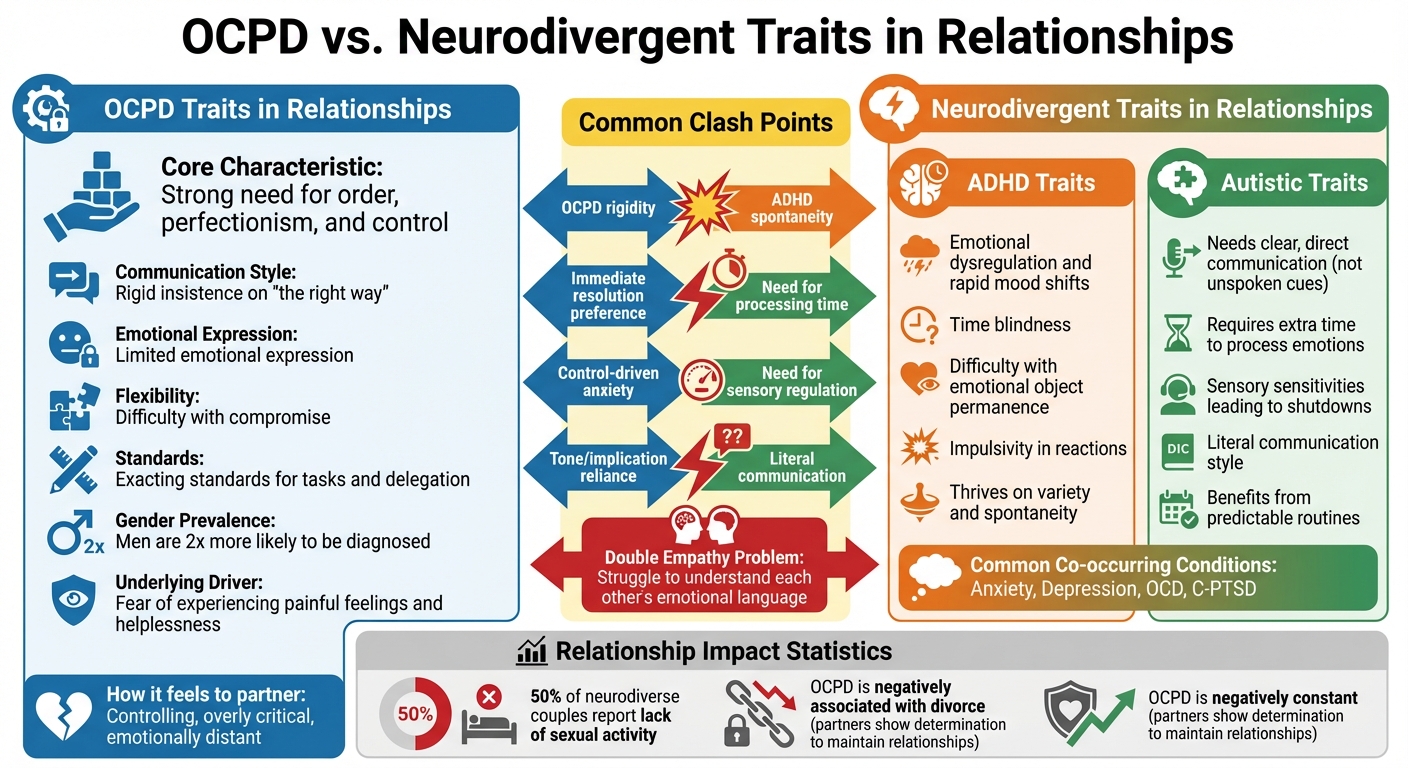
OCPD vs Neurodivergent Traits in Relationships: Key Differences and Emotional Impact
OCPD Traits and Their Effect on Relationships
Obsessive-Compulsive Personality Disorder (OCPD) is marked by a strong need for order, perfectionism, and control [3]. Individuals with OCPD often adhere rigidly to rules and schedules, finding it difficult to delegate tasks unless others meet their exacting standards [3]. In relationships, this can manifest as a persistent insistence on doing things "the right way", which may come across as domineering or overly critical [1]. Complicating matters, those with OCPD usually view their approach as the correct one, making compromise challenging [3]. Emotional expression is often limited, which can leave their partners feeling isolated or emotionally neglected [3]. Interestingly, men are twice as likely as women to be diagnosed with OCPD [1].
"Underneath OCPD is usually a fear of experiencing painful feelings and the helplessness of not being able to control anything." – Imi Lo, MA [3]
On the other hand, neurodivergent traits bring a different set of dynamics to relationships.
Neurodivergent Traits in Relationships
While OCPD leans heavily on rigidity, neurodivergence introduces unique emotional and behavioral patterns. For example, ADHD often involves emotional dysregulation, rapid shifts in feelings, and difficulty maintaining emotional balance [2]. Time blindness and challenges with emotional object permanence can lead to moments of unintentional neglect, particularly during periods of hyperfocus [2][4]. Impulsivity may also cause reactions that feel overwhelming to a partner who values predictability [2].
Autistic individuals, by contrast, tend to benefit from clear, direct communication rather than relying on unspoken cues [2]. They may require more time to process and identify emotions, which can sometimes be mistaken for withdrawal or disinterest [2]. Additionally, sensory sensitivities might lead to shutdowns or avoidance behaviors, which can be misinterpreted as emotional disengagement [2][4]. Neurodivergent individuals often experience co-occurring conditions such as anxiety, depression, OCD, or C-PTSD, further complicating relationship dynamics [2].
When OCPD and Neurodivergent Traits Clash
The interaction of these differing traits can sometimes lead to friction as partners struggle to meet each other’s needs. For instance, an OCPD partner’s rigid insistence on doing things "the right way" may feel stifling to an ADHD partner who thrives on variety and spontaneity [2]. Similarly, an autistic partner’s need for extra time to process emotions may conflict with an OCPD partner’s preference for immediate resolutions and strict schedules [2].
Miscommunication often arises from what researchers call the "double empathy problem", where individuals with different neurotypes struggle to understand each other’s emotional language and social cues [2][6]. For example, an autistic partner’s literal communication style might confuse an ADHD partner who relies more on tone and implication [2][6]. At the same time, the OCPD partner’s anxiety-driven need for control can feel like criticism, while the neurodivergent partner’s need for sensory regulation or alone time may be perceived as rejection [1][2].
Despite these challenges, these relationships can thrive when both partners shift from judgment to curiosity. By openly sharing their internal experiences in ways the other can understand, couples can use their differences as opportunities for growth and connection [2][6].
The Emotional Cost of Misunderstanding
When traits of OCPD and neurodivergence collide, the result is often a breakdown in communication that chips away at the emotional bond between partners. Over time, this disconnect fosters feelings of invisibility and undervaluation, leading to resentment and emotional distance. These tensions shape the unique emotional experiences of each partner in the relationship.
What OCPD Partners Experience Emotionally
For partners with OCPD, their actions are often misunderstood as controlling. In reality, what may appear as rigid behavior is often a response to underlying anxiety – a defense mechanism protecting against deeper insecurities. When their high standards are questioned, it can feel like a direct attack on their competence and identity [1][7].
"While an OCPD spouse’s behavior may appear to be driven by self-interest, disrespect, or indifference, their motivations are actually much different." – Gary Trosclair, DMA, LCSW [7]
OCPD partners often see their meticulousness as a form of dedication and responsibility – an effort to do what’s best for the family. However, when their neurodivergent partner interprets these actions as critical or malicious, it can lead to feelings of hurt and resentment. This is compounded by the immense self-imposed pressure they feel to maintain order and avoid failure. For someone with OCPD, being "right" is closely tied to being "good." As a result, even gentle suggestions for change can feel deeply personal, triggering defensiveness and anger [1][5][7].
What Neurodivergent Partners Experience Emotionally
Neurodivergent partners often feel like they’re walking on eggshells, carefully modifying their behavior to avoid triggering criticism. The rigid "right versus wrong" lens through which their OCPD partner views the world can make a neurodivergent partner’s more flexible or non-linear way of handling tasks seem like a flaw or even a threat, inviting harsh judgment.
"Every day, you have to deal with your partner’s nit-picking, rigidity, and the standards they impose on you. Sadly, they are unaware of their behaviors and how they affect those around them." – Imi Lo, Author and Psychotherapist [3]
This constant criticism can wear down self-esteem, making neurodivergent partners feel incompetent or inadequate. Furthermore, when rules and routines are prioritized over spontaneity, the relationship can feel devoid of warmth, leaving the neurodivergent partner feeling emotionally neglected and unloved. Research shows that 50% of neurodiverse couples report a lack of sexual activity in their relationships, further highlighting the emotional strain [8].
How Miscommunication Creates Emotional Distance
Miscommunication is a key driver of emotional isolation in these relationships. The OCPD partner’s anxiety often leads to increased control, which in turn causes the neurodivergent partner to withdraw or react defensively. This cycle of control and withdrawal only deepens the divide.
"Doing things right can become more important than being happy together." – Gary Trosclair, DMA, LCSW [1]
Over time, repeated misunderstandings erode trust and vulnerability. Both partners may begin to withhold their emotions, leaving the relationship fraught with resentment and disconnection. It’s as if they’re speaking entirely different languages, with each attempt at connection falling flat [7][8].
How to Build Emotional Connection
After experiencing the challenges of miscommunication, couples can work toward rebuilding their connection through shared, intentional strategies. This requires effort from both sides, with the goal of creating a space where different processing styles can coexist. Instead of focusing on "fixing" one partner, the emphasis shifts to fostering mutual understanding and finding ways to accommodate each other’s needs. These approaches help bridge the gap between simply understanding differences and taking meaningful action.
Developing Empathy and Acceptance
Empathy is the foundation for connection, and it starts with reframing how we view each other’s traits. For example, traits associated with OCPD (Obsessive-Compulsive Personality Disorder) often act as protective mechanisms against anxiety, rooted in early experiences of shame or helplessness. These aren’t character flaws but coping strategies. Similarly, neurodivergent traits like needing extra processing time or reacting strongly to sensory input aren’t quirks or difficulties – they reflect genuine neurological needs.
Shifting focus to strengths rather than deficits can make a big difference. OCPD partners often bring qualities like loyalty, reliability, and an eye for detail, while neurodivergent partners may excel in creative problem-solving and adaptability. Assuming positive intent is key – different emotional expressions or behaviors don’t mean a lack of care. Developing what some therapists call "emotional bilingualism" can help both partners translate their internal experiences into terms the other can understand.
Setting Realistic Expectations
Realistic expectations are essential for navigating differences. Many conflicts stem from misinterpreting neurological differences as moral failings. Instead of labeling behaviors as "right" or "wrong", try viewing them as differences in approach. For instance, an OCPD partner’s preference for a structured routine isn’t inherently better than a neurodivergent partner’s ease with flexibility. These differences present opportunities for negotiation rather than conflict.
Couples can divide roles based on their strengths – one partner might handle structured tasks like bill payments, while the other focuses on decisions requiring adaptability. For those balancing routine and variety, "planned spontaneity" can be a helpful compromise, creating flexible plans that offer both predictability and room for change. Reassuring an OCPD partner that perfection isn’t necessary can also ease tension and reduce pressure for both sides.
Building Emotional Safety Together
Emotional safety grows when both partners feel their needs are respected and valued. One practical tool is establishing an "emotional pause" signal – a word or gesture that either partner can use to take a break when emotions run high. Using "I" statements (e.g., "I feel overwhelmed when…") instead of blaming language reduces defensiveness and fosters open communication.
"The magic happened when we stopped trying to love each other the same way and started loving each other the right way."
– Dr. K, Licensed Psychologist and Gottman-certified therapist
Creating sensory-friendly spaces at home can also help. This might mean dimmable lighting, noise-canceling headphones, or a quiet area for unwinding. For social events, consider practical arrangements like taking separate cars, so the partner with lower social stamina can leave early without disrupting plans. Regular check-ins can help avoid the stress of unexpected deep conversations. These small but meaningful adjustments show that both partners’ needs are equally valued, building trust and emotional security over time.
sbb-itb-596b85d
Communication Techniques That Work
Navigating relationships where partners process information differently can be challenging, but with the right strategies, couples can reduce misunderstandings and build stronger connections. Instead of relying on assumptions or subtle hints, structured communication approaches create clarity and address the unique challenges that arise from different neurotypes. This clarity helps foster deeper mutual understanding.
Using Clear and Direct Language
When partners process information in distinct ways, clear and direct communication becomes a must. Subtle cues might go unnoticed, particularly for autistic individuals, so it’s crucial to express needs and feelings plainly. For instance, instead of hinting at what you need, say something like, "I need 20 minutes alone to decompress."
Using "I" statements can also make a big difference by reducing defensiveness. As Gary Trosclair, LCSW, DMA, notes:
"Let them know the effect they have on you with ‘I’ statements (not ‘you’ statements). People with OCPD tend to be so consumed with getting projects done… that they may lose track of the effect they have on others." [5]
For example, saying "I feel overwhelmed when plans change suddenly" is far more constructive than "You always change plans without asking me."
Asking clarifying questions can further prevent miscommunication. Phrases like, "What do you mean by ‘support’ in this situation?" or "Are you looking for advice, or do you just need someone to listen?" can ensure both partners are on the same page. This approach ties into the Double Empathy Problem, which highlights how different neurotypes interpret communication in unique ways, without placing blame on either partner.
Starting Conversations Gently
Building on the importance of clear communication, how you start a conversation can set the tone for the entire discussion. Gentle conversation openers, or softened start-ups, can help minimize defensiveness. For instance, partners with OCPD may view criticism as a personal attack, while neurodivergent partners might feel overwhelmed if they sense hostility.
Yolanda Renteria, LPC, NCC, suggests:
"Make it a goal to communicate directly and clearly when it comes to topics that can turn into conflict. Implement softened start-ups and give your partner the benefit of the doubt." [10]
A simple phrase like, "I’m bringing this up because I want us to feel closer, not to criticize you", can reframe the conversation positively.
Timing is also key. Avoid tough discussions when either partner is tired, hungry, or in the middle of a stressful transition. For neurodivergent individuals, creating a comfortable environment – free from loud noises or bright lights – can make a big difference. Similarly, when addressing OCPD traits, using neutral terms like "driven" or "Type A personality" instead of labels like "control freak" can ease anxiety and reduce defensiveness.
Trying Different Communication Methods
Sometimes, face-to-face discussions can feel overwhelming. In these cases, alternative communication methods can provide structure and calm. Writing letters, sending texts, or using visual lists can reduce emotional intensity and give neurodivergent partners more time to process and respond.
Structured approaches like setting a 15-minute timer for check-ins or using visual tools like emotional scale charts can help maintain clarity and predictability. These tools create a framework that makes emotionally charged conversations feel more manageable.
Many couples also find success with code words or scripts for recurring situations. For example, a phrase like "I need listening mode, not fixing mode" can quickly communicate the type of support needed without lengthy explanations. Regularly scheduled check-ins can further establish a predictable routine for emotional sharing, which can ease anxiety for OCPD partners and allow neurodivergent partners to prepare for deeper discussions.
Ultimately, effective communication is not about sticking to a single method. It’s about experimenting and finding what works best for the unique dynamics of your relationship. By tailoring these strategies to your needs, you can strengthen your connection and improve understanding.
Getting Professional Help
When self-help strategies and communication techniques fall short in resolving deep-rooted conflicts, seeking professional assistance becomes crucial. Relationships that involve both OCPD and neurodivergence often have intricate dynamics that require specialized expertise. OCPD is one of the least recognized personality disorders among both clinicians and the general public, making it essential to find a therapist who truly understands these complexities [1].
Therapy Approaches for Neurodiverse Relationships
When communication tools reach their limits, therapy can provide the support needed to navigate differing perspectives. Certain therapeutic methods are particularly effective for neurodiverse couples. Cognitive Behavioral Therapy (CBT) offers a structured framework, breaking down challenges into manageable steps and predictable patterns, which can help reduce anxiety [9]. Another option, Acceptance and Commitment Therapy (ACT), emphasizes psychological flexibility, encouraging partners to accept their differences instead of trying to change one another [9]. As Dr. K, a licensed psychologist, puts it:
"Neurodiversity in relationships isn’t a flaw to fix but a difference to understand and embrace" [9].
Neurodivergent-affirming counseling takes an inclusive approach, recognizing neurodivergence as a natural variation rather than something to correct [11][12]. For some couples, therapy intensives – focused sessions conducted over a shorter period – can be more effective than traditional weekly therapy, particularly when frequent transitions or maintaining continuity between sessions feels overwhelming [9].
How Couples Therapy Helps Resolve Conflict
Specialized couples therapy can bridge the gap between differing neurocognitive styles, helping partners better understand each other’s processing patterns [11]. A skilled therapist can guide couples to see that many miscommunications stem from neurological differences rather than a lack of love or effort. For relationships impacted by OCPD, therapy is especially valuable in shifting away from rigid "right vs. wrong" thinking and fostering collaborative problem-solving [1].
When encouraging a partner with OCPD to seek help, how you frame the conversation matters. Describing traits as "driven", "Type A", or even "workaholic" can feel less confrontational than using clinical terms [1]. Often, individual therapy for the OCPD partner runs parallel to couples therapy, addressing the anxiety and shame that fuel their perfectionism and rigidity [1]. Meanwhile, therapists can help neurodivergent partners develop authentic communication styles that align with their natural tendencies, reinforcing emotional safety and clarity.
Growth and Change Counseling Services
For those seeking targeted support, specialized services like Growth and Change Counseling in California focus on neurodiverse relationships and couples therapy. They provide in-person sessions in Campbell, San Jose, Los Angeles, and Roseville, as well as telehealth options across the state. Their Marriage Rescue Institute also offers a 12-week intensive couples coaching program tailored for high-stakes situations.
In addition to couples therapy, the practice provides individual therapy, family therapy, and parent coaching. They address related challenges such as anxiety, depression, addiction, and trauma, which often co-occur with OCPD and neurodivergence. Flexible pricing, including sliding scale options, ensures accessibility for those with financial needs.
Conclusion
Relationships where OCPD and neurodivergence intersect aren’t broken – they’re just different. The challenges these couples face often come down to neurological differences, not a lack of love or commitment. By letting go of "right versus wrong" thinking and understanding that your partner’s brain processes the world in its own unique way, you open the door to deeper connection. As Gary Trosclair, DMA, LCSW, wisely puts it:
"Doing things right can become more important than being happy together" [1].
The strategies discussed earlier can help create a stronger, more connected bond. Empathy, clear communication, and seeking professional support are key steps. Tools like using "I" statements, writing down thoughts for complex discussions, and making explicit requests can reduce misunderstandings and create practical bridges between different ways of seeing the world [9].
Although OCPD is more common than many realize, it’s still underrecognized by both clinicians and the general public [1]. Finding a therapist who truly understands the dynamics of neurodiverse relationships can make a world of difference. Growth and Change Counseling offers specialized services for couples in Campbell, San Jose, Los Angeles, and Roseville, along with telehealth options across California.
Moving forward requires small, intentional steps from both partners. Try introducing one new communication technique this week or designating a quiet, sensory-friendly space in your home. Interestingly, OCPD is negatively associated with divorce – partners with OCPD traits often have the determination to maintain relationships when equipped with the right tools [7]. Harness that strength to build a more resilient connection.
As Dr. K explains:
"Neurodiversity in relationships isn’t a flaw to fix but a difference to understand and embrace" [9].
When you stop expecting identical approaches and start celebrating each other’s differences, meaningful transformation becomes possible.
FAQs
How can couples where one partner has OCPD and the other is neurodivergent improve their communication?
Improving communication in relationships where OCPD and neurodivergence intersect begins with acknowledging and valuing each other’s unique perspectives and needs. For the partner with OCPD, their emphasis on order, perfectionism, and control can sometimes translate into rigid communication patterns. To ease potential misunderstandings, using clear and straightforward language and allowing additional time for processing can make a big difference. Creating shared routines and agreeing on boundaries can further provide a sense of stability and predictability, which may feel reassuring.
On the other hand, the neurodivergent partner may need support in navigating differences in emotional expression and processing. For example, autistic individuals might require more time to identify and communicate their emotions, while someone with ADHD may experience rapid emotional changes. Tools like structured routines, visual supports, and explicit communication can help bridge these gaps. Regularly scheduled check-ins and offering space for emotional regulation can also strengthen the relationship. With patience, flexibility, and, when necessary, professional guidance, couples can work through these challenges and build a more meaningful connection.
What types of therapy can help couples navigate challenges when one partner has OCPD and the other is neurodivergent?
Couples therapy for relationships where OCPD and neurodivergence intersect focuses on navigating the unique challenges these dynamics bring. The goal is to enhance communication, build emotional connection, and address areas of conflict. Techniques like Emotionally Focused Therapy (EFT) and the Gottman Method are often effective, as they help couples manage emotional regulation, ease tension, and encourage more flexibility, especially when perfectionism or rigid thinking is involved.
In neurodiverse relationships, therapists might incorporate specific strategies, such as fostering clear and direct communication, establishing structured routines, and using tools like emotional mapping or visual aids to bridge gaps in understanding. These methods ensure both partners feel valued and heard while encouraging patience and shared growth. By addressing sensory sensitivities and emotional differences, therapy can help create a more balanced and supportive partnership.
How can couples with OCPD and neurodivergence build emotional safety in their relationship?
Building emotional safety in relationships where one partner has OCPD and the other is neurodivergent takes effort, understanding, and a willingness to adapt. Traits like perfectionism and rigidity, often tied to OCPD, can lead to challenges, but these differences don’t have to be insurmountable.
A good starting point is to validate each other’s emotions and viewpoints – even if they don’t fully align. This creates a sense of acknowledgment and respect. To minimize misunderstandings, try structured communication methods like clear, explicit language, routines, or even visual aids. Establishing boundaries around control and maintaining a calm, predictable environment can also help reduce stress and build trust.
Regular emotional check-ins are another powerful tool. These moments of connection allow both partners to feel heard. During conflicts, non-verbal signals can be incredibly effective in communicating needs without escalating tension. For additional support, seeking professional couples therapy designed for neurodiverse and OCPD relationships can introduce strategies to deepen empathy and strengthen your bond. With commitment and patience, it’s possible to build a lasting emotional connection.
Related Blog Posts
- OCD and Emotional Intimacy in Neurodiverse Couples
- Understanding Emotional Cues in Neurodiverse Couples
- Personality Disorders vs. Neurodivergence in Relationships
- How ADHD and Autism Impact Emotional Regulation in Relationships
