Co-parenting after divorce is challenging, especially when emotions run high. Poor communication can lead to conflicts, emotional exhaustion, and legal battles, all of which negatively affect children. Research shows that unresolved parental conflict can cause toxic stress, harming a child’s mental and physical health. The good news? You can improve communication with clear strategies that prioritize your child’s well-being.
Key Takeaways:
- Set boundaries: Use co-parenting apps, define response times, and stick to agreed methods.
- Use neutral language: Avoid blame, focus on facts, and keep discussions child-centered.
- Leverage technology: Apps like TalkingParents or OurFamilyWizard help track communication and reduce conflict.
- Stay emotionally grounded: Identify triggers, pause before reacting, and maintain a professional tone.
These steps not only reduce stress but also create a healthier environment for your child. Let’s explore how to implement them effectively.
Protect Your Peace while Communicating with Your “High Conflict” Co-Parent with Jill Kaufman
Set Clear Communication Boundaries
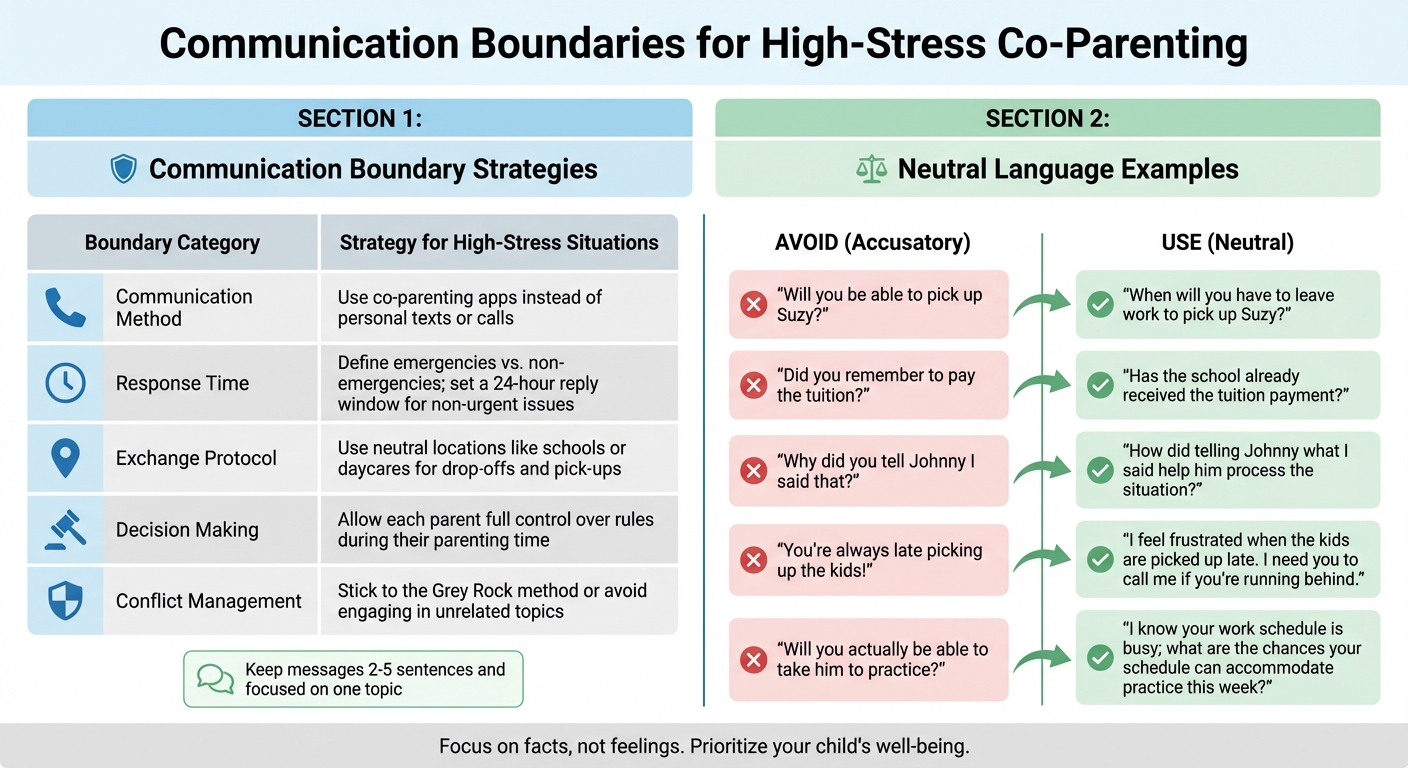
High-Stress Co-Parenting Communication Strategies: Boundaries and Language Guide
Establishing boundaries is like creating a roadmap that reduces stress and sets expectations for both you and your child. Guardian ad Litem Elle Barr explains it well: "If you both know you can rely on your agreement or order, then you will feel more comfortable and confident" [2]. By setting clear rules about when and how you communicate, you can minimize misunderstandings and prevent conflicts from spiraling out of control.
Think of co-parenting communication as a professional exchange. Define clear methods, timing, and response guidelines to keep things organized. Here’s how you can build and maintain these boundaries effectively.
Choose Communication Methods and Response Times
Start by agreeing on the best way to communicate for various situations. Many co-parents, especially in high-conflict scenarios, find platforms like TalkingParents or OurFamilyWizard extremely helpful. These apps keep a permanent and uneditable record of all exchanges, which can even be used in court if necessary. Some platforms include tools like ToneMeter, which flags emotionally charged language before you send a message.
It’s also important to clarify what qualifies as an emergency versus a non-emergency. Emergencies might include a child’s injury or sudden illness, while non-urgent matters could involve weekend schedule changes or questions about school supplies. Attorney Bruggemann, Esq. suggests treating your communication as you would in a professional setting: ensure your message is complete, respectful, and focused. For non-urgent matters, establish a 24-hour response window to avoid unnecessary stress.
| Boundary Category | Strategy for High-Stress Situations |
|---|---|
| Communication Method | Use co-parenting apps instead of personal texts or calls. |
| Response Time | Define emergencies vs. non-emergencies; set a 24-hour reply window for non-urgent issues. |
| Exchange Protocol | Use neutral locations like schools or daycares for drop-offs and pick-ups. |
| Decision Making | Allow each parent full control over rules during their parenting time. |
| Conflict Management | Stick to the Grey Rock method or avoid engaging in unrelated topics. |
To keep things manageable, you can also set limits on the number of messages exchanged daily, ensuring neither parent feels overwhelmed.
Develop a Detailed Parenting Plan
A well-thought-out parenting plan serves as a guide, outlining everything from visitation schedules to decision-making responsibilities. The more specific your plan, the fewer disagreements you’ll face down the road. Include details like exact pickup and drop-off times, transportation arrangements, and what to do in case of delays.
For situations with high tension, consider parallel parenting. This approach allows each parent to manage their household independently, with minimal coordination. It reduces the need for frequent communication while ensuring your child’s needs are met.
If you’re having trouble finalizing a plan, consider working with a mediator, parenting coordinator, or family therapist. Their expertise can help you reach an agreement and avoid future disputes. Keeping a copy of the finalized plan handy ensures you can refer back to it when needed, preventing recurring arguments.
Maintain Boundaries When Tested
Even the best boundaries will face challenges. Your co-parent might send late-night texts about non-urgent matters, show up early for pickups without notice, or try to discuss issues outside your agreed-upon plan. When this happens, stay calm and reaffirm your boundaries without escalating the situation.
For instance, if you receive a late-night text about switching weekends, you could respond with, “I’ll review non-emergency schedule requests during my check-in time tomorrow at 6:00 PM.” Use a neutral and factual tone. Bill Eddy recommends the BIFF method (Brief, Informative, Friendly, Firm) to keep responses focused and reduce emotional tension [7].
If your boundaries continue to be ignored, consider using the Grey Rock method. This involves giving short, unemotional replies to discourage further conflict. The goal isn’t to be rude but to protect your energy and maintain focus on your child’s well-being.
When maintaining boundaries feels overwhelming, professional support can make a difference. Growth and Change Counseling offers tailored strategies for navigating high-conflict co-parenting situations, helping you create a smoother path forward.
Use Neutral and Child-Focused Language
When co-parenting gets stressful, the way you communicate can make all the difference. The words you choose can either ease tension or escalate conflict, so it’s important to focus on language that prioritizes your child’s needs. Using accusatory or emotionally charged language often leads to defensiveness and shifts focus away from what truly matters – your child’s well-being. Guardian ad Litem Elle Barr explains:
"There’s never a good reason to address anything personal, because you no longer share a personal life – you just share children" [2].
Switching to neutral, child-centered communication takes practice, but it’s one of the most effective ways to keep the peace. By framing conversations around facts and your child’s interests, you create room for cooperation rather than confrontation.
Replace Accusatory Words with Neutral Phrases
Conflict often arises from what’s known as “blame speak” – language that assigns fault or assumes the worst. Even seemingly harmless questions can carry an accusatory tone. For example, asking, "Will you be able to pick up Suzy?" subtly questions the other parent’s reliability. A better alternative would be, "When will you have to leave work to pick up Suzy?" – a question that focuses on logistics rather than judgment.
The "AAA" Rule is a helpful guide for keeping communication neutral: Avoid Admonishments (personal criticisms), Advice (which can come across as patronizing), and Apologies (which might validate unreasonable behavior). Keep your messages short – ideally 2-5 sentences – and focused on a single issue. Brief communication leaves less room for escalation.
Using "I" messages can also help you express concerns without triggering defensiveness. Instead of saying, "You’re always late picking up the kids!" try, "I feel frustrated when the kids are picked up late. I need you to call me if you’re running behind." This approach shifts the focus from blame to problem-solving.
Here are some examples of how to reframe accusatory phrases into more productive alternatives:
| Accusatory/Confrontational Phrase | Neutral/Productive Alternative |
|---|---|
| "Will you be able to pick up Suzy?" | "When will you have to leave work to pick up Suzy?" |
| "Did you remember to pay the tuition?" | "Has the school already received the tuition payment?" |
| "Why did you tell Johnny I said that?" | "How did telling Johnny what I said help him process the situation?" |
| "Why didn’t you pay the doctor’s bill?" | "What other bills need to be paid before the doctor’s bill?" |
| "You’re always late picking up the kids!" | "I feel frustrated when the kids are picked up late. I need you to call me if you’re running behind." |
| "Will you actually be able to take him to practice?" | "I know your work schedule is busy; what are the chances your schedule can accommodate practice this week?" |
To avoid reacting impulsively, take a 10-second pause before responding to a triggering message. Lock your device, count silently, and let the initial frustration pass. This small delay allows you to craft a more thoughtful reply. You can also disarm with politeness by starting or ending messages with neutral phrases like "Thanks for bringing this up" or "I appreciate your flexibility." These small gestures can help keep the conversation civil.
By focusing on neutral language, you naturally guide discussions toward solutions that benefit your child.
Keep Discussions Centered on the Child
Treat co-parenting like a professional partnership, keeping all communication centered on your child’s needs. Attorney Bruggemann, Esq. advises:
"Treat your communication as if it were a professional relationship" [4].
This approach helps you stay focused on shared goals and keeps personal history out of the conversation. Stick to topics like your child’s health, education, custody decisions, and logistics. If a message doesn’t address one of these areas, it likely doesn’t need a response.
Instead of complaining, make requests that focus on future actions. For example, say, "Can you confirm the pickup time for this Friday?" rather than launching into a critique of past behavior. This forward-thinking approach reduces defensiveness and encourages cooperation.
Research from Kaiser Permanente and the CDC on Adverse Childhood Experiences (ACEs) highlights the serious impact of unmanaged parental conflict on children’s health. Toxic stress from high-conflict communication can affect a child’s brain development, immune function, and overall well-being [2]. Keeping discussions child-focused isn’t just about avoiding arguments – it’s about safeguarding your child’s future.
Keep Written Records of Agreements
Clear boundaries are even stronger when paired with written records. Keeping all communication in writing helps prevent miscommunication and provides a solid legal trail. As Elle Barr, Guardian ad Litem, explains:
"It’s best practice to keep all your co-parenting communications in writing. Then there’s a very clear track record. It gets rid of the arguments about ‘who said what, when?’" [2].
Written documentation is crucial for legal protection, especially when addressing custody issues or modifying parenting plans [8][6]. Tools like TalkingParents or OurFamilyWizard create court-admissible records, complete with timestamps, which can discourage inflammatory behavior since both parents know the messages may be reviewed by a judge [2].
If you disagree with a claim from your co-parent, respond with a simple "I do not agree to that." This prevents silence from being interpreted as consent. Never edit or delete messages – keeping the full context intact is essential for transparency. For more detailed discussions, email is a great option as it provides a searchable and organized record [5].
Consider using a shared digital calendar to track important dates like school events, doctor appointments, and parenting exchanges. For ongoing updates, such as medical treatments or school assignments, a physical or digital journal that travels with your child can be helpful [5]. These tools ensure clarity and reduce the chance of misunderstandings, reinforcing a child-focused approach.
sbb-itb-596b85d
Use Technology to Simplify Communication
Digital tools have become a game-changer for co-parenting, especially when it comes to reducing conflict and streamlining communication. By centralizing all interactions, these tools eliminate the hassle of juggling multiple platforms and help create a more structured and accountable system. Every message sent through these apps is documented, cutting down on those "he said, she said" disputes that can lead to unnecessary tension.
Many of these apps go beyond simple messaging. They offer features like shared custody calendars, expense trackers that automatically calculate cost-sharing, and even timestamps to confirm when a message has been read. Some, like ToneMeter, even flag emotionally charged or aggressive language before you hit send, encouraging a calm, professional tone that keeps the focus on your child.
"Because I’m able to regulate my responses and take a little bit more control of the communication with my ex-husband, my kids aren’t suffering like they used to."
Try Co-Parenting Apps and Digital Tools
Co-parenting apps are designed with features tailored for even the most challenging situations. Shared calendars help both parents stay on the same page about custody schedules, school events, and other important dates. Expense tracking tools let you upload receipts, request reimbursements, and manage cost-sharing without awkward back-and-forth conversations about money.
For parents who struggle to communicate directly, these apps support a "parallel parenting" approach. This model allows each parent to manage their responsibilities independently, with minimal direct contact. You can update schedules, make requests, and handle logistics without constant coordination. Philip Lockwood, a co-parent, shared how this approach has helped him:
"When we were using text or email, it was really hard to refer back to anything. With TalkingParents, I can easily do a search of our messages if I need proof of something for the other parent."
Some apps also include private journaling features, giving you a secure space to document your thoughts, emotions, or incidents that occur outside the platform. This can be invaluable for emotional processing or as a resource for legal purposes. In high-conflict cases, certain apps even allow attorneys or mediators to monitor communications, adding another layer of accountability.
Follow Best Practices for Email and Messaging
While apps can simplify logistics, the way you communicate still matters. Keep your messages brief, clear, and focused on specific topics like custody schedules, medical updates, or school-related issues. Stick to one topic per message and phrase your communication as a request for action rather than a criticism. For instance, instead of saying, "You never tell me about doctor appointments", try, "Can you send me the details for the next appointment?"
If emotions are running high, take a pause. Waiting an hour – or even a full day for non-urgent matters – can help you craft a more neutral and professional response. Corey Gulley, who uses TalkingParents, highlights how this approach has helped him:
"The app has helped me control my attitude and improve my patience. It’s really helped change my thoughts from negative to positive."
Using active listening techniques in written communication, such as paraphrasing the other parent’s points, can reduce misunderstandings. For quick updates, like notifying about a traffic delay during a custody exchange, texting works well. For more detailed discussions or proposals, email provides the necessary space.
Save and Organize Digital Messages
Keeping organized records of your communication can be a lifesaver during disputes. Digital tools make it easy to search past messages, export records for court, or reference agreements without digging through a mess of texts. As noted by OurFamilyWizard:
"If everything is written, then it’s easier to bring an organized record to court or mediation."
The permanence of these records also discourages inflammatory behavior. Knowing that messages can’t be deleted and might be reviewed by a judge often encourages more respectful interactions. Establishing clear boundaries – like setting specific times to respond (except in emergencies) – can also help manage expectations and reduce constant interruptions, giving you better control over your co-parenting exchanges.
Control Your Emotions During Difficult Conversations
Navigating tough conversations can stir up strong emotions, even if you have a solid strategy in place. The key is recognizing when you’re on the verge of being overwhelmed and stepping back before things escalate. It’s not the separation itself but unresolved conflict that often leaves lasting scars on children [2]. By managing your emotions, you reinforce the boundaries and neutral communication you’ve worked to establish.
Identify Your Triggers and Take a Pause
Pay attention to physical signals like a racing heart, a tight chest, or a knot in your stomach. These are often signs that emotions are running high. When you notice these cues, take a moment to name what you’re feeling. Robin Maddox, a Licensed Marriage and Family Therapist, suggests saying:
"I’m feeling overwhelmed and reactive. This is a really hard topic for me." [9]
Acknowledging your emotions can help you regain perspective and might even encourage empathy from the other parent. If the conversation gets too heated, try the three-second rule: pause, count to three, and take a deep breath before responding [9]. And if necessary, call for a timeout, agreeing to revisit the discussion within 24 hours [9].
Once you’ve taken a moment to calm down, shift your focus to understanding your co-parent’s point of view.
Listen Without Interrupting
Active listening means genuinely hearing and understanding the other parent’s perspective before you reply. Reflect back what they’ve said to confirm you’re on the same page [4]. Even if you strongly disagree, acknowledging their viewpoint can prevent the conversation from turning into a cycle of attack and defense. As Robin Maddox explains:
"Arguments escalate most rapidly when both parties feel attacked or go on the attack." [9]
To stay on track, define your goal for the conversation ahead of time and keep the discussion solution-focused [1].
Align Your Words, Tone, and Body Language
Your tone and body language can either support or undermine your words. For example, if your voice is sharp or your posture rigid, it can send a mixed message. Treat co-parenting conversations like a professional exchange to maintain a calm and neutral demeanor [4]. Ask yourself: Is my tone respectful? Is my message clear? Am I keeping personal feelings about the other parent out of this? This approach complements the boundaries and neutral language you’ve already set.
In face-to-face interactions, consider your physical positioning. If tensions are high, staying in your car during transitions can help avoid prolonged exchanges that might create visible stress for the children [3]. For written communication, pause before hitting send to ensure your tone remains calm [4]. Atty Bruggemann, Esq. offers this advice:
"Treat your communication as if it were a professional relationship." [4]
When your words, tone, and body language are in sync, you reduce misunderstandings and keep the focus where it belongs – on your child’s well-being.
Managing High-Conflict Co-Parenting: Growth and Change Counseling
Co-parenting communication works best when you stick to three main principles: stay focused on your child, establish clear boundaries, and manage your emotions. By treating co-parenting like a professional relationship and keeping your messages short and factual, you can help shield your child from unnecessary conflict.
As Atty Bruggemann, Esq. puts it:
"Co-parenting with someone you just divorced, civilly and respectfully, may be one of the hardest things you’ll ever do. But it’s essential." [4]
The goal is to ensure that every interaction prioritizes your child’s well-being, whether you’re discussing medical appointments, school activities, or everyday schedules.
If you’re finding it difficult to navigate these strategies on your own, seeking extra support can make a difference. For those struggling with high-conflict situations, professional parent coaching can provide valuable tools and guidance. Growth and Change Counseling offers specialized coaching to help parents improve communication, develop relational skills, and regain confidence in their parenting. Their solutions-focused approach includes practical exercises designed to foster healthier interactions.
Based in Campbell, San Jose, Los Angeles, and Roseville, with telehealth options across California, Growth and Change Counseling provides free consultations to explore personalized coaching and family therapy services. Visit Growth and Change Counseling to learn more.
Even in the most challenging co-parenting dynamics, the right tools and support can create a calmer, more child-focused environment.
FAQs
How can co-parenting apps help improve communication and reduce conflict?
Co-parenting apps can make a big difference when it comes to reducing conflict between parents. They provide neutral and structured tools for communication, which can help keep things organized and focused on what matters most: the well-being of the children. Features like secure messaging, shared calendars, and task management ensure that both parents stay on the same page while minimizing the chances of misunderstandings or emotional flare-ups.
These apps also encourage a more business-like tone in communication, which can help avoid heated confrontations. By keeping a clear, accessible record of all interactions, they promote respectful dialogue and can be especially useful during stressful moments – or even if legal documentation is required. Overall, using a co-parenting app can create a more cooperative atmosphere, making the often challenging journey of co-parenting smoother and more manageable.
What is the Grey Rock method, and how can it help in co-parenting?
The Grey Rock method is a communication strategy designed to minimize conflict and emotional strain when interacting with a high-conflict or manipulative co-parent. The key is to keep your responses neutral, concise, and emotionally unengaged, sticking strictly to necessary topics about your children. By maintaining this calm and detached demeanor, you can prevent conflicts from escalating and discourage manipulative tactics.
This method not only helps create a more stable environment for your children but also safeguards your emotional health. When you avoid emotional reactions, you remove the leverage a difficult co-parent might use to provoke or control you, enabling clearer and more productive communication.
Why is it important to focus on the child when communicating with your co-parent?
Focusing communication on your child during high-stress co-parenting situations is key to reducing conflict and safeguarding their emotional well-being. By keeping the spotlight on their needs, you can steer clear of unnecessary disputes and create a more stable, supportive environment that nurtures their growth.
This child-first mindset also helps keep conversations practical – covering topics like schedules, health, or education – rather than letting them veer into personal disagreements. Doing so not only encourages better collaboration between co-parents but also models healthy communication and teamwork for your child. This approach gives them a stronger sense of security during difficult times. Prioritizing your child in these interactions strengthens the co-parenting dynamic and promotes their overall happiness and stability.
Related Blog Posts
- Ultimate Guide to Co-Parenting in Recovery
- Mental Health and Co-Parenting: Problem-Solving Strategies
- How Couples Manage Anger During Parenting Conflicts
- 5 Steps to De-Escalate Co-Parenting Arguments
