Navigating co-parenting while managing mental health challenges can feel overwhelming, but it’s possible to create stability for your children and maintain balance. This guide focuses on practical solutions to common co-parenting hurdles, including poor communication, inconsistent routines, and handling a co-parent with untreated mental health issues. Key takeaways include:
- Structured Communication: Use co-parenting apps or email to reduce emotional conflicts and keep conversations focused on your child.
- Consistency for Kids: Develop written parenting plans and realistic schedules to provide stability across households.
- Safety Boundaries: If a co-parent’s untreated mental health poses risks, consider legal measures like supervised visitation.
- Emotional Support: Avoid putting children in the middle and validate their feelings to protect their emotional well-being.
These strategies aim to reduce conflict, prioritize your child’s needs, and support your mental health. When needed, professional help, such as therapy or parent coaching, can provide additional tools to navigate these challenges effectively.
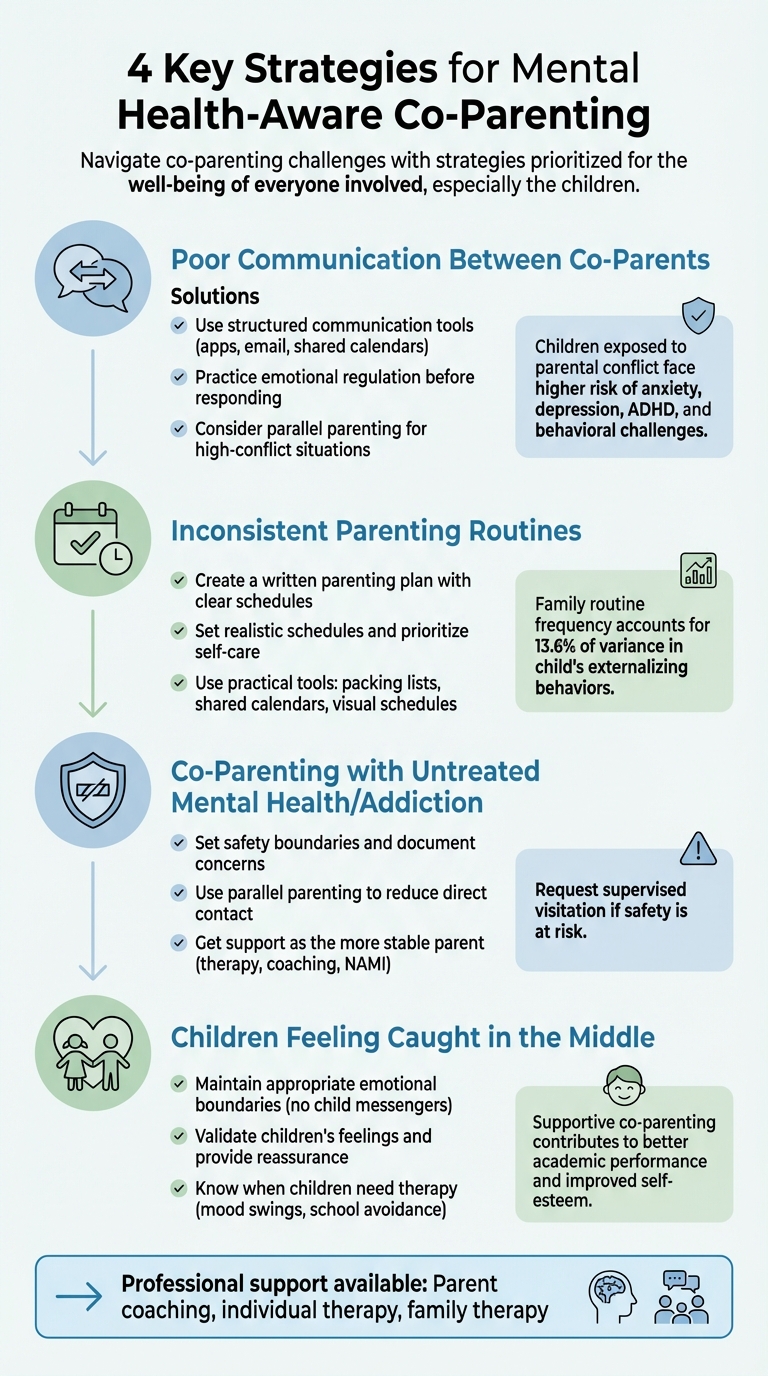
4 Key Strategies for Mental Health-Aware Co-Parenting
Co-Parenting in High-Conflict Situations: Effective Strategies for Preserving Your Mental Health
Challenge 1: Poor Communication Between Co-Parents
Mental health struggles can quickly derail communication between co-parents. For instance, anxiety might lead to oversharing or relying on the child to relay messages [9]. Anger can escalate minor scheduling disagreements into full-blown arguments [2], while depression often results in a lack of communication about important matters [9].
These behaviors can create a cycle of mistrust. When one parent feels blindsided by unexpected changes or ignored messages, tension builds – not just between the adults but also for the child, who can sense the underlying stress. Below are some practical strategies to rebuild effective, child-centered communication.
"The key to successful co-parenting is to separate the personal relationship with your ex from the co-parenting relationship."
– Jocelyn Block, M.A. and Melinda Smith, M.A. [2]
Use Structured Communication Tools
Switching to written communication methods, like co-parenting apps, shared digital calendars, or email, can help reduce emotional outbursts [9]. A shared calendar, for example, ensures both parents are on the same page about appointments and events, cutting down on unnecessary disputes. Keep messages neutral, concise, and focused on the child. For instance, you might say, "Can you pick up Sam at 3:00 PM?" rather than involving emotions. And remember, logistical details should always be discussed directly between parents – never through the child [2][9].
Practice Emotional Regulation Techniques
Before hitting "send" on that text or email, take a moment. Breathe deeply, count to ten, and make sure your response is calm, factual, and centered on your child’s needs [9].
Consider Parallel Parenting for High-Conflict Situations
For situations where direct communication seems to spark more conflict than cooperation, parallel parenting can be a workable alternative. This approach allows each parent to handle their responsibilities independently, limiting communication to essential written exchanges [9].
"Parallel parenting might be the best solution in some situations, because tough transitions are less stressful than witnessing your parents argue bitterly all the time."
– OurFamilyWizard [9]
Studies show that children who are repeatedly exposed to parental conflict face a higher risk of anxiety, depression, ADHD, and behavioral challenges [2][7]. By setting clear boundaries – avoiding personal topics and sticking strictly to logistical matters – parallel parenting can help shield kids from ongoing disputes while ensuring both parents remain actively involved in their lives.
Challenge 2: Inconsistent Parenting Routines
Managing consistent routines can be incredibly challenging for parents dealing with mental health conditions. For instance, depression can sap the motivation needed to stick to schedules, while PTSD may lead to emotional outbursts or withdrawal, leaving children feeling uncertain about what to expect [6][12]. Research highlights a clear connection between family routines and children’s behavior. Parents under significant stress often report using family routines less frequently, which can directly affect their children. In fact, studies show that how often families maintain routines accounts for 13.6% of the variance in a child’s externalizing behaviors [11]. To bring back predictability, here are some strategies to consider.
"Lack of consistency of expectations can create more stress for all involved. The child can struggle to adjust between households and parents become increasingly frustrated."
– Audra Heiking, LMFT, Behavioral Health Consultant [10]
Create a Written Parenting Plan
A written parenting plan can provide clarity and stability for both parents and children. By documenting schedules, discipline approaches, and responsibilities, everyone knows what’s expected, reducing misunderstandings and creating a sense of security for children [13][14].
"Sticking to the parenting plan helps you avoid conflict and misunderstandings. It also gives children a predictable and stable environment they can trust."
– Minkyung Chung, MS, LMHC, Talkspace [14]
When creating a plan, consider each parent’s realistic capacity. If certain tasks are especially difficult for one parent due to mental health challenges, responsibilities should be distributed accordingly [6]. Courts, such as those in California, focus on whether a mental health condition impacts a parent’s ability to provide a safe and stable environment, rather than disqualifying them based solely on a diagnosis [1]. Reflect this practical approach in your parenting plan, and adjust schedules to align with what’s manageable daily.
Set Realistic Schedules and Prioritize Self-Care
Parenting effectively requires a foundation of good sleep and nutrition. Be honest about what you can realistically handle instead of overcommitting and constantly revising plans. A predictable routine – no matter how simple – can reduce stress and provide stability. Research has shown that higher parenting stress is linked to fewer established family routines [11].
Use Practical Tools to Share Responsibilities
Small adjustments can make co-parenting smoother. For example, create packing lists for transitions to ensure nothing is forgotten, and use shared digital calendars to track appointments and custody exchanges. Stocking both homes with essentials like toiletries and favorite toys can also help ease transitions [2].
For families facing heightened stress or managing neurodiversity, visual schedules and tracking systems can support daily routines and help with emotional regulation [15]. Weekly check-ins, even if brief, can address necessary adjustments. Communicate clearly and respectfully during these discussions, using “I” statements like, “I noticed bedtime has been difficult this week,” to avoid unnecessary conflict [15].
Above all, keep co-parenting conversations focused on what’s best for your child, maintaining a professional and respectful tone [2].
sbb-itb-596b85d
Managing High-Conflict Co-Parenting: Growth and Change Counseling
Dealing with a co-parent who refuses treatment for mental health or addiction issues can create a challenging and unpredictable environment. These untreated conditions can lead to erratic behavior, neglect, and unsafe situations for your child [1]. To protect your child, it’s essential to establish clear boundaries and implement structured plans that prioritize their well-being.
"If your co-parent’s mental health poses a direct risk to your child, you can request supervised visitation. This allows them to maintain a relationship with their child under the watchful eye of a neutral third party, ensuring your child’s safety."
– Valerie Fenchel, Family Law Attorney [1]
Set Safety Boundaries and Document Concerns
When a co-parent’s behavior creates risks, setting firm safety boundaries becomes a non-negotiable step. Courts can intervene by ordering supervised visitation, ensuring that contact occurs only under the supervision of a neutral third party [1][16]. A well-crafted parenting plan should outline specific expectations, such as maintaining a sober environment and meeting basic caregiving responsibilities, to safeguard your child [1]. Using neutral, public locations for child exchanges can also help minimize conflict and create a safer environment.
It’s crucial to document any concerning incidents, such as missed pick-ups, erratic communication, or unsafe conditions. Supporting evidence like photos, witness statements, and saved messages can be invaluable if legal action becomes necessary [1]. Additionally, having contingency plans for missed exchanges or emergencies ensures you’re prepared to act swiftly when needed [4]. In some cases, requesting a court-ordered custody evaluation by a licensed mental health professional can provide an objective assessment of how the co-parent’s condition impacts your child [1][16].
"Having realistic expectations means installing plan B, C, and D in place, so you are ready and can protect your children when your co-parent does it again."
– Dr. Ramani Durvasula, Clinical Psychologist & Narcissism Expert [4]
Use Parallel Parenting to Reduce Direct Contact
Parallel parenting is a practical strategy for minimizing conflict with an unstable co-parent. Instead of working collaboratively, each parent operates independently during their designated parenting time, reducing the need for direct interaction [1][2]. Communicating through written channels like email or parenting apps creates a clear record and helps avoid unnecessary arguments [2][4]. A detailed parenting plan with specific guidelines for exchanges and behavior expectations can further reduce misunderstandings and conflict [1][2].
"The key to successful co-parenting is to separate the personal relationship with your ex from the co-parenting relationship."
– Jocelyn Block, M.A. and Melinda Smith, M.A. [2]
By limiting direct contact, you shield your children from adult disagreements and provide stability in your own home, even if the other parent’s environment remains unpredictable [17][2]. When appropriate, explain to your children – using age-appropriate language – that their other parent’s confusing behavior is due to an illness and is not their fault [8].
Get Support as the More Stable Parent
Taking on the extra responsibilities of co-parenting with an unstable partner can be emotionally and physically draining. Individual therapy or parent coaching can equip you with the tools to manage these challenges while protecting your mental health [3][1]. Organizations like the National Alliance on Mental Illness (NAMI) offer support groups and educational resources for families navigating these complex situations [8].
For high-conflict cases, you might consider requesting a court-appointed Parenting Coordinator. This professional can help enforce the parenting plan and make decisions that prioritize your child’s well-being [18]. Growth and Change Counseling also provides parent coaching services, offering practical strategies through telehealth across California or in-person in locations such as Campbell, San Jose, Los Angeles, and Roseville.
"Setting healthy boundaries in co-parenting is a way to respect both parents’ time, energy, and privacy while they work together to cooperatively raise their children."
– Tessa Noel, Certified Divorce Transition & Recovery Coach [4]
To avoid burnout, establish boundaries around your time and energy. Separate your personal feelings about your co-parent from the co-parenting relationship, and lean on friends, therapists, or support groups for emotional support instead of your children [2]. Regular self-care is essential for maintaining your stability – watch for signs like disrupted sleep, irritability, or low energy, and address them promptly [4]. These steps not only protect your well-being but also help you create a secure and nurturing environment for your child.
Challenge 4: Children Feeling Caught in the Middle
When co-parents grapple with unresolved conflicts or mental health challenges, children often carry an unseen emotional burden. They may feel torn between parents or pressured to act as messengers, which can weigh heavily on their sense of security. This stress can lead to self-doubt and feelings of helplessness. Studies reveal that children exposed to ongoing co-parenting conflicts are at higher risk of developing conditions like depression, anxiety, and ADHD [2]. In some cases, the emotional toll may even cause children to resist visitation.
To safeguard their emotional well-being, it’s crucial to set clear boundaries in communication.
Maintain Appropriate Emotional Boundaries
Avoid putting your child in the middle. Using them to pass along schedules, financial matters, or other adult concerns places an unfair strain on them. Instead, communicate directly with your co-parent through email or co-parenting apps. When discussing the other parent’s mental health challenges, frame them as medical issues without resorting to negative labels. Refrain from venting about your ex-partner in front of your child. If your child criticizes the other parent, gently redirect the conversation by discouraging disrespect and highlighting positive traits. For instance, you might say, "I know Dad’s rules can feel strict, but he’s great at helping with your school projects." As one resource wisely puts it:
"Co-parenting is not about your feelings, or those of your ex-spouse, but rather about your child’s happiness, stability, and future well-being."
– HelpGuide [2]
Validate Children’s Feelings and Provide Reassurance
Acknowledge that living between two homes can be challenging. Give your child a day or two of notice before transitions, and encourage them to bring a comforting item. Establish a calming "return routine" – whether it’s reading a book together or cooking a favorite meal – to reinforce that your home is a stable, welcoming space. Consistency across both households, like similar rules for bedtime or homework, can also provide a sense of security. When your child shares feelings of sadness or confusion, listen without judgment. Validate their emotions with phrases like, "I know this is tough, and it’s okay to feel this way. It’s normal to miss both of us."
"Putting aside personal differences and agreeing to mutual respect as parents allows the child(ren) to see that, regardless of the dissolution of the relationship, the parents are still united in parenting together."
– Minkyung Chung, MS, LMHC [14]
If reassurance and routines aren’t enough, additional support may be necessary.
Know When Children Need Therapy
Be alert for signs that your child might benefit from professional support. Warning signs include school avoidance, frequent mood swings, loss of interest in activities they once enjoyed, or any indication that they feel caught in the middle of household matters. A noticeable difference in behavior between homes can also signal emotional distress. In such cases, therapy can provide a safe space for your child to process their emotions and develop healthy coping strategies. Growth and Change Counseling offers both individual and family therapy, with services available through telehealth across California and in-person in locations like Campbell, San Jose, Los Angeles, and Roseville. Professional guidance can help children build resilience and learn to manage the challenges of co-parenting dynamics more effectively.
Conclusion: Moving Toward Healthier Co-Parenting
Navigating co-parenting while dealing with mental health challenges requires thoughtful strategies that create stability for your children and safeguard your own well-being. Studies highlight that supportive co-parenting significantly impacts children’s success after divorce, contributing to better academic performance and improved self-esteem [5]. Tools like "I" statements, detailed parenting plans, and contingency plans for unexpected situations can help manage conflicts effectively. Approaches such as parallel parenting can also minimize direct disagreements, fostering a consistent and emotionally secure environment for your child.
Equally important is taking care of yourself. Self-care isn’t just a luxury – it’s a necessity. Activities like regular exercise, journaling, or leaning on your support network can help you stay emotionally balanced and present for your children [4]. Interestingly, parent coaching often yields more impactful and lasting results than relying solely on child therapy [3].
Professional guidance can make a world of difference. Growth and Change Counseling offers tailored parent coaching and therapy to address co-parenting challenges tied to mental health concerns. Their team specializes in supporting neurodiverse families, those recovering from addiction, and high-conflict situations. With both in-person and telehealth options available across California – including Campbell, San Jose, Los Angeles, and Roseville – they provide flexible support. A free consultation can help you explore the best options for your family’s unique needs.
FAQs
How can I communicate effectively with a co-parent dealing with untreated mental health issues?
Communicating with a co-parent dealing with untreated mental health challenges can be tricky, but a calm and focused approach can make a big difference. Keep your exchanges short, straightforward, and centered on what’s best for your kids. Using email or text for things like schedules, pick-up and drop-off details, or health and safety updates can help keep the tone neutral and avoid unnecessary emotional tension. If you need to talk in person, choose a neutral location, stay calm, and use reflective listening to ensure both sides understand each other and avoid miscommunication.
If their behavior becomes disruptive, it’s important to document incidents. In some cases, involving a neutral third party – like a mediator or family-law professional – can help keep conversations productive. Setting clear boundaries, such as sticking strictly to child-related topics and agreeing on a regular communication schedule, can also create some much-needed structure and reduce potential conflicts.
Encouraging the co-parent to seek professional help is another step you can take. Let them know there are resources available to support them. And don’t forget to take care of yourself – if the situation is affecting your mental health, consider reaching out to a counselor or a parent coach. Growth and Change Counseling, for instance, offers services tailored to high-conflict co-parenting situations, equipping you with tools to manage stress, improve communication, and create a more stable environment for your children.
How can co-parents create consistent routines to support their children’s well-being?
Consistency in routines gives children a much-needed sense of stability and comfort, especially when they’re navigating life between two homes. A great starting point is creating a clear and detailed parenting plan. This plan should cover the basics – things like drop-offs, pick-ups, meals, bedtimes, and homework schedules. When everyone sticks to this plan, it brings predictability, which is reassuring for kids and simplifies coordination for parents.
A shared digital calendar can be a game-changer here. It keeps both parents on the same page about any schedule changes, minimizing confusion or last-minute surprises. Additionally, agreeing on key rules and values, such as limits on screen time or consistent bedtime routines, ensures that kids experience similar expectations in both households.
To make transitions smoother, try incorporating simple rituals. A goodbye hug before leaving or a special welcome-home moment can help children feel more at ease with the changes. If any issues come up, keep conversations respectful and focused on what’s best for the child. For families needing extra support, Growth and Change Counseling offers parent-coaching services to help establish routines that work for everyone involved.
When should I seek professional help for my child due to co-parenting conflicts?
If co-parenting conflicts are starting to take a toll on your child’s emotional or physical health, it might be time to seek professional help. Some key warning signs to watch for include frequent mood swings, angry outbursts happening in front of your child, neglectful care, an unsafe home environment, self-harming behaviors, substance use, or sudden changes in sleep patterns, appetite, school performance, or overall mood. When these issues persist, it could mean the ongoing conflict is affecting your child’s mental well-being.
Professionals, like the team at Growth and Change Counseling, can provide valuable support through child therapy, parent coaching, and practical strategies to help reduce conflict. Addressing these challenges early can strengthen your child’s emotional resilience, enhance communication between parents, and foster a more stable, healthier environment for everyone involved.
Related Blog Posts
- Parent Coaching for Better Boundaries
- Parenting Through Marital Conflict and Mental Health Struggles
- Ultimate Guide to Co-Parenting in Recovery
- How to Create Emotional Safety for Kids in Recovery
