When addiction impacts a family, roles shift to manage the chaos. One common pattern is the “hero role,” often taken by the eldest child, who strives to restore stability and protect the family’s image. While their achievements may mask dysfunction, they often face anxiety, stress, and emotional exhaustion. Healing involves recognizing this role, setting boundaries, and embracing vulnerability. Family therapy and individual support can help heroes move from overachieving to becoming balanced supporters, fostering healthier relationships and personal well-being. Here’s how to navigate this transformation effectively.
Characteristics and Challenges of the Hero Role
Key Traits of the Hero
The hero in a family dynamic operates with a distinct set of behaviors, often shaped by the need to maintain a sense of order amidst chaos. At the heart of their role lies perfectionism. They push themselves relentlessly to excel, using their achievements to mask the dysfunction within the family. Mark Shandrow, CEO of Asana Recovery, explains it well: "The consistent internal need for everything to seem like it is under control typically produces intense amounts of anxiety and stress, compromising their overall physical and emotional wellbeing" [3].
Control is another defining trait. Heroes often position themselves as the family’s problem solver, rejecting outside help and holding tightly to their role as the fixer. Mike Loverde, MHS, CIP, highlights this tendency: "The Hero is the family role that is most likely to prevent any help or suggested solutions from anyone other than themselves" [1]. This behavior can lead them to resist or even sabotage professional interventions, fearing that outside solutions might undermine their authority or disrupt the delicate balance they’ve worked so hard to maintain.
Recognition is another driving force for heroes, though it’s not rooted in vanity. Instead, it stems from a deep need to feel seen and valued. They watch as the addicted family member draws attention – whether through destructive behaviors or small improvements – while their own significant accomplishments often go unnoticed. This dynamic, sometimes referred to as the "Yale Brother" phenomenon, can create resentment. It’s a situation where the high-achieving sibling harbors frustration over the struggling family member monopolizing parental energy and resources [1]. Beneath their polished exterior, heroes often wrestle with feelings of fear, guilt, and an overwhelming sense of emptiness [4].
These behaviors, while outwardly impressive, come at a steep cost, both emotionally and relationally.
Emotional and Relational Impacts
The hero’s constant drive for perfection and control takes a heavy toll on their emotional well-being. While they may appear strong and composed, they often suppress their emotions to maintain the family’s facade. Over time, this emotional denial drains their mental and physical reserves. They become so consumed by their role that they lose sight of who they are outside of the family’s needs [4].
Their relationships within the family often suffer as well. Heroes frequently harbor resentment toward the enabler – usually a parent – who focuses their attention on the addicted family member while overlooking the hero’s accomplishments [1]. This neglect fosters bitterness and emotional distance, sometimes persisting for years. Moreover, the hero’s need to control outcomes can hinder the family’s ability to seek meaningful help. They may view professional support as a threat to their role rather than as a resource for everyone’s benefit [1].
These challenges reveal the complex and often painful reality of being the family hero, highlighting the emotional weight they carry in their pursuit to hold everything together.
The Hero – Understanding Codependency and Family Roles in Addiction
Healing Strategies for Transitioning Away from the Hero Role
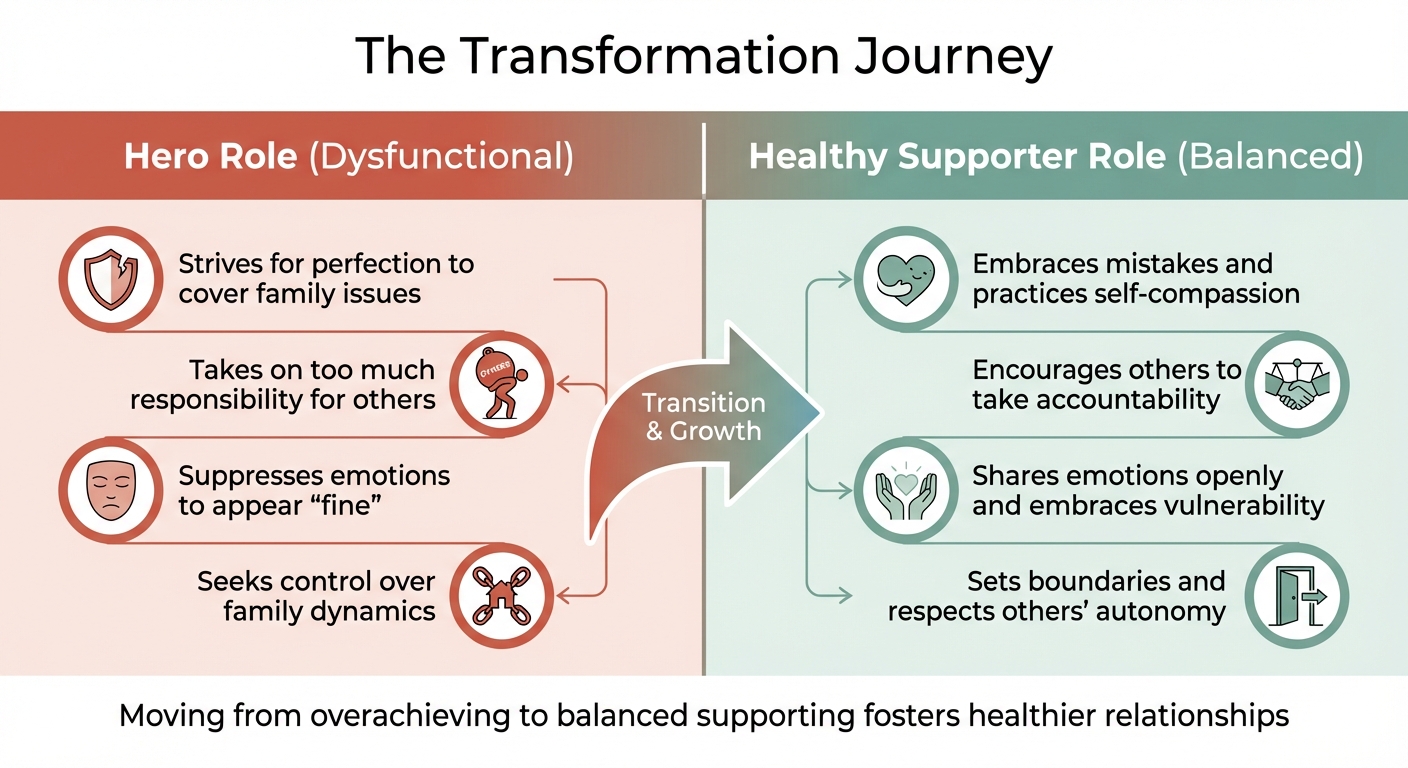
Hero Role vs Healthy Supporter Role in Family Systems
Recognizing and Letting Go of Perfectionism
Stepping away from the hero role starts with understanding how this pattern developed in the first place. Often, overachievement emerges as a way to cope with family dysfunction. Recognize that striving for perfection may have been a survival mechanism, but it’s time to release it.
Challenge the internal rules you’ve lived by, like “If I don’t handle everything, it will fall apart” or “I need to be perfect to make up for the chaos.” These beliefs keep you locked in a cycle of self-criticism. One way to uncover these patterns is through journaling, especially during moments of stress. Writing can help you identify where the hero role still influences your decisions. Another helpful step is practicing role flexibility – say “no” to a small request or let go of a responsibility that isn’t truly yours. This helps you separate your personal values from the expectations tied to the hero role, showing that this behavior was once a coping strategy, not a character flaw.
From here, focus on embracing vulnerability and prioritizing self-care as part of your healing process.
Building Emotional Vulnerability and Self-Care
Many who take on the hero role maintain a facade of being endlessly competent, but this often comes at the cost of deep loneliness. Therapist Tom Moon, M.F.T., explains:
"The deepest issue that adult heroes live with is loneliness. Heroes make good leaders and managers, but often have a hard time being close and intimate with others outside of work roles" [7].
To break this pattern, start by confronting the fears and burdens you’ve carried for so long. A simple yet effective method is to name or write down the concept of the hero role. This act can shift the emotional weight from the limbic system, where raw feelings dominate, to the prefrontal cortex, where rational decisions are made [6]. Research backs this up – Cognitive Behavioral Therapy has been shown to reduce distress tied to family roles by up to 40%, with consistent practice over 8–12 weeks helping to rewire automatic reactions [6].
Self-care is another powerful tool for healing. Licensed Professional Counselor Jenilyn Bartolo emphasizes:
"In dysfunctional family roles, we’re often letting emotions lead. When we don’t regulate ourselves, our brain isn’t fully online" [5].
One simple technique is the “10-Minute Rule.” Before engaging in any family conflict, take a short walk or sit quietly to help calm your nervous system [5].
Healing also means shifting your focus from being valued for what you accomplish to being valued for who you are. Open up about your emotions and needs, even if it feels unfamiliar. Celebrate small wins, like saying “no” to a non-essential task or asking for help. These moments create positive emotional shifts [6].
With this foundation, you can begin to redefine your role within the family, moving from rescuer to supporter.
Shifting to a Supportive Role
Once you’ve addressed perfectionism and embraced vulnerability, the next step is redirecting your energy toward healthier ways of supporting others. Letting go of the hero role doesn’t mean stepping back entirely – it’s about showing up differently. Instead of trying to control outcomes or fix every problem, focus on offering emotional support while allowing others to take responsibility for their choices.
Here’s a comparison to clarify the difference:
| Hero Role (Dysfunctional) | Healthy Supporter Role (Balanced) |
|---|---|
| Strives for perfection to cover family issues | Embraces mistakes and practices self-compassion |
| Takes on too much responsibility for others | Encourages others to take accountability |
| Suppresses emotions to appear “fine” | Shares emotions openly and embraces vulnerability |
| Seeks control over family dynamics | Sets boundaries and respects others’ autonomy |
Practical strategies can help you make this shift. For instance, use “I” statements to express your needs without placing blame. Instead of saying, “You always make me fix everything,” try, “I feel overwhelmed when I’m expected to solve problems that aren’t mine.” If family members try to pull you back into the hero role, use the “Broken Record” technique – calmly and consistently repeat your boundary.
Prentis Hemphill offers a helpful perspective on boundaries:
"Boundaries are the distance at which I can love you and me simultaneously" [8].
Setting boundaries isn’t about caring less for others; it’s about valuing your own well-being as much as theirs.
For personalized support in navigating these changes, you can reach out to the team at Growth and Change Counseling (https://johnmarkkane.com). Their expertise in family and individual therapy can guide you toward more balanced and fulfilling relationships.
sbb-itb-596b85d
Family Therapy Interventions for Healing the Hero Role
The Role of Family Therapy in Recovery
Family therapy offers a structured environment where every family member can explore and rethink the roles they’ve taken on. When one person in a family battles substance use, the entire family unit shifts, often in unhealthy ways, to maintain a sense of balance. Lori Fiester, LCSW-S, MAC, CIP, CDWF, and Clinical Director for The Council on Recovery, puts it this way:
"Family members slip into their roles to re-establish equilibrium when faced with anxiety… Chronic addiction entrenches these roles as habitual responses" [9].
For those in the hero role, therapy helps separate their sense of self-worth from their tendency to manage family crises. Mike Loverde, MHS, CIP, a family interventionist, notes that heroes may unintentionally slow recovery efforts because their need for control and their role as the family’s “positive center” can take over. Family therapy brings attention to this dynamic, revealing how the hero’s frustration – seemingly directed at the addicted person – is often rooted in their conflict with the family’s primary enabler. By addressing these feelings openly, therapy helps heroes ease their compulsive need to overachieve and allows healthier family dynamics to emerge.
Studies show that therapy involving the entire family is more effective than focusing solely on the individual with substance use issues. Growth and Change Counseling, for instance, provides family therapy services throughout California, offering both in-person sessions in cities like Campbell, San Jose, Los Angeles, and Roseville, as well as telehealth options. Their approach prioritizes emotional and relational well-being, guiding families through the challenges of addiction recovery and role adjustments.
This therapeutic process helps families distinguish between harmful and supportive roles, paving the way for healthier interactions.
Hero Role vs. Healthy Supporter Role
A key part of healing involves understanding how family therapy reshapes these entrenched roles. Moving from the hero role to a balanced, supportive role requires a clear understanding of their differences. The table below outlines these contrasts:
| Feature | Hero Role (Dysfunctional) | Healthy Supporter Role (Balanced) |
|---|---|---|
| Core Motivation | Driven by fear of losing control and the need to hide family shame | Rooted in a genuine desire for their loved one’s recovery and overall well-being |
| Behavior | Perfectionism, overachievement, and attempts to "fix" everything | Establishes firm boundaries and allows natural consequences |
| Reaction to Help | Resists solutions they didn’t create, often sabotaging external efforts | Welcomes professional guidance and works collaboratively |
| View of Addict | Feels resentment, seeing the addicted person as competition for attention | Balances support with accountability for the loved one |
| Emotional State | Struggles with anxiety, emptiness, and high stress | Focuses on self-care and maintains emotional honesty |
Shifting from the hero role to a healthy supporter role isn’t about caring less – it’s about caring in a way that promotes both personal well-being and the recovery process. Instead of covering up problems or taking on responsibilities that don’t belong to you, the goal is to encourage accountability while practicing self-care. This transition takes effort and support, which is why family therapy is such a critical part of the healing journey.
Sustaining Long-Term Healing and Growth
Combining Individual and Family Therapy
To achieve long-term healing, it’s crucial to blend individual and family therapy. While individual therapy focuses on breaking free from perfectionist tendencies and rebuilding a sense of self, family therapy works to reshape unhealthy dynamics within the household. Programs like Behavioral Couples Therapy (BCT) and Multidimensional Family Therapy (MDFT) are structured to guide families from survival-mode roles into healthier patterns. BCT usually involves 12 to 20 weekly sessions, whereas MDFT spans 16 to 25 sessions over four to six months [11]. Studies consistently show that family-based treatments for substance use are more effective than approaches that focus solely on individuals or groups [11].
The Substance Abuse and Mental Health Services Administration (SAMHSA) emphasizes this point:
"When family members change their thinking about and responses to substance misuse, the entire family system changes" [11].
Growth and Change Counseling offers both individual and family therapy across California, with in-person options in Campbell, San Jose, Los Angeles, and Roseville, as well as telehealth sessions. Their method addresses both personal recovery and family dynamics, laying a foundation for lasting improvements in communication and boundaries.
Monitoring Progress with Boundaries and Communication
Maintaining progress requires continuous adjustments in how family members interact day-to-day. Moving from the role of a perfectionist “hero” to a supportive family member involves evolving boundaries and refining communication. Early in recovery, boundaries often focus on safety and accountability, such as attending treatment or undergoing drug testing. As recovery stabilizes, these boundaries shift toward fostering healthy adult relationships, emphasizing respectful communication and financial independence [10].
Daily trust discussions can help reinforce intentions and improve communication [11]. Using “I” statements – like “I feel uneasy when money goes missing, so I keep cash in a secure place” – can clarify boundaries without blame [10]. Techniques like the "Broken Record", where you calmly restate your limits without engaging in arguments, can also be effective [10]. Schedule serious conversations during calm moments, and regularly revisit boundaries with the help of a therapist or support group to ensure they remain relevant and effective [10][11]. Keeping a recovery notebook can be a helpful tool for tracking what strategies work and where adjustments are needed [11].
Conclusion and Next Steps
Letting go of the "hero" role is a game-changer – for you and your family. When you replace overcompensation with healthy boundaries, it opens the door for your family to confront addiction head-on. Studies show that involving family members in substance abuse treatment significantly improves outcomes [2]. As Mike Loverde, MHS, CIP, wisely notes:
"Before a family can do something about the problem, they must stop allowing the problem to persist" [1].
The first step is self-awareness. Recognizing your hero tendencies is crucial. Research suggests that writing down or talking about these tendencies moves the process from the emotional brain to the prefrontal cortex – the part responsible for planning and decision-making. This shift can help you pinpoint triggers (like holiday gatherings, certain feedback at work, or specific tones of voice) that prompt your automatic hero response [6]. With this clarity, you can consciously choose healthier reactions instead of falling back into old patterns.
Professional support can make all the difference. A 2023 meta-analysis found that Cognitive Behavioral Therapy (CBT) reduced family-role distress scores by 40% in just 8–12 weeks [6]. Growth and Change Counseling, available throughout California, offers both individual and family therapy. Their approach helps individuals in the hero role focus on personal recovery while guiding families toward better communication and accountability.
Start small. Join family therapy or support groups like Al-Anon, Nar-Anon, or CoDA to develop effective coping strategies [2]. Commit to setting one new boundary each week to reinforce positive change. Healing the hero role isn’t about carrying every burden – it’s about supporting your family’s recovery with balanced love and shared responsibility.
FAQs
How can I tell if I’ve taken on the hero role in my family?
The "hero" role within a family often involves striving for an impossible standard of perfection to shield deeper emotions like fear or shame. If you’re constantly pushing yourself to overachieve, taking on more responsibilities than you can handle, or working hard to maintain a flawless image for the sake of your family, you might be stepping into this role. Heroes tend to bury their own feelings, focusing instead on keeping family struggles under wraps and projecting a polished exterior.
Some common signs of this role include feeling a strong need to control situations, harboring resentment toward others’ progress, or experiencing intense pressure to appear "perfect" as a way to address family challenges. These behaviors often stem from guilt, fear, or a deep desire to protect the family’s reputation. Recognizing these patterns is an essential step toward breaking free from them.
If this description feels familiar, reaching out for professional help can make a world of difference. Growth and Change Counseling offers therapy tailored to individuals and families navigating codependent roles, creating space for healing and building healthier, more balanced relationships.
How can someone shift from the ‘hero’ role in a family system to a more supportive role?
Shifting away from the "hero" role – often defined by perfectionism, overachievement, and a strong need for control – begins with self-awareness. It’s about understanding how fear, guilt, or shame might be fueling these behaviors and taking steps to break the pattern for healthier family dynamics.
One helpful approach is seeking professional support, such as therapy from providers like Growth and Change Counseling. Therapy can help uncover underlying fears and guide the development of healthier interaction patterns. Beyond that, practicing active listening, sharing responsibilities, and setting firm boundaries can make space for others to step up and contribute. Letting go of perfectionism is another important step. This can be achieved by embracing self-compassion through mindfulness practices or self-care routines. These changes not only help the individual but also create a more balanced and supportive environment for the entire family.
How can family therapy help rebuild healthy relationships affected by addiction?
Family therapy plays a crucial role in helping families affected by addiction by addressing the unhealthy patterns and roles that often emerge. For example, some family members may take on roles like the hero, who overachieves to make up for the chaos, the enabler, who inadvertently supports the addiction by shielding the person from consequences, or the scapegoat, who becomes the target of blame. Therapists work with families to uncover these dynamics, improve communication, and establish clear boundaries, creating a healthier and more supportive environment.
By focusing on emotional safety, rebuilding trust, and encouraging shared responsibility in the recovery process, family therapy can transform the household into a source of stability rather than conflict. Research shows that these approaches can reduce relapse rates, enhance treatment participation, and support long-term recovery. Growth and Change Counseling offers personalized family therapy options to help families heal and provide meaningful support to their loved ones on their recovery journey.
Common Questions About the Hero Role at Growth and Change Counseling
- Family Systems Model for Addiction Recovery
- Ultimate Guide to Family Resilience in Addiction Recovery
- Managing Relapse Triggers in Family Systems
- Scapegoat Role in Addiction Recovery
