When addiction affects a family, the "scapegoat" often bears the blame for problems that stem from deeper issues, like substance use. This role unfairly shifts attention away from the addiction, creating a toxic family dynamic. Scapegoats often face isolation, emotional trauma, and a higher risk of developing their own substance use issues. Families using scapegoating as a coping mechanism not only harm the individual but also block recovery for everyone involved.
Key Points:
- Scapegoats are often blamed for family problems to avoid addressing addiction.
- They may experience guilt, shame, and low self-esteem, leading to risky behaviors.
- Scapegoating disrupts the recovery process by maintaining unhealthy family roles.
- Breaking this cycle requires open communication, clear boundaries, and professional therapy.
Addressing scapegoating is vital for recovery. Therapy, such as Family Systems Therapy or Cognitive Behavioral Therapy, can help families rebuild trust and create healthier dynamics. Services like Growth and Change Counseling in California offer targeted support for families dealing with these challenges.
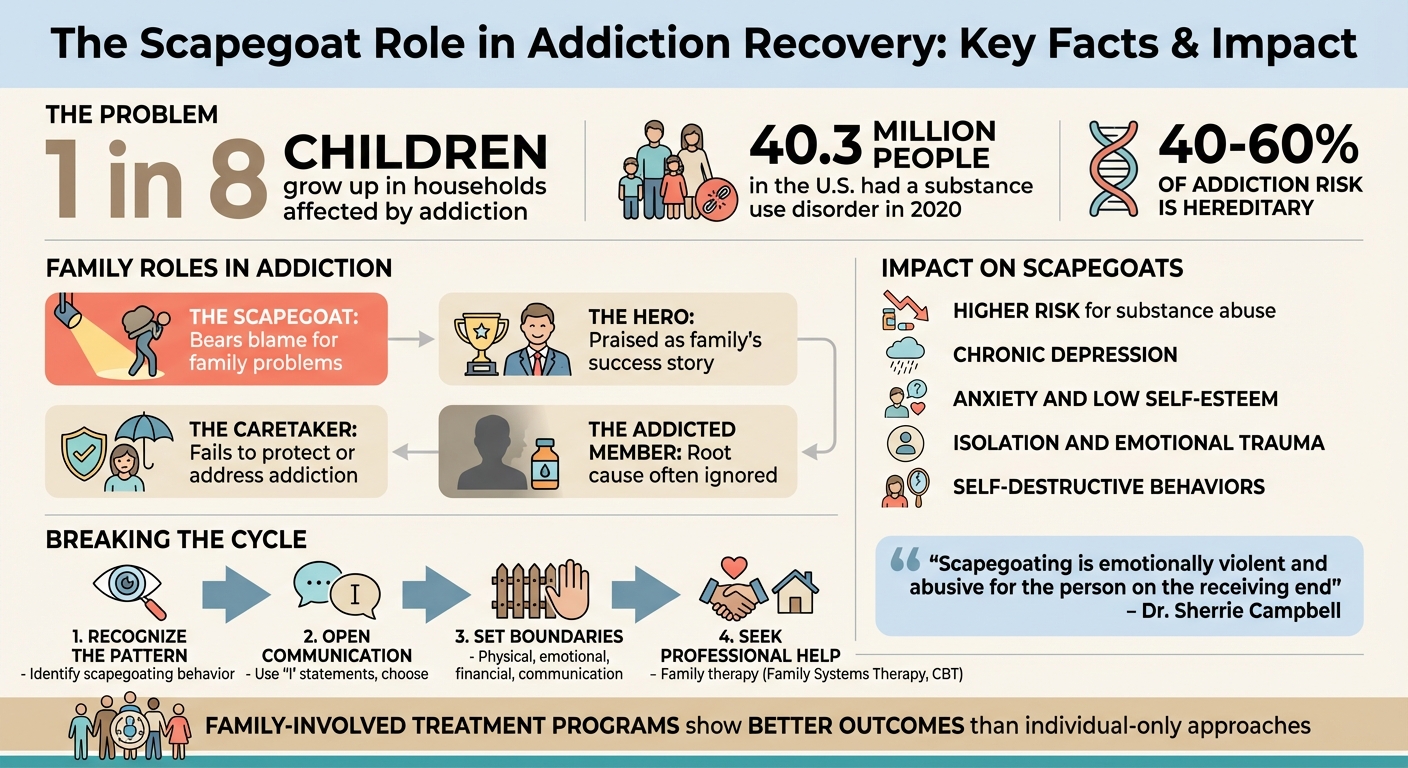
Impact of Scapegoating on Addiction Recovery: Key Statistics and Family Roles
How Therapy Helps Scapegoat Survivors Think What Used To Be Unthinkable
What the Scapegoat Role Looks Like
The scapegoat in a family often becomes the target for blame, absorbing the collective frustration and anger caused by addiction. This role comes with distinct emotional, behavioral, and relational challenges that can leave lasting scars.
Common Emotional and Behavioral Patterns
Scapegoats are known for pushing boundaries, rebelling, and sometimes engaging in risky or even destructive behaviors. But these actions aren’t random – they’re often reactions to the overwhelming pressure placed on them to distract from the deeper issue of addiction within the family.
Emotionally, they carry a heavy burden. Guilt, shame, and a sense of emptiness are common, along with deep resentment toward those who failed to shield them from harm. Sophie Settle, a Licensed Professional Counselor at Family Guidance Centers, explains:
"The Scapegoat often bears intense anger and resentment towards the Caretaker and/or the Hero for their unwillingness or inability to protect the family from the effects of the addiction."
Their attempts to speak the painful truth about the family’s dysfunction are often met with punishment or dismissal. Over time, they may internalize the negative labels placed on them, leading to low self-esteem and a cycle of self-destructive behavior.
The long-term effects can be severe. Scapegoats are at greater risk for substance abuse and chronic depression. Genetic factors play a role, with studies indicating that 40%–60% of addiction risk is hereditary [7]. When combined with the emotional trauma they endure, these risks increase significantly. This dynamic not only harms the scapegoat but also distracts the family from addressing the root issue of addiction.
How Scapegoats Interact with Other Family Members
Relationships within the family are often strained for scapegoats. They frequently harbor resentment toward the "Hero" sibling, who is often praised and held up as the family’s success story. At the same time, they feel anger toward the Caretaker for failing to protect them or address the addiction.
Siblings may label the scapegoat as the "troublemaker", which only deepens their sense of isolation. Paradoxically, scapegoats sometimes form a bond with the addicted family member, as both are treated as outsiders within the family dynamic. However, this connection doesn’t offer much solace. The scapegoat’s opinions are often dismissed outright, even when others express similar views and are heard. To make matters worse, family members may damage the scapegoat’s reputation with outsiders, further isolating them and solidifying their role as the family’s scapegoat.
How Scapegoating Damages Families and Recovery
When families lean on scapegoating as a coping mechanism, they create a fragile sense of stability built on blame. This approach doesn’t just harm the individual scapegoat – it disrupts the entire recovery process and locks everyone into unhealthy patterns.
Carrying Blame That Isn’t Theirs
In scapegoating, one family member becomes the outlet for all blame. Instead of addressing the root issues, like addiction, the family shifts focus onto this individual. As Emily Turinas, PhD, explains:
"By projecting problems onto one member, the family avoids confronting deeper, more systemic issues." [6]
The scapegoat ends up carrying emotions that don’t belong to them, absorbing shame and guilt that should never have been theirs. Research shows that scapegoated children are more likely to experience anxiety and depression, with these struggles often affecting their self-esteem and ability to trust others well into adulthood [6].
This emotional burden can be devastating. Scapegoats may come to believe they are fundamentally flawed or unworthy of love [9]. Such misplaced blame doesn’t just harm the individual – it also creates cracks in the family’s ability to heal and recover.
How Scapegoating Blocks Recovery
Beyond the emotional damage, scapegoating actively hinders recovery efforts. It prevents families from addressing both the addiction itself and the dysfunctional dynamics that fuel it [6]. Instead of growing and adapting, family members remain stuck in rigid, harmful roles [5]. These roles provide a false sense of control but keep the family in survival mode.
As one source explains:
"Abstinence from drug and alcohol misuse cannot be sustained if everyone around the person in recovery continues to cling to their family roles in addiction." [2]
This resistance to change – driven by a desire to maintain a toxic but familiar status quo – can derail recovery [6]. For scapegoats, the consequences are even more severe. Many turn to substance use themselves, attempting to cope with the isolation, guilt, and shame they endure [2]. Considering that 40.3 million people in the U.S. had a substance use disorder in 2020 and that 1 in 8 children grow up in households affected by addiction, breaking these cycles is essential not just for families but for the broader community [1][3].
How to Recognize and Stop Scapegoating
Breaking free from scapegoating begins with acknowledging the pattern and understanding the harmful roles at play [12]. Taking these steps not only addresses the issue but also helps restore balance within the family, which is essential for long-term healing. Psychologist Sherrie Campbell, Ph.D., emphasizes the seriousness of scapegoating:
"Scapegoating is a major red flag that a family has toxic underlying patterns… it is emotionally violent and abusive for the person on the receiving end." [10]
Once the behavior is identified, the next step is to dismantle it through open communication, firm boundaries, and, when needed, professional guidance.
Creating Space for Honest Conversations
To shift away from blame, use "I" statements that focus on your feelings rather than accusations. For example, instead of saying, "You keep causing problems", try, "I feel worried when conflicts arise" [11]. Timing is also key – these conversations are most effective when everyone is calm and receptive, rather than during moments of heightened tension or crisis.
Establishing Boundaries and Shared Responsibility
Healthy boundaries are essential to replacing blame with accountability. These boundaries should cover areas such as physical space, emotional interactions, financial matters, and communication [11]. As Chapter House Recovery explains:
"Healthy boundaries are an expression of love – they communicate care for both the individual’s long-term wellbeing and the health of the family system as a whole." [11]
When boundaries are tested, a helpful strategy is the "broken record" technique. This involves calmly and consistently repeating your boundary without escalating the situation. Following through on these boundaries is crucial to ensure they are respected by everyone involved.
If efforts within the family aren’t enough to break the cycle, seeking professional help can provide the tools and support needed.
Getting Help from a Therapist
Therapy offers a neutral, expert perspective to tackle deeply ingrained family dynamics [11]. Techniques like Family Systems Therapy and Cognitive Behavioral Therapy (CBT) are particularly effective in redistributing roles more fairly and addressing unresolved resentments [6].
For families in California navigating addiction recovery and scapegoating, Growth and Change Counseling provides specialized family therapy services. With offices in Campbell, San Jose, Los Angeles, and Roseville – and telehealth options available statewide – their therapists focus on these specific challenges. Individual therapy with a Licensed Marriage and Family Therapist costs US$200 for a 45-minute session, while sessions with Associate therapists are available for US$150. Sliding scale rates start at US$100 for those facing financial difficulties. Their approach, which emphasizes practical solutions, helps families move from merely coping to truly healing.
sbb-itb-596b85d
Therapy Approaches for Healing Scapegoat Patterns
Professional therapy offers structured methods to break the cycle of scapegoating and rebuild family dynamics on healthier foundations. These approaches provide families with tools to address harmful patterns and encourage mutual growth.
Reshaping How Family Roles Work
One effective method is Family Behavior Loop Mapping, which examines family interactions and identifies the sequence of events that may lead to substance use. By analyzing these behavioral chains, families can see how each member contributes to the system, shifting the focus away from blaming a single individual for the group’s challenges [13].
Therapists also rely on Cognitive Restructuring to challenge harmful beliefs that fuel scapegoating. For instance, a statement like "He’s irresponsible; he’ll never change" is reframed to highlight individual strengths and the potential for positive change [13]. Another tool, Contingency Contracting, involves creating formal agreements where family members commit to specific actions in exchange for supportive behaviors. This approach moves the family dynamic from blame to shared accountability [13].
Research backs these methods. Behavioral Couples Therapy (BCT), which includes similar strategies, has been shown to be highly effective in reducing substance use and improving relationship satisfaction. Klostermann, Kelley, Mignone, Pusateri, and Wills describe the approach as follows:
"The goal of BCT is to create a ‘virtuous cycle’ (i.e., enlisting the … partner’s support in the client’s recovery) between substance use recovery and relationship functioning by using interventions designed to address both sets of issues concurrently and reinforce positive behaviors." [13]
Once family roles are redefined, the focus shifts to resolving conflicts and addressing emotional wounds.
Resolving Conflicts and Processing Emotions
Communication Skills Training is a key component in helping families navigate difficult conversations. Through active listening and behavioral coaching, families learn how to reduce conflict and improve understanding [13][5]. Systemic-Motivational Therapy takes this a step further by engaging families in "mini-experiments", where they collaboratively test and refine strategies to improve their interactions [13].
Rebuilding trust is another critical element. Trust-building exercises encourage family members to demonstrate honesty and consistency in their actions, helping to repair the damage caused by addiction and scapegoating [5]. Therapists also guide families through addressing long-held resentments, often working directly with those involved to resolve deep-seated conflicts [5]. As Clear Behavioral Health explains:
"Trust tends to be the first thing broken when it comes to addiction, as well as the last thing to be repaired." [5]
Moving Toward Healthier Family Patterns
Healing from scapegoating patterns within a family requires more than just recognizing the issue – it demands a commitment to lasting change. Families must take deliberate steps to rebuild relationships and create an environment where everyone feels valued and supported. By working together and seeking professional guidance, families can redistribute roles more fairly, paving the way for recovery and trust to flourish [6].
Rebuilding Trust Between Family Members
In families affected by addiction and scapegoating, trust is often one of the first things to break down. Rebuilding it takes effort from everyone – not just the person in recovery. Each family member needs to take responsibility for their actions and acknowledge the unfair burden placed on the scapegoat [5][6]. Validating the scapegoat’s experiences and addressing past harms openly are key steps in this process [6]. Therapy can be a valuable tool for resolving lingering resentments and ensuring that old wounds don’t continue to cause harm [5]. Open conversations about family histories, including struggles with substance use, can also help normalize these challenges and create a foundation for honest dialogue [8].
Taking practical steps can further strengthen trust. Setting clear boundaries – like treating one another with respect, avoiding enabling behaviors, and refusing to fund substance use – can help redefine family dynamics [5][15]. Engaging in consistent trust-building activities, such as family meetings or shared projects, can gradually rebuild confidence and strengthen relationships [5].
Staying Committed to Long-Term Change
True recovery isn’t just about addressing the addiction; it’s about the entire family working together to break free from harmful roles like scapegoat or enabler [2][8]. This involves each member developing their own resilience and sense of identity, separate from the dysfunction of the past [6][8]. Support groups can also be an excellent resource, offering strategies to balance genuine concern with healthy boundaries [2][14].
Focusing on positive actions rather than past mistakes can make a significant difference. Studies show that substance abuse treatment programs involving family members often have better outcomes than those focused solely on the individual [14]. Growth and Change Counseling provides family therapy services that emphasize this collaborative approach. With offices in Campbell, San Jose, Los Angeles, and Roseville, CA, as well as telehealth options throughout California, their services focus on fostering emotional and relational well-being. By maintaining accountability and offering mutual support, families can move beyond managing crises and work toward lasting healing together.
How Therapy Heals Scapegoat Trauma at Growth and Change Counseling
Scapegoating disrupts the healing process for the entire family. Pointing fingers at one person allows everyone to sidestep the real issue: the addiction itself. Unfortunately, this behavior not only hinders recovery but also increases the likelihood that the scapegoated individual may develop substance abuse problems of their own [5][4]. With around 1 in 8 children living in homes impacted by addiction [3], breaking these harmful cycles is crucial to stopping the problem from affecting future generations.
Effectively addressing the scapegoat role requires the participation of the entire family. Studies show that recovery programs involving the whole family achieve better outcomes compared to those focused solely on the individual struggling with addiction [14]. Each family member must take responsibility for their role in the dynamic and commit to fostering healthier patterns. This shared accountability lays the groundwork for meaningful therapeutic progress.
Professional therapy provides the structure needed to make these changes stick. Therapists specializing in family systems can help redistribute roles, set clear boundaries, and rebuild the trust that addiction often destroys [5][6]. Growth and Change Counseling offers family therapy services tailored to these challenges, with offices in Campbell, San Jose, Los Angeles, and Roseville, CA, as well as telehealth options across California.
Breaking free from destructive family roles is essential for long-term recovery. Recovery isn’t just about achieving sobriety – it’s about creating a family environment where no one is unfairly burdened with blame. While the journey can be difficult, building a foundation of respect, honest communication, and mutual support has the power to transform lives. Seeking professional help is the first step toward reshaping your family’s future.
FAQs
What is the scapegoat role, and how does it impact addiction recovery in families?
The scapegoat role emerges when one family member is unfairly blamed for the family’s problems. This often serves as a way to sidestep deeper, underlying issues within the household. In families struggling with addiction, the scapegoated person often becomes the target for others’ anger, shame, or anxiety. Over time, this can lead to feelings of isolation, low self-worth, and significant emotional distress. Unfortunately, this dynamic can block progress toward recovery by shutting down open communication and reinforcing unhealthy coping mechanisms.
Breaking free from the scapegoat role is a critical step in creating a supportive environment for sobriety. Family therapy and coaching can help identify these harmful patterns, encourage better communication, and rebuild trust. By working together, families can create a healthier foundation for recovery. Growth and Change Counseling offers guidance through these challenges with therapy approaches designed to meet the specific needs of each family.
How does being scapegoated affect someone in the long term?
Being labeled as the scapegoat in a family can leave deep emotional and psychological scars. Many people in this position absorb the blame and criticism directed at them, which often results in low self-esteem, persistent anxiety, or even depression. Over time, this can make it harder for them to recognize their own needs, leading to unhealthy coping habits and difficulties in building secure, trusting relationships.
If these patterns persist, they can pave the way for struggles like substance use, trouble setting boundaries, and repeating harmful dynamics in future relationships or parenting. Addressing these issues through family-focused therapy can be a powerful step toward breaking such cycles. Growth and Change Counseling provides tailored support to help individuals heal, rebuild their sense of self-worth, and create healthier connections, paving the way for lasting recovery and well-being.
How can families break the scapegoating cycle to support addiction recovery?
Scapegoating happens when one family member is unfairly blamed for the family’s problems, often as a way to hide deeper issues like codependency or unresolved trauma. This pattern can block genuine healing and allow the person struggling with addiction to avoid accountability.
Breaking out of this harmful cycle requires intentional steps. Start by raising awareness – have calm, open discussions about the roles each family member plays, such as the scapegoat or the hero. Recognizing these roles can reveal how they might unintentionally shield the addiction. Simply naming the pattern can begin to weaken its grip. Next, work on shifting responsibility. Encourage the person with the addiction to take ownership of their actions while family members focus on their own well-being. Set healthy boundaries, avoid enabling behaviors, and use constructive communication techniques like "I" statements to express concerns without assigning blame.
Professional family therapy can also make a huge difference. A therapist can guide families in re-balancing roles, rebuilding trust, and creating healthier dynamics. Growth and Change Counseling offers personalized family therapy and parent coaching to help families navigate these challenges, strengthen relationships, and support lasting recovery.
Related Blog Posts
- How Family Therapy Restores Trust After Addiction
- Boundaries for Addiction Recovery and Healthy Love
- Family Systems Model for Addiction Recovery
- Managing Relapse Triggers in Family Systems
