Addiction recovery in Indigenous communities often requires addressing historical trauma and reconnecting individuals with their identity and community. Western treatment models focus on addiction as a brain disease, emphasizing individual responsibility and medical interventions. Here’s a quick breakdown:
- Indigenous Practices: Focus on emotional, physical, mental, and spiritual balance. Healing involves ceremonies, traditional medicines, and community participation.
- Western Models: Use evidence-based methods like medication-assisted treatments and behavioral therapies, often isolating individuals during recovery.
Blending these approaches can improve outcomes, with research showing higher program completion rates when Indigenous practices are included. The key is integrating both perspectives to address addiction comprehensively.
1. Indigenous Healing Practices
Foundations and Worldview
Indigenous healing practices are deeply rooted in a worldview where culture and spirituality play a central role in achieving wellness [7]. In this perspective, the well-being of an individual is inseparably tied to the health of their community, creating an interdependent system [2]. Health isn’t just about being free from disease – it’s a state of balance, closely connected to spiritual harmony and the natural world [8]. Many Indigenous communities describe this harmonious state as "walking in beauty" [8][4]. This guiding principle shapes healing methods that seamlessly blend traditional knowledge with spiritual practices.
Treatment Modalities
These healing practices take a holistic approach to addiction by addressing the interconnected aspects of mind, body, emotions, and spirit [6]. They acknowledge that addiction often stems from deep-seated historical trauma and a loss of cultural connection [9][5][10]. Indigenous ceremonies aim to heal these root causes, tackling feelings of sadness, anxiety, anger, and the risk of relapse. Traditional approaches include ceremonial rituals, storytelling, and the use of traditional medicines – all designed to restore balance and help individuals reconnect with their identity.
Role of Family and Community
A key element of Indigenous healing is the involvement of family and community, which stands in contrast to treatment models that isolate individuals [3][1]. During ceremonies, family members and the larger community come together, contributing to the healing process through shared songs, prayers, music, and dance [8]. This collective participation not only strengthens the individual but also builds a network of resilience and support that continues well after formal treatment ends. It’s this sense of togetherness that makes Indigenous healing practices profoundly impactful and enduring.
2. Western Addiction Treatment Models
Foundations and Worldview
In Western medicine, addiction is primarily viewed as a brain disease [4]. This approach treats addiction as a medical condition rooted in the brain, focusing on individual pathology rather than considering broader social or spiritual influences. Personal autonomy is seen as a cornerstone of health and recovery, with the emphasis placed on the individual’s ability to make independent choices [2]. This focus on individual responsibility shapes the treatment methods commonly used in these models.
Treatment Modalities
Western addiction treatment often combines medication-assisted treatments (MAT) with behavioral therapies [12]. These methods are grounded in evidence-based practices and treat addiction as a chronic condition that requires ongoing management [12]. The primary goals are to help individuals stop using substances, address the impact of addiction on the brain and behavior, prevent relapses, and support a return to a functional, productive life. However, many programs concentrate on resolving immediate issues rather than offering long-term, preventive care [11].
Role of Family and Community
One key characteristic of Western models is their tendency to isolate individuals from their families and communities during treatment [3]. Patients are often reconnected with their support systems only after achieving a certain level of recovery, rather than involving these networks throughout the process. This contrasts with Indigenous approaches, which integrate family and community at every stage of treatment. While some Western programs do include opportunities for family and community involvement, these elements are typically seen as supplementary rather than central to the recovery process.
Outcomes and Effectiveness
The differences in structure and philosophy between Western and Indigenous approaches lead to varied results. Studies show that American Indian adults often favor traditional, informal services over formal Western medical treatments, perceiving off-reservation professional services as the least effective option [11]. Additionally, Western providers may misinterpret Indigenous behavioral norms as signs of mental illness or fail to understand spiritual descriptions of mental health struggles, leading to misdiagnoses [2]. These mismatches in worldview can create feelings of discomfort or alienation for Indigenous clients in standard Western treatment settings [1].
Honouring Our Strengths: Indigenous Culture as Intervention in Addictions Treatment
sbb-itb-596b85d
Indigenous Cultural Healing at Growth and Change Counseling
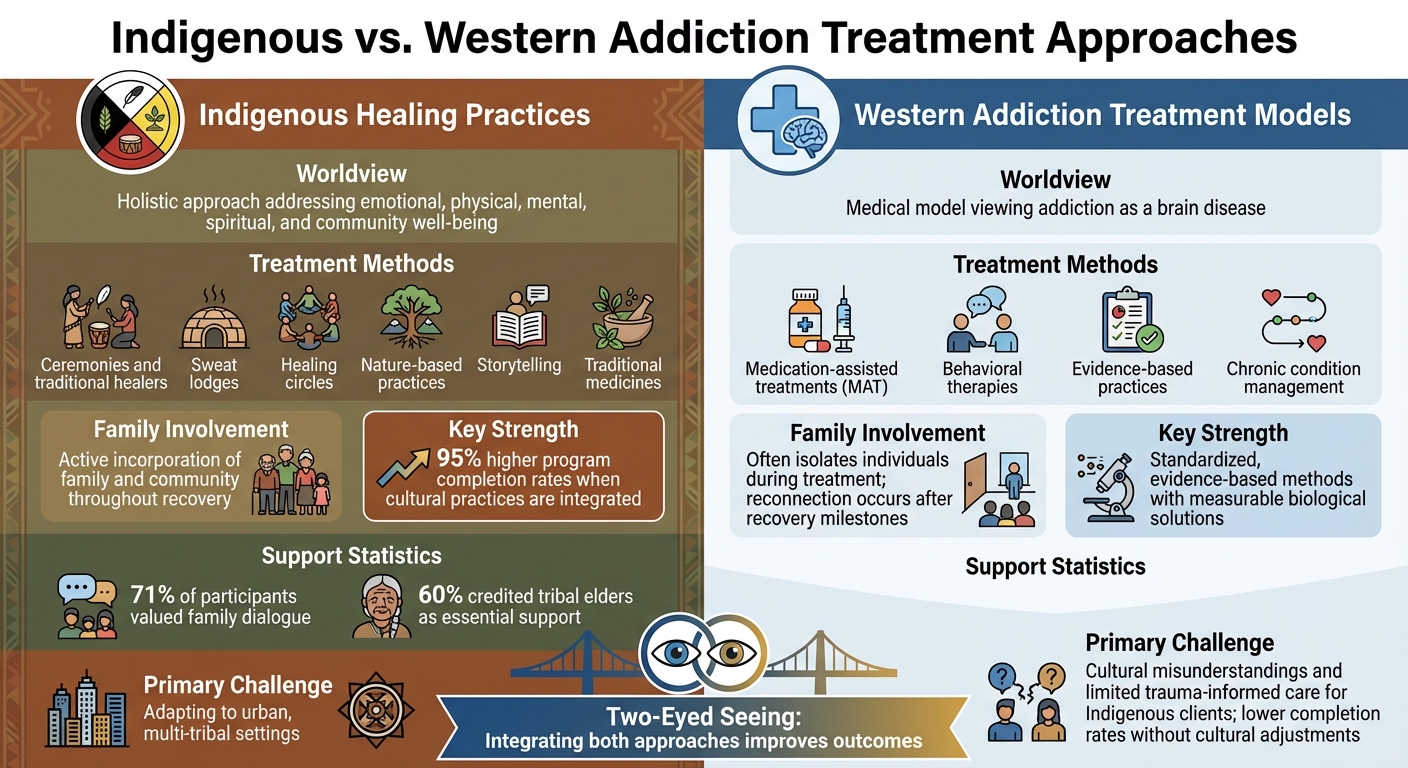
Indigenous vs Western Addiction Treatment Approaches Comparison
Indigenous healing practices and Western addiction treatment models each offer distinct strengths, and bringing them together can create a more well-rounded path to recovery. Here’s a closer look at how these approaches tackle addiction recovery in unique ways.
Indigenous healing practices emphasize a deep connection to community and cultural identity – both of which can act as powerful protective factors against addiction. For example, a study found that 71% of participants valued family dialogue, while nearly 60% credited tribal elders as essential sources of support [11]. Programs like the Indigenous Healing and Seeking Safety (IHSS) model have shown outstanding results, with a 95% improvement in program completion rates when cultural elements are included [13]. However, these practices can face hurdles, particularly in urban areas where multi-tribal dynamics add complexity [3].
Western addiction treatment models, on the other hand, are built on standardized, evidence-based methods that can be applied broadly. Treatments such as medication-assisted therapy offer measurable biological solutions to manage withdrawal symptoms and cravings. However, these models often focus on individual pathology and may overlook cultural and spiritual elements that are central to Indigenous approaches. This gap can sometimes lead to misinterpretations of Indigenous behavioral norms [3].
Here’s a side-by-side comparison to better understand their differences and areas of overlap:
| Aspect | Indigenous Healing Practices | Western Addiction Treatment Models |
|---|---|---|
| Worldview | Holistic – addresses emotional, physical, mental, spiritual, and community well-being [3] | Medical – views addiction primarily as a brain disease |
| Treatment Methods | Includes ceremonies, guidance from traditional healers, sweat lodges, healing circles, and nature-based practices | Focuses on medication-assisted treatments and behavioral therapies |
| Family Involvement | Actively incorporates family and community support throughout recovery [8] | Often isolates individuals during treatment |
| Program Completion | Achieves up to 95% higher completion rates when cultural practices are integrated [13] | Lower completion rates observed among Indigenous clients without cultural adjustments |
| Primary Challenge | Adapting to urban, multi-tribal settings can be difficult [3] | Cultural misunderstandings and limited trauma-informed care for Indigenous clients |
By integrating these two approaches, it’s possible to combine the precision of clinical methods with the cultural and spiritual depth of Indigenous healing. This blend can create a recovery process that feels both effective and deeply personal.
At Growth and Change Counseling, we take this integrated approach seriously, merging evidence-based practices with cultural awareness to support emotional and relational healing in a meaningful way.
Conclusion
Indigenous approaches to addiction recovery emphasize a community-driven, all-encompassing view of healing that touches on emotional, physical, mental, and spiritual health. On the other hand, Western models focus on standardized, evidence-based strategies with measurable results. Neither approach, by itself, fully addresses the complexities of effective addiction recovery.
A promising solution lies in the concept of Two-Eyed Seeing, a framework rooted in Indigenous wisdom. This approach encourages the equal integration of Indigenous and Western knowledge systems, combining holistic and clinical perspectives to create more effective treatment strategies [6]. Research has shown that incorporating cultural elements into treatment significantly improves completion rates [13]. The goal isn’t just to adapt Western methods for Indigenous clients but to build collaborative programs that weave together both worldviews at every level of care.
To make this integration practical, treatment programs can blend traditional healing practices with evidence-based therapies, tailoring each plan to honor the cultural and spiritual backgrounds of clients [3][4][7][15]. Addressing historical trauma is also essential, shifting the focus from viewing mental health as an individual issue to seeing it as part of a broader community healing process [14]. For instance, dedicating time in therapy sessions for cultural sharing allows clients to explore their tribal identity and articulate how they wish to incorporate Indigenous perspectives into their recovery. This approach demands cultural humility – recognizing the historical impacts of colonization and valuing the rich traditions of Indigenous communities [2].
FAQs
How do Indigenous healing practices approach addiction differently from Western methods?
Indigenous healing practices approach addiction as more than a personal medical condition; they see it as a disturbance in spiritual and communal balance. To address this, these practices rely on cultural rituals such as sweat-lodge ceremonies, smudging, drumming, talking circles, and storytelling. These traditions aim to reconnect individuals with their ancestors, the land, and their community, offering a sense of belonging and purpose – key elements often missing in the lives of those struggling with addiction.
On the other hand, Western methods tend to center on the individual, using tools like medication, cognitive-behavioral therapy, and 12-step programs that focus on personal accountability and abstinence. While these approaches can be effective for some, they often overlook the importance of cultural identity and community support – both of which are deeply embedded in Indigenous healing. By grounding recovery in cultural traditions and shared experiences, Indigenous practices offer a more holistic and community-centered path to healing, one that aligns with the values and needs of their people.
How does community support enhance addiction recovery in Indigenous practices?
Community plays a crucial role in Indigenous addiction recovery by providing connection, accountability, and a shared path to healing. Traditional practices such as Sweat Lodge ceremonies, Talking Circles, and other rituals help individuals reconnect with their identity and spiritual heritage. These practices also foster a sense of belonging and mutual support, which are essential for recovery.
Many modern Indigenous-led programs build on these traditions by involving families, encouraging peer support, and creating culturally grounded environments. These spaces allow participants to feel supported on a daily basis. When combined with harm-reduction strategies and approaches like "seeking safety", these programs often lead to better engagement and more sustainable recovery compared to standard, individual-focused treatments.
At Growth and Change Counseling, we recognize the power of community and cultural awareness in addiction recovery. Through telehealth services available across California, we provide evidence-based, personalized care that helps clients stay connected to their support networks while addressing their unique needs.
How do Indigenous cultural practices enhance addiction recovery when combined with Western treatments?
Blending Indigenous healing traditions with Western medical treatments offers a more balanced and inclusive path to addiction recovery. Practices like sweat lodges, smudging, storytelling, and talking circles focus on the spiritual and relational dimensions of healing – areas that conventional clinical methods often miss. When combined with treatments such as counseling and medication, these approaches create a space where individuals feel a stronger sense of trust, connection to their heritage, and emotional safety.
Studies indicate that this integration leads to better engagement, reduced stigma, and higher satisfaction with care – key ingredients for long-term recovery success. By respecting both Indigenous traditions and modern therapeutic methods, addiction treatment can be tailored to meet the specific needs of Indigenous individuals, making the process more meaningful and effective.
Related Blog Posts
- Top 7 Therapy Approaches for Cross-Cultural Couples with Addiction
- Parent Coaching with Faith in Addiction Recovery
- Emotional Triggers in Addiction Recovery
- Addiction Recovery and Marriage: What Works
