Helping neurodiverse children manage emotions can feel overwhelming, but play-based strategies offer a natural and stress-free way to support emotional regulation.
By focusing on sensory activities, storytelling, and role-playing, parents can guide their child through calming techniques without relying on verbal instructions, which can be challenging for some kids. Play-based methods work by addressing the child’s sensory needs first, stabilizing their nervous system, and allowing them to practice emotional skills in a supportive environment.
Key takeaways include:
- Sensory play (e.g., water, sand, or tools) helps calm the nervous system.
- Storytelling builds emotional awareness and problem-solving.
- Role-playing teaches social and emotional skills in a low-pressure setting.
- Tailored activities ensure the strategies match your child’s unique sensory and communication needs.
If challenges persist, professional play therapy can provide additional support through structured sessions designed for neurodiverse children. These methods empower kids to better understand and manage their emotions while building confidence over time.
Play Therapy Intervention for Self-Regulation
sbb-itb-596b85d
Emotional Regulation Challenges in Neurodiverse Children
Neurodiverse children often face emotional regulation hurdles that can look quite different from those experienced by neurotypical kids. For instance, while a neurotypical child might throw a tantrum over not getting a toy, they typically calm down once the issue is resolved. In contrast, neurodiverse children may experience meltdowns triggered by sensory overload, unexpected transitions, or even unrecognized internal signals. These meltdowns aren’t something that can be "disciplined away" with traditional methods like time-outs. In fact, such approaches can worsen the situation, amplifying feelings of panic and isolation instead of helping the child regain control.
These struggles manifest in various settings. At school, for example, a child who is sensitive to noise might cover their ears and retreat when the classroom becomes too loud. At home, challenges with interoception – the ability to sense internal body signals like hunger or the need to use the bathroom – can lead to sudden outbursts when discomfort becomes overwhelming [1]. Similarly, a child with reduced proprioceptive awareness might crave deep pressure, leading to behaviors like giving overly tight hugs or repeatedly pushing against furniture [1]. These actions often signal an overstimulated nervous system or unmet sensory needs, offering valuable clues about the underlying neurological processes at play.
How Brain Differences Affect Emotional Control
The root of these challenges lies in how the brain processes stress. Neurotypical children typically rely on "top-down" regulation, using their prefrontal cortex to manage emotions and stress. In contrast, neurodiverse children often experience "bottom-up" dysregulation, where sensory input overwhelms their system before reasoning can kick in. The amygdala, often referred to as the brain’s alarm system, takes over, triggering emotional responses before the logical centers of the brain have a chance to engage.
Many neurodiverse children also face alexithymia, which makes it harder for them to identify and label their emotions. This means they may not even realize they’re upset until they’re already in the middle of a meltdown. On top of that, executive function deficits – such as difficulties with working memory, impulse control, and cognitive flexibility – further complicate their ability to pause, reflect, or transition between activities without distress. Standard emotional regulation strategies often rely on these very skills, which explains why they tend to fall short for neurodiverse children. This is where alternative approaches, like play-based methods, come into the picture.
Why Play Works for Emotional Development
Play provides a natural, sensory-rich way to support emotional regulation without relying on verbal or logical reasoning. It allows children to engage in movement and sensory experiences that help calm their bodies and minds. Unlike traditional techniques, play doesn’t demand that a child name their feelings or use cognitive skills they may not yet have developed.
"Self-regulation is more than ‘calming down’ or ‘staying focused.’ It’s a dynamic brain-body process that shapes how children engage, learn, and connect" [1].
Through play, children can build new neural pathways by experiencing consistent and safe sensory interactions. This approach taps directly into the brain-body connection, offering a path to emotional growth that feels natural and achievable for neurodiverse children.
The Science Behind Play Therapy
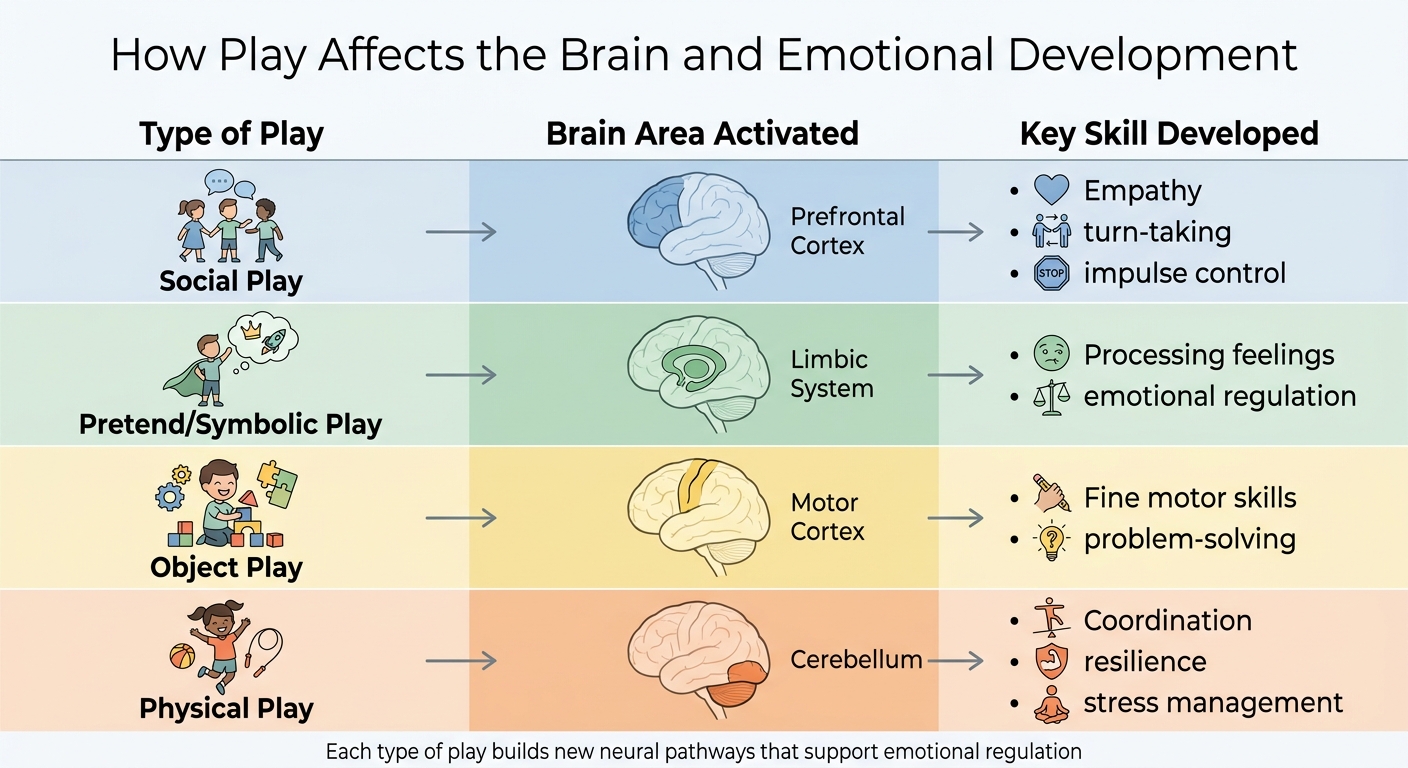
How Different Types of Play Affect Brain Development and Emotional Skills
Play therapy is deeply rooted in neuroscience and developmental psychology. It’s not just about having fun – it creates measurable changes in the brain that improve emotional regulation. By tapping into specific brain regions and neurochemical systems, play therapy can reach areas that traditional talk therapy might miss, particularly for neurodiverse children who may find verbal communication difficult.
How Play Affects the Brain
Play has a unique way of shifting the brain from "survival mode" to a more regulated state. When children feel stressed, the amygdala – our brain’s built-in alarm system – takes over, suppressing the prefrontal cortex, which is responsible for impulse control and managing emotions [3][4]. Engaging in play helps calm the amygdala, allowing the prefrontal cortex to regain control [3][4].
Different types of play activate various brain regions, each contributing to critical developmental skills:
- Social play engages the prefrontal cortex, improving executive functions like impulse control and decision-making.
- Pretend and symbolic play lights up the limbic system, helping kids process emotions through imagination.
- Physical play activates the cerebellum, enhancing coordination, resilience, and stress management by regulating cortisol levels [2].
Through repeated play, new neural pathways form, gradually replacing fear-driven responses with healthier, more adaptive ones [3]. The therapeutic relationship in play therapy also plays a key role, promoting the release of oxytocin and serotonin – chemicals tied to trust, bonding, and mood regulation [3].
These brain changes set the stage for meaningful improvements in how children manage their emotions.
What Play Does for Emotional Control
Building on these brain shifts, play therapy teaches children essential emotional regulation skills by changing how they process their feelings. For starters, it helps children work through implicit memories – those fragmented, nonverbal sensations and emotions that are often hard to express, especially for kids dealing with trauma or chronic stress [3]. Activities like role-playing or drawing allow them to process overwhelming experiences without needing advanced verbal skills.
Play therapy also fosters co-regulation, which is a stepping stone to self-regulation. In the therapy setting, the therapist acts as a co-regulator, helping the child navigate intense emotions in real time [3]. Over time, repeated experiences of co-regulation with a calm adult build the neural pathways needed for emotional control [4].
| Type of Play | Brain Area Activated | Key Skill Developed |
|---|---|---|
| Social Play | Prefrontal Cortex | Empathy, turn-taking, impulse control |
| Pretend/Symbolic Play | Limbic System | Processing feelings, emotional regulation |
| Object Play | Motor Cortex | Fine motor skills, problem-solving |
| Physical Play | Cerebellum | Coordination, resilience, stress management |
Regular play also supports brain plasticity – the brain’s ability to adapt and form new connections. Studies show that a lack of play increases stress vulnerability and reduces the brain’s capacity to adapt [2]. As The World Game aptly put it:
"A brain that doesn’t play is a brain that struggles to adapt" [2].
Pretend play, in particular, lets children experiment with how to handle "big feelings" in a safe, controlled environment. This builds confidence and resilience in ways that straightforward instruction simply can’t replicate.
Play-Based Activities You Can Use at Home
You don’t need fancy gadgets or expensive tools to help your child develop emotional regulation skills. Everyday items and a little creativity can go a long way. By focusing on sensory and narrative play, you can create calming moments and teach valuable emotional skills right at home.
Sensory Play Ideas
Sensory play is a great way to help calm your child’s nervous system. One simple idea? Warm water play. Fill a basin with warm water, add a bit of dish soap, and hand your child some measuring cups. According to Andrea Callahan, a preschool teacher with experience working with neurodiverse children:
"Pouring the water back and forth between the containers allows the child to relax, reset, and work through their emotions to prevent a larger tantrum." [6]
The repetitive motion of pouring creates a soothing rhythm, helping your child regain composure when they’re feeling overwhelmed.
If your child benefits from deeper sensory input, a screwdriver board could be a great option. This activity involves using safe, child-friendly tools to screw and unscrew bolts on a board with pre-drilled holes. The repetitive motion provides grounding input, helping your child focus and feel more centered. For moments when your child is too upset to safely handle tools, stick to gentler activities like water play.
Sand play is another excellent choice. The forgiving nature of sand allows children to smooth over mistakes, which can nurture flexible thinking and emotional resilience. Using a small tub or tray to contain the sand helps define the play area, keeping things tidy while giving your child a sense of structure. Before starting, set clear expectations using a calm and steady tone – often referred to as a "low and slow" approach. This ensures the activity stays relaxing rather than overstimulating.
Your involvement is just as important as the activity itself. Sitting with your child and modeling a slow, steady pace can make them feel supported and secure.
Once your child has calmed their body with sensory play, stories can provide a great way to process emotions.
Using Stories to Process Emotions
Stories are powerful tools for helping children understand and navigate emotions. They create a safe space for your child to observe and discuss feelings before applying that understanding to real-life situations.
Pick books that feature characters dealing with emotions your child often experiences. After reading, spark a conversation with questions like, "How do you think the character felt?" or "What could they do differently next time?" These discussions help expand your child’s emotional vocabulary and encourage problem-solving.
You can also create personalized stories together. Make your child the hero of a recent challenge they faced. Rewrite the story to show how strategies like taking deep breaths, asking for help, or trying a new approach lead to a positive outcome. This kind of narrative practice builds confidence and equips your child to handle similar situations in the future.
Role-Playing for Emotional Skills
Role-playing is another fun and effective way to build emotional and social skills. It allows children to practice handling real-life challenges in a safe, low-pressure environment.
For example, the "Change of Plans" scenario can help your child practice flexibility. Pretend you’re at the park, but the visit ends earlier than expected. Guide your child through taking deep breaths, naming their disappointment, and choosing an alternative activity.
Another idea is the "Collaborative Builder" scenario, which focuses on turn-taking and teamwork. Work together to build something with blocks or LEGOs, taking turns and agreeing on the design. This helps your child practice communication and compromise – skills that are useful in both play and social settings.
Role reversal can also be a powerful tool. Let your child play the role of the parent while you act as the challenging child. This exercise encourages empathy and can reveal which strategies your child finds most helpful.
Keep these role-playing sessions short – just 5 to 10 minutes. This keeps the activity fun and allows for repeated practice without overwhelming your child. These short, guided scenarios provide a safe space for learning and reinforce the self-regulation skills they’ll need in everyday life.
Adapting Play to Your Child’s Needs
Every neurodiverse child has their own sensory preferences – what soothes one might overwhelm another. By observing how your child responds to different activities and adjusting to their natural preferences, you create a space that highlights their strengths. Building on the earlier discussion about play’s role in emotional regulation, customizing activities to fit your child’s sensory and communication needs ensures they reap all the benefits.
Identifying Your Child’s Sensory Needs
To better understand your child’s sensory profile, watch how they react to different stimuli. Some kids are sensory seekers – they thrive on intense input like jumping, spinning, or crashing into cushions. Others are sensory avoiders, easily overwhelmed by bright lights, loud noises, or specific textures. Knowing if your child seeks or avoids sensory input helps you choose activities that feel comforting instead of stressful.
For instance, a child who loves spinning might enjoy time on a swing or rolling games. On the other hand, a child struggling with body awareness might benefit from activities that involve deep pressure, like using weighted items or engaging in squeezing motions.
Take note of what calms your child. Do they relax after squishing playdough? Do they become distressed in brightly lit rooms? These observations serve as a guide for creating play experiences that feel safe and enjoyable.
Adjusting Activities for Different Communication Styles
Once sensory preferences are clear, focus on adjusting how you communicate during play to support your child further. Communication styles vary greatly, and some children may find verbal instructions challenging. In these cases, visual aids can make a big difference. For example, a "First/Then" board with pictures – like "First build with blocks, then snack time" – can simplify multi-step directions and reduce frustration.
Incorporating AAC tools into play can also make communication easier. Keeping communication cards nearby allows your child to express needs like "more", "help", or "all done" without interrupting the flow of play.
You might also shift from giving commands to using declarative language. Instead of asking, "What color do you want?" or saying, "Put the block here", try describing what you notice: "You picked the blue block" or "The tower is getting taller." This approach reduces pressure and encourages your child to participate at their own pace, making play more collaborative and fun.
When to Get Professional Help
While home-based play activities can be effective, there are times when professional support can make a big difference. Knowing when to seek help ensures your child receives the care and guidance they need to thrive.
Signs You Need Professional Support
Certain patterns may suggest that home strategies aren’t enough. Frequent meltdowns, difficulty calming down after getting upset, or intense anxiety in unfamiliar social situations are key signs to watch for[5]. If your child consistently avoids eye contact, struggles to interact with peers, or has difficulty engaging in pretend play, it may be time to consider professional intervention[6,8].
These behaviors often hint at deeper emotional challenges. Another important factor to look out for is masking. This is when children suppress their neurodivergent traits to fit in socially. Katie Fries from All of You Therapy, LLC explains:
"Masking requires an incredible amount of energy and self-control, and it can lead to negative outcomes like physical illness, worsening symptoms, and depression"[7].
If your child seems drained after school or social gatherings and has trouble expressing their emotions, a therapist can provide a safe and supportive space for them to process their feelings authentically[7]. These signs suggest that professional help could complement the strategies you’ve been using at home.
What Happens in Play Therapy Sessions
Play therapy uses structured play as a way to address emotional and developmental challenges. Sessions usually last between 30 and 50 minutes[5] and follow a clear format. They often begin with a check-in, followed by an observation of your child’s natural play. Guided activities then focus on specific goals, such as improving social skills or expressing emotions. Sessions typically end with feedback for parents[5].
Therapists create a neutral, welcoming space where children can explore their feelings without judgment. This therapeutic relationship is one of the key benefits of professional play therapy. Techniques like Floor Time (DIR), which emphasizes emotional milestones and the parent–child connection, or TEACCH, which uses visual supports to aid communication for pre-verbal children, are often employed[9].
How to Find a Qualified Play Therapist
Professional guidance can enhance the strategies you’re already using at home. Start by consulting your child’s doctor for referrals[9]. Look for therapists trained in approaches like Floor Time or TEACCH, which are designed with neurodiverse children in mind. Research indicates that 58% of children in Floor Time therapy show positive progress[9].
Make sure the therapist holds appropriate credentials, such as LCSW, LPC, or Ph.D., and has experience working with neurodiverse conditions like autism, ADHD, dyslexia, or dyspraxia[8,10]. Seek out neurodiversity-affirming professionals who focus on empowering your child and avoid using stigmatizing language. Ask about their playroom setup to ensure it’s sensory-friendly, and share your child’s interests and strengths so the therapist can create a personalized, strength-based plan[7]. Look for providers who offer comprehensive services, including assessments, school advocacy, and collaboration with other specialists[8].
If you’re looking for professional support in emotional regulation for neurodiverse children, consider Growth and Change Counseling. They offer both in-person and telehealth therapy across California, using integrative, solutions-focused approaches tailored to your child’s needs.
Conclusion
Play-based emotional regulation isn’t about finding shortcuts or expecting instant results. It’s about laying the groundwork for meaningful growth through consistent, playful interactions with your child. The strategies shared here are effective because they align with how neurodiverse children naturally engage with the world – through play. This approach takes time but fosters lasting progress.
Patience is key. Emotional regulation is tied to complex brain development, which doesn’t follow a straight path, especially for neurodiverse children. Instead of focusing on immediate changes, look for the small victories. Every deep breath, every moment your child uses a sensory tool independently – these small steps are the building blocks of progress.
Tailoring the approach to your child’s needs is what makes it work. Activities that soothe one child might overwhelm another, so understanding your child’s sensory preferences is critical. Use these play ideas as starting points, adapting them to fit your child’s unique profile for the best results.
Lastly, remember that your own emotional state matters. Children often reflect the emotions of their caregivers, so maintaining your own calm is essential for co-regulation. When challenging behaviors surface, try to see them as signs of unmet needs or developmental delays. This perspective can help you stay grounded and provide the steady support your child needs to thrive.
FAQs
How do I know what sensory play will calm my child?
To figure out which sensory play activities help calm your child, pay close attention to how they respond to different options. Activities like playing with textured materials, splashing in water, or exploring sensory tables can be great starting points. Watch for the ones that your child gravitates toward and that seem to help them feel more at ease. These activities can play a big role in helping them manage emotions and find a sense of calm during stressful moments.
What can I do if my child won’t talk about feelings?
If your child finds it hard to talk about their feelings, play therapy might be the solution. Play allows children to express emotions in a way that feels natural and non-threatening, which is especially helpful for kids who struggle with verbal communication. Activities can be customized to support neurodiverse children, offering a safe environment for emotional expression and sensory experiences. This gentle, indirect approach often helps children share their feelings more easily.
How can I tell when play therapy is needed?
Play therapy can be a great tool for children who find it hard to express their feelings, communicate through words, or connect with others socially. Some signs that a child might benefit include challenges with imaginative play, avoiding eye contact, or showing anxiety in unfamiliar situations. For neurodiverse children, particularly those on the autism spectrum, play therapy offers a safe, child-focused space to work on emotional regulation and develop important social skills.
Related Blog Posts
- Parenting Stress: Solutions for Neurodiverse Families
- How Storytelling Helps Neurodiverse Kids Understand Emotions
- Trauma and Self-Esteem in Neurodiverse Kids
- ADHD Parenting: Emotional Regulation Strategies
