Trauma from childhood can deeply affect how you handle conflicts as an adult. It shapes emotional responses, communication patterns, and even trust in relationships. For instance, unresolved trauma may lead to overreacting, shutting down, or misinterpreting others’ intentions during disagreements. These patterns can harm relationships and make resolving conflicts feel overwhelming.
Healing from trauma helps you regulate emotions, improve self-awareness, and build empathy. Simple practices like pausing during arguments, naming your feelings, or using grounding exercises can make a big difference. Addressing trauma isn’t just about the past – it’s about creating healthier, more connected relationships today.
Key points:
- Trauma impacts emotional regulation and conflict patterns.
- Recovery involves recognizing and replacing old reactions.
- Techniques like mindfulness, time-outs, and open communication improve conflict resolution.
- Therapy can provide tools to rebuild trust and manage emotions effectively.
The Conflict Wounds of Trauma | Catriona Morten
How Childhood Trauma Affects Conflict Resolution
How Childhood Trauma Impacts Adult Relationships and Conflict Resolution
Unresolved childhood trauma can rewire your stress response system, leading to heightened emotional reactions during disagreements. It disrupts the balance between the limbic system (your emotional hub) and the prefrontal cortex (your rational thinking center), making it harder to stay calm and collected [6]. These changes in the brain often set the stage for challenges in managing emotions during conflict.
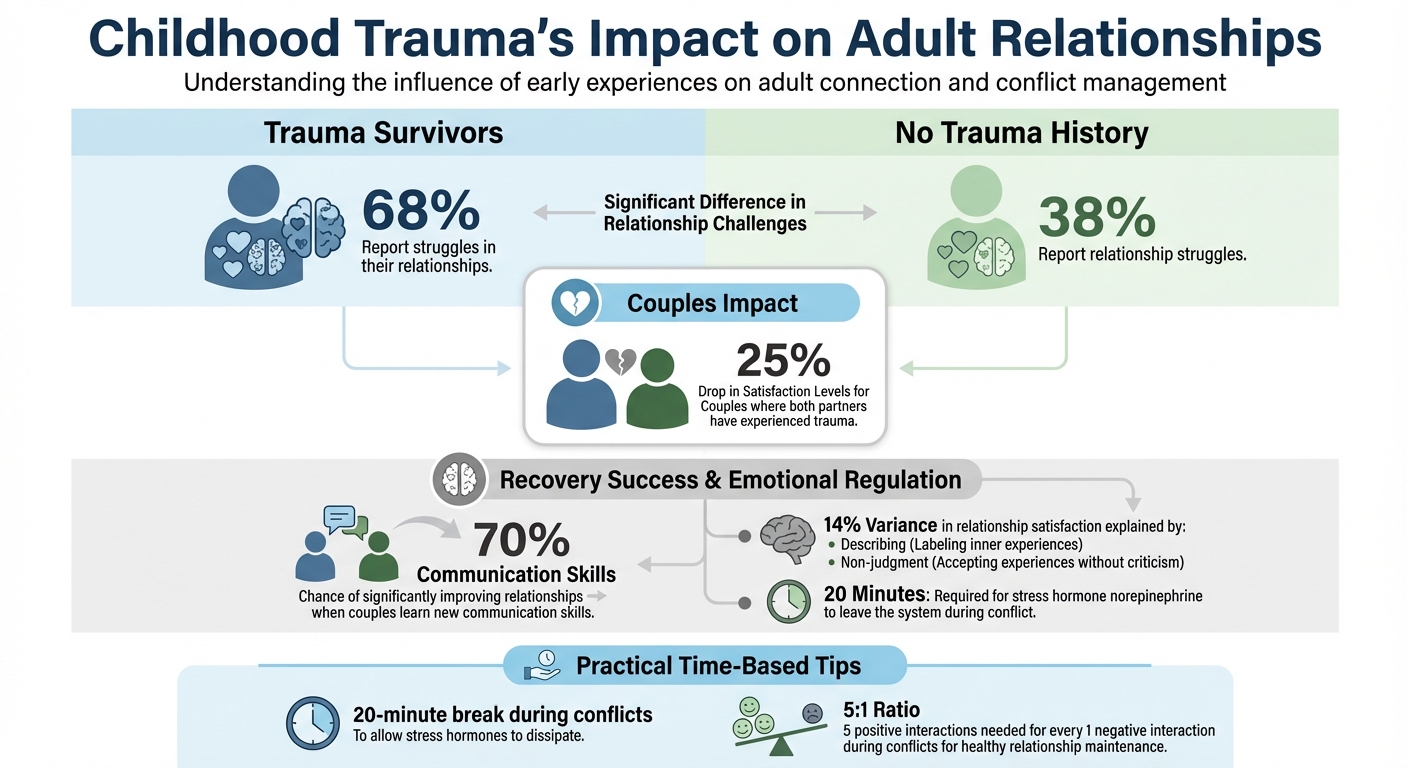
Research highlights the impact: 68% of trauma survivors report struggles in their relationships, compared to 38% of those without such experiences. For couples where both partners have experienced trauma, satisfaction levels drop by 25% [8]. These statistics reflect the very real challenges that can surface in daily conflicts and misunderstandings.
Trauma’s Effect on Emotional Regulation
Trauma affects how you regulate emotions, often leading to two extremes. On one end, there’s undermodulation, characterized by anxiety, hyperarousal, and explosive anger. On the other, there’s overmodulation, which involves emotional numbness, dissociation, or mentally shutting down [6]. This might look like snapping over minor issues or feeling crushed by criticism that others might easily dismiss. Or, you might find yourself zoning out, feeling disconnected, or even forgetting parts of heated arguments.
Dr. Yael Dvir from the Division of Child and Adolescent Psychiatry describes this as:
"Affect dysregulation, defined as the impaired ability to regulate and/or tolerate negative emotional states, and has been associated with interpersonal trauma and post-traumatic stress" [6].
Research also shows that trauma can disrupt the brain’s natural calming mechanisms. The connection between the amygdala (which processes emotions) and the pregenual cingulate (which helps regulate them) often fails to engage, leaving emotions unchecked during conflicts [7].
Attachment styles formed in childhood also play a role. Anxious attachment can heighten sensitivity and amplify negative emotions, while avoidant attachment may lead to emotional withdrawal and suppression [9]. These patterns often keep you stuck in "survival mode", where reactions like impulsiveness, rage, or people-pleasing take over [1]. Becoming aware of these automatic responses is a crucial step toward turning conflict into an opportunity for growth.
Common Conflict Patterns Caused by Trauma
Over time, these emotional disruptions can lead to predictable patterns in how you handle conflict. For instance, you might avoid confrontation altogether, withdraw out of fear, or insist on being fiercely independent to avoid feeling vulnerable. On the flip side, some people become hyper-reactive, lashing out with anger, irritability, or defensiveness during even minor discussions.
Another common challenge is alexithymia, where you struggle to identify and articulate your emotions. This makes it difficult to communicate your needs clearly during arguments [11].
Trauma can also lead to hostile attribution bias, where you interpret neutral remarks or ambiguous actions as threatening or judgmental [10][11]. For example, a simple "How was your day?" from your partner might feel like an accusation or criticism. This happens because trauma conditions your brain to focus on potential threats, even in safe relationships.
Other destructive patterns include perseveration, where you can’t let go of an issue and keep bringing up new problems during cool-down periods, and rigidity, where the need to be "right" overshadows your ability to understand another person’s perspective [1]. Behaviors like the silent treatment, sarcasm, name-calling, and blame often stem from these trauma-driven adaptations. While these reactions may have once helped you cope as a child, they can now erode the trust and intimacy needed for healthy adult relationships.
How Trauma Recovery Improves Conflict Skills
Recovering from trauma can profoundly reshape how you handle conflicts. It shifts your nervous system from a state of constant self-protection to one that fosters connection and understanding [13]. This shift isn’t just about symptom management – it’s about developing cognitive flexibility, which allows you to see conflicts through multiple lenses [4]. Dr. Arielle Schwartz describes this as equanimity, the ability to face differences, disconnection, and discord without viewing every disagreement as a threat [4]. These changes encourage clarity and reduce defensiveness, laying the groundwork for emotional steadiness and deeper empathy in challenging situations.
Rebuilding Emotional Balance
One of the key aspects of recovery is learning to identify and replace old trauma scripts – those instinctive defensive responses formed during childhood that no longer serve you [13]. Instead of reacting based on past wounds, recovery helps you respond to the present moment with greater awareness.
A simple yet powerful technique involves naming your internal state as it arises. For example, saying, “I feel my chest tightening” or “I notice my jaw clenching” signals your brain to move from a reactive state to one of awareness [12]. This small act of acknowledgment can stop an emotional spiral before it begins.
Take the example of a client who struggled with trauma-driven perfectionism. She replaced her internal "should" narrative with mindfulness practices and soothing actions, which helped her shift from a state of hyperarousal to one of calm connection [13].
Other practical tools for emotional balance include structured time-outs – taking a brief 30-minute pause to calm your body before revisiting the conflict [12]. Grounding exercises, like the "5-4-3-2-1" method (identify 5 things you see, 4 you can touch, 3 you hear, 2 you smell, and 1 you taste) paired with deep breathing, can deactivate your fight-or-flight response [12]. Additionally, co-regulation – using gentle touch or reassuring words like “We’re okay, let’s slow down” – can help both you and your partner settle emotionally [12].
Increasing Self-Awareness and Empathy
Beyond emotional regulation, trauma recovery enhances self-awareness and empathy. It makes you more conscious of your emotional wake – the impact your behavior has on others [4]. For instance, you might start noticing patterns like blame, sarcasm, or withdrawing that previously went unchecked. To uncover these blind spots, try asking a trusted partner questions like, “How do you feel after our conversations?” or “What do you experience when I enter or leave the room?” [4]. These insights can inspire meaningful changes in your interactions.
Research backs this up. A study of 330 participants found that two mindfulness practices – Describing (labeling inner experiences) and Non-judgment (accepting experiences without criticism) – accounted for 14% of the variance in relationship satisfaction among individuals with childhood trauma [15]. When you can name your emotions in real time, it improves both communication and emotional regulation.
Dr. Schwartz explains:
"Healthy conflict requires tolerance for difference, disconnection, and discord. Letting someone know that they have hurt your feelings can feel frightening. Taking responsibility for hurting someone you love can evoke shame. It takes wisdom to refine primal reactions into caring, thoughtful responses." [4]
This wisdom often begins with mindful pauses – moments where you stop to reflect before reacting [4]. When triggered, ask yourself: “What is this really about for me?”, “What am I afraid of?”, or “What story am I telling myself?” [14]. These questions help identify lingering wounds that might be affecting your current responses.
Most importantly, recovery nurtures empathy by reframing conflicts as opportunities to build trust rather than threats to your safety [4][3]. A longitudinal study of 73 young-adult couples found that partners who recovered well from conflict reported higher relationship satisfaction. For individuals with insecure attachment histories, this ability to repair conflicts served as a protective factor, leading to stronger relationship stability over two years [5]. Healing doesn’t just benefit you – it creates a safer, more connected space for your partner, transforming conflicts into moments of growth.
Practical Methods for Better Conflict Resolution
Building on the connection between trauma recovery and emotional regulation, these strategies can help reshape the way conflicts unfold. They focus on creating a sense of safety, managing overwhelming emotions, and finding solutions that respect both partners’ needs.
Creating Safety and Trust
The groundwork for safety begins long before any conflict arises. Starting difficult conversations with softened approaches – using curiosity instead of criticism – can set the stage for productive discussions [17][19]. For example, saying, "I felt overwhelmed cleaning alone yesterday; can we discuss a fairer approach?" shifts the focus to your feelings and minimizes defensiveness [14][2].
Setting ground rules is another way to create predictability, which is particularly important for trauma survivors who may struggle with uncertainty [12]. Agree on boundaries like avoiding name-calling, refraining from interruptions, and not dragging past grievances into current discussions [18][19]. Timing is also crucial – bring up important topics when both of you are rested and free from distractions, not after a long, stressful day [18].
Research highlights the importance of maintaining a ratio of 5 positive interactions for every 1 negative interaction, even during conflicts [19]. Building what experts call a "foundation of fondness" by regularly expressing gratitude and admiration can act as a buffer against contempt during future disagreements [14]. These practices not only build trust but also make it easier to navigate conflicts effectively.
Managing Strong Emotions During Conflicts
When emotions run high – your heart races, your muscles tense, or your thoughts spiral – it becomes almost impossible to listen or empathize [12]. It takes about 20 minutes for the stress hormone norepinephrine to leave your system and allow your body to return to a calmer state [16].
In such moments, revisit your agreed-upon time-out plan to prevent the conflict from escalating. Take a structured break (20–30 minutes) and use techniques like TIPP (temperature, intense exercise, paced breathing, and progressive relaxation) to regulate your body. For instance, applying ice or cold water to your face can activate the "dive reflex", which helps reset your heart rate. Holding a physically demanding pose like a plank for 60 seconds can burn off excess energy. Slow, deep breaths with extended exhales or progressive muscle relaxation – tightening and releasing muscle groups from head to toe – can also help [16]. Always agree on a specific time to resume the discussion so your partner doesn’t feel abandoned [12][16][17].
If both partners are open to it, co-regulation – using a calm voice, gentle touch, or reassuring phrases like "I’m here. We’re okay. Let’s slow down" – can help settle both of your nervous systems at the same time [12]. Simple self-compassion gestures, such as placing a hand on your heart or belly, can also shift your body from a defensive state to a more nurturing one [14].
Working Together to Solve Problems
Once you’ve established safety and managed intense emotions, the focus can shift to finding solutions together. Research shows that 69% of relationship problems are unsolvable [17], so the goal should be managing conflicts rather than trying to eliminate them entirely. Couples who learn new communication skills have a 70% chance of significantly improving their relationship [18].
Reflective listening is a key tool to ensure both partners feel heard before jumping into solutions. Paraphrasing what your partner says – such as, "So what I’m hearing is… Is that accurate?" – can clarify misunderstandings and prevent assumptions [18]. This practice avoids the "mind-reading trap", where partners expect each other to know their needs without expressing them [12].
When brainstorming solutions, start with "wild ideas" without judgment, then look for areas of overlap in your values or goals to reach a compromise [17][18]. Make specific, actionable agreements instead of vague promises. For instance, instead of saying, "We’ll communicate better", commit to something concrete like, "We’ll check in for 10 minutes every evening without distractions like phones" [18]. Remember, most arguments are not about surface issues but deeper needs like security, appreciation, autonomy, or connection [18]. Addressing these core needs can turn conflicts into opportunities for greater understanding and growth. By applying these strategies, you can transform conflicts into moments of connection and progress.
sbb-itb-596b85d
How Growth and Change Counseling Supports Trauma Recovery
When trauma disrupts your ability to navigate conflicts or connect with others, having the right support can change everything. Growth and Change Counseling offers trauma-focused services that provide practical tools to turn conflicts into opportunities for deeper connection. With over 13 years of experience in relationship therapy and mental health services[3], their approach is designed to help rebuild emotional regulation while enhancing relationship skills. Instead of relying solely on traditional talk therapy, they focus on identifying and addressing outdated protective responses – those survival mechanisms that may now block intimacy and connection. This method not only helps heal past wounds but also sharpens your ability to handle conflicts constructively.
Individual Trauma Therapy
Growth and Change Counseling takes a solutions-focused, integrative approach to trauma therapy, helping you recognize patterns rooted in past experiences. April Silva, LMFT and trauma specialist at Growth and Change Counseling, explains:
"In cases of PTSD, I will help you identify outdated protective responses that now hinder your intimacy."[3]
Therapy sessions also emphasize building relational intelligence by connecting past beliefs to current conflict behaviors. You’ll gain actionable skills and receive homework to practice emotional regulation techniques in everyday situations, ensuring that the progress you make in therapy translates into lasting change.
Couples Counseling for Relationship Repair
For couples working to rebuild their connection, Growth and Change Counseling offers The Marriage Rescue Institute, a 12-week intensive program tailored for marriages facing serious challenges[3]. This trauma-informed program follows a structured, five-step process: creating safety, building trust, processing trauma stories, learning co-regulation, and restoring intimacy[2]. Along the way, couples learn practical conflict resolution techniques, such as "softened startups", structured pauses during disagreements, and using "I-statements" to minimize reactivity[2]. As Growth and Change Counseling explains:
"Conflict is a pathway to intimacy. If there’s no conflict in a relationship, at least one person isn’t being genuine."[3]
Telehealth and In-Person Options in California
Healing from trauma requires accessibility and flexibility. Growth and Change Counseling offers both in-person sessions at offices in Campbell, San Jose, Los Angeles, and Roseville, as well as telehealth options for clients across California. This flexibility allows you to choose the setting that feels most comfortable – whether it’s the privacy of your home or the focused environment of a therapist’s office. All therapists at Growth and Change Counseling follow a unified approach, ensuring consistent and effective care. Individual sessions are priced at $200 for a 45-minute session with a Licensed Therapist or $150 with an Associate, with sliding scale options beginning at $100[3]. By offering adaptable and affordable support, they make it easier to strengthen conflict management skills and rebuild meaningful relationships.
Long-Term Benefits of Trauma Recovery
Stronger Relationships
Recovering from trauma can significantly enhance your ability to connect with others by improving emotional awareness and understanding [1]. When you’re stuck in survival mode, impulsive reactions and self-defeating behaviors often push people away. Healing helps you break free from this cycle. Instead of seeing conflict as something to avoid, you start recognizing it as a chance to build deeper intimacy [3]. Studies show that individuals with childhood trauma often experience more distress in their relationships [8]. Through recovery, you can move from insecure attachment patterns to secure, trusting bonds, transforming conflicts into opportunities for meaningful resolution.
Lasting Emotional Control
Another key benefit of trauma recovery is gaining better control over your emotions. Healing rewires the brain, particularly in areas like the prefrontal cortex and anterior cingulate cortex, making emotional regulation more efficient [23]. As you move past unhelpful habits like overthinking or suppressing emotions, you develop healthier strategies, such as cognitive reappraisal. This allows you to view challenging situations in a calmer, more balanced way [24][10]. Over time, you’ll find it easier to bounce back emotionally after intense situations and to handle difficult feelings without feeling overwhelmed [22]. Even dedicating just 5–10 minutes a day to mindful meditation can make a noticeable difference [22]. This emotional stability is crucial for approaching conflicts with clarity and composure.
Better Problem-Solving Skills
Trauma recovery also sharpens your ability to solve problems effectively. By replacing harmful thought patterns with balanced, constructive ones, you can shift from reacting impulsively to responding thoughtfully [25][1]. This mental shift improves your ability to evaluate situations and come up with creative solutions. Research shows that involving partners in trauma-focused therapy, such as conjoint therapy, not only helps reduce PTSD symptoms but also encourages teamwork in addressing challenges [21]. Strengthening communication skills further minimizes defensiveness and fosters collaboration [1][2]. Instead of viewing relationship hurdles as threats, you’ll see them as chances to grow together. These problem-solving improvements lay the groundwork for healthier, more resilient relationships.
Conclusion
Healing from trauma is about reclaiming your ability to connect with others and, most importantly, with yourself. Addressing childhood trauma allows you to rediscover and embrace your true self. As Shauna Niequist wisely says:
"What people miss about transformation is that it’s not about becoming someone else. It’s about becoming yourself more fully" [3].
Through this process, survival habits like withdrawal or aggression can be replaced with genuine relational skills, turning conflicts into moments of growth and deeper intimacy [3][4].
Recovery also strengthens emotional regulation. It helps you build the ability to pause and respond thoughtfully, rather than reacting impulsively. Dr. Arielle Schwartz captures this beautifully:
"The journey of trauma recovery is an awakening of the spiritual heart" [4].
This shift moves you from ego-driven responses to heart-centered connections, fostering more meaningful relationships.
For those who’ve experienced early trauma, the path forward includes developing cognitive flexibility, staying mindful in heated moments, and learning to see your partner’s perspective with empathy. These skills not only enhance present relationships but also help break intergenerational cycles, ensuring healthier patterns for future generations [20].
Professional support can make this transformation more attainable. Growth and Change Counseling offers trauma-informed individual and couples therapy throughout California, both in-person and via telehealth. Whether you’re working through personal trauma or rebuilding relationship dynamics, expert guidance can provide the tools you need for lasting change.
As a reminder:
"It is not our mistakes that define us. Rather, it is our ability to learn from those moments and make amends that really shapes who we are" [4].
Ultimately, how you respond to past challenges matters far more than the challenges themselves. Each step in recovery brings you closer to authentic connections and equips you with the skills to navigate conflicts with grace and understanding.
FAQs
How can childhood trauma impact conflict resolution skills in adulthood?
Childhood trauma can leave a lasting mark on how adults navigate conflicts. It often shapes insecure attachment styles, such as anxious or avoidant tendencies, and can disrupt emotional regulation. This means that when disagreements arise, some may react with intense hostility, pull away entirely, or struggle to show empathy.
These behaviors can complicate conflict resolution and put a strain on relationships. The good news? Therapy can play a pivotal role in addressing unresolved trauma. By working through these experiences, individuals can develop better emotional awareness, improve communication, and learn healthier ways to manage conflicts – building stronger, more rewarding connections in the process.
How can I manage intense emotions during conflicts?
Managing strong emotions during conflicts means staying composed and present so you can express yourself clearly and keep the dialogue productive. Rather than pushing feelings aside, focus on strategies that help you manage emotions and maintain a positive tone in the conversation.
Here are a few effective techniques:
- Pause and take a breather. If emotions start to feel overwhelming, let your partner know you need a moment to step away. Use this time to calm down before re-engaging in the conversation.
- Engage in mindfulness. Pay attention to your breathing, feel the ground beneath your feet, or do a quick body scan to release tension and regain a sense of control.
- Name your emotions. For example, saying, “I feel frustrated because I don’t think I’m being understood,” not only helps you process your feelings but also signals to your partner that you’re trying to work toward a resolution.
These methods can be especially useful if past experiences, such as childhood trauma, make it harder to stay calm during disagreements. Growth and Change Counseling provides trauma-informed therapy designed to help individuals and couples strengthen emotional resilience and improve their ability to navigate conflicts.
How does healing from trauma improve relationships?
Healing from childhood trauma can play a transformative role in improving relationship satisfaction. By addressing deep-seated attachment wounds, individuals are more likely to develop secure attachment styles, which pave the way for healthier communication, reduced conflict, and stronger emotional bonds with their partner.
Working through trauma often eases related struggles like depression and anxiety, which can otherwise put a strain on intimacy. Studies highlight that resolving emotional pain linked to trauma can lead to noticeable shifts in relationship dynamics. At Growth and Change Counseling, trauma-focused therapy – such as the intensive 12-week Marriage Rescue Institute program – offers couples tools to rebuild trust, navigate conflicts more effectively, and create deeper, more meaningful connections.
Related Blog Posts
- Relationship Trauma: Root Causes and Solutions
- Trauma Recovery for Couples: A Path to Healing
- How Trauma Shapes Anger in Relationships
- Relational Intelligence in Parenting: Lessons from Trauma Recovery
