Trauma can significantly influence how anger emerges in relationships. It often rewires the brain, making it harder to regulate emotions and distinguish between real threats and harmless situations. This can lead to intense reactions, miscommunication, and emotional withdrawal. Partners may experience cycles of conflict driven by unresolved fears and past experiences.
Key takeaways:
- Trauma impacts the brain’s threat response, often causing heightened sensitivity and emotional flooding.
- Anger can be internalized or externalized, showing up as withdrawal or outbursts.
- Triggers often stem from "feeling memories," where past trauma blends into current interactions.
- Resentment and mistrust rooted in trauma can escalate conflicts.
- Therapies like EMDR, CBT, and couples counseling help address trauma and improve emotional regulation.
Understanding these dynamics allows couples to approach conflicts with empathy, creating a path to healing and stronger communication.
Reclaim Your Anger: Trauma, Repression, and Healthy Protest | Elizabeth Ferreira, Being Well
sbb-itb-596b85d
How Trauma Affects the Brain and Triggers Anger
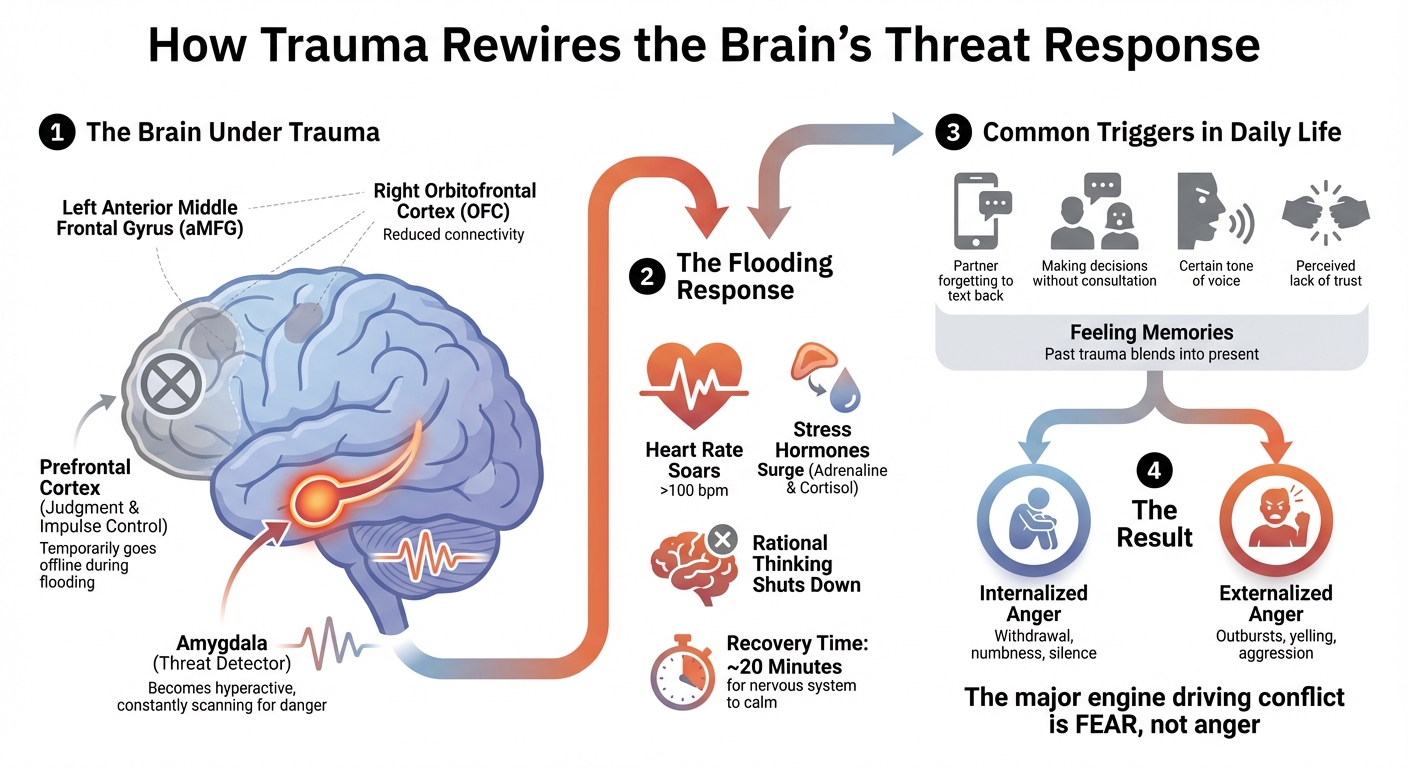
How Trauma Affects the Brain and Triggers Anger in Relationships
Trauma’s Impact on the Brain’s Threat Response
Trauma changes how the brain processes threats, essentially rewiring its alarm system. The amygdala, the brain’s "threat detector", becomes hyperactive, constantly scanning for danger. This leads to "flooding" – a state where heart rates soar above 100 bpm, and stress hormones like adrenaline and cortisol surge [4]. Meanwhile, the prefrontal cortex, which handles judgment and impulse control, temporarily goes offline [4][7]. Dr. Robert Navarra from the Gottman Institute explains this phenomenon:
"When partners get flooded, reactions are intense, come quickly, and are involuntary. What that means is that the amygdala is running the show and the prefrontal cortex – the part of the brain associated with judgment and impulse control – is temporarily disengaged and not available" [4].
Research from Stanford University highlights specific brain regions affected by trauma-related anger. For example, trauma survivors often show reduced connectivity between the left anterior middle frontal gyrus (aMFG) and the right orbitofrontal cortex (OFC) [5]. Interestingly, individuals with higher activity in the left aMFG tend to experience less anger, suggesting this region might act as a buffer against chronic anger [5]. Neir Eshel and colleagues noted:
"Left aMFG activity may confer protection against the development of anger, and therefore may be an intriguing target for circuit-based interventions for anger in PTSD" [5].
These changes in brain function make it easier for everyday situations to feel like threats, even when no real danger exists.
Common Trauma Triggers in Daily Life
The changes in brain activity caused by trauma can make seemingly ordinary events feel overwhelming. Survivors often develop an overgeneralized sense of danger, interpreting harmless interactions as threatening [3]. For instance, a partner forgetting to text back, making a decision without consulting them, or using a certain tone of voice can activate the brain’s alarm system. These reactions aren’t deliberate overreactions – they’re "feeling memories", where past trauma blends into the present [4]. This makes it hard for the brain to separate genuine threats from reminders of old wounds.
Cognitive distortions further fuel these triggers. Trauma survivors might develop beliefs like "people can’t be trusted", which causes them to view neutral actions as personal attacks [3]. Rumination – dwelling on perceived offenses – intensifies this, narrowing focus to hostile thoughts and increasing the likelihood of aggressive responses [3]. Andrea A. Massa from Purdue University found:
"negative cognitions about the world were directly associated with both physical and psychological IPA [Intimate Partner Aggression] perpetration and that these relationships were mediated by anger misappraisal and emotion dysregulation" [3].
Though the intense physiological reaction from flooding is temporary, it can take about 20 minutes for the nervous system to calm down [4]. During this time, the brain remains in survival mode, making rational conversations nearly impossible.
How Anger Shows Up in Relationships
Internalized vs. Externalized Anger
Anger stemming from trauma doesn’t show up the same way for everyone in relationships. For some, it’s internalized – kept inside and hidden from view. This can look like emotional withdrawal, numbness, or a heavy silence that slowly chips away at intimacy. For others, anger is externalized, coming out as yelling, blaming, irritability, or even physical aggression. This is often a "fight" response, triggered when the amygdala – the brain’s emotional alarm system – takes over.
Interestingly, research highlights that internalized anger and struggles with managing it are more closely tied to PTSD than outward displays of anger. Emotional numbing, a common result, reduces the ability to feel and share positive emotions. This not only diminishes warmth and connection but also places a heavy emotional burden on partners. As Licensed Marriage & Family Therapist Joanne Kim puts it:
"The major engine that drives couples’ conflict is NOT anger, but FEAR." [6]
Understanding this distinction helps explain why feelings of betrayal and unresolved resentment can amplify these anger responses.
How Betrayal and Resentment Fuel Anger
Trauma undermines trust, often leading to chronic hostility. Many trauma survivors develop negative beliefs about others and the world – such as "people can’t be trusted" or "I must always be on guard." These beliefs can make both physical and psychological aggression more likely [3]. When individuals dwell on perceived threats, it strengthens the connection between these beliefs and aggressive actions. What might look like anger on the surface often masks deeper fears tied to attachment issues. This is sometimes referred to as "intimacy anger", where a fear of abandonment drives unhealthy attempts to control the relationship [8]. Such patterns can intensify conflicts, making them harder to resolve.
How Conflicts Escalate into Aggression
Trauma can make conflicts escalate quickly, especially when unresolved wounds are triggered. Partners may view the same disagreement through completely different trauma-informed perspectives, turning minor issues into major standoffs [6]. For instance, a study of parents in a community sample revealed that 97% admitted to engaging in psychological aggression within their relationships, and 49% acknowledged physical aggression [9]. On a broader scale, about 35.6% of women and 28.5% of men in the U.S. report experiencing physical violence, stalking, or sexual assault by an intimate partner at some point in their lives [8].
Escalation often starts when a trigger activates a deep-seated vulnerability, leading to a state of physiological flooding. In this state, rational thinking shuts down, and survival instincts take over [4]. Research shows a strong connection between PTSD and overall anger and hostility, with an average effect size of 0.48 [2]. When emotional numbing and withdrawal set in, the foundation of intimacy weakens, making every conflict feel like an impossible hurdle [1].
Treating Trauma and Managing Anger in Relationships
Evidence-Based Therapies for Trauma
When it comes to addressing PTSD and trauma-related symptoms, therapies like Cognitive Processing Therapy (CPT), Prolonged Exposure (PE), and Trauma-Focused Cognitive Behavioral Therapy (TF-CBT) are frequently recommended. These treatments focus on helping individuals process traumatic memories and challenge the distorted beliefs that often fuel anger and fear. Successfully treating PTSD with these methods often leads to better anger management and a reduced tendency to react angrily in various situations[2]. Other effective approaches include Eye Movement Desensitization and Reprocessing (EMDR), Cognitive Therapy, and Narrative Exposure Therapy.
Clinical trials reveal that about 50% of participants respond well to PTSD treatments, though 25% drop out and another 25% do not respond[2]. This highlights the importance of finding the right therapy and staying committed, even when progress feels slow.
Couples Counseling for Trauma and Anger
For couples dealing with trauma and anger, Cognitive-Behavioral Conjoint Therapy (CBCT) offers a tailored 15-session program that addresses both PTSD symptoms and relationship satisfaction. This therapy treats trauma as a shared challenge rather than placing the burden solely on the trauma survivor. CBCT is broken into three phases: creating physical and emotional safety, improving communication skills while reducing avoidance, and tackling trauma-related beliefs that impact the relationship[11].
"Clinicians should consider systematically involving partners in PTSD treatments to facilitate treatment by targeting both individual and relationship factors maintaining PTSD symptoms."
This perspective, shared by Nicole D. Pukay-Martin, Ph.D., from the Trauma Recovery Center, underscores the value of involving both partners in the healing process[11]. Another option, Growth and Change Counseling, offers a program called The Marriage Rescue Institute, which provides a 12-week intensive couples coaching experience. This program, available in California and through telehealth, is designed to help couples address trauma and anger together. Alongside structured therapies, simple daily practices can provide immediate tools for managing emotions.
Daily Practices for Managing Emotions
In moments of emotional overwhelm, or "flooding", partners can agree on a signal to pause and take a 20-minute break to reset their nervous systems[4]. During this break, it’s helpful to avoid replaying the argument. Instead, engaging in neutral activities like walking or listening to a podcast can be more effective.
Grounding techniques are also useful for calming intense emotional reactions. Practices like deep breathing, identifying nearby objects, or splashing cold water on your face can help restore a sense of safety[10]. When conversations hit a deadlock, the "Bird’s-Eye" technique can offer a fresh perspective. For instance, one partner might say, "I feel like we’re on different pages. Can we pause and talk about what this means to you?"[6] This shifts the focus from the disagreement to understanding each other’s deeper fears and vulnerabilities. Additionally, setting boundaries with straightforward statements like "I’m not ready to talk about that" can protect emotional safety without requiring lengthy justifications[10].
Conclusion
Trauma has a profound impact on how couples communicate and handle conflict. Studies reveal that PTSD significantly correlates with relationship distress, affecting both survivors (ρ = .38) and their partners (r = .24) [1]. However, addressing trauma offers an opportunity to disrupt these patterns and rebuild emotional safety.
This calls for a shift in how we view certain reactions. For instance, an angry outburst may not be a personal attack but rather a "feeling memory" resurfacing. As Robert Navarra, Psy.D., points out, unresolved wounds from the past can emerge in the present, urging us to respond with compassion rather than defensiveness [4]. By adopting this perspective, partners can create an environment that fosters understanding and genuine healing.
Professional support plays a key role in this process. Evidence-based therapies such as EMDR, CPT, and trauma-informed CBT address the brain’s threat response, while couples-focused approaches directly tackle the relational impact. Growth and Change Counseling provides trauma therapy and couples counseling across California, including The Marriage Rescue Institute – a 12-week intensive program tailored for couples in crisis. Whether it’s emotional numbing, overwhelming anger, or a cycle of negative interactions, professional guidance equips couples with tools to create meaningful and lasting change.
Healing is a journey that requires time and effort. As Positive Reset Eatontown wisely states:
"Emotional safety doesn’t happen overnight – it’s built through trust, patience, and consistent care" [10].
With the right support, couples can move from merely surviving to truly connecting, reshaping how trauma influences their relationship and restoring emotional well-being in their daily lives.
FAQs
How does trauma therapy help couples manage anger in their relationship?
Trauma therapy offers couples a way to break free from the harmful cycle where unresolved trauma fuels anger during conflicts. By addressing the underlying causes, approaches like EMDR (Eye Movement Desensitization and Reprocessing) and trauma-focused CBT (Cognitive Behavioral Therapy) help individuals process distressing memories and develop better emotional regulation. This can significantly reduce the intense "fight-or-flight" reactions that often show up as anger, enabling partners to respond with greater calm and understanding.
For couples specifically, methods like Cognitive-Behavioral Conjoint Therapy (CBCT) provide a structured framework to rebuild trust and improve communication. These approaches not only help reduce PTSD symptoms and anger but also enhance overall relationship satisfaction. At Growth and Change Counseling, therapists integrate proven trauma treatments with relational skills to help couples reconnect, navigate conflicts more effectively, and build resilience for the future.
What triggers trauma-related anger in relationships?
Trauma-related anger often surfaces when everyday situations stir up memories of past experiences tied to danger, rejection, or helplessness. Triggers like perceived criticism, disrespect, or abandonment can feel like a replay of old emotional wounds. Even seemingly minor disagreements can set off the brain’s heightened threat response, leading to intense reactions in otherwise harmless scenarios.
In close relationships, these triggers can stem from actions that unintentionally mirror past events – like a raised voice, abrupt gestures, or feeling overlooked. Such moments can spark fear-driven anger, which acts as a shield against deeper emotions like sadness or vulnerability. Understanding these patterns can be a powerful first step for couples looking to uncover the root causes and build healthier ways to communicate.
How can therapy help couples heal from trauma and rebuild trust?
Trauma can often bring about intense emotions, distrust, and anger, which can put a strain on relationships and lead to conflict. Therapy offers a safe environment where individuals and couples can address these challenges and work toward rebuilding emotional security. Trauma-focused therapies are particularly effective in helping individuals manage overwhelming reactions, easing the emotional outbursts that can negatively impact relationships. As partners learn to navigate these responses, they create a more peaceful and supportive space where trust can gradually flourish.
Couples-focused therapies, such as Cognitive-Behavioral Conjoint Therapy (CBCT) for PTSD or Emotionally Focused Couple Therapy (EFT), provide tools for partners to better understand each other’s triggers, improve communication, and heal attachment wounds. These approaches shift the dynamic from reacting with anger to responding with empathy, paving the way for stronger emotional bonds and renewed trust.
At Growth and Change Counseling, couples have access to evidence-based techniques through The Marriage Rescue Institute, a 12-week intensive program designed to help partners resolve trauma-related conflicts and rebuild their connection. Services are offered in-person throughout California and via telehealth, ensuring expert care is within reach no matter where you are.
Related Blog Posts
- Relationship Trauma: Root Causes and Solutions
- Trauma and Depression in Marriage: Key Connections
- Trauma Recovery for Couples: A Path to Healing
- Trauma and Shame: How Couples Rebuild Trust
