Trauma-informed family therapy focuses on healing broken family relationships caused by trauma. It addresses attachment issues, trust problems, and emotional disconnection by creating safe spaces, reframing family narratives, and building positive interactions. This therapy is particularly effective for families dealing with unresolved trauma, high conflict, or adolescent mental health struggles.
Key takeaways:
- Focus: Repairing trust and attachment within families.
- Approach: Understanding trauma’s impact and addressing root causes of conflict.
- Techniques: Emotion coaching, Attachment-Based Family Therapy (ABFT), and trauma-processing tools like EMDR.
- Outcomes: Improved communication, stronger family bonds, and reduced symptoms of depression and anxiety.
With structured steps, this therapy helps families rebuild secure, supportive relationships and break cycles of conflict.
Trauma-Informed Therapy: Finding the Right Fit for Your Family
Attachment Theory and Trauma
Attachment theory sheds light on how our earliest relationships shape the way we connect with others throughout life. When trauma enters the equation, it doesn’t just affect the individual – it ripples through the entire family, altering how members relate to one another. Understanding these attachment dynamics helps us grasp how trauma profoundly impacts family bonds.
How Attachment Styles Affect Relationships
The bonds we form with caregivers in childhood play a huge role in shaping our attachment styles. When caregivers consistently respond with warmth and sensitivity, children develop a secure attachment. This fosters confidence in their caregivers’ support and a belief in their own worthiness of love. As John Bowlby observed, these early bonds create "internal models" that influence how we view ourselves and others [6].
But when caregivers are inconsistent or unavailable, children often adapt by developing insecure attachment styles. For instance:
- Dismissive attachment arises when children stop expecting support, learning to rely on themselves instead.
- Preoccupied attachment develops when children crave attention but fear rejection, leading to clinginess or anxiety.
- Disorganized attachment occurs when children simultaneously fear and seek love, often in cases of abuse or neglect.
Children with secure attachments typically grow into adults with better emotional regulation skills. In contrast, those with insecure attachments may rely on protective behaviors like withdrawal or constant vigilance to shield themselves from further pain. These adaptations create what researchers call "epistemic space", or the mental capacity to reflect on and manage vulnerable emotions.
While attachment styles shape how we relate to others, trauma can deepen and complicate these patterns.
How Trauma Disrupts Attachment
Trauma, particularly in the form of abuse or neglect, disrupts attachment by breaking down trust – often at the heart of family conflict. These "attachment ruptures" make it hard for children to seek the support they desperately need. Taylor Mayman from The Pennsylvania State University’s Department of Biobehavioral Health explains:
"Childhood trauma… Trauma leaves scars that disrupt trust and undermine family support" [4].
Trauma also affects brain development, leading to defensive responses like dissociation, hypervigilance, or emotional numbness – all of which make healthy bonding more difficult. Children who experience trauma often come to expect rejection instead of support. When the trauma stems from a primary caregiver or occurs in an unstable environment, it frequently results in insecure attachment patterns, making it even harder for children to trust or express vulnerability.
This disruption can create a harmful cycle. Traumatized children may act out with anger or withdrawal, prompting caregivers to respond with frustration or avoidance. This mutual dysregulation can spiral, leaving emotional wounds that may be passed down through generations. Guy Diamond, Director of the Center for Family Intervention Science, emphasizes the importance of breaking this cycle:
"From an attachment perspective, individual and relational change occurs through the restoration or refurbishing of healthy, trustworthy, reliable, and emotionally sensitive parent–child relationships" [6].
Understanding these disruptions is key to developing therapeutic approaches that rebuild trust and create a safe emotional foundation for families.
Core Components of Trauma-Informed Family Therapy
Trauma-informed family therapy focuses on rebuilding trust and repairing family bonds. Guy S. Diamond, PhD, Director of the Center for Family Intervention at Drexel University, captures its essence:
"Attachment-based family therapy (ABFT) is a trust-based, emotion-focused, empirically supported treatment that aims to repair interpersonal ruptures and rebuild secure, protective caregiver-child relationships" [3].
Typically conducted over 12 to 16 weeks, this therapy provides families with a structured path to address deep-seated issues without feeling overwhelmed [3]. It moves beyond simply managing symptoms like anxiety or defiance, targeting the root causes of conflict – attachment ruptures and trauma. Let’s explore the practical steps that form the foundation of this approach.
Creating a Safe Therapeutic Environment
Establishing safety is the cornerstone of trauma-informed therapy. Without it, families struggle to open up about painful experiences or take the emotional risks necessary for healing. Taylor Mayman from The Pennsylvania State University’s Department of Biobehavioral Health underscores this point:
"Safety is paramount in trauma therapy, and TFFT emphasizes creating a secure environment for family members to explore their emotions and discuss difficult topics" [4].
A predictable and non-judgmental space allows family members to move from defensiveness to openness. Therapists foster this sense of safety through clear boundaries, structured sessions, and calm communication. In this environment, vulnerability becomes possible, enabling family members to share their struggles without fear of criticism or rejection.
Reframing Family Stories
Families often develop rigid narratives about blame or what’s "wrong" with a specific member. Reframing these stories helps shift the focus from accusations to understanding. For instance, instead of viewing a child’s anger or withdrawal as deliberate misbehavior, therapists guide families to see these responses as survival mechanisms.
Mayman elaborates on this perspective:
"Psychoeducation helps to normalize the child’s symptoms (such as anxiety, anger, or withdrawal) and helps family members recognize how their reactions to the child’s behavior may inadvertently contribute to the cycle of trauma" [4].
This shift reduces blame and guilt, encouraging empathy. The question changes from "What’s wrong with you?" to "What happened to you?" – a subtle but powerful adjustment that fosters understanding. With these new narratives in place, families can begin creating healthier patterns of interaction.
Building Corrective Attachment Experiences
While understanding trauma is essential, true healing happens through new, positive experiences – moments where trust is rebuilt through meaningful interactions. These "corrective attachment experiences" allow families to practice healthier ways of relating during therapy.
Therapists create opportunities for caregivers to respond with empathy and validation, showing that relationships can be a source of safety rather than pain. These moments might seem small – a parent listening attentively or a child expressing fear without being dismissed – but they are transformative. Each positive interaction helps repair emotional wounds and reinforces the possibility of connection.
Through this process, families develop "relational intelligence", linking behaviors like anxiety or anger to underlying attachment wounds [2]. As they practice these new patterns during therapy, families gradually replace cycles of conflict with healthier dynamics of support and understanding. These corrective experiences not only heal past hurts but also lay the groundwork for enduring emotional connections.
sbb-itb-596b85d
Therapy Techniques for Trauma and Attachment
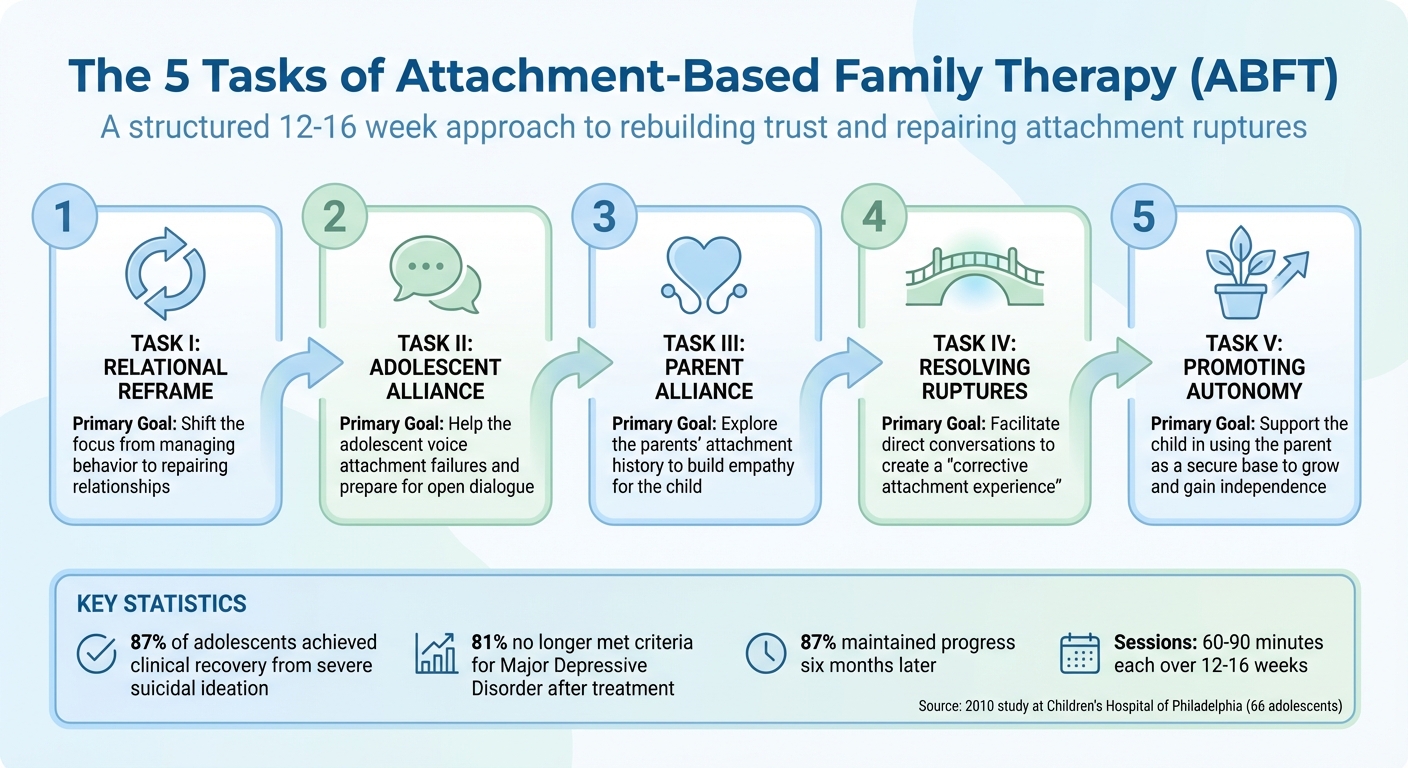
5 Tasks of Attachment-Based Family Therapy (ABFT) Process
Trauma-informed family therapy employs proven methods to address emotional wounds and mend broken attachments. These approaches go beyond surface-level issues, targeting the underlying ruptures that often drive conflict and emotional distress within families.
Emotion Coaching and Regulation
Families often get stuck reacting to secondary emotions – like anger, frustration, or blame – without addressing the deeper feelings beneath, such as fear, hurt, or shame. Emotion coaching helps family members identify and express these core emotions, fostering connection instead of defensiveness.
Katherine Stavrianopoulos from John Jay College of Criminal Justice highlights the impact of this method:
"A parent’s emotionally engaged presence makes all the difference between disconnection and security" [7].
When children share their vulnerabilities instead of acting out, it can naturally elicit a parent’s caregiving instincts, transforming criticism into empathy. Therapists often use the RISSSC technique – Repetition, Images, Simple words, speaking Softly and Slowly, and using the Child’s own words – to help families notice physical cues like chest tightness or shoulder tension. This approach interrupts negative patterns, such as one family member withdrawing while another becomes overly critical, and prepares the family for structured interventions like Attachment-Based Family Therapy (ABFT).
Attachment-Based Family Therapy (ABFT)
ABFT builds on emotion regulation strategies to systematically rebuild trust and repair attachment ruptures. This structured therapy unfolds across five key tasks, typically over 12 to 16 weeks, with sessions lasting 60 to 90 minutes. Its effectiveness is well-documented. For example, a 2010 study at the Children’s Hospital of Philadelphia led by Guy Diamond evaluated 66 adolescents with severe suicidal ideation. By the end of treatment, 87% of those in the ABFT group achieved clinical recovery, compared to just 51% in the enhanced usual care group [9].
| ABFT Treatment Task | Primary Goal |
|---|---|
| Task I: Relational Reframe | Shift the focus from managing behavior to repairing relationships. |
| Task II: Adolescent Alliance | Help the adolescent voice attachment failures and prepare for open dialogue. |
| Task III: Parent Alliance | Explore the parents’ attachment history to build empathy for the child. |
| Task IV: Resolving Ruptures | Facilitate direct conversations to create a "corrective attachment experience." |
| Task V: Promoting Autonomy | Support the child in using the parent as a secure base to grow and gain independence. |
ABFT has proven especially effective for adolescents with histories of sexual trauma, who often show limited progress with standard treatments [1]. Guy Diamond explains the philosophy behind this approach:
"The therapist promotes the caregivers as the medicine (not the problem) to help adolescents cope with and recover from depression and suicidal ideation" [1].
Trauma-Processing Methods
While family therapy focuses on relational healing, individual trauma-processing techniques can enhance this work. Tools like Eye Movement Desensitization and Reprocessing (EMDR), somatic therapy, and mindfulness practices allow individuals to process trauma memories that might otherwise interfere with family relationships [2]. By weaving these methods into family sessions, therapists help individuals heal while simultaneously rebuilding trust within the family unit.
Benefits and Outcomes
Better Family Communication and Connection
Trauma-informed family therapy transforms how families communicate. Instead of falling into cycles of blame and defensiveness, family members learn healthier ways to express emotions and navigate tough conversations without escalating conflicts. Through psychoeducation, caregivers gain a deeper understanding of trauma’s physical and emotional effects. This helps them see behaviors like withdrawal or anger not as defiance but as signs of distress that need compassion.
This shift from judgment to empathy builds a stronger foundation for connection. Taylor Mayman from Pennsylvania State University highlights this broader impact:
"By involving not only the traumatized child but also their caregivers and family members, TFFT seeks to rebuild trust, improve communication, and create a supportive environment that fosters emotional healing and resilience" [4].
Families also begin to address intergenerational patterns, such as emotional distance or over-controlling behaviors, replacing them with more supportive and nurturing interactions [4]. These changes pave the way for deeper healing and stronger bonds within the family.
Healing Trauma and Strengthening Attachment
At the heart of this therapy is repairing attachment ruptures – the breaks in trust and safety that often drive family conflict. Adolescents are encouraged to share vulnerable emotions, while parents learn to listen without reacting defensively. This process emphasizes validation over criticism, helping reframe how children see themselves and their relationships [1].
The results are striking. Clinical trials reveal that 81% of treated adolescents no longer met the criteria for Major Depressive Disorder immediately after therapy, with 87% maintaining this progress six months later [1]. Additionally, 87% of participants reported suicidal ideation scores below the clinical threshold, compared to just 51% in groups receiving enhanced usual care [1][5].
Guy Diamond from Drexel University explains the philosophy behind these outcomes:
"Secure-based family relationships become the context in which children learn essential relational and psychological skills" [1].
By rebuilding trust and addressing past wounds, families are better equipped to face future challenges together.
Long-Term Emotional and Relational Health
The positive effects of trauma-informed family therapy extend far beyond the therapy sessions. Families develop adaptive coping strategies that help them handle future stress with greater resilience. Children show lasting improvements in managing emotions like anxiety, anger, and withdrawal [4][1]. This enhanced ability to understand and empathize with each other’s perspectives strengthens family cohesion and fosters long-term relational repair [1].
Instead of simply addressing symptoms, this therapy tackles the root causes of dysfunction, breaking harmful cycles and creating lasting change. As Taylor Mayman describes:
"By focusing on the healing of both the individual and the family system, Trauma-Focused Family Therapy offers a powerful approach to restoring balance and fostering long-term emotional well-being for all members of the family" [4].
Beginning Your Journey with Growth and Change Counseling
The Path to Healing
When it comes to trauma-informed approaches, the journey toward healing focuses on mending attachment issues through a structured process. It starts with a relational reframe – shifting attention away from individual symptoms like depression or behavioral struggles and instead examining the quality of relationships. This approach builds on earlier therapeutic efforts aimed at restoring secure family bonds [8][10]. The ultimate goal goes beyond simply alleviating symptoms; it seeks to address unresolved anger and traumatic memories that often fuel anxiety and depression [2].
John Kane, LMFT, underscores the importance of relational health in the healing process:
"The more relationally healthy people are, the less anxious, addicted, and depressed they are" [2].
From here, tailored services can further support your family’s progress toward healing.
How Growth and Change Counseling Can Help
Specialized services play a crucial role in reinforcing these therapeutic pathways. Growth and Change Counseling brings over 13 years of experience in helping families build stronger, healthier relationships [2]. Their integrative, evidence-based approach incorporates methods like EMDR, CBT, and EFT [2]. The team focuses on addressing complex trauma, healing attachment wounds, and offering parent coaching to enhance parental support, ensuring long-term positive outcomes [2]. Services are available in Campbell, San Jose, Los Angeles, and Roseville, as well as through telehealth across California. Families can start with a free consultation to explore the best options for their needs [2].
As Arione Capolupo, LMFT, explains:
"Our goal is to get you in and out as quickly as reasonably can be done and do it in a way that hopefully you will never need to come back!" [2]
FAQs
What makes trauma-informed family therapy different from traditional family therapy?
Trauma-informed family therapy delves into the ways trauma affects family dynamics, offering a more specialized approach compared to traditional family therapy. While conventional therapy often focuses on improving communication, defining roles, and addressing relational patterns, trauma-informed methods emphasize creating a sense of safety, fostering trust, and exploring how trauma influences emotions, behaviors, and even physical well-being.
This approach uses tools like trauma screening and attachment-based techniques to help families rebuild secure bonds and navigate emotional regulation together. Sessions often include preparation for caregivers and tailored interventions designed to meet the unique needs of each family. Unlike traditional family therapy, which may not directly address trauma or its physical effects, trauma-informed therapy is specifically crafted for families facing trauma-related challenges.
What techniques are used in trauma-informed family therapy to address attachment issues?
Trauma-informed family therapy aims to create a safe, supportive space where families can rebuild trust and deepen emotional connections. A key part of this approach is psychoeducation, which helps family members understand how trauma affects thoughts, emotions, and behaviors. Another important technique is co-regulation, where parents learn to model calm and nurturing responses, guiding children in managing their own emotions.
Therapists often incorporate attachment-based interventions to repair and strengthen parent-child relationships. They also use proven strategies like relaxation techniques, emotional regulation skills, and trauma narrative work to help families process and heal from past experiences. These methods are carefully adapted to address the specific needs of each family, with the goal of encouraging recovery and resilience.
At Growth and Change Counseling, we bring these approaches into our trauma-informed family therapy services. Whether in-person or through telehealth, we offer support to families across California as they navigate their healing journey.
How can Attachment-Based Family Therapy (ABFT) help repair family relationships?
Attachment-Based Family Therapy (ABFT) is a specialized approach aimed at repairing trust and strengthening the emotional connection between teens and their caregivers. It views challenges like depression, trauma, and suicidal thoughts as issues rooted in relationships, working to rebuild a safe and supportive family dynamic.
This therapy uses a structured framework to address these challenges. It focuses on reframing conflicts within the family, earning trust from both the adolescent and their parents, and encouraging honest, empathetic conversations to heal emotional wounds. Through this process, families enhance communication, rebuild trust, and support their teen’s healthy independence – all while paving the way for deeper, more lasting connections.
Studies highlight that ABFT can effectively reduce symptoms of depression, decrease the risk of suicide, and strengthen the bond between parents and children. Growth and Change Counseling incorporates ABFT into its family therapy services, providing families in California with a caring and effective way to heal and rebuild their relationships.
Related Blog Posts
- How Trauma Impacts Parent-Child Relationships
- Trauma-Informed Family Therapy Techniques
- Family Therapy for Trauma Recovery: What Works
- Relational Intelligence in Parenting: Lessons from Trauma Recovery
