When trust breaks in a relationship, it often stems from betrayal, dishonesty, or emotional neglect. These experiences can lead to relational trauma and shame, creating a cycle of disconnection and pain. Trauma triggers hypervigilance or withdrawal in the hurt partner, while shame leads to defensiveness or avoidance in the partner who caused harm. This dynamic makes rebuilding trust feel overwhelming.
Key Takeaways:
- Trauma Responses: Hurt partners may become overly cautious or emotionally numb.
- Shame Responses: The partner responsible may react with defensiveness or retreat.
- The Cycle: Trauma and shame feed into each other, deepening disconnection.
- Rebuilding Trust: Requires recognizing harmful patterns, creating emotional safety, and consistent accountability.
Healing involves small, intentional actions like open communication, empathy, and professional support. Tools like structured conversations, "I" statements, and therapies (e.g., EFT, EMDR) can help couples move forward. Trust is rebuilt gradually through consistent behaviors and shared commitment.
HOW to HEAL from TRAUMA, rebuild TRUST and LOVE again
How Trauma and Shame Damage Connection and Safety
When trauma and shame take hold in a relationship, they don’t just stir up occasional arguments – they fundamentally change how partners relate to one another. The nervous system, which typically seeks connection, shifts into protection mode, making intimacy feel almost impossible [3]. What emerges is a pattern of behaviors that, while meant to shield each partner from further pain, often deepens the divide between them.
Trauma Responses in the Injured Partner
For the partner who has been hurt, trauma often shows up as hypervigilance – a constant state of high alert [8]. This might mean frequently checking on their partner’s actions, reading harmless behaviors as potential signs of betrayal, or mentally cataloging evidence of wrongdoing. These actions reflect the nervous system’s attempt to predict and prevent future harm.
On the other end of the spectrum, trauma can also lead to emotional numbness or withdrawal. Some partners cope by shutting down emotionally, which can make them seem unresponsive or distant. These reactions are often driven by "trauma scripts" – deeply ingrained defensive patterns rooted in past wounds rather than the current situation [3].
While the injured partner navigates these trauma responses, the partner who caused harm often wrestles with their own shame-driven reactions.
Shame Responses in the Partner Who Caused Harm
For the partner responsible for the hurt, shame can trigger behaviors that block accountability and repair. One of the most common responses is defensiveness. When confronted with their partner’s pain, they might say things like, "Why can’t you just move on?" or "You need to let this go" [1]. As Jenny TeGrotenhuis, LMHC, explains:
Nobody can connect to another person’s defenses [3].
This defensiveness often stems from what researchers Steven Stosny and Pat Love call the "schmuck-meter" – a sensitivity to feeling like a failure [9]. In these moments, the focus shifts to their own feelings of inadequacy, overshadowing opportunities for genuine remorse. While guilt (focused on actions) can motivate change, shame (focused on identity) tends to leave people feeling stuck [4].
Shame can also lead to withdrawal, denial, or resentment. The partner may emotionally retreat, avoid vulnerability, or even lash out in an attempt to regain control [4]. Some might adopt "masks", presenting themselves as easy-going to hide their deeper insecurities and sidestep difficult emotional engagement [6].
These defensive reactions, from both partners, often fuel a larger cycle of disconnection.
The Disconnection Cycle
The real damage happens when trauma and shame responses feed off each other, creating a self-reinforcing cycle. For example, the hurt partner’s hypervigilance or accusations can provoke the other’s defensive shame. This, in turn, reinforces the belief that trust is impossible to rebuild.
This cycle often leads to what John Bradshaw has described as a "lack of intimacy" rooted in the couple’s shared shame-cores [7]. Communication breaks down, arguments become circular, and manipulation or avoidance takes over. Both partners may silently agree to avoid tough conversations, but this only makes true vulnerability – and healing – feel out of reach.
Caught between the desire for closeness and the fear of being hurt again, couples often find themselves stuck. As Sigmund Freud insightfully put it:
We are never so defenseless against suffering as when we love [8].
Breaking the Trauma-Shame Cycle: Steps Toward Healing
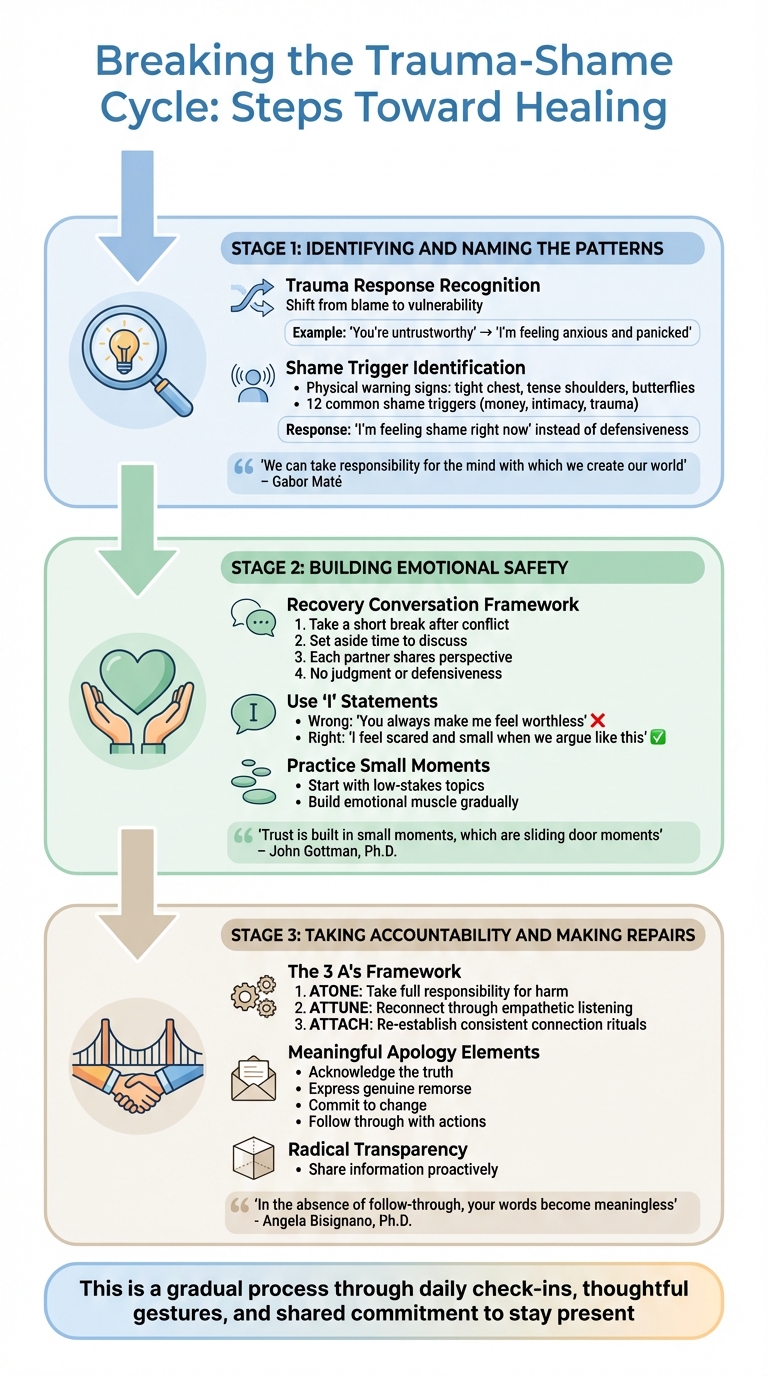
Breaking the Trauma-Shame Cycle: A Step-by-Step Guide for Couples
Healing isn’t about erasing the past; it’s about changing how we respond to it in the present. For couples, this means moving away from automatic, defensive reactions and leaning into intentional, vulnerable interactions. It’s a process that starts with recognizing harmful patterns, creating a safe emotional space, and taking tangible steps toward repair. These actions can help counteract the disconnection that trauma and shame often create.
Identifying and Naming the Patterns
The first step in healing is understanding when trauma and shame are steering the interaction. Recognizing responses like hypervigilance or withdrawal as rooted in trauma shifts the focus from blame to vulnerability. For instance, instead of saying, "You’re untrustworthy", a vulnerable approach might sound like, "I’m feeling anxious and panicked again."
Likewise, the partner who caused harm must identify their own shame triggers. Shame often manifests physically – like a tight chest, tense shoulders, or butterflies in the stomach. These sensations can serve as early warning signs that shame is about to take over. Research by Brené Brown outlines 12 common shame triggers, including topics like money, intimacy, and trauma. If partners can name these triggers, they can acknowledge their feelings by saying, "I’m feeling shame right now", instead of reacting defensively or withdrawing. This awareness helps foster accountability and emotional safety, both of which are crucial for rebuilding trust.
Couples can deepen this understanding by discussing how trauma is stored in their bodies – whether it’s felt in the chest, stomach, or elsewhere. As Gabor Maté insightfully notes:
We may not be responsible for the world that created our minds, but we can take responsibility for the mind with which we create our world [3].
Once these patterns are identified, the next step is to create an environment where vulnerability feels safe.
Building Emotional Safety
Emotional safety isn’t something that happens overnight; it’s built gradually through consistent, mindful actions. This includes responding to bids for connection, maintaining eye contact, reflecting back what you hear, and using intentional conversations to process conflicts without blame.
One effective tool is the "recovery conversation" – a structured way to revisit and process arguments. After a conflict, take a short break to cool down, then set aside time to discuss what happened. Each partner shares their perspective without judgment or defensiveness. The goal isn’t to assign blame but to understand how the experience affected each person.
Using "I" statements can also transform communication. For example, instead of saying, "You always make me feel worthless", try, "I feel scared and small when we argue like this." This approach reduces the chances of triggering the other partner’s shame and keeps the focus on expressing emotional truths rather than accusations.
Start small. Practice vulnerability with less emotionally charged topics – like coordinating schedules or deciding on meals. This helps build the emotional "muscle" needed for tackling more challenging issues, such as finances or infidelity. As John Gottman, Ph.D., explains:
Trust is built in small moments, which [are] ‘sliding door’ moments. These are everyday opportunities to show care, understanding, and reliability [10].
Once emotional safety is established, couples can begin working on accountability and repair.
Taking Accountability and Making Repairs
Rebuilding trust requires more than just words – it takes consistent action. For the partner who caused harm, this means shifting from defensiveness to genuine accountability. A meaningful apology should focus on the hurt caused, rather than the discomfort of the person apologizing or their desire for forgiveness.
A sincere apology involves acknowledging the truth, expressing genuine remorse, and committing to change. As Angela Bisignano, Ph.D., cautions:
In the absence of follow-through, your words become meaningless and future attempts at repair may be rejected [11].
Radical transparency can also help rebuild trust. Sharing information proactively demonstrates reliability and reinforces the commitment to repair.
The repair process often follows a three-stage framework: Atone, Attune, Attach. This means taking full responsibility for harm caused, reconnecting emotionally through empathetic listening, and re-establishing consistent connection rituals. As Lori Epting, LPC, describes:
When the pain of old hurts gets triggered, it is no longer ‘Here we go again,’ but rather, ‘Of course you feel this way sometimes. I’m in it with you’ [1].
Repairing a relationship isn’t a one-time event. It’s a gradual process that unfolds through daily check-ins, thoughtful gestures, and a shared commitment to stay present, even when it feels uncomfortable. Over time, as both partners engage in this work, the grip of the trauma-shame cycle begins to loosen.
sbb-itb-596b85d
Rebuilding Trust and Intimacy Over Time
Recovering from trauma and shame takes time, patience, and small, deliberate efforts to reconnect. Zach Brittle, a Certified Gottman Therapist, offers a powerful perspective:
The work of attunement and trust building is a single conversation spread out over the many seasons of a marriage [5].
This process isn’t a quick fix. It requires both partners to commit to consistent actions, build resilience in the face of shame, and, when necessary, seek professional help to address deeper emotional wounds.
Building Predictability and Reliability
Trust grows through consistent actions and what researchers call "sliding door" moments – those everyday opportunities to show attentiveness and dependability. For example, when your partner shares a frustration, do you take the time to listen? When they’re feeling anxious, do you respond with curiosity or brush it off? These small moments matter more than you might think.
The ATTUNE model provides a helpful guide for nurturing trust: Awareness of your partner’s emotions, Turning toward their needs, Tolerance for differences, Understanding their perspective, Non-defensive responses, and Empathy [5]. These aren’t one-time skills – they’re habits you practice every day.
Reliability also means aligning words with actions. If you’ve apologized for a betrayal, your partner needs to see consistent, trustworthy behavior over time. This might include being radically transparent – sharing your schedule, offering access to devices, or checking in regularly. These actions help ease the hypervigilance caused by trauma and slowly rebuild a sense of safety.
Developing Shame Resilience
Shame thrives in secrecy. For the partner who caused harm, it’s important to recognize and address shame triggers – like a racing heart or tight chest – before they lead to defensiveness or withdrawal. Dr. Brené Brown outlines four key steps to building shame resilience: acknowledging and naming the shame, identifying its source, reaching out to someone who offers empathy, and openly sharing your feelings [4]. As Brown explains:
If we can share our story with someone who responds with empathy and understanding, shame can’t survive [4].
This doesn’t mean unloading your shame onto your partner. Instead, create a support network – trusted friends, a therapist, or a group – where you can process these emotions without adding more weight to the relationship. It’s also crucial to differentiate between guilt ("I made a mistake") and shame ("I am a bad person"). Guilt can motivate you to make amends, while shame often leaves you stuck.
For the injured partner, recognizing when old wounds resurface can be equally important. Communicating triggers – like saying, "I’m feeling triggered and need reassurance" – can shift moments of tension into opportunities for connection. If personal efforts fall short, seeking professional guidance can strengthen the healing process.
Working with Professional Support
Sometimes, the path to healing requires more than what couples can manage on their own. Therapies like EMDR (Eye Movement Desensitization and Reprocessing) can help release deeply rooted trauma. Somatic approaches – which focus on how trauma is stored in the body – use techniques like movement and breathwork to transition from a state of protection to one of connection. Shared activities like hiking, yoga, or dancing can also help couples break through the emotional numbness trauma often causes and reconnect with each other [2].
Attachment-based therapies, such as Emotionally Focused Therapy (EFT), focus on strengthening the emotional bond between partners. These methods help couples uncover "enduring vulnerabilities" – past wounds that influence present reactions – and create new, healthier ways of responding that promote safety instead of fear [1].
Seeking professional help isn’t a sign of failure. It’s an acknowledgment that some wounds are too deep to heal without expert care. A skilled therapist can help regulate emotional responses, uncover patterns that are hard to see from within the relationship, and provide tools to guide the repair process – tools that most couples simply don’t have access to in their day-to-day lives.
How Growth and Change Counseling Supports Couples
When trust is shattered by trauma and shame, expert guidance can be the key to rebuilding and moving forward. Growth and Change Counseling offers couples a path to healing through solutions-focused therapy that addresses both immediate crises and long-standing relational patterns [12]. This approach builds on a couple’s commitment to break free from destructive cycles of trauma and shame, providing the tools needed for meaningful recovery.
Counseling for Trauma and Relationships
Growth and Change Counseling focuses on disrupting harmful patterns and fostering genuine accountability. Rather than just managing crises, their therapy delves into the deeper roots of trauma, helping couples reconcile past experiences that continue to influence their present dynamics. The goal is to address the core wounds that drive these patterns, offering strategies tailored to each couple’s unique challenges. This approach ensures that healing goes beyond surface-level solutions, creating space for lasting change.
The Marriage Rescue Institute: A 12-Week Program
For couples in crisis, The Marriage Rescue Institute provides a structured 12-week coaching program designed to rebuild trust and connection. The program guides couples through three essential phases – Atonement, Attunement, and Attachment – emphasizing radical transparency and consistent connection as the foundation for healing [13].
Services Across California
Growth and Change Counseling offers in-person sessions in Campbell, San Jose, Los Angeles, and Roseville, as well as telehealth services throughout California. Whether couples are navigating the aftermath of infidelity, dealing with the strain of addiction, or struggling with years of unresolved conflict, the practice tailors its care to meet each couple’s unique needs. This comprehensive support helps restore intimacy and rebuild the foundation of trust in relationships.
Conclusion: Moving Forward Together
Rebuilding trust after trauma and shame isn’t about pretending the past didn’t happen – it’s about learning to respond to it differently. When old wounds resurface, it’s a reminder for couples to identify and shift recurring patterns. As Lori Epting, LPC, puts it:
When the pain of old hurts gets triggered, it is no longer ‘Here we go again,’ but rather, ‘Of course you feel this way sometimes. I’m in it with you. You are not alone in this’ [1].
Trust is rebuilt through small, consistent actions – what Dr. John Gottman refers to as "sliding door" moments. These are everyday opportunities to show care, empathy, and dependability [10]. Whether it’s offering understanding during a difficult moment or keeping a simple promise, these gestures build up over time. The partner who caused harm must shift from defensiveness to becoming a safe and supportive presence, while the hurt partner must acknowledge genuine efforts toward change.
Understanding the difference between shame and guilt is crucial for progress. Guilt says, "I did something bad", which can inspire repair, while shame whispers, "I am bad", leading to feelings of inadequacy [4]. Brené Brown explains:
If we can share our story with someone who responds with empathy and understanding, shame can’t survive [4].
For couples, this journey often requires ongoing effort and professional guidance. Research shows that individuals who grew up witnessing violence are at a much higher risk of repeating those patterns – women are 3.5 times more likely, and men 3.8 times more likely [14]. Breaking these cycles demands structured support, proven strategies, and consistent new behaviors.
Accepting trauma as a starting point opens the door to growth. As Leo Flowers, Masters in Counseling/Psychology, reminds us:
The trauma is not the end of the story. It’s the beginning of a new one [2].
With the right tools, professional help, and a shared commitment, couples can transform a relationship once marked by pain into one built on safety, connection, and genuine trust.
FAQs
How can couples recognize and overcome cycles of trauma and shame in their relationship?
Couples can start by spotting recurring patterns that keep trauma and shame alive in their relationship. Often, actions like infidelity, struggles with addiction, or shared losses can spark feelings of shame, leading to cycles of avoidance, anger, or defensiveness. Recognizing these moments and naming the emotions tied to them – such as "I feel unworthy" or "I feel like a failure" – is a vital first step toward breaking these harmful cycles.
To move forward, structured approaches that promote safety and empathy can make a big difference. Techniques like Emotionally Focused Therapy and self-compassion exercises encourage partners to respond with understanding instead of criticism, easing shame-driven reactions. Trauma-informed strategies, such as grounding exercises, can also help partners reset their emotional responses and begin rebuilding trust. By working together to reframe their shared narrative, couples can turn painful experiences into opportunities for connection and growth.
Growth and Change Counseling provides a 12-week couples coaching program through The Marriage Rescue Institute. This program combines trauma-awareness practices, compassionate communication techniques, and evidence-based tools to help couples restore trust, reduce shame, and build a stronger, healthier relationship.
How can couples create emotional safety and rebuild trust in their relationship?
Building emotional safety begins with open, non-judgmental communication and responding thoughtfully to each other’s needs. Couples can deepen their connection by recognizing and validating each other’s emotions, owning up to mistakes, and offering heartfelt apologies. Small shifts, like using "I" statements, respecting personal boundaries, and affirming each other’s experiences – especially in the context of past trauma or betrayal – can nurture trust and a sense of security.
For couples carrying the weight of trauma or shame, tackling these challenges together is key. Acknowledging the effects of shared experiences, creating room for honest emotional expression, and seeking professional guidance can pave the way for a stronger bond. Growth and Change Counseling offers a 12-week couples coaching program designed to rebuild trust and intimacy. Through trauma-informed, solution-focused strategies, this program helps couples heal and move forward as a team.
How can therapy help couples rebuild trust after betrayal?
Therapy offers couples a supportive and structured environment to confront the pain of betrayal and take steps toward rebuilding trust. A trained therapist works with both partners to explore the emotional toll of the betrayal, encouraging honest communication, establishing boundaries, and promoting transparency. This process helps create accountability, eases feelings of shame, and lays the groundwork for restoring emotional safety.
Proven methods like Emotionally Focused Therapy (EFT) and interventions based on the Gottman method focus on meeting the attachment needs of both individuals. These approaches emphasize trust-building through actionable steps and encourage vulnerability between partners. Growth and Change Counseling’s Marriage Rescue Institute provides a focused 12-week program aimed at helping couples in crisis repair their relationships. This program incorporates trauma-informed strategies, communication skill-building, and accountability practices. With the right guidance, couples can turn the experience of betrayal into an opportunity for stronger connection and deeper intimacy.
Common Questions About Healing with Growth and Change Counseling
- Overcoming Trust Issues After Betrayal
- Root Causes of Shame in Sexual Addiction
- Relationship Trauma: Root Causes and Solutions
- How Accountability Supports Intimacy Restoration
