I’d start with the source of stress – not the diagnosis. If noise is overwhelming, reduce it. If a transition feels uncertain, show what comes next. During overload, put safety first and save skill practice for calmer moments.
I compare six approaches by when they help, what research supports them, access, caregiver effort, and limits. <u>Caregiver relief counts too.</u> A plan that adds work without easing strain needs a change.
Quick Comparison
| Approach | Best fit and timing | Research and limits | Access and caregiver effort |
|---|---|---|---|
| Co-regulation | Quiet support as distress builds | Interview findings support its role; closeness may feel overwhelming | Few supplies, but needs an available adult |
| Sensory adjustments | Noise, light, touch, or crowding; before or during overload | Results vary by person and tool | Simple changes may cost little; equipment and clinician access vary |
| Visual supports | Uncertainty and transitions; prepare when calm | May help predictability; schedules alone may not resolve distress | Often low-cost, with setup and updates |
| Caregiver-supported coping | Practicing help requests and coping during calm periods | Promising but limited research; not a substitute for accommodations | Requires brief practice and guidance |
| Shared care and respite | Acute caregiver overload or repeated exhaustion | Findings vary; help must provide actual relief | Cost, availability, and handoff planning can limit access |
| Family therapy and parent coaching | Repeated conflict or routine problems; start before crisis | Promising but limited research | Fees, waitlists, sessions, and home practice add demands |
More tools do not always mean less stress. In the article’s cited review of 20 parent-mediated studies, only one – 5% – focused on emotion regulation as its main outcome. I’d use research as a guide, then check whether a support helps your family.
Start with one recurring stressor and one or two changes. Over two to four weeks, track recovery, daily participation, and caregiver strain – not compliance. Include the person’s feedback, stop anything that adds distress, and seek professional help when safety or daily functioning is affected.
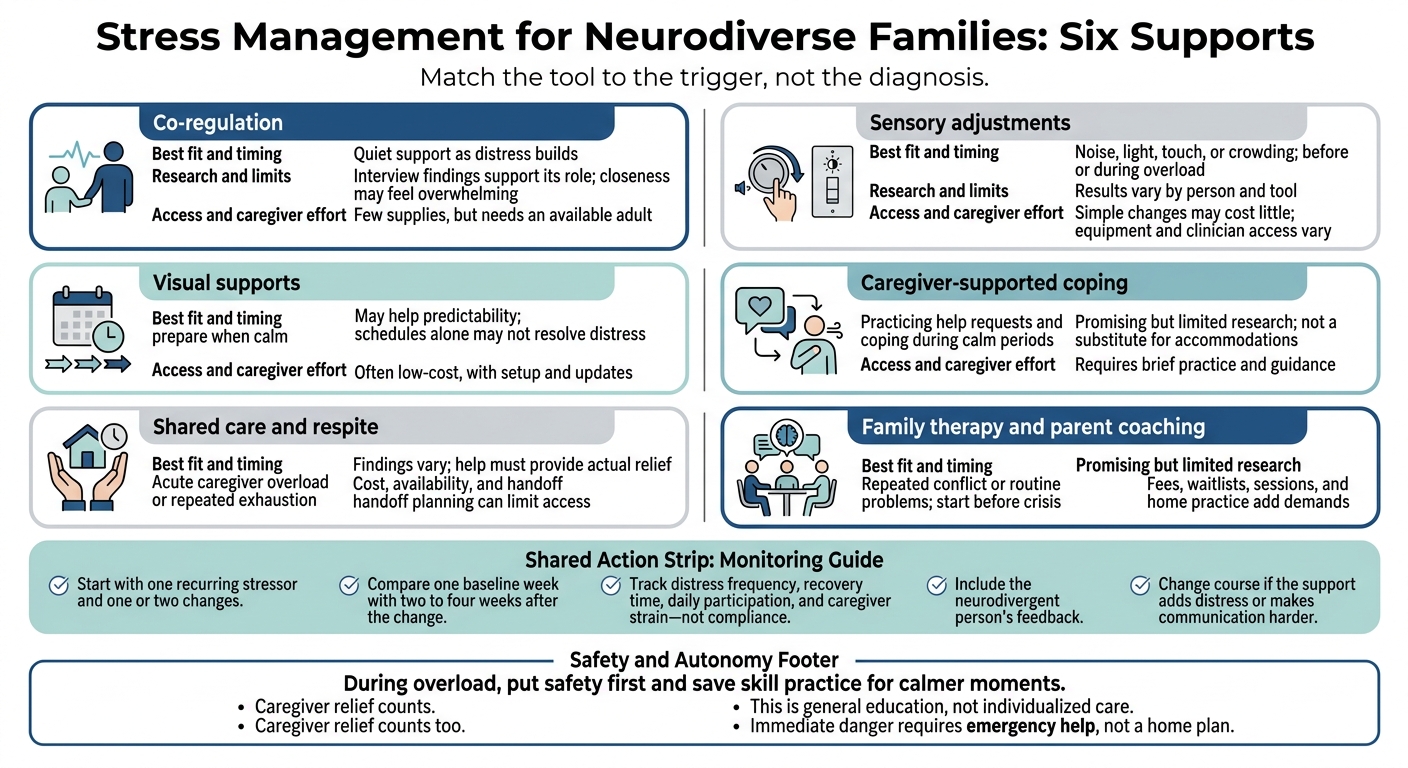
Stress Management for Neurodiverse Families: Six Supports
1. Co-Regulation and Relationship Support
Stress Patterns and Best-Fit Situations
Co-regulation means adjusting how you respond to someone’s distress. It can help when overload shows up as pacing, withdrawal, or delayed replies. Lower your voice, slow your speech and movements, and share one brief idea at a time. Offer quiet company or a preferred space without requiring eye contact, conversation, or touch.[3][4][6]
Research and Possible Benefits
A 2025 interview study of 57 adolescents with autism, ADHD, or both found that co-regulation, acceptance, and a choice of coping strategies mattered to emotional well-being.[5] Match your response to the person and what they need in that moment.
Preparation and Timing
When everyone is calm, agree on phrases, communication options, and preferred spaces. Gentle closeness may help early on but feel overwhelming during a meltdown. Allow pointing, text, or AAC instead of speech. Give the person time to process without repeating questions.
Track recovery time, then ask afterward whether the support felt calm, respectful, and predictable. Use these supports before stress peaks. Once overload starts, switch to simpler responses that ask less of the person.
Limits and Support Needs
Calm support can’t resolve every trigger. Pain, poor sleep, anxiety, medication side effects, trauma, and communication barriers can also drive distress. If episodes keep recurring, family therapy or parent coaching may help. If there’s immediate danger, follow the person’s crisis plan and seek emergency help if you can’t maintain safety.
If distress increases with noise, light, touch, or crowding, the next step is to adjust sensory input and the setting.
sbb-itb-596b85d
2. Sensory Support and Setting Adjustments
Stress Patterns and Best-Fit Situations
Match the adjustment to the sensory input: sound, light, smell, texture, crowding, or movement. Headphones may help with noise that can’t be avoided. Walking, rocking, or stretching may help someone who needs to move.
When sensory input causes stress, change the setting before asking the person to cope. Use co-regulation when they need another person’s calming support.
Research and Possible Benefits
Research findings vary by support. Some sensory changes help in certain settings, but weighted vests have limited research support.[11][12] Judge each tool by comfort and access, not by how still it makes someone.
Preparation and Timing
Set up a quiet space with softer lighting, less clutter, comfortable seating, and preferred items. Let the person leave freely. For outings, pack hearing protection they tolerate and find a low-stimulation area ahead of time.
For one to two weeks, record the trigger, adjustment, signs of distress, recovery time, and side effects. Change one support at a time when practical. Keep what improves comfort or participation, and stop using anything that adds strain.
Limits and Support Needs
Headphones can make it harder to notice traffic, alarms, caregivers, or other hazards. Movement can sometimes make discomfort worse, so stop when the person signals distress.
Seek an occupational therapist or another qualified clinician when sensory distress limits daily life or involves self-injury. Accommodations should not replace medical assessment.[2][8][10]
If sensory changes only partly reduce stress, the next step is to make transitions more predictable with routines.
Childhood Neurodivergence: Managing Parental/Carer Stress
3. Visual Supports and Transition Planning
Sensory support may help, but stress can return during changes or handoffs. Visual structure can make the next step easier to follow.
Stress Patterns and Best-Fit Situations
Use visual supports when uncertainty or sudden transitions cause stress. Match objects, photos, checklists, or a first–then board to the person’s communication level. If attention is limited, start with a short sequence instead of a full-day schedule that may feel overwhelming.[15][18][19]
Research and Possible Benefits
Research suggests visual schedules can make activities more predictable and help with transitions. But when they’re used alongside other supports, it’s harder to tell which effects come from the schedules themselves.[17][13] Start with the simplest format the person understands, then build from there.
Preparation and Timing
Teach the system during calm periods. Review what comes next and mark tasks as finished. During transitions, show the next step and give just one warning. Shorten or skip warnings if they increase anxiety. When plans change, use a labeled “change” card and immediately show the replacement activity.[19]
For two to four weeks, track prompts, transition time, and recovery. Ask the family member whether the support feels clear. Fewer prompts and faster recovery are signs of progress.
Limits and Support Needs
Knowing what comes next doesn’t make every task easier. Warnings can increase distress when they signal the end of a preferred activity, and schedules alone don’t help everyone.[14][16] Give the person ways to request help, a break, or more time. Before labeling distress as refusal, check what the next activity asks of them. Seek an individualized assessment for self-injury, aggression, running away, or severe functional impairment.
If visual structure isn’t enough, the next step is to teach coping skills the person can use in the moment.
4. Caregiver-Supported Coping Skills
Stress Patterns and Best-Fit Situations
Once sensory and visual supports are in place, teach one simple coping response. Practice during mild-to-moderate stress, while the child can still participate. Start with visible signs or body sensations the child reports, rather than expecting them to name a feeling. Use communication supports that fit their needs: speech, gestures, or AAC.
Research and Possible Benefits
A 2022 review of 20 parent-mediated studies found promising but limited evidence. Only one study treated emotion regulation as the main outcome.[20]
Preparation and Timing
Choose one or two tools the child can use, and offer picture cards to help them choose.
Options include requesting help, taking a movement break, or using a relaxation strategy that fits the child.
Practice with adult guidance for a few minutes once or twice a day when the child is calm. Model how to notice a body signal, choose a tool, and request support. Accept gestures or AAC without requiring spoken labels. Reward attempts, not perfect wording.
Track independent help requests, recovery time, and how much prompting the child needs. After recovery, review what helped. Look for more help requests, faster recovery, and better participation – not just calm behavior.
Limits and Support Needs
Coping skills do not replace accommodations or co-regulation. Never require a child to name a feeling before receiving help. During severe distress, stop teaching, pause practice, avoid pressure, and put safety first.
Breathing or mindfulness may feel uncomfortable or be difficult for the child to use. Stop using any tool that increases distress. Worsening distress calls for clinical evaluation for pain, sleep problems, medication effects, or other causes.[21][22]
If caregiver strain is increasing, move next to shared care and caregiver relief.
5. Caregiver Stress Relief and Shared Care
When caregivers have less capacity, it becomes harder to keep a child’s regulation plan on track.
Stress Patterns and Best-Fit Situations
Match the help to the strain. A brief handoff can help with acute overload. Recurring respite addresses chronic depletion, peer support helps with isolation, and shared responsibilities address an uneven workload.
For acute overload, prioritize a 30–60 minute handoff.
Respite means handing over care – not trying to rest while staying on call. Neurodivergent caregivers may find quiet time alone more restorative than social activities.[23][24]
Research and Possible Benefits
A 2017 scoping review covered 49 studies across six caregiver-support areas, including respite, care coordination, and peer support.[27] Results showed promise, but no single approach came out best. Evidence for support groups alone is mixed.[27][26]
The U.S. Department of Health and Human Services reports that several studies combining training, respite, support, and referrals found reduced caregiver burden and depression. Support needs to fit the caregiver’s situation and be accessible.[26]
Preparation and Timing
Hold a 10-minute weekly planning meeting before exhaustion builds. Assign responsibility for school communication, appointments, meals, direct care, and the planning behind those tasks. Schedule recurring coverage and name a backup.
Introduce respite during a stable period. Provide written guidance on communication preferences, sensory needs, safety instructions, and familiar routines.[24]
Protect recovery time after demanding appointments or school meetings. Choose rest that lightens the load rather than adding another task. For peer support, check whether the group has a moderator and allows listening, captions, or written participation.
Over four weeks, track sleep, missed meals, recovery time, and conflict intensity. Change arrangements that add preparation without providing actual relief.
Limits and Support Needs
Self-care cannot replace adequate help. Relaxation does not fix chronic sleep loss, too little supervision, or an unequal workload. Persistent distress, reduced ability to function, or unsafe supervision calls for professional assessment and more practical support.[25] If shared care still isn’t enough, move to family therapy or parent coaching.
6. Family Therapy and Parent Coaching
Stress Patterns and Best-Fit Situations
When co-regulation, sensory changes, and shared care only partly reduce stress, therapy can help address patterns that keep coming back.
Choose parent coaching for routines and caregiver uncertainty. Choose family therapy for repeated conflict, blame, sibling strain, or communication breakdowns. Used together, they can address both behavior patterns and family stress. Before treating behavior as the problem, a family assessment should check for sleep loss, pain, anxiety, and communication barriers.
Research and Possible Benefits
The approach should fit the family – not the other way around. Consider these options when conflict repeats, routines break down, or caregivers respond differently.
The research is promising but limited. A 2025 review of 13 articles involving 292 families reported mostly positive outcomes for relationships and well-being. A separate review of 30 randomized trials found that parents reported better daily functioning and possible reductions in disruptive behavior, but no clear effect on parent well-being.[29][30] The family-based intervention review also found weak study quality and no large randomized trials.[29]
Preparation and Timing
Bring notes on triggers, recovery times, helpful responses, and each person’s goals. Agree on one or two clear targets, who will attend, how practice will fit into daily life, care costs, and when you’ll review progress.
Include the child or teen using their preferred communication method. Start before a crisis; during acute distress, focus on safety and stabilization.
Growth and Change Counseling offers family therapy and parent coaching in Campbell, San Jose, Los Angeles, and Roseville, plus telehealth across California.[1]
Limits and Support Needs
Track caregiver strain separately from the child’s progress. Coaching assignments can add work without easing stress. If that happens, simplify or adjust them.[28]
Success should mean better safety, autonomy, communication, and relationships – not forced eye contact, masking, or blocking harmless self-regulation. Medical problems, serious safety risks, and substance-use needs may call for coordinated care beyond family therapy.
Next, compare these approaches by fit, effort, and expected payoff.
How the Approaches Compare
Each approach targets a different part of family stress: the body, surroundings, routines, caregiver workload, or family interaction.
Stress Patterns and Best-Fit Situations
Respond to the trigger first. Plan longer-term support once the immediate stress eases.
| Family scenario | Primary stress target | Suitable approaches | Rationale |
|---|---|---|---|
| Meltdown or shutdown | Overload; difficulty communicating | Co-regulation and relationship support; sensory support and setting adjustments; caregiver-supported coping skills after recovery begins | Reduce pressure before asking the person to process instructions. |
| Transition distress | Uncertainty; difficulty shifting attention | Visual supports and transition planning; sensory support and setting adjustments; co-regulation and relationship support | Preview changes and follow a predictable transition routine. |
| Caregiver overload | Sleep loss; too many responsibilities | Caregiver stress relief and shared care; family therapy and parent coaching; co-regulation and relationship support | Reduce the workload instead of adding another task. |
| Parent–child escalation | Repeated prompting; distress that feeds back and forth | Co-regulation and relationship support; caregiver-supported coping skills; family therapy and parent coaching | Pause the argument. Practice skills later. |
| Caregiver conflict | Conflicting expectations and responses | Co-regulation and relationship support; family therapy and parent coaching | Agree on roles, communication preferences, and safety responses. |
| Persistent anxiety or reduced functioning | Continuing fear, avoidance, sleep disruption, or loss of daily skills | Family therapy and parent coaching; caregiver-supported coping skills; sensory support and setting adjustments; medical or mental-health evaluation when indicated | Pair assessment with practical support rather than relying on home strategies alone. |
Next, look at what research supports – and which families the findings apply to.
Research and Possible Benefits
Studies often test several components together, making it hard to tell which strategy produced a benefit. Findings from autism or ADHD research do not apply to every neurodivergent family.
| Approach | Proposed mechanism | Possible benefit | Evidence type | Research caveat |
|---|---|---|---|---|
| Co-regulation and relationship support | Responsive presence reduces stress | Easier recovery and communication | Relational, developmental, and caregiver-mediated research; practice guidance | Studies define and measure co-regulation differently. |
| Sensory support and setting adjustments | Reduce sensory demands in the surroundings or improve access to preferred sensory input | Better comfort and participation | Occupational-therapy research and sensory-intervention studies | Effects vary by person and tool. Sensory strategies should not be generalized across diagnoses. |
| Visual supports and transition planning | Make time and expectations visible | More predictable transitions | Autism and developmental-disability intervention research, including visual-support studies | Results depend on how supports are used, the person’s understanding and developmental level, and how well supports fit their needs. |
| Caregiver-supported coping skills | Practice recognizing stress and using acceptable coping actions | More ways to manage early distress | Skills-training, cognitive-behavioral, and caregiver-mediated research | Skills learned when calm may not carry over automatically to severe distress. |
| Caregiver stress relief and shared care | Rest, respite, social support, and shared responsibilities reduce caregiver workload | Better caregiver well-being and ability to respond consistently | Caregiver-stress, respite, and family-support research | Benefits depend on availability, quality, affordability, and fit. |
| Family therapy and parent coaching | Change interaction patterns, caregiver responses, communication, and problem-solving | Better parenting practices and family functioning | Family-intervention and parent-training reviews | Studies often combine components, making it hard to isolate one mechanism. |
Sensory evidence is mixed, and responses vary greatly from person to person.[9]
Fit is only part of the decision. Each approach also takes preparation, time, and coordination.
Preparation and Timing
| Approach | Preparation | Consistency | Caregiver coordination | Best use window |
|---|---|---|---|---|
| Co-regulation and relationship support | Learn communication preferences, early warning signs, ways to offer a calming presence, and safety boundaries | Consistent adult responses help, but leave room to adjust | Agree on brief language, proximity, and when to pause demands | Immediate de-escalation and continued relationship building |
| Sensory support and setting adjustments | Identify triggers, preferred spaces, tolerable tools, and changes to surroundings | Keep options available, not mandatory | Share preferences across settings | Immediate relief from surroundings and preventive planning |
| Visual supports and transition planning | Create individualized schedules, warnings, timers, first–then cues, and backup plans | Use familiar formats repeatedly | Coordinate symbols and expectations across settings | Advance planning, repeated practice, and transition support |
| Caregiver-supported coping skills | Choose a few acceptable skills and practice when calm | Keep practice brief, repeat it, and adjust as needs change | Model skills without pressure | Longer-term skill development, with possible use during early stress |
| Caregiver stress relief and shared care | Identify practical helpers, respite options, emergency contacts, and task-sharing arrangements | Schedule relief or make it dependable enough to use | Make explicit agreements about responsibilities and backup coverage | Immediate reduction of caregiver burden and continued prevention of overload |
| Family therapy and parent coaching | Schedule assessment, identify goals, and prepare relevant examples or records | Progress usually depends on using agreed strategies between sessions | Coordination may include caregivers, schools, clinicians, and the neurodivergent person when appropriate | Medium- to long-term support, with urgent support |
Choose the simplest format the family can use. Match it to caregiver capacity, access, and the need: predictability, comfort, de-escalation, or caregiver support.
Also consider where an approach may fall short and when more help is needed.
Limits and Support Needs
| Approach | Main limits | Individual adjustments | When professional help is needed |
|---|---|---|---|
| Co-regulation and relationship support | A distressed caregiver may struggle to co-regulate; closeness may feel intrusive to some people | Offer quiet, distance, movement, a familiar voice, or a specific communication method | Escalation repeatedly becomes unsafe |
| Sensory support and setting adjustments | A tool may be ineffective, distracting, aversive, or unsafe; reducing sensory input may not address anxiety or sleep problems | Offer choices, monitor the response, and consult an appropriately trained professional for complex sensory needs | Sensory distress prevents daily participation |
| Visual supports and transition planning | A schedule can become another demand if it is too complex, changes unexpectedly, or does not match the person’s communication system | Use simple, accessible formats; prepare for changes; let the person help design the system | Transition distress severely restricts daily life |
| Caregiver-supported coping skills | Practice may fail during severe distress or become coercive if adults insist on one technique | Practice only when calm. Accept nonverbal or movement-based coping, and do not require eye contact, stillness, or verbal disclosure. | Anxiety persists or functioning declines |
| Caregiver stress relief and shared care | Respite may be unavailable, unaffordable, inconsistent, or unsuitable for the family’s customs and values | Consider informal support, school or community resources, rotating responsibilities, and realistic low-cost relief where appropriate | Exhaustion compromises safe care |
| Family therapy and parent coaching | Access, cost, waitlists, provider expertise, and a mismatch with neurodiversity-affirming values can limit usefulness | Ask about relevant training, communication accommodations, goals, caregiver involvement, and how progress will be assessed | Repeated crises require coordinated assessment |
Seek urgent help for persistent self-injury, severe anxiety, major sleep disruption, repeated crises, or declining daily functioning. Call 911 for immediate danger or 988 for a mental-health crisis.[31][32]
Advantages and Limits at a Glance
Match the support to the stress pattern. The table shows where each approach helps, what effort it requires, and where it may fall short. Start with the main trigger and choose the lightest support that works.
| Approach | Key advantages | Disadvantages or constraints | Useful companion strategies |
|---|---|---|---|
| Co-Regulation and Relationship Support | Offers immediate support through relationships. | Needs a calm, available adult. | Shared-care plans. |
| Sensory Support and Setting Adjustments | Helps prevent avoidable overload. | Some settings restrict changes. | Flexible exit plans. |
| Visual Supports and Transition Planning | Easy to carry and often inexpensive. | Takes preparation and regular updates. | A visible change cue. |
| Caregiver-Supported Coping Skills | Gives the person more ways to communicate needs. | Skills may not carry over during acute distress. | Adult modeling. |
| Caregiver Stress Relief and Shared Care | Reduces the caregiver’s workload. | Trusted help may be hard to find or costly. | Scheduled relief with clear handoffs. |
| Family Therapy and Parent Coaching | Helps improve family interaction patterns. | Cost and finding the right provider can limit access. | Clear goals with review dates. |
Low cost doesn’t mean low effort. Shared care can still be out of reach because of costs, waitlists, or missing information.
When seeking professional support, ask how the provider accommodates AAC, movement breaks, sensory needs, flexible communication, and the person’s own goals.
Regulation support should never demand masking, forced compliance, eye contact, still hands, or suppression of harmless stimming. Keep sensory supports available rather than making them rewards for obedience. When there’s an immediate risk of injury, use safer alternatives. Measure progress by safety, communication, participation, and recovery – not by how typical the person looks.[33][34][35]
Conclusion: Match Support to the Stress Pattern
Across the six approaches, match the tool to the trigger, not the diagnosis. During acute distress, protect safety, reduce sensory input, and offer quiet connection or the person’s preferred space. Keep language brief and allow time to recover.[7] For recurring triggers, combine sensory adjustments with predictable but flexible routines. Practice coping skills when the person is calm, and arrange shared care or respite for sustained overload.
Once the crisis settles, check what changed. Start with one recurring stressor and one or two changes. Compare one baseline week with two to four weeks after the change. Track distress frequency, recovery time, daily participation, and caregiver strain – not compliance. Include the neurodivergent person’s feedback. Change course if the support adds distress or makes communication harder.
This is general education, not individualized care.
Seek individualized professional help if distress persists, daily functioning declines, or safety is uncertain.[36] Immediate danger requires emergency help, not a home plan.
FAQs
How can we balance conflicting sensory needs at home?
Make room at home for different sensory needs. Set up a quiet corner with soft lighting, cozy textures, and a white noise machine or earmuffs to help when someone feels overstimulated.
Use visual schedules and timers to make transitions more predictable and ease anxiety. Capacity Cards with red, yellow, and green signals let family members share their energy levels and sensory limits without saying a word.
Growth and Change Counseling offers parent coaching and family therapy to help families tailor these low-demand strategies to their needs.
How can we tell overload from anxiety?
Pay attention to how long symptoms last, how intense they are, and what sets them off. Sensory or digital overload often causes lasting physical symptoms, such as headaches, eye strain, or fatigue. It may also lead to a loss of interest in activities.
Anxiety is often linked to specific triggers or adverse experiences. It may involve hypervigilance, avoidance, or emotional outbursts that change over time. Both can cause meltdowns or shutdowns.
What if our child rejects every coping tool?
When your child rejects coping tools, it often means their nervous system is overwhelmed – not that they’re being defiant. Instead of pushing those tools, reduce the demands around them and acknowledge what they’re experiencing.
Growth and Change Counseling offers parent coaching and family therapy to help families move away from compliance-based discipline. The focus is on working together and building on your child’s strengths while respecting their neurotype. With that support, your child can feel safe, understood, and better able to regulate their emotions over time.
Related Blog Posts
- Trauma and Advocacy: Supporting Neurodiverse Families
- Parenting Stress: Solutions for Neurodiverse Families
- Trauma and Self-Esteem in Neurodiverse Kids
- Parenting Tips for Neurodiverse Families: Building Support
