I can help family without putting my household’s bills, savings, or relationship at risk. My starting point: agree with my partner on a dollar limit before answering any request.
Here’s the plan I’d follow:
- Set the limit together. Cover our needs first, then decide what we can give, lend, or offer as practical help.
- Put terms in writing. Spell out payment amounts, repayment expectations, review dates, and when support ends. Get tax or legal advice for large or complex loans.
- Give one shared answer. Keep it warm, clear, and firm – even when relatives push back.
- Check in for 30–45 minutes each month. Review payments and disagreements. Seek counseling if conflict persists; if threats or control are involved, seek confidential individual help and put safety first.
The rule I’d keep in mind: caring doesn’t require saying yes. <u>A clear limit is not a measure of love.</u>
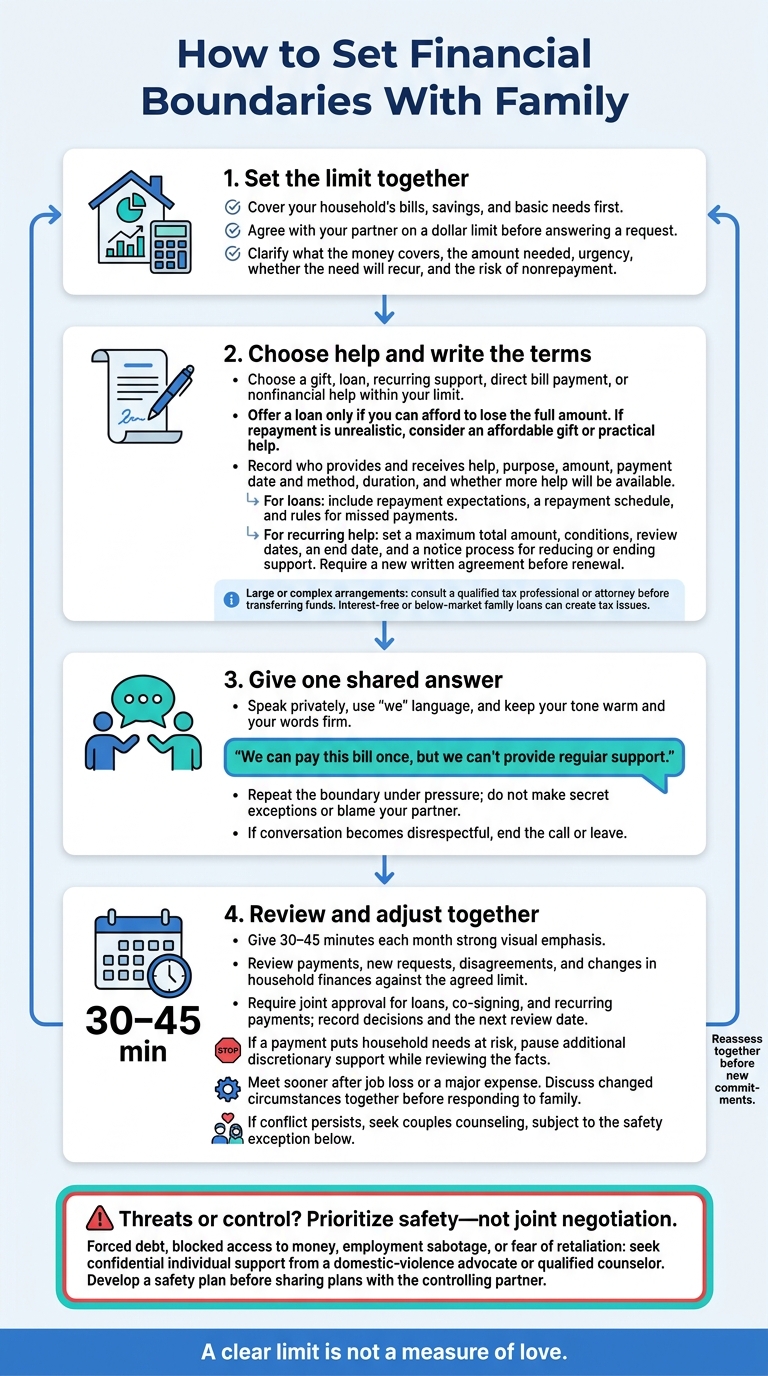
How to Set Financial Boundaries With Family
Setting Financial Boundaries With Family | Part 1 | Episode 216
sbb-itb-596b85d
Step 1: Choose How to Help and Document the Terms
Once you’ve set your support limit, choose a form of help that fits within it. Sort each request into a basic need, emergency, recurring shortfall, or optional expense. Ask what the money will cover, how much your relative needs, and what they’ve already tried. Before committing, confirm how urgent the need is, whether it will recur, and the risk of nonrepayment.
Choose the Type of Support
Keep any help within your household’s limit. Offer a loan only if you can afford to lose the full amount. If there’s no realistic source of repayment, consider an affordable gift or practical help instead. The Consumer Financial Protection Bureau recommends clarifying who provides what, how much, how often, for how long, and with what repayment expectations.[1]
| Support type | Financial risk | Documentation needs | Suitable use |
|---|---|---|---|
| Gift | Permanent expense | Amount; gift designation | One-time need |
| Loan | Nonrepayment | Repayment agreement | Short-term need with a clear repayment path |
| Recurring support | Cumulative cost | Amount, dates, conditions | Time-limited need |
| Direct bill payment | Repeat requests | Bill, receipt, support limit | Specific bill |
| Nonfinancial help | Time commitment | Scope and time limit | Practical assistance |
Write Down the Agreement
Put the terms in writing: who’s providing and receiving help, the purpose, amount, payment date and method, duration, and whether more help will be available. For loans, include a repayment schedule and rules for missed payments.
For recurring help, set a maximum total amount within your household’s limit. Include eligibility conditions, review dates, and whether unused amounts carry over. Have everyone confirm the terms, give each party a copy, and keep receipts and payment records.[1][4]
Interest-free or below-market family loans can create tax issues, including imputed interest or amounts treated as gifts. Applicable federal rates and exceptions depend on the facts and the loan date. This is general information, not individualized legal or tax advice.[2][3][5]
For large or complex arrangements, consult a qualified tax professional or attorney before transferring funds. A written agreement doesn’t replace that advice.
Set Review Dates and Rules for Ending Support
Agree on a notice process for reducing or ending recurring help, including how much notice you’ll give before making changes. Changes in income, need, or agreed conditions should prompt a discussion – not an automatic extension. Require a new written agreement before renewing support.[1]
| Arrangement | Duration | Review schedule | Stopping conditions |
|---|---|---|---|
| One-time support | One payment; loans may have a repayment period | Before payment; at agreed repayment checkpoints if applicable | No further assistance after payment; outstanding loan obligations continue |
| Recurring support | Defined start and end dates | Agreed intervals and before renewal | End date, unmet conditions, or changes in household affordability, following the notice process |
Step 2: Explain and Keep Your Boundary
Before talking with your relative, agree on who will lead and how you’ll handle pushback. Choose a calm moment and speak privately. Use “we” language and give one shared answer. Don’t blame your spouse or disagree in front of family. This helps keep family pressure from dividing you or pushing you into conflicting answers.
State Your Decision Clearly
Acknowledge the request, state your limit, and close the conversation without debating. Keep your tone warm and your words firm. Avoid “maybe” or “we’ll see” unless you intend to reconsider.
For example: “We can pay this bill once, but we can’t provide regular support.”
You don’t need to share your income, account balances, retirement savings, or disagreements with your partner. State the boundary once, then stop. If your relative blames your spouse, explain that you made the decision together.
Hold Your Limit Under Pressure
Repeat your boundary without adding new explanations.[6] Acknowledge your relative’s disappointment without changing your answer. Give the same response if another relative steps in or contacts your partner separately. Don’t keep secrets or make private exceptions just to stop the pressure.
If things escalate, say you’ll continue only when the conversation is respectful. Then end the call or leave. Uphold the boundary together, not just during the conversation. If circumstances change, talk them through with marriage counseling before responding. Bring any new request to your next couple check-in before giving an answer.
Step 3: Work Through Disagreements as a Couple
If the boundary still causes tension, set a regular time to review it together.
Disagreements about family support often stem from guilt, loyalty, fear, or different views of care. Treat those feelings as information – not a verdict. The goal is support both partners can agree to.
Check In About Family Support Each Month
Set aside 30–45 minutes each month when neither of you feels rushed. Review support using the same records.[11]
- Review payments, new requests, resentment, and changes in income, debt, savings, or basic living expenses. Compare support with your agreed limit, and address secret transfers, payments above that limit, and repeated arguments about the same relative.
- If a payment has put household needs at risk, pause additional discretionary support until you understand the facts. List every payment and its funding source, then decide whether to replenish the household account.
- Require joint approval for loans, co-signing, and recurring payments. Record each decision and the next review date. Meet sooner if either partner loses a job or a major expense comes up.
Get Help When Conflict Persists
If monthly reviews keep turning into arguments – or talks end in blame, secrecy, or stalemate – seek couples counseling. Growth and Change Counseling offers couples counseling and family therapy in California and by telehealth.[7][8]
If support involves threats or control, stop negotiating and focus on safety. Warning signs include forced debt, blocked access to money, employment sabotage, or fear of retaliation. Seek confidential individual support from a domestic-violence advocate or qualified counselor. Develop a safety plan before sharing your plans with the controlling partner.[9][10][11][12]
Conclusion: Help Family Without Exceeding Your Limits
Before responding to the next request, review your limit together. Give one shared answer, follow the terms you agreed on, and revisit the arrangement on schedule.
If you can’t give cash, offer practical help.
For example, offer transportation.
Clear limits protect your marriage and household while setting boundaries around the help you can keep giving.
FAQs
How do we set a fair family support budget?
Review your finances together and cover your household’s needs first. Set a fixed monthly cap, such as $200, and put it in writing as a shared rule. This helps prevent repeat arguments and lets you give relatives consistent answers. Both spouses must approve any financial commitment.
If a request goes over your budget, the spouse related to the person asking should respond kindly:
“We’ve reached our budget limit for this month.”
What if my partner and I disagree about helping?
Get on the same page as a couple before responding to extended family’s requests for financial help. Talk privately about what the request means to each of you, without blame. Put your rules in writing, whether that’s a monthly gift limit or requiring both spouses’ approval before committing money.
If you feel stuck, Growth and Change Counseling offers support, including a 12-week intensive couples coaching program to help you restore your relationship and work through family dynamics.
How can I manage guilt after saying no?
Guilt after saying no is a learned feeling – not proof that you’ve done something wrong. Setting boundaries shows honesty and self-respect, not selfishness. It also supports healthy independence.
Start small. Practice saying no politely and firmly, without lengthy explanations. The discomfort usually eases as you keep practicing.
If guilt feels overwhelming, Growth and Change Counseling offers professional support to help you set boundaries and regain emotional balance.
Related Blog Posts
- Boundaries for Addiction Recovery and Healthy Love
- Study: Financial Stress and Divorce Risk
- Managing Cultural Differences in Marriage
- Cultural Clashes in Marriage: Problem-Solution Guide
