If I don’t believe my life, time, and recovery matter, my boundaries usually fail under guilt, fear, or pressure. That’s the core idea here.
This guide comes down to a few plain points:
- Self-acceptance comes first. My worth does not depend on performance, another person’s mood, or whether I can stop a crisis.
- Boundaries are about my actions. They are not rules I use to control someone else.
- I can own harm without calling myself worthless. The guide separates identity, responsibility, and repair.
- Healthy boundaries vs. codependency often involves patterns that blur limits. That often shows up as rescuing, overexplaining, monitoring, people-pleasing, and neglecting my own life.
- Weak limits can show up in six areas: physical, emotional, mental, time, money, and recovery.
- Healthy boundaries sit in the middle. Not too loose, not total shutdown.
- A 5-step process helps: name the value, name the behavior, state the boundary, state what I will do, and follow through.
- Daily practice matters. Guilt and fear are common, and setbacks do not mean failure.
- Safety comes first. A boundary is not enough in cases of threats, stalking, violence, overdose, seizures, confusion, or suicidal intent.
A 2024 study cited in the article found a strong negative link between self-compassion and contingent self-esteem. In plain terms: when my self-view depends on outside approval, my limits are more likely to collapse.
Bottom line: this guide says recovery gets steadier when I know my worth, set clear limits, and get support when needed.
Discovering The Key To Self-worth In Codependency
sbb-itb-596b85d
How Codependent Patterns Distort Responsibility and Limits
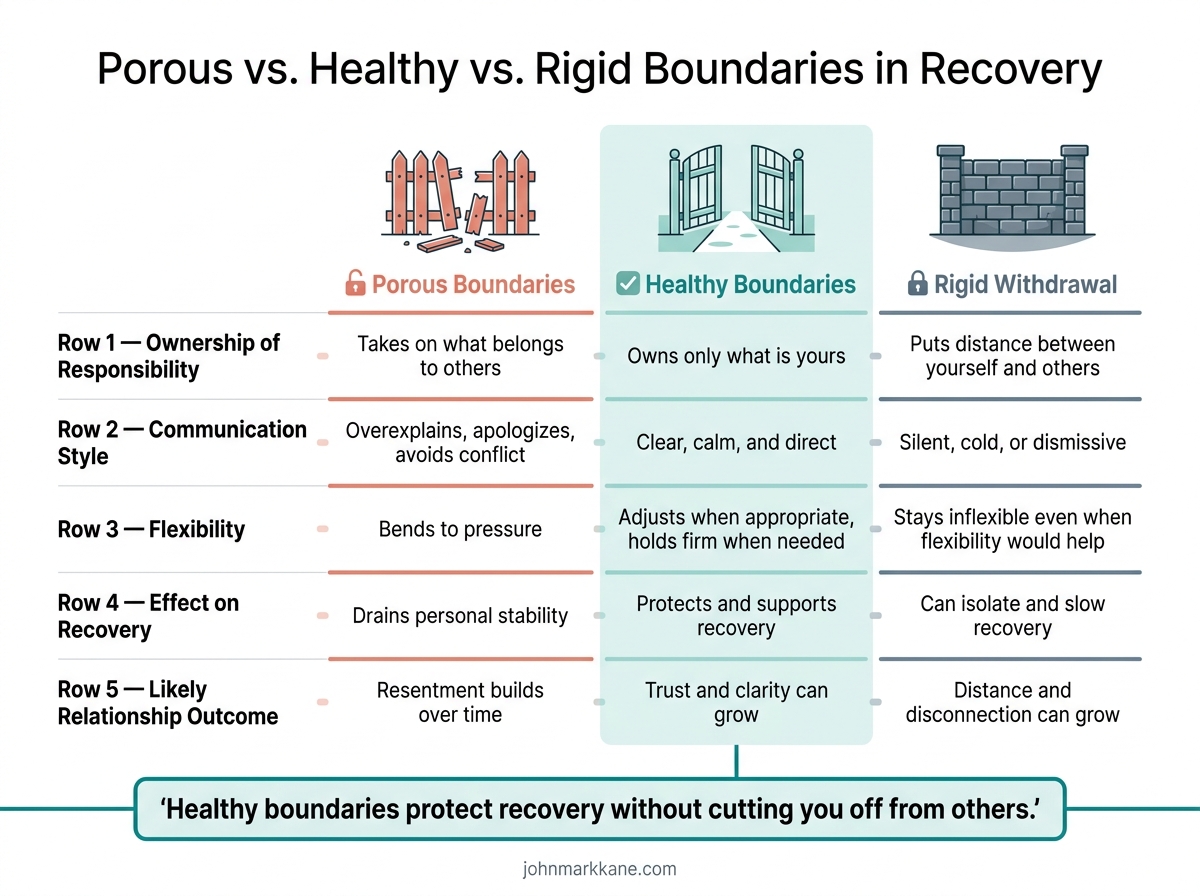
Porous vs. Healthy vs. Rigid Boundaries in Recovery
Codependency can twist your sense of responsibility. When your sense of calm depends on someone else’s mood, it gets hard to tell what’s yours to carry and what isn’t. And that confusion doesn’t stay abstract. It shows up in everyday behavior.
Common Signs: Rescuing, Overexplaining, Monitoring, and Neglecting Your Own Life
You might say yes just to avoid tension. You might watch someone else’s mood all day, trying to guess what version of them you’ll get. You may overexplain simple choices so nobody gets upset. And in many cases, you end up rescuing people from consequences that were never yours to handle in the first place.
While all of that is happening, your own life can start to get smaller.
Your routines slip. Your responsibilities sit on the back burner. Friendships fade. Basic self-care starts to feel optional. The relationship becomes the center of gravity, and you stay locked in on keeping it steady. From the outside, you may look fine. Underneath, you feel worn down[2].
Six Boundary Categories to Check: Physical, Emotional, Mental, Time, Financial, and Recovery-Related
Codependency can weaken limits across several parts of life.
| Boundary Area | What It Can Look Like When Limits Are Weak |
|---|---|
| Physical | You ignore discomfort or personal space to keep the peace |
| Emotional | You feel responsible for another person’s anger, mood, or distress |
| Mental | Your beliefs, decisions, or values are repeatedly dismissed or overridden |
| Time | You are constantly available and have little uninterrupted time for yourself |
| Financial | Money gets used to manage another person’s problems or reduce tension |
| Recovery-Related | You stay in situations that keep pulling you away from your own healing |
Try naming the boundary area that breaks down most often. That matters because one weak limit rarely stays in one lane. A problem with time can spill into money. Emotional strain can chip away at recovery. Once you can name the pattern, you’re in a much better spot to set limits that fit your healing.
Healthy Boundaries vs. Rigid Withdrawal vs. Porous Boundaries
Not every limit is healthy. That’s where people often get stuck.
Some people have almost no limits at all. Others get fed up and pull back so hard that connection disappears. Both ends of the spectrum can create trouble, especially during recovery. One leaves you drained. The other can leave you cut off.
Here’s how those patterns compare:
| Porous Boundaries | Healthy Boundaries | Rigid Withdrawal | |
|---|---|---|---|
| Ownership of responsibility | Takes on what belongs to others | Owns only what is yours | Puts distance between yourself and others |
| Communication style | Overexplains, apologizes, avoids conflict | Clear, calm, direct | Silent, cold, or dismissive |
| Flexibility | Bends to pressure | Adjusts when appropriate, holds firm when needed | Stays inflexible even when flexibility would help |
| Effect on recovery | Drains personal stability | Protects and supports it | Can isolate and slow recovery |
| Likely relationship outcome | Resentment builds over time | Trust and clarity can grow | Distance and disconnection can grow |
Healthy boundaries for recovery protect your sobriety without cutting you off from other people.
How to Set Boundaries from a Place of Self-Acceptance
Your worth doesn’t swing up and down based on how someone reacts to you. That matters here. When you start from self-acceptance, boundaries stop feeling like a desperate move and start feeling like a clear decision. You’re not setting a limit to prove your value. You’re setting it to protect your safety, your values, and your recovery.
Because your value doesn’t rise or fall with your behavior, you can set limits without panic or apology. Even when emotions run high, the boundary can stay steady.
A 5-Step Boundary Process You Can Repeat
It helps to have a process you can come back to when things get messy. A repeatable boundary process can look like this:
| Step | What to Do |
|---|---|
| 1. Name the value | Name what you are protecting. |
| 2. Name the behavior | Describe the specific situation as clearly as you can. |
| 3. State the boundary | Decide what you will and will not accept going forward. |
| 4. State what you will do | Say what you will do if it happens again. |
| 5. Carry it out | Do it consistently. |
For most people, follow-through is the hard part. Fear and guilt can hit fast, even when the boundary is right.
Simple Wording for Difficult Conversations
You don’t need a long speech. A simple script often works better:
"When [specific behavior] happens, I will [specific action] because I need to protect [safety, recovery, or values]."
That wording matters because it keeps the focus on your actions, not on trying to control theirs.
What Makes a Boundary Realistic Instead of Controlling
Here’s the difference: a demand tells someone else what to do. A boundary says what you will do and what you can actually follow through on. If you can’t carry it out, it isn’t much of a boundary.
And if it feels uncomfortable? That doesn’t automatically mean it’s wrong. A lot of the time, discomfort just means the limit is new.
Once the boundary is clear, the next step is practicing it daily so it holds under guilt, fear, and pressure.
Daily Practices That Build Self-Acceptance and Follow-Through
Once you state a boundary, what happens next matters most. Daily habits are what decide if that boundary stays in place. A boundary starts as a choice, but day by day, it becomes a habit.
Identity, Values, and Responsibility Exercises
When shame starts creeping in, come back to your worth. As John Mark Kane, LMFT, says:
"No matter what your struggle, background, belief system, or things you have done, you are inherently valuable." [1]
That doesn’t give harmful behavior a pass. It gives you a steady place to stand. It helps you separate who you are from what you did.
It also helps to practice these skills before conflict shows up. One simple way to do that is a values check. Write down a few things that matter most to you, then look at your choices honestly. Are they lining up?
When your boundaries match your values, they’re easier to keep. You’re not just saying no at random. You’re acting in a way that fits the kind of person you want to be.
As pressure builds, these daily check-ins keep your boundary connected to what matters. If fear-based or distorted thoughts are steering your choices, work on replacing them with truth-based thinking. That kind of steady inner work makes follow-through much more likely.
How to Handle Guilt, Fear, and Setbacks Without Giving Up
When people push back, guilt and fear often show up first. That’s common. Guilt after saying no often means the limit is new. Fear doesn’t mean the boundary is wrong. It means the boundary is hard.
In codependency, guilt and fear often spike when a boundary interrupts old habits like caretaking, rescuing, or appeasing. Seeing that link can help you hold the line instead of folding under the pressure.
And if you slip, don’t turn one setback into a label for who you are. Notice what happened. Repair what needs repair. Then come back to the practice. The goal is steady effort, not perfection.
Support, Safety, and the Next Step in Recovery
Sometimes self-work gets you part of the way, and then you hit a wall. That’s often the moment when outside support starts to matter. It can help you keep boundaries in place when guilt, fear, or old habits keep pulling you back.
When to Consider Therapy, Couples Work, or Family Support
Shame, trauma, addiction, and compulsive caretaking often need help from outside the relationship. Therapy can be a good fit when you know your limits in theory but still cave under guilt, panic, or fear of abandonment.
Supporting neurodiverse couples with mental health issues can help, but only under the right conditions. Everyone needs to join willingly, speak openly, and take part without pressure. If one person is afraid of retaliation or can’t talk freely, joint sessions are not the place to start.
Use therapy for long-running relationship patterns. If the risk is immediate, move to safety planning instead.
Safety Planning for Intimidation, Violence, or Crisis
When things shift from painful to dangerous, the goal changes too. At that point, the focus is no longer better boundary-setting. It’s protection.
A boundary is not a substitute for a safety plan. Guilt and conflict are normal. Threats, stalking, violence, and retaliation are not. Those situations call for safety-focused support, not a stronger or more polished boundary talk.
If someone is facing overdose, seizures, confusion, or suicidal intent, call 911 right away. For intimate-partner violence or coercive control, the National Domestic Violence Hotline is available 24/7 at 800-799-SAFE (7233), by texting START to 88788, or through online chat. For substance-use treatment referrals, SAMHSA’s National Helpline is available at 1-800-662-HELP (4357) or at FindTreatment.gov. [3][4]
A basic written safety plan can stay private and does not need to be announced. It may include:
- One trusted contact and a code word
- A safe place to go
- Transportation options
- Copies of key documents
- Access to emergency funds
- Essential medications
It should also cover digital safety. Location sharing, shared accounts, and browsing history can expose attempts to get help. [3]
Conclusion: Stable Identity, Clear Limits, and Consistent Support
Recovery tends to get steadier when self-acceptance, boundaries, and support work together. Self-acceptance rests on God-given worth, not performance. From that starting point, boundaries become clear actions, and recovery grows stronger through steady follow-through and support.
For readers in California, Growth and Change Counseling offers individual therapy, family therapy, and couples counseling, along with specialized support for addiction, trauma, anxiety, depression, and neurodiverse relationships, with services in Campbell, San Jose, Los Angeles, and Roseville, and telehealth across California. In an immediate crisis, call emergency services first.
FAQs
How do I know if a boundary is healthy or too rigid?
Healthy boundaries work like doors with locks. They let safe people in and keep harmful patterns out. But if a boundary starts to feel more like a solid wall, it may be too rigid.
Your emotions can tell you a lot here. Resentment, anxiety, exhaustion, or guilt often point to overextension or an unhealthy dynamic. If you feel drained, or the other person starts acting more entitled, the relationship likely isn’t balanced.
Why do I feel guilty when I set a boundary?
Feeling guilty when you set a boundary is common, especially if you grew up learning that putting your needs first was selfish.
In codependent dynamics, your sense of worth can get tied to fixing other people or keeping the peace at all costs. So when you start doing something different, it can feel uncomfortable. You might worry about rejection, conflict, or losing someone’s approval.
But a boundary isn’t a rejection. It’s a needed step to protect your emotional health and well-being.
What should I do if someone ignores my boundaries?
Stay calm. Don’t apologize or explain too much. Just restate your boundary in a clear, steady way using the “broken record” technique.
Set clear consequences, and follow through every time the boundary gets crossed. That might mean leaving the room to take care of yourself, cutting back on contact, or spending less time with them.
If they keep pushing, reduce your exposure. And if holding that line starts to feel like too much, consider getting support from a mental health professional.
Boundary FAQs for Growth and Change Counseling
- Boundaries for Addiction Recovery and Healthy Love
- Codependency Recovery: Steps to Build Healthy Boundaries
- How to Set Boundaries in Codependency Recovery
- Codependency vs. Accountability in Recovery Relationships
