Too much screen time is hurting family connections. Parents and teens now average 9 hours of daily screen use, often at the expense of quality family moments. While screens can provide educational benefits and bonding opportunities, excessive use leads to mental health issues, poor sleep, and even social isolation.
Here’s what you can do:
- Set boundaries: Create screen-free zones (like bedrooms or during meals) and limit usage before bedtime to improve sleep.
- Prioritize family time: Replace screen use with shared activities like outdoor play, board games, or family meals.
- Lead by example: Kids mimic parents’ habits, so model healthy screen behavior by putting devices away during family interactions.
- Use screens wisely: When unavoidable, use them as tools for connection, like co-watching shows or playing games together.
Balancing screen time with meaningful family activities strengthens emotional bonds and supports healthier habits for everyone.
Helping Kids & Families Navigate Screen Time Balance | Stacy Jagger
Understanding Screen Time: Benefits and Risks
Screen time can either be a tool for growth or a source of distraction – it all depends on how it’s used.
Benefits of Moderate Screen Time
When approached thoughtfully, screen time can be a valuable part of a child’s development. Educational apps, for instance, can help with schoolwork and even aid in building social-emotional skills [10]. Watching shows or playing video games together as a family can strengthen parent-child bonds and create natural opportunities to talk about emotions and mental health [9]. Beyond entertainment, digital platforms can spark curiosity, encourage cognitive growth, and even inspire new hobbies. For teenagers, screens often serve as a way to stay socially connected and explore their sense of identity [9][10].
The American Academy of Pediatrics emphasizes the importance of focusing on how screens are used rather than simply counting hours:
"Rather than setting a guideline for specific time limits on digital media use, we recommend considering the quality of interactions with digital media and not just the quantity, or amount of time." [10]
The difference between positive and negative outcomes often lies in whether screen time is active or passive. Activities like learning new skills, creating content, or engaging with others meaningfully tend to yield positive results. While moderate use offers clear benefits, overuse can lead to serious challenges.
Risks of Too Much Screen Time
Excessive screen use can take a toll on both physical and mental health. Studies reveal that children spending more than two hours a day on devices often perform worse on language and reasoning tests. Even more alarming, MRI scans show that spending over seven hours daily on screens is linked to significant thinning of the brain’s cortex [6][11]. For adolescents, the risks are particularly concerning: those using screens for more than five hours a day are 70% more likely to experience suicidal thoughts compared to peers who use screens for less than an hour [5]. High screen usage is also associated with increased rates of depression, anxiety, social isolation, and even aggression [5][6][11].
Physical health isn’t spared either. Long hours in front of screens often lead to issues like obesity due to inactivity, chronic neck and back pain from poor posture, and "Computer Vision Syndrome", which includes symptoms like eye strain, headaches, and blurred vision [5][6]. Blue light exposure from screens can disrupt melatonin production, throwing off sleep cycles. Alarmingly, children with nighttime access to devices are 79% more likely to sleep fewer than the recommended nine hours [11].
As these risks grow, certain behaviors may point to an emerging addiction.
Warning Signs of Screen Addiction
Addiction to screens often reveals itself through disruptions in daily life. Look for signs such as an uncontrollable urge to use devices, withdrawal from in-person interactions, and heightened irritability or anxiety when screens are unavailable [5][11]. Other red flags include declining academic performance, neglecting responsibilities at home, and secrecy about device usage [2][11][12]. Dr. Jason Nagata highlights one critical concern:
"Screen time at bedtime displaces sleep time, which is essential for health and development in young adolescents." [12]
Using devices as a primary way to cope with stress or falling asleep with them – despite family rules – can also indicate problematic behavior. Interestingly, nearly 70% of children report that their parents spend too much time on devices, underlining the importance of parents modeling healthy habits [2].
If you’re worried about your child’s screen habits, it might be worth reflecting on your own device use and establishing clear, healthy boundaries for the whole family.
The Value of Family Time: Building Stronger Connections
Spending time together as a family strengthens emotional bonds and builds essential life skills. In a world where screens often dominate our attention, prioritizing face-to-face interactions creates deeper connections that digital devices simply can’t replicate. These moments of quality time lay the groundwork for emotional well-being, stronger communication, and resilience that lasts a lifetime.
How Family Time Supports Child Development
Spending time with family directly impacts a child’s growth in ways that screens just can’t. Activities like shared meals, conversations, or even playing together foster empathy and help kids develop a better understanding of others’ perspectives. These interactions build critical social skills that are essential for healthy relationships [2].
For example, unstructured play encourages kids to use their imagination, practice self-control, and handle frustration – skills they can’t develop through video games that rely on instant rewards and external stimulation [2]. Traditional play helps children focus on slower-paced, real-world activities, which balances the overstimulation often linked to excessive screen use.
Even moments of frustration, like when a child gets upset about screen limits, can become opportunities for growth. A calm response, such as saying, "You seem upset; can you tell me what’s bothering you?" teaches emotional regulation and helps children learn to express their feelings constructively instead of retreating into digital distractions [2].
The Power of Family Routines
Family routines amplify the benefits of direct interactions by creating consistent opportunities for connection. Whether it’s eating meals together, enjoying bedtime rituals, or hosting weekly game nights, these routines provide a sense of security and predictability [13]. They also naturally create tech-free zones, encouraging family members to engage with one another instead of their devices.
As Maryam Abdullah, Ph.D., from the Greater Good Science Center suggests:
"Rather than setting a goal to limit screen time (avoidance), set a goal for outdoor play (approach), which would naturally take the place of time spent using screens." [1]
One example of this in action comes from a 2019 ABC News report by the Gottman Institute. A family that previously spent 4 to 8 hours daily on devices in near silence transformed their dynamic by introducing weekly family meetings and outdoor activities like kayaking and hiking. These changes replaced digital isolation with laughter and meaningful emotional connections [3].
Making Family Time Work Despite Digital Distractions
Balancing family time with the pull of digital distractions can be tough, but even small moments of undivided attention can make a big difference. Quality matters more than quantity. For instance, asking thoughtful questions at dinner, like "Who made you feel happiest today?" encourages empathy and helps children think about others’ perspectives.
When screens are unavoidable, using them as a shared activity – watching a show or playing a game together – can spark conversations and create opportunities for connection, rather than serving as a substitute for interaction. By modeling focused, face-to-face engagement, parents can show that technology has its place but should never overshadow genuine relationships. As the Gottman Institute highlights, it’s all about finding a thoughtful balance between digital use and real-life connections [3].
sbb-itb-596b85d
Screen Time vs. Family Time: Key Differences
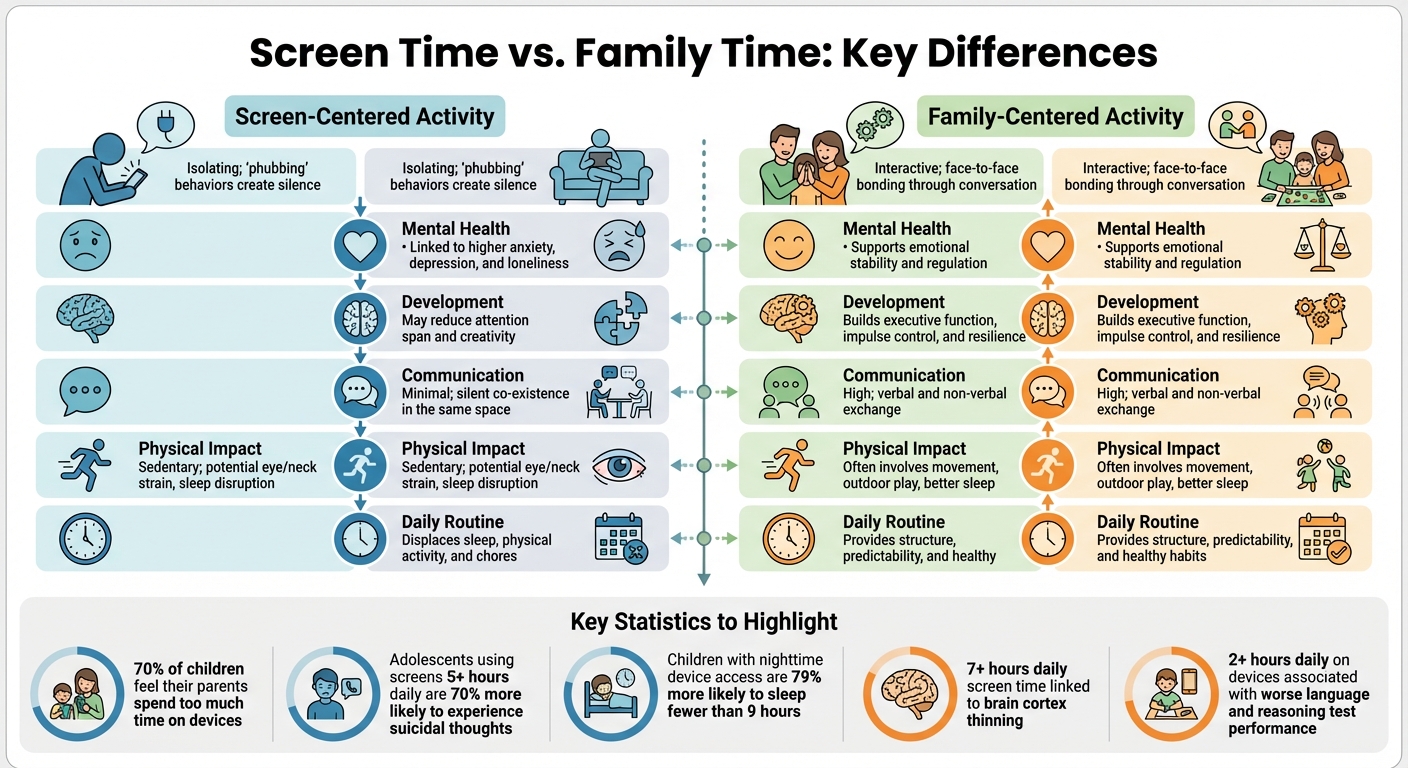
Screen Time vs Family Time: Impact Comparison on Mental Health and Development
Understanding how screen time and family time influence relationships, mental health, and daily routines is crucial for making better choices. By recognizing these differences, families can reclaim meaningful interactions. Let’s explore how screen time can either isolate or bring family members closer together.
When Screen Time Replaces Family Time
When screens dominate, families often fall into "parallel media use", where everyone is physically present but emotionally disconnected. This phenomenon, sometimes called "phubbing", happens when people focus on their devices instead of engaging with those around them. The effects go beyond just missed conversations. Studies link excessive screen use to higher rates of depression, anxiety, and even suicidal thoughts. It also disrupts sleep, shortens attention spans, and encourages sedentary habits that negatively impact overall health [5] [11] [14].
In fact, nearly 70% of children surveyed expressed feeling that their parents spend too much time on their own devices [2]. This highlights how screen time can create a gap, even in shared spaces.
When Screen Time Can Enhance Family Time
On the flip side, screens can bring families together when used thoughtfully. The key lies in engagement. Instead of isolating themselves, families can watch movies, play cooperative video games, or share funny videos that spark conversations and laughter.
Don and Carrie Cole, Certified Gottman Therapists, explain:
"Technology doesn’t need to be the enemy of connection. Try sending each other daily text messages as a way of connecting" [3].
This proactive approach turns screens into tools for building relationships rather than barriers. Activities like co-viewing or co-playing also allow parents to guide their children, discussing content and teaching critical thinking about digital media.
Comparison Table: Screen Time vs. Family Time
| Feature | Screen-Centered Activity | Family-Centered Activity |
|---|---|---|
| Connection | Isolating; "phubbing" behaviors create silence | Interactive; face-to-face bonding through conversation |
| Mental Health | Linked to higher anxiety, depression, and loneliness | Supports emotional stability and regulation |
| Development | May reduce attention span and creativity | Builds executive function, impulse control, and resilience |
| Communication | Minimal; silent co-existence in the same space | High; verbal and non-verbal exchange |
| Physical Impact | Sedentary; potential eye/neck strain, sleep disruption | Often involves movement, outdoor play, better sleep |
| Daily Routine | Displaces sleep, physical activity, and chores | Provides structure, predictability, and healthy habits |
Practical Strategies for Balancing Screen Time and Family Time
Setting Limits and Boundaries
When it comes to managing screen time, it’s less about the exact hours spent and more about what gets sidelined – whether it’s sleep, exercise, family bonding, schoolwork, or hobbies. The American Academy of Pediatrics suggests that children aged 2 to 5 years should have no more than one hour per day of high-quality content, while older kids benefit from consistent boundaries that safeguard these essential activities [16]. As David Anderson, PhD, a clinical psychologist, puts it:
"If the worry is that your child is having too much screen time, it’s not about how much time that actually is. It’s about what it infringes on." [8]
A study conducted by UCSF in June 2024, involving 10,048 participants, revealed that parental monitoring and setting limits on screen time reduced children’s daily usage by 0.83 hours and 1.29 hours, respectively [12].
To make these changes stick, involve your kids in the process. Weekly family discussions about screen time rules can reduce conflicts and encourage teamwork [1]. Be prepared for resistance, especially when new rules are introduced. Experts call this initial pushback the "extinction burst", but staying consistent for one to two weeks usually helps children adjust [8].
Practical steps like using visual timers for younger kids and establishing screen-free zones in bedrooms or kitchens can also make a big difference [15][16]. Turning off devices at least an hour before bedtime is another key strategy, as it helps minimize blue light exposure, which can disrupt sleep cycles [15][16].
Once these boundaries are in place, focus on replacing screen time with engaging, tech-free activities that enrich family life.
Creating Tech-Free Routines
Instead of just saying "no" to screens, shift the focus to what your kids can do instead. Stephanie Lee, PsyD, a clinical psychologist, emphasizes:
"When we tell kids not to do something, we almost always need to tell them what to be doing instead." [8]
For example, set "approach goals" like "let’s spend an hour playing outside" rather than framing it as "no tablets today." These positive goals naturally redirect attention and create a more enjoyable experience [1].
Work together as a family to create an "activity menu" filled with screen-free options like crafts, board games, reading, or playing with pets. This way, when boredom strikes, your kids will have ready alternatives [8]. You can also map out your family’s weekly schedule to identify "time leaks" and plan intentional device-free moments, such as family meals, weekend hikes, or game nights [2]. Another helpful tip is to set up a central charging station in a common area, where all devices must be placed at least an hour before bedtime [15].
By establishing these routines, you’ll not only support your child’s development but also strengthen family bonds through quality time together.
Leading by Example as Parents
Kids naturally mimic their parents’ behavior, making your own screen habits just as important as the rules you set. Developmental pediatrician Mark Bertin, MD, explains:
"Children unconsciously mirror their parents’ behavior in countless ways, so if we want them off their screens more often, that change starts with us." [2]
The UCSF study also found that poor screen habits among parents led to an increase of 0.66 hours in their child’s daily screen use [12]. Dr. Jason Nagata, the study’s lead researcher, highlighted practical steps for parents:
"These results are heartening because they give parents some concrete strategies they can use with their tweens and young teens: set screen time limits, keep track of your kids’ screen use, and avoid screens in bedrooms and at mealtimes." [12]
Model intentional device use by explaining your choices. For instance, you could say, "I’m putting my phone away now so we can talk about your day", or "I’m checking the weather for our walk" [16]. This helps kids understand the difference between purposeful use and mindless scrolling. Parents who use their phones to find social support or parenting advice often report feeling less guilt compared to those who use devices as a way to escape stress [1].
If you’re looking for additional guidance on balancing screen time with meaningful family interactions, professionals at Growth and Change Counseling can provide further support.
Conclusion
Finding a balance between screen time and family time takes deliberate choices that put meaningful connections first. Shifting from simply "monitoring" screen usage to actively "mentoring" your family’s digital habits can help focus on the quality of interactions rather than just the number of minutes spent online [4]. This perspective opens the door to practical strategies that can make a real difference.
Regan Vidiksis, Senior Researcher at EDC’s Center for Children and Technology, puts it well:
"Technology is just another medium in their lives and something that they need to learn to develop healthy habits around, with the support of their families and other media mentors." [4]
The approaches discussed here – like setting clear boundaries, establishing tech-free routines, and leading by example – are most effective when combined into a cohesive plan. Your own relationship with technology plays a key role in shaping your children’s habits. Even small adjustments can make a big impact on strengthening family bonds.
If self-guided efforts feel overwhelming, professional support can provide personalized solutions. Growth and Change Counseling offers services such as parent coaching, family therapy, and media addiction treatment, available in Campbell, San Jose, Los Angeles, Roseville, and throughout California via telehealth. As John Kane, LMFT, points out:
"The more relationally healthy people are, the less anxious, addicted, and depressed they are." [7]
Whether it’s through family meetings, setting clear boundaries, or seeking professional help, taking steps to address screen use can help your family reconnect in a world that’s increasingly shaped by digital interactions.
Finding Your Path to Balance with Growth and Change Counseling
How can families create healthy screen time boundaries?
Start by having an open and honest discussion with your family about how everyone uses their devices and what a healthy balance might look like. Together, set clear rules about where, when, and how screens are used. For instance, you might agree on no phones during meals, no screens until homework is finished, or limiting screen time before bed. Writing these rules down and revisiting them as your kids grow can help ensure everyone stays aligned.
To make these guidelines work, consider using tools like parental controls to monitor and limit screen time. Just as importantly, set an example by managing your own screen habits. Plan regular family activities – like playing board games, cooking together, or going for walks – that provide fun, screen-free alternatives. If you need additional guidance, Growth and Change Counseling offers parent coaching and family therapy to help families create tailored media plans and strengthen their offline connections. With consistent teamwork, families can enjoy the benefits of technology while still prioritizing quality time together.
How can I tell if my child is spending too much time on screens?
Excessive screen time in children often reveals itself through changes in behavior, emotions, and even physical health. Kids may become irritable, anxious, or resistant when it’s time to step away from their devices. Some might even go as far as hiding their screen use or lying about how much time they spend online. You might also notice them losing interest in hobbies or activities they used to love, along with neglecting schoolwork or skipping out on household tasks.
On the physical side, issues like disrupted sleep, frequent headaches, or eye strain are common signs of too much screen exposure. There’s also evidence linking excessive screen use to attention difficulties, hyperactivity, and even symptoms of depression. If these patterns sound familiar, it could be a good moment to introduce clearer limits around screen time and encourage activities that don’t involve screens to help create a healthier balance.
How can families use screen time to strengthen their relationships?
Screen time, when used thoughtfully, can be a meaningful way for families to connect. Whether it’s watching a family-friendly movie, playing cooperative video games, or catching up with distant relatives on a video call, screens can create shared moments that strengthen bonds. Even revisiting old home videos or browsing through family photos can bring back cherished memories and inspire new traditions.
To turn screen time into a bonding experience, try setting simple rules like having a "media-free dinner" followed by a designated family screen hour. You could read an e-book together, watch a program and discuss its message, or explore educational content as a group. These activities can help children understand that screens are more than just entertainment – they can also be tools for connection. For families looking for tailored advice, Growth and Change Counseling provides parent coaching and family therapy to encourage healthy media habits and build stronger relationships.
Related Blog Posts
- Parent Coaching Checklist: 10 Essential Skills
- Signs Screen Time Hurts Your Marriage
- Ultimate Guide to Co-Parenting in Recovery
- How Couples Heal After Technology-Driven Conflicts
