Rebuilding self-worth after trauma is challenging but achievable. Trauma, especially from childhood, often distorts how you see yourself, leaving behind feelings of shame, unworthiness, or self-doubt. This guide outlines five actionable steps to help you reclaim your sense of value and confidence:
- Challenge Trauma-Based Beliefs: Identify and question the negative beliefs about yourself that stem from past experiences. Journaling and reflection can help uncover these patterns.
- Practice Self-Compassion: Replace harsh self-criticism with kindness and understanding. Use tools like reframing negative self-talk and body-based practices to build emotional resilience.
- Set Healthy Boundaries: Learn to say "no" and prioritize your needs. Boundaries affirm your worth and protect your emotional space.
- Rebuild Self-Trust: Start small by keeping promises to yourself. Consistent actions, no matter how minor, reinforce your reliability and confidence.
- Strengthen Relationships: Surround yourself with emotionally safe people who respect your boundaries and values. Rediscover your strengths and passions to rebuild a positive self-image.
Healing takes time, but these steps can help you move forward. Trauma may shape your story, but it doesn’t define your worth.
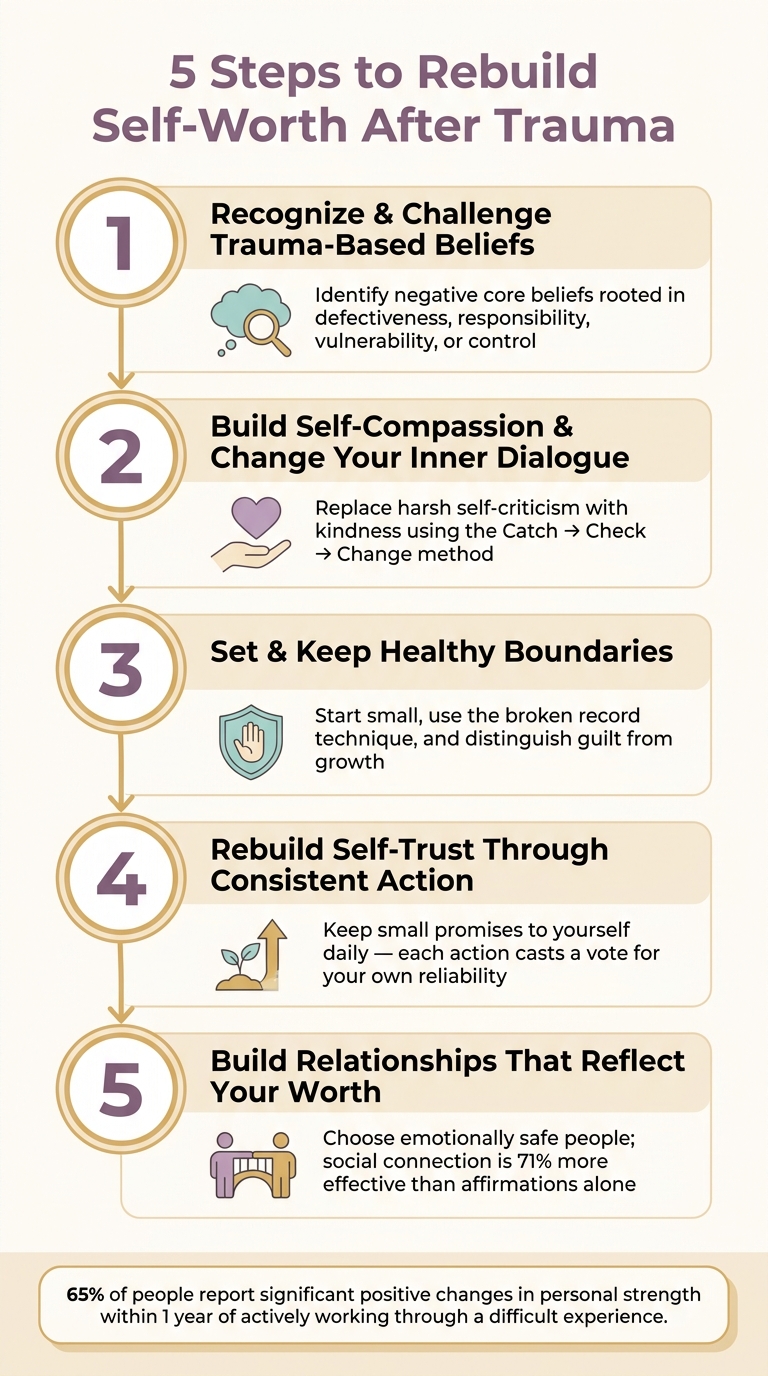
5 Steps to Rebuild Self-Worth After Trauma
How To Build Self-Esteem As A Trauma Survivor | Permission to Love Podcast
sbb-itb-596b85d
Step 1: Recognize and Challenge Trauma-Based Beliefs
Rebuilding self-worth starts with examining the deep-seated beliefs you hold about yourself – those rooted in emotion rather than logic. Trauma often creates a disconnect: you might logically understand that a tough childhood wasn’t your fault, yet still feel fundamentally flawed or unworthy. The key is to uncover these beliefs and recognize how they influence your thoughts and actions.
How to Identify Negative Core Beliefs
Trauma-based beliefs often fall into four main categories. These beliefs typically emerge as a younger version of you tried to make sense of painful experiences:
| Category | Common Thought | Likely Childhood Root |
|---|---|---|
| Defectiveness | "I am unlovable" or "I am broken" | Emotional neglect; being ignored or mocked |
| Responsibility | "It was my fault" or "I should’ve done more" | Taking blame to protect a caregiver’s image |
| Vulnerability | "I am not safe" or "I can’t trust anyone" | Unpredictable home environments |
| Control | "I am powerless" or "I am trapped" | Situations where choices were restricted |
Journaling can be a helpful way to bring these beliefs to the surface. Use prompts like, “What childhood experiences taught me that my needs were a burden?” Pay attention to your body as well – physical tension when expressing needs might signal deeply held beliefs.
Spotting Trauma-Driven Patterns in Relationships
These beliefs often show up in how you interact with others. Behaviors like people-pleasing, over-apologizing, or staying hyper-alert in relationships can be survival strategies lingering from the past. Self-blame is a common thread here: as a child, believing you were at fault might have been a way to feel some control over chaotic or painful situations. This mindset can later manifest as perfectionism or a constant need for approval.
"What you believe about yourself defines and shapes all of your relationships!" – John Kane, Licensed Marriage and Family Therapist
How to Step Back from These Patterns
One of the most effective first steps is simply naming the behavior – without judgment. When you catch yourself people-pleasing or withdrawing, acknowledge it: “This is a survival strategy, not who I really am.” This shift helps you move from self-criticism to self-awareness.
"It is not the trials in your life that develop or destroy you, but rather your response to those hardships." – Stephanie Hayes, Associate Marriage and Family Therapist, Growth and Change Counseling
A trigger journal can also be a valuable tool. Record moments when you feel intense emotional reactions, then reflect on the underlying beliefs they might reveal. For example, feeling anxious when a friend doesn’t respond to a text could point to a deeper fear of abandonment. Over time, recognizing these patterns is the first step toward transforming them.
Step 2: Build Self-Compassion and Change Your Inner Dialogue
Once you’ve identified trauma-based beliefs, the next step is to shift your internal dialogue. For many trauma survivors, the most critical voice often comes from within.
Why Self-Compassion Plays a Role in Trauma Recovery
Self-compassion isn’t about ignoring your struggles or pretending everything is fine. Instead, it’s about treating yourself with the same care and understanding you’d offer a close friend in pain. Dr. Kristin Neff outlines three components of self-compassion – self-kindness, common humanity, and mindfulness – which work together to counteract feelings of shame and help activate the body’s rest-and-repair response [5].
Shame can be a significant obstacle in trauma recovery. It convinces you that you’re uniquely flawed, making progress feel impossible. Self-compassion challenges this narrative head-on.
"Self-compassionate people are more likely, not less, to take responsibility for their actions, repair relationships, and engage with difficult internal material – because they are not paralyzed by shame and self-attack." – City Behavioral Health [5]
Steps to Reframe Negative Self-Talk
The harsh inner critic many trauma survivors experience often originates as a survival mechanism, a voice shaped by navigating unsafe or unpredictable environments [5]. Recognizing this is the first step toward change.
A simple three-step process can help you transform harmful self-talk:
- Catch it: Notice when a harsh or critical thought arises.
- Check it: Ask yourself if you’d say the same thing to someone you care about in a similar situation.
- Change it: Replace the thought with something more compassionate and truthful, acknowledging the difficulty without self-blame.
This isn’t about forcing positivity; it’s about being accurate. Trauma-driven self-talk is often distorted and overly critical.
"Self-compassion makes it possible to look honestly at what happened… without that examination collapsing into self-punishment." – City Behavioral Health [5]
Pairing these cognitive shifts with physical practices can further support self-compassion.
Body-Based Practices for Building Self-Compassion
Trauma often resides in the body as much as in the mind. Psychiatrist and trauma expert Bessel van der Kolk, MD, explains:
"The body remembers what the conscious mind can’t articulate." [6]
This means that simply knowing you should be kinder to yourself isn’t always enough. Body-based practices can help by signaling safety directly to your nervous system. Some research-supported techniques include:
- Placing a hand on your heart during moments of distress to provide comfort.
- Slow diaphragmatic breathing to calm the body before facing difficult emotions.
- Regular body check-ins to identify and release physical tension [5][1].
Another practical tool is the Self-Compassion Break. In this exercise, pause and acknowledge your pain, remind yourself that struggle is part of being human, and offer yourself a kind phrase like, “This is hard, but I’m doing the best I can.” [5] These small, consistent actions can gradually retrain your nervous system to respond to pain with care instead of criticism.
If you’d like help mastering these techniques, consider reaching out to Growth and Change Counseling.
Step 3: Set and Keep Healthy Boundaries
Now that self-compassion is reshaping how you speak to yourself, it’s time to bring that change into your interactions with others by setting clear boundaries. Boundaries are more than just limits – they’re a way to show yourself respect. As Joy Spring explains, "Boundaries are self-respect in action." [7] For those who’ve experienced trauma, learning to set boundaries is more than a practical skill – it’s a powerful way to affirm that your needs and well-being are important.
Why Boundaries Are Important for Self-Worth
If you’ve experienced childhood trauma, you might find it hard to separate your needs from others’. Often, prioritizing others felt necessary for safety. Pete Walker, in his book Complex PTSD: From Surviving to Thriving, describes this as the "fawn" response:
"The fawn type seeks safety by merging with the wishes, needs, and demands of others. They act as if they unconsciously believe that the price of admission to any relationship is the forfeiture of all their needs, rights, preferences, and boundaries." – Pete Walker [8]
Each time you set a boundary, you’re making a statement: your needs matter. Over time, these actions help you build a stronger sense of self-worth. [7] Every boundary you uphold reinforces the idea that your well-being is a priority.
How to Begin Setting Boundaries
Start small. Don’t dive into setting firm limits with someone difficult right away. Instead, practice in lower-stakes situations, like declining a casual invitation or addressing a minor mistake at a coffee shop. [9]
When framing a boundary, focus on what you can control. For example, say, "If X happens, I will do Y." [11][12] This approach keeps the focus on your actions, making your boundary clear and less likely to feel confrontational.
If someone pushes back, resist the urge to over-explain. The "broken record" technique can be helpful here. Calmly and consistently repeat your boundary without adding extra explanations, which might give the other person room to argue. [9][10] These small steps can help you build confidence and prepare for any guilt or self-doubt that may come up.
Managing Guilt and Self-Doubt When Setting Boundaries
It’s normal to feel guilt when you first start setting boundaries, especially if you’re challenging long-standing habits. But guilt doesn’t mean you’ve done something wrong.
"The guilt that arises when you set a boundary is real. It is not evidence that the boundary is wrong – it is evidence that an old rule is being challenged." – Ummara Ashfaq, Registered Psychotherapist [11]
When guilt surfaces, ask yourself: Are you violating your own values, or are you simply breaking a pattern of self-sacrifice? If your boundary aligns with your values, then the discomfort is a sign of growth. [11][13] Learning to distinguish between genuine guilt and guilt tied to old expectations can be incredibly liberating as you continue on your recovery journey.
Step 4: Rebuild Self-Trust Through Consistent Action
Rebuilding self-trust is a crucial part of reclaiming the self-worth that trauma may have undermined. While setting boundaries (as outlined in Step 3) is one way to affirm your needs, true healing also involves learning to trust your instincts again.
How Trauma Undermines Self-Trust
When a child’s emotions are dismissed, punished, or ignored, they often conclude that their inner experiences are unreliable. Over time, they may stop trusting their instincts and instead rely on external signals for guidance. This adaptation is a survival mechanism, not a personal shortcoming.
Trauma therapist Diane Dempcy explains it well:
"Self-trust is the ability to rely on your internal experience – to believe that your emotions make sense, your perceptions are valid, and your body’s signals are worth listening to." [15]
Rebuilding this trust doesn’t mean eliminating fear altogether. As Dempcy notes, "Rebuilding trust in yourself is not about becoming fearless – it’s about learning you can handle what comes up." [15]
Restoring self-trust takes consistent, intentional actions that remind you of your own dependability.
Daily Habits That Strengthen Self-Trust
Self-trust develops through small, consistent actions. Each time you follow through on a promise to yourself, you cast a "vote" for your own reliability:
"Self-trust grows with each tiny, self-made decision." [14]
This could look like committing to a short morning walk, jotting down a journal entry at night, or even making a simple decision – like choosing what to eat – without seeking outside input. Regularly pausing to check in with your needs is another way to rebuild self-reliance, complementing the mind-body work from Step 2.
Even with these efforts, setbacks are inevitable. What matters is how you respond when they happen.
Bouncing Back After a Missed Commitment
Missing a commitment doesn’t mean failure – it’s part of the healing process. The key is to approach setbacks with curiosity rather than judgment. Instead of asking, "Why did I fail again?" try asking, "What did I need in that moment?" Patrick Scully, co-founder of Steps to Hope, offers this perspective:
"What if being wrong didn’t mean failure? What if it simply meant growth?" [16]
If you falter, scale back to the smallest version of your commitment. Even a single deep breath or a moment of stillness can serve as a reset. Then, when a new day begins, recommit. Yesterday doesn’t have to define today – it’s another chance to choose yourself.
For additional guidance on rebuilding self-trust, consider reaching out to Growth and Change Counseling.
Step 5: Build Relationships and a Self-Image That Reflect Your Worth
The inner work you’ve done so far – challenging outdated beliefs, practicing self-compassion, setting boundaries, and rebuilding trust in yourself – will naturally start to influence the quality of your relationships. This step focuses on ensuring that your connections with others, as well as the way you see yourself, truly reflect the worth you’ve been reclaiming. As you grow, these changes will lead to healthier, more genuine relationships.
How to Choose Emotionally Safe Relationships
Emotionally safe relationships are built on the foundation of the boundaries you’ve worked so hard to establish. Safe individuals are consistent, respectful, and honest. They listen without judgment and honor your needs and limits. One way to test emotional safety is by setting a small boundary. Healthy people will respect it, while manipulative individuals may push back or even retaliate.
"Emotionally secure love may initially feel unfamiliar." [2]
Research backs this up. Studies show that social connection and meaningful relationships are 71% more effective in building lasting self-esteem than relying on positive affirmations alone, which only have a 23% effectiveness rate [18]. Choosing the right people to surround yourself with isn’t just helpful – it’s a critical part of your recovery.
Reconnecting with Your Strengths and Interests
Trauma often silences your unique abilities and passions. Part of healing involves rediscovering these parts of yourself. A practical way to start is by writing a short personal narrative – just a couple of paragraphs – about what you’ve been through, what you lost, what survived, and what has emerged since. Revisiting and refining this story over time helps with what researchers call identity reconstruction: creating a cohesive self-narrative where trauma is a chapter in your story, not the whole book [18]. This process strengthens the groundwork you’ve already laid by challenging trauma-based beliefs and setting boundaries. Reclaiming your authentic self not only rebuilds your identity but also helps you find relationships that reflect your true worth. Engaging in this kind of intentional meaning-making can make post-traumatic growth three times more likely than passive recovery [18].
Brené Brown, PhD, LCSW, explains it perfectly:
"Shame is the intensely painful feeling or experience of believing that we are flawed and therefore unworthy of love and belonging – something we’ve experienced, done, or failed to do makes us unworthy of connection." [19]
By reconnecting with your strengths, you actively counter shame through action.
How Better Self-Worth Changes Your Relationships
As your self-worth grows, it transforms your relationships. You’ll rely less on others for validation and instead build more authentic, meaningful connections. Your needs will no longer feel like burdens but rather as important truths worth sharing [4].
Licensed Marriage and Family Therapist Figs O’Sullivan explains:
"The healthy relationship is a result of the self-esteem work, not a shortcut around it." [17]
This shift allows you to move from seeking completion in others to complementing your strengths with the support of those around you [17]. In fact, about 65% of people report significant positive changes in their personal strength within a year of actively working through a difficult experience [18]. The effort you’re putting in now can lead to measurable, meaningful growth in both your self-image and your relationships.
Conclusion: Moving Forward on the Path to Self-Worth
Rebuilding self-worth after childhood trauma is a journey, not a straight line. Along the way, you’ve explored five key steps: recognizing and challenging trauma-based beliefs, cultivating self-compassion, setting healthy boundaries, rebuilding trust in yourself through consistent actions, and fostering relationships that honor your value. Each step is a piece of the larger puzzle, and revisiting earlier steps is a natural part of the healing process.
As therapist Annie Wright, LMFT, wisely reminds us:
"The amount of time your healing takes is not a measure of your brokenness. It’s a measure of what you survived." [21]
Healing takes time. Studies suggest that it can take 12 to 18 months to surpass pre-trauma self-esteem levels [18], while deeper changes from complex relational trauma may require 2 to 4 years of steady effort [3]. This gradual progress is entirely normal. Feeling like you’re circling back to old patterns doesn’t mean failure – it’s your nervous system continuing to process and heal.
For those moments when self-guided work feels insufficient, trauma-focused therapy can be transformative. Techniques like EMDR, Somatic Experiencing, and Internal Family Systems (IFS) target both the mind and the body’s stored trauma responses [20][21]. As John Kane, founder of Growth and Change Counseling, explains:
"Treating symptoms is like putting band-aids on something that needs stitches." [22]
Growth and Change Counseling provides trauma therapy and telehealth services across California, offering support for those ready to take the next step.
Your self-worth has always been there – it’s just been waiting for you to rediscover it. Every effort you make brings it closer to the surface.
FAQs
How can I recognize beliefs rooted in trauma?
Trauma-based beliefs can often feel unyielding, all-encompassing, and deeply emotional, sparking overwhelming feelings of shame, fear, or guilt. These beliefs are often rooted in the body, making them feel as though they are tied to the present moment, even if they stem from past experiences. Common patterns include thoughts of self-blame, feelings of being inherently flawed, or a sense of helplessness. If you find yourself battling constant negative self-talk, Growth and Change Counseling provides tailored support to assist in the process of trauma recovery.
What if self-compassion feels fake or unsafe?
If self-compassion feels unnatural or even uncomfortable, it might be because your nervous system is in survival mode, making kindness toward yourself seem out of place. This isn’t a personal shortcoming – it’s your body’s natural way of trying to protect you.
Rather than pushing yourself toward self-compassion, consider practicing self-attunement. This means acknowledging your emotions as they are, without trying to judge or alter them. If this feels too intense or unmanageable, Growth and Change Counseling provides trauma-informed therapy to help you heal in a safe and supportive environment.
When should I consider trauma-focused therapy?
If you’re feeling stuck, dealing with persistent emotional or relationship challenges, or noticing that childhood experiences still impact your self-esteem, nervous system, or daily life, trauma-focused therapy could be a good option. It’s particularly effective for chronic issues like anxiety, depression, or ongoing relationship difficulties that haven’t improved with other methods. Growth and Change Counseling provides specialized trauma treatments designed to help you heal and regain a stronger sense of self through practical, solutions-driven support.
Related Blog Posts
- Complete Guide to Trauma Recovery Steps
- Root Causes of Shame in Sexual Addiction
- How Betrayal Trauma Impacts Partners of Addicts
- Trust Issues in Marriage After Childhood Abuse
