Childhood abuse often leads to long-lasting trust issues that can deeply impact marriages. Survivors may struggle with feelings of insecurity, self-doubt, and difficulty connecting emotionally with their partners. These challenges often show up in behaviors like emotional withdrawal, hypervigilance, or excessive need for reassurance. The root of these issues lies in early experiences where caregivers, meant to provide safety, caused harm, leading to ingrained beliefs that others cannot be trusted.
Key takeaways:
- Trust challenges often arise as protective responses to past trauma, not personal flaws.
- Survivors may develop insecure attachment styles, causing them to either cling to or distance themselves from their partners.
- Communication struggles, like defensiveness or misinterpreting neutral actions as hurtful, are common.
- Rebuilding trust requires understanding how past trauma shapes current behaviors, practicing open communication, and seeking professional help.
Couples can rebuild trust by addressing these patterns through small, consistent actions, therapy, and patience. Professional counseling, such as trauma-informed therapy or structured programs like the 12-week Marriage Rescue Institute, can help couples navigate these complex challenges and strengthen their relationship over time.
HOW to HEAL from TRAUMA, rebuild TRUST and LOVE again
How Childhood Abuse Affects Emotional and Relationship Health
Childhood abuse leaves deep scars that can reshape how individuals see themselves and connect with others. For many survivors, even when both partners in a marriage strive for closeness, these wounds can turn the relationship into a challenging terrain. Let’s take a closer look at how these experiences impact self-worth, attachment styles, and communication.
Emotional Wounds and Low Self-Worth
Survivors of childhood abuse often carry "negative self-beliefs", a term therapists use to describe deeply rooted feelings of being unlovable, flawed, or unworthy [12]. These beliefs act like a filter, coloring every interaction. For example, a kind word from a spouse might be dismissed as insincere, or a minor conflict may lead the survivor to believe they are the problem or that the relationship is doomed.
Interestingly, research shows that these self-beliefs often harm relationships more than negative assumptions about others [12]. Imagine a husband who genuinely loves his wife, but her internal belief that she’s unworthy of love makes it impossible for her to accept his reassurance. These feelings of diminished self-worth not only affect the individual but also create trust issues, feeding into harmful narratives like "I’m too broken to be loved" or "Everyone leaves eventually." These "trauma lies" actively destabilize relationships.
The emotional toll doesn’t stop there. A longitudinal study involving 414 newlywed couples revealed that spouses with histories of childhood abuse reported higher levels of depression and substance abuse [3]. These struggles make it even harder to build trust or show up emotionally in a relationship, compounding the challenges they already face.
Attachment Patterns and Trust Issues
Childhood abuse often disrupts the development of secure attachment, which is essential for understanding emotions and forming safe connections [11]. When caregivers are a source of harm instead of comfort, children may develop insecure attachment styles that linger into adulthood and marriage.
- Anxious/ambivalent attachment: People with this style often fear abandonment and become "pursuers" in their relationships. They might constantly seek reassurance, check in excessively, or act clingy when they sense emotional distance. As Dr. Andrea Brandt explains, "If this is your attachment style, you likely desire lots of intimacy and are ever watchful of change in your relationship, sometimes to the point of paranoia" [11].
- Avoidant attachment: This style leads to the opposite behavior. These individuals, fearing control or entrapment, become "distancers." They may withdraw emotionally, focus on tasks to avoid intimacy, or rely heavily on themselves. This self-reliance can leave their partner feeling shut out, especially during vulnerable moments.
- Disorganized attachment: This is a mix of craving intimacy and fearing it at the same time [11]. One moment, the individual seeks connection; the next, they push their partner away. This unpredictability can confuse both partners and make it nearly impossible to build trust.
Trauma Triggers and Communication Challenges
The effects of unhealed trauma go beyond emotions – they can alter the way survivors communicate. Many live in a state of hypervigilance, always on the lookout for threats, even in safe environments [6]. A neutral comment from a spouse might be misinterpreted as criticism, or a forgotten anniversary could trigger overwhelming feelings of abandonment.
Studies of newlywed couples show that husbands with childhood abuse histories often exhibit more negative communication behaviors during conflicts [3]. This isn’t a reflection of character flaws; it’s the nervous system’s "survival mode" kicking in, making calm, rational conversations difficult [1] [13].
Some survivors cope by "fawning", or excessive people-pleasing, to avoid conflict [13]. They suppress their own needs, agree to things they don’t want, and prioritize their partner’s feelings over their own. While this may seem to maintain peace, it prevents honest communication and often leads to resentment. Others may become defensive, interpreting even mild feedback as a personal attack. This creates a tense "walking on eggshells" environment, where the non-abused partner feels unable to address concerns without triggering an emotional reaction [10] [13].
"We develop defenses against the inadequacies of our childhoods, over which we have no control, and we drag them along with us wherever we go, whomever we’re with." – Harville Hendrix, Ph.D. [10]
These communication difficulties can create a vicious cycle. When survivors struggle to express their needs or receive feedback without defensiveness, conflicts escalate instead of resolving. This reinforces the belief that relationships are unsafe, making the connection they long for feel even more out of reach. These challenges highlight the critical need for strategies to rebuild trust and improve communication in marriage.
How to Rebuild Trust in Marriage After Childhood Abuse
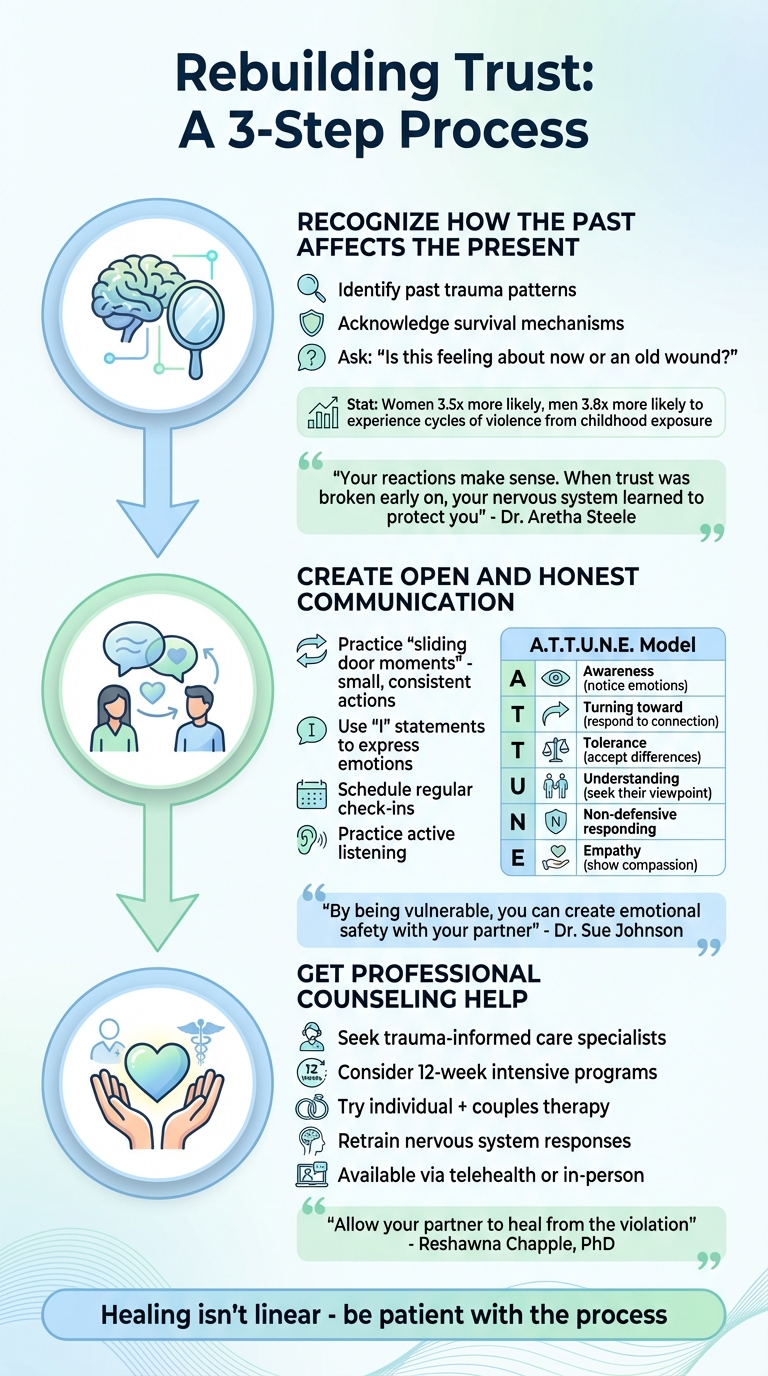
3-Step Process to Rebuild Trust in Marriage After Childhood Trauma
Rebuilding trust in a marriage after childhood abuse involves creating healthier patterns that respect both partners’ needs while acknowledging the impact of past trauma. Understanding how earlier experiences shape current behaviors lays the groundwork for rebuilding trust.
Recognizing How the Past Affects the Present
The first step is identifying what happened and acknowledging how it continues to influence the relationship. Dr. Aretha Steele from Mindful Healing Counseling explains:
"Your reactions make sense. When trust was broken early on, your nervous system learned to protect you by staying guarded" [1].
This isn’t about assigning blame. It’s about understanding that survival mechanisms developed during unsafe childhoods can still affect present-day reactions [1].
Reframing past triggers within the context of current realities sharpens communication. In moments of mistrust, it helps to pause and ask, "Is this feeling tied to what’s happening now, or is it rooted in an old wound?" [1] [4]. For instance, if one partner becomes distant because the other forgot to send a text, the real trigger might be a lingering belief from childhood that "people’s actions don’t match their words" [6]. As John Kane from Growth and Change Counseling points out, reshaping self-perception is essential for restoring intimacy:
"What you believe about yourself defines and shapes all of your relationships!" [5].
Research highlights that individuals exposed to violence in childhood are 3.5 times (for women) or 3.8 times (for men) more likely to experience cycles of violence in adulthood [6]. Recognizing these patterns early helps couples break the cycle before it causes further harm.
Once the influence of the past is acknowledged, building trust requires clear and honest communication.
Creating Open and Honest Communication
Trust is rebuilt through small, consistent actions. Dr. John Gottman refers to these as "sliding door moments" – everyday opportunities to demonstrate care, understanding, and reliability [14]. It’s not about grand gestures but rather the small acts, like sharing a concern and responding with empathy, that make a lasting impact.
Start with small steps toward vulnerability. Use "I" statements (e.g., "I feel unheard when you’re on your phone") to express emotions without triggering defensiveness [14] [2].
Scheduling regular check-ins can create a safe space for honest dialogue, ensuring neither partner feels ambushed [14]. During these sessions, practice active listening: one partner speaks without interruption, and the other reflects back what was heard to confirm understanding [14] [2]. Dr. Sue Johnson, author of Hold Me Tight, emphasizes the importance of vulnerability:
"By being vulnerable, you can create a level of emotional safety with your partner. It’s the primary way to strengthen a marital bond and keep love alive" [4].
A helpful framework for fostering this connection is the A.T.T.U.N.E. model from the Gottman method:
| Element | What It Means |
|---|---|
| Awareness | Noticing your partner’s emotions |
| Turning toward | Responding to bids for connection |
| Tolerance | Accepting differing perspectives |
| Understanding | Genuinely seeking to understand your partner’s viewpoint |
| Non-defensive responding | Listening and responding without attacking or withdrawing |
| Empathy | Expressing compassion for your partner’s feelings |
After conflicts, recovery conversations – taking a break to cool down before revisiting the issue calmly – help restore emotional safety and prevent resentment [4].
Getting Professional Counseling Help
Professional counseling offers the structure and expertise needed to address complex trauma while rebuilding the relationship. Therapists can help retrain the nervous system, making emotional closeness feel less threatening [1] [7]. They also guide couples through empathy exercises that promote emotional honesty without blame [9].
Growth and Change Counseling provides specialized support through The Marriage Rescue Institute, a 12-week program designed for couples in crisis. This intensive coaching process addresses root issues like trauma and attachment patterns, with services available in Campbell, CA; San Jose, CA; Los Angeles, CA; Roseville, CA; and via telehealth across California [5].
When seeking professional help, look for therapists who specialize in trauma-informed care or attachment-based approaches, as these methods are particularly effective for healing trust and relationship wounds [1]. Many therapists offer free phone consultations to ensure their approach aligns with a couple’s needs [8]. Individual therapy alongside couples counseling can also help each partner process personal wounds separately [6].
Reshawna Chapple, PhD, LCSW, a therapist with Talkspace, stresses the importance of patience in the healing process:
"One of the most important steps to healing a relationship with broken trust is the violator’s ability to apologize, show remorse, and patiently allow their partner to heal from the violation" [15].
Whether the challenges stem from past trauma or recent hurts, patience is vital for rebuilding trust and strengthening the bond.
sbb-itb-596b85d
How Growth and Change Counseling Helps Couples
When childhood abuse disrupts the foundation of marital trust, specialized trauma-informed support can pave the way for genuine healing. Growth and Change Counseling focuses on helping couples by combining strategies for open communication with a deep understanding of past emotional triggers. Their therapists take a unified, results-focused approach to emotional and relational well-being, offering consistent care tailored to each couple’s needs. This method doesn’t just address trauma – it provides clear, actionable steps to rebuild trust and strengthen the relationship.
The Marriage Rescue Institute: A 12-Week Path to Healing
The Marriage Rescue Institute offers an intensive 12-week program specifically designed for couples navigating significant challenges. Founder John Kane, LMFT, describes the program’s mission:
"The Marriage Rescue Institute, our 12 week marriage program is in the habit of putting marriages in dire circumstances back together!" – John Kane, LMFT
This program dives deep into the root causes of relational struggles, often rooted in trauma, and helps couples reshape their dynamics. A key focus is building what the practice refers to as "relational intelligence", which helps partners understand how their internal beliefs and thought patterns – often shaped by past trauma – affect their current relationship. Couples are also assigned relational homework between sessions to practice and reinforce new skills in real-life situations. Therapist Arione Capolupo, LMFT, emphasizes the program’s efficiency:
"Our goal is to get you in and out as quickly as reasonably can be done and do it in a way that hopefully you will never need to come back!" – Arione Capolupo, LMFT
In addition to the marriage program, individual trauma therapy is available to further support each partner’s healing journey.
Trauma Therapy for Individuals and Couples
Growth and Change Counseling provides evidence-based trauma therapies like EMDR, Somatic Therapy, and CBT to help individuals process deep-seated wounds and rebuild intimacy. April Silva, LMFT, a trauma specialist, works closely with clients who have experienced childhood abuse. She explains her approach:
"In cases of PTSD, I will help you uncover the underlying defenses that protected you through a traumatic experience but now are interfering with your ability to move forward in intimacy." – April Silva, LMFT
This comprehensive approach addresses both individual trauma and relationship challenges. The practice also incorporates principles from Emotionally Focused Therapy, which supports couples in fostering deeper intimacy and a shared sense of purpose.
Services Available Through Telehealth and Local Offices
Growth and Change Counseling offers its services in Campbell, San Jose, Los Angeles, and Roseville, CA, as well as statewide through telehealth. Individual sessions cost $200 for LMFTs and $150 for AMFTs, with sliding-scale options starting at $100. Couples can also take advantage of a free initial consultation. For many, telehealth provides a safe and private space to tackle sensitive issues like childhood trauma, allowing couples to begin their healing journey from the comfort of their own home. This accessibility reinforces the importance of specialized care in helping partners move forward together.
Conclusion: Moving Forward Together
Key Steps to Rebuilding Trust
Rebuilding trust starts with recognizing how childhood trauma can influence present behaviors. From there, open communication becomes essential. Using "I" statements and practicing active listening can create space for vulnerability in everyday interactions. Professional support is also crucial, as it helps address deep-seated issues rather than just surface-level symptoms. As Rebecca Williams, LMFT, puts it:
"Trust is so much more than the belief that your partner won’t cheat on you. It is the sense that your partner has your back, that they value your interests and comfort as much as their own" [8].
Small, consistent actions – like daily rituals and setting clear boundaries – help reinforce trust over time. Think of boundaries as "doors with locks" rather than unyielding walls; they allow safe people in while keeping harmful patterns out. Trust, as the foundation of marital stability, requires ongoing commitment and effort. These consistent practices enable couples to weather challenges and build a stronger, more resilient relationship.
Committing to the Healing Journey
Healing and rebuilding trust demand long-term dedication. It’s important to remember that healing isn’t a straight path – it’s a process that can take months or even years. This commitment not only strengthens the relationship but also supports individual emotional growth. Dr. Aretha Steele from Mindful Healing Counseling offers this reminder:
"Healing isn’t linear. Speak to yourself with kindness – especially when it feels hardest" [1].
Staying committed means showing up even during setbacks and celebrating small wins along the way. The nervous system needs time to relearn that closeness is safe. Both partners contribute to creating this sense of safety through consistent, reliable actions. By embracing patience and persistence, couples can break cycles of trauma and build a relationship rooted in trust and mutual understanding.
Common Questions About Healing with Growth and Change Counseling
How can couples work through trust issues caused by childhood abuse?
Trust issues stemming from childhood abuse can create significant challenges in a marriage, but with compassion, patience, and the right resources, these difficulties can be worked through. Recognizing the signs of trust struggles is an important first step. These signs might include a fear of being vulnerable, hesitation to share feelings, or persistent doubt and suspicion. Often, these behaviors are tied to earlier experiences of betrayal or neglect.
Healing from these trust barriers involves both self-reflection and emotional development. Therapy can play a crucial role in helping individuals process past trauma and understand how it affects their ability to trust and connect with others. For couples, counseling – like the services offered by Growth and Change Counseling – provides a supportive environment to rebuild trust, enhance communication, and create a sense of emotional security. With dedication, effort, and professional guidance, couples can navigate these challenges and build a stronger, more trusting bond.
How does childhood abuse affect trust in marriage through attachment styles?
Attachment styles, shaped by our early life experiences, play a major role in trust dynamics within a marriage – especially for individuals who have faced childhood abuse. Experiences like neglect, betrayal, or trauma during formative years can lead to insecure attachment patterns, such as anxious, avoidant, or disorganized styles. These patterns often make it harder to trust others, open up emotionally, or feel secure in relationships.
Take disorganized attachment, for instance. This style, often tied to trauma, can result in conflicting behaviors – craving closeness while simultaneously fearing vulnerability. Such inner conflict can create barriers to trust and emotional intimacy in a marriage. Recognizing your attachment style and working through these past wounds is a crucial step toward rebuilding trust and nurturing a secure, loving relationship. Couples counseling can offer a safe space to tackle these challenges together.
How can counseling help couples rebuild trust when childhood trauma is involved?
Counseling offers couples a supportive space to address trust issues that stem from childhood trauma. A knowledgeable therapist can guide individuals in uncovering how early experiences, like neglect or abuse, influence their ability to trust and build connections in their marriage. By tackling unresolved trauma, couples gain insight into their emotional triggers and learn healthier ways to engage with one another.
Through therapy, couples focus on enhancing communication, rebuilding emotional closeness, and establishing trust using tailored exercises and strategies. This often involves setting clear boundaries, addressing insecurities, and nurturing a sense of safety and connection. With the guidance of a professional, couples can work through emotional pain, deepen their bond, and create a relationship that feels more secure and rewarding.
Related Blog Posts
- Relationship Trauma: Root Causes and Solutions
- Trauma and Shame: How Couples Rebuild Trust
- How Betrayal Trauma Impacts Partners of Addicts
- Top Strategies for Rebuilding Trust in Marriage
