When your neurodiverse child faces challenges at school, building a strong partnership between parents, schools, and therapists is crucial. This collaboration ensures consistent support across environments, helping your child thrive both academically and emotionally. Here’s how to make it work:
- Set up clear communication: Use Release of Information (ROI) forms, group emails, and shared notebooks to keep everyone aligned. Regular updates prevent misunderstandings.
- Understand your child’s needs: Compare behaviors at home and school, interview your child for insights, and review evaluation reports before meetings to advocate effectively.
- Participate in IEP/504 plans: Share external evaluations, suggest practical accommodations, and ensure goals are specific and measurable.
- Schedule regular check-ins: Frequent communication keeps the team aligned and progress on track.
- Focus on strengths: Highlight your child’s abilities to create a positive foundation for strategies and discussions.
- Promote neurodiversity-affirming practices: Advocate for tools and accommodations that celebrate your child’s individuality rather than forcing conformity.
- Seek outside support when needed: Involve specialists for deeper evaluations or additional help.
- Handle conflicts constructively: Use clear communication and focus on your child’s needs to resolve disagreements.
- Celebrate progress: Recognize achievements to boost your child’s confidence and strengthen team morale.
Start small – send an email, prepare for the next meeting, or jot down your child’s strengths. These steps can create a unified team working toward your child’s success.
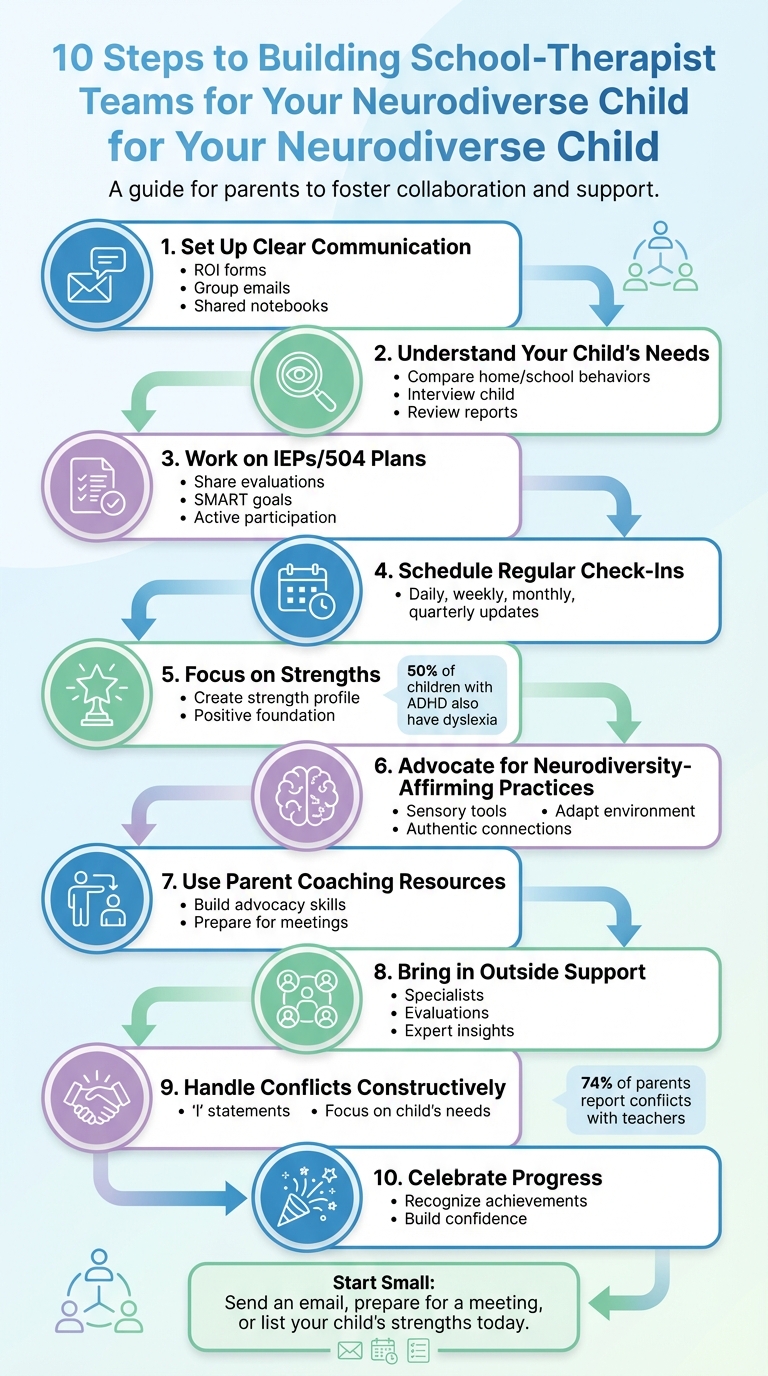
10 Steps to Build Effective School-Therapist Teams for Neurodiverse Children
Advocating for Neurodivergent Kids at School
Why Collaboration Matters
Collaboration transforms isolated efforts into meaningful, everyday progress. When parents, schools, and therapists work together, neurodiverse children receive benefits that no single group could provide on its own. Research highlights how shared responsibility for a child’s success creates a stronger, more impactful support system [7].
By working as a team, therapy becomes more effective because skills are reinforced across different environments [2] [3]. For example, a coping strategy introduced in a therapist’s office gains real-world power when teachers apply it during challenging classroom moments and parents reinforce it at home. Without this coordination, progress often remains confined to the therapy room.
Academic success and emotional well-being are deeply connected. As Harold S. Koplewicz, MD, President of the Child Mind Institute, emphasizes:
Academic achievement is intimately tied to emotional well-being [8].
This connection is especially important when you consider that about 50% of children with ADHD also have dyslexia, and half of those with learning disorders face chronic depression as adults [8]. A coordinated team monitoring both academic progress and emotional health can help ensure children feel supported, safe, and ready to learn.
When therapists and teachers share insights, they gain a fuller understanding of a child’s behavior. Teachers who know the clinical reasons behind specific behaviors or accommodations can respond with thoughtful support instead of frustration [6]. This shared understanding fosters trust and respect among everyone involved, paving the way for effective interventions that help children reach their potential.
With these principles in mind, let’s look at how to establish clear and open communication with your team.
1. Set Up Clear Communication Channels
Good communication is the backbone of effective coordination between your child’s school and therapy team.
Start by signing Release of Information (ROI) forms at both the school and the therapy office. These forms legally allow the sharing of records and treatment plans, ensuring that everyone involved can work together to support your child’s progress.
Once the paperwork is sorted, create a group email thread that includes key staff members – teachers, the school psychologist, speech therapists, and any external clinicians. This way, everyone stays on the same page without you having to repeat yourself. In your first email, introduce each team member, share a quick overview of your child’s strengths and challenges, and ask that all future updates include you as well.
For quick, daily updates, consider using a shared notebook that travels with your child between school and therapy sessions. Teachers and therapists can jot down notes about what worked, what didn’t, or any notable progress. Susan Schwartz, MAEd, a learning and educational therapist at the Child Mind Institute, emphasizes the importance of keeping teachers informed:
Keeping a teacher in the dark about an issue you already know about only leads to surprises and frustration for the teacher (and for your child) [6].
After verbal discussions, follow up with a short email summarizing the key points. As the Exceptional Children’s Assistance Center advises:
If a statement is not written down, it ‘was not said’ [13].
This approach creates a clear record of agreements, accommodations, and interventions, protecting your child’s rights.
Finally, designate a primary contact at the school, such as the school psychologist or a special education teacher, to streamline communication. This person can help coordinate updates and serve as your go-to for questions or concerns. Schedule regular check-ins – whether through weekly emails or monthly calls – to address potential issues before they escalate.
2. Understand Your Child’s Needs and Goals
To build an effective support team for your child, start by understanding their unique needs. As Rachel Fish, Assistant Professor of Special Education at New York University, emphasizes:
[Parents] really are the experts on their child. They see other facets of their child that people at school don’t see. They see their child succeeding at other things at home. They see the things that are hard at home.[14]
Your firsthand knowledge is invaluable, but turning those observations into actionable insights is key. Begin by comparing your child’s behavior at home and school. Neurodiverse children often mask their struggles at school, only to express them more openly at home[14][16]. For example, if your child frequently has meltdowns after reading but not during math, this pattern can reveal challenges that might go unnoticed in the classroom.
Take time to interview your child before team meetings. Simple questions like, "What feels easy during the day?" or "What subject feels hardest?" can uncover struggles they might not verbalize otherwise[8]. Use this information to create a short list of their strengths, stress triggers, and strategies that help them manage frustration[4]. Sharing this with teachers and therapists ensures they have a more complete understanding of your child.
Request evaluation reports ahead of meetings so you can prepare thoughtful questions and focus on accommodations that will truly help[14][17]. Maggie Moroff, Senior Special Education Policy Coordinator at Advocates For Children, points out that these reports are often written for professionals, not parents[14]. Taking the time to review them beforehand equips you to better advocate for your child.
Once you have a clear picture of your child’s needs, share your insights with the school and therapy teams. When everyone understands the reasoning behind specific accommodations, it’s easier to build consensus. As Matthew Cruger, PhD, a neuropsychologist at the Child Mind Institute, explains:
I think a lot of resistance from schools comes from not necessarily knowing why something has been suggested. Keeping everyone on the same page about a student’s strengths and weaknesses will make it easier to agree on how to help them.[6]
3. Work Together on IEPs or 504 Plans
Once you’ve established clear communication and a solid understanding of your child’s needs, your active participation in IEP (Individualized Education Program) or 504 Plan meetings becomes essential. These meetings aren’t just formalities – they’re opportunities to collaborate as an equal partner. Federal law ensures that parents are full participants in decisions about their child’s placement and services[18][15]. Your involvement can be the difference between a plan that truly supports your child and one that falls short.
Bringing in insights from your child’s external therapist can add significant value to the process. Sharing evaluation results from private therapists or specialists during these meetings provides educators with a clinical perspective they might not otherwise have. As Dr. Matthew Cruger, a neuropsychologist at the Child Mind Institute, points out:
The school might not be able to do everything the specialist recommends, but they generally want to have that information. I think a lot of resistance from schools comes from not necessarily knowing why something has been suggested.[6]
This collaboration between external evaluations and classroom input helps create a more comprehensive plan tailored to your child’s unique needs.
Preparation is key to making these meetings productive. Before the meeting, request copies of all school reports and evaluations, preferably several days in advance. If possible, ask for draft goals or accommodation suggestions ahead of time. Come prepared with a list of strategies that work at home – such as sensory breaks, specific seating arrangements, or digital tools – that could be formalized into accommodations[14][9]. Once your child is deemed eligible for special education, the school is required to develop the IEP within 30 calendar days[9]. Being prepared helps you take an active, informed role in shaping your child’s support plan.
When working on the IEP, focus on creating SMART goals – goals that are Specific, Measurable, Achievable, Relevant, and Time-bound[9][19]. A strong IEP should clearly outline your child’s current performance levels, measurable annual goals, the services and accommodations they’ll receive, and how progress will be tracked[9][19]. While teachers and school staff may change from year to year, you remain the constant advocate for your child’s development[15]. To stay organized, keep an IEP binder with everything – evaluations, past plans, and school communications[19][20]. By working together to develop clear, measurable goals, you help create a unified approach that supports your child’s growth and success.
4. Schedule Regular Check-Ins with the Team
Once you’ve established a collaborative framework, regular check-ins are key to keeping things on track. These meetings help maintain momentum, ensure alignment, and address small concerns before they grow into larger issues. The frequency of these check-ins should be tailored to your child’s needs and the level of support required. For example, you might schedule daily updates to monitor behavior, send weekly group emails for general updates, hold monthly calls to review broader goals, and share quarterly progress reports based on data and observations [11][12][21][6].
At the beginning of the school year, meet with your team to decide on the best communication methods and set a clear check-in schedule [5][12]. A group email thread that includes school staff and external therapists ensures that everyone stays informed and receives the same updates simultaneously [3]. If your child works with outside providers, consider using a therapy notebook that travels between home, school, and the clinic. This notebook serves as a shared resource, helping to create a seamless flow of information and ensuring consistency across all settings [3][12]. This approach strengthens the unified strategy you’ve worked hard to establish.
It’s important to know that you have the legal right to request a special IEP team meeting at any time if you feel the current plan isn’t effective or if services aren’t being delivered as promised [21][12]. To make the most of these meetings, ask for reports a few days in advance so you can prepare specific questions [22]. You can also include your child in the process by asking them what they find easy or challenging. Their perspective can add valuable insights during check-ins [6].
During these meetings, focus on three key areas: tracking progress, aligning strategies, and maintaining consistency between home and school. Discuss classroom accommodations, your observations at home, and updates from therapists to ensure everyone is working toward the same goals [3][5][14]. If challenges arise, describe the issue with specific examples, set a realistic goal, and agree on a timeline to test solutions before deciding on the next steps [5]. After each check-in, send a follow-up email summarizing the agreed actions. This creates a clear record and keeps everyone accountable [12][14].
5. Focus on Your Child’s Strengths
When attending meetings about your child, start by emphasizing their strengths rather than jumping straight into the challenges. This approach creates a more balanced and constructive conversation. By sharing your unique perspective, you might uncover strengths that educators haven’t noticed – like creativity expressed at home, perseverance in hobbies, or a natural kindness shown to siblings.
Before the meeting, consider preparing a one-page strength profile. This profile can highlight your child’s strengths, interests, and strategies that have worked well in the past. If your child is older, involve them in crafting or even presenting the profile, which can help them develop self-advocacy skills [5][9]. To organize the strengths, you might use frameworks like the 24 character strengths, which include traits such as creativity, persistence, kindness, and zest [23]. Presenting these strengths concisely during meetings ensures they are part of the conversation.
It’s important to note that focusing on strengths doesn’t mean ignoring challenges. Dr. Lea Waters, a psychologist, explains:
Strength-based parenting is not about ignoring or unrealistically turning a blind eye to the downsides; it’s about where you place your attention first [24].
By identifying and prioritizing what your child excels at, you provide the team with a foundation for creating strategies that harness those strengths to address areas of difficulty. For instance, Grace, a child with ADHD, tapped into her creativity to select exciting project topics. This strategy not only helped her manage ADHD-related challenges but also made school more enjoyable [24].
During meetings, ask questions that focus on successes, such as: "What is my child doing well right now?" or "What does a good day look like for them?" [23]. Dr. Matthew Cruger, a neuropsychologist at the Child Mind Institute, emphasizes the importance of this approach:
Keeping everyone on the same page about a student’s strengths and weaknesses will make it easier to agree on how to help them. It also lays the foundation for a relationship based on mutual trust and respect [6].
Highlighting strengths not only builds your child’s confidence but also shapes their identity in a positive way. Research indicates that emphasizing a child’s strengths and interests can reduce struggles with mood, social interactions, and behavior, particularly in children with autism and ADHD [24]. By focusing on strengths, you set the tone for productive, team-oriented discussions.
sbb-itb-596b85d
6. Advocate for Neurodiversity-Affirming Practices
Neurodiversity-affirming care takes a refreshing perspective on conditions like ADHD, autism, and dyslexia. Rather than treating these as problems to "fix", it recognizes them as natural variations in how human brains work. This approach prioritizes embracing a child’s unique strengths and providing the right support, instead of trying to make them fit into a neurotypical mold. Dr. Megan Anna Neff, Founder of Neurodivergent Insights, puts it perfectly:
The neurodiversity paradigm is an identity model that views neurodivergent conditions as an integral part of a person that is not going to be cured or changed. We’ve learned that when you try to cure neurodivergence you hurt the person’s mental health and self-identity. [25]
Using these principles, parents and caregivers can shape how they communicate and advocate for their child in school and therapy settings.
When advocating, it’s important to use clear, specific language to promote practices that affirm neurodiversity. For example, you can request sensory-friendly environments that include tools like noise-canceling headphones, fidget aids, or adjustable lighting. For executive functioning challenges, ask for supports such as visual schedules, checklists, or timers. Instead of pushing for traditional social skills training that often enforces rigid behavioral norms, advocate for social scaffolding through mentoring programs or small peer groups that nurture authentic connections.
Another practical step is creating an "About Me" letter for teachers and therapists. This document can highlight your child’s strengths, stress triggers, and strategies that work well for them. During IEP or 504 meetings, focus on goals that encourage interdependence and leverage your child’s interests, rather than just compliance. If verbal communication is difficult for your child, suggest alternative ways for them to express themselves, like writing, art, or music. Also, request accommodations like movement breaks or adaptive seating to help your child regulate their energy without disrupting others.
The goal is to adapt the environment and provide tools that help your child thrive, not erase their neurodivergent traits. Matthew D. Lerner from Stony Brook University‘s Department of Psychology emphasizes this point:
focus on supporting the strengths – including the social strengths – of autistic individuals, and creating environments that foster them [26].
This kind of affirming approach reduces the need for masking and helps prevent burnout, allowing children to embrace their true selves.
7. Use Parent Coaching Resources
Navigating the school and therapy systems can feel overwhelming, but parent coaching provides practical tools and personalized support to help you manage these challenges effectively.
Parent coaching builds on the collaboration with your child’s support team, helping you sharpen your advocacy skills and better understand complex systems. As Anxiety In The Classroom explains:
When it’s your own child, it is virtually impossible to separate emotion from reason in the heat of the moment [28].
A coach can guide you in preparing for IEP or 504 meetings by helping you set clear goals, draft written requests for services or evaluations, and identify the right questions to ask. They also assist in understanding regulations, case law, and local school policies, which can be critical for fostering positive collaborations with schools [28].
When choosing a coach, look for someone experienced in your child’s specific condition – whether it’s ADHD, autism, anxiety, or a learning disability. Verify their credentials through trusted organizations like the Parent Coaching Institute [27]. For instance, the Hallowell Todaro ADHD & Behavioral Health Center offers a Parent Coaching Package that includes six hours of tailored coaching, as well as a more extensive Parent Survival Basket with ten hours of coaching and educational presentations [27].
Beyond meeting preparation, coaches can help you maintain organized records of communications and offer stress-management strategies for the ups and downs of your child’s educational journey. This kind of support can be especially helpful during disputes, ensuring you stay focused on your child’s needs while responding constructively. These benefits align with the unified approach discussed earlier, emphasizing collaboration.
Parent coaching empowers you to embrace your role as the central figure in your child’s support network. By building your confidence and addressing emotional challenges, coaching helps you form productive partnerships with schools and therapists. Growth and Change Counseling, for example, offers parent coaching services across California – both in person and via telehealth – to support families wherever they are.
8. Bring in Outside Support Services When Needed
Sometimes, the support your child receives from school and therapists just isn’t enough. If you notice your child falling behind academically, struggling with behavior or emotions that disrupt learning, or exhibiting major changes in mood or personality, it might be time to consider bringing in outside specialists for additional help [8][11].
Challenges like trouble making friends, difficulty reading social cues, or struggling to stay organized can signal the need for more targeted evaluations [4]. For instance, if a school evaluation doesn’t address specific concerns – like neuropsychological functioning – an outside assessment can help fill those gaps [6]. If you’re not satisfied with the school’s evaluation, seeking external expertise can provide deeper insights.
Once you decide to involve outside specialists, it’s important to keep communication clear and organized. Make sure ROI (Release of Information) forms include all the professionals working with your child [3]. Use tools like a shared email thread to keep everyone on the same page about strategies and progress [3]. Neuropsychologist Matthew Cruger, PhD, emphasizes that schools often resist recommendations simply because they don’t fully understand them [6]. Sharing private evaluation reports with the school can clarify the reasoning behind specific recommendations, making collaboration smoother.
Under the Individuals with Disabilities Education Act (IDEA), you have the legal right to include external providers – such as private psychologists, occupational therapists, or speech therapists – in IEP or 504 meetings [10][9]. These experts can offer valuable insights to school staff about your child’s treatment progress and how accommodations at school can support their needs [28]. To make the process more effective, submit written recommendations from outside specialists before meetings so the team has time to review them [28].
When everyone works together, external specialists can enhance the efforts of both the school and therapy teams. Common specialists include neuropsychologists, speech and language therapists, occupational therapists, reading specialists, and educational advocates [6][10]. For example, Growth and Change Counseling provides family therapy, parent coaching, and treatments for issues like anxiety, depression, and neurodiverse relationships. These services, available across California through in-person or telehealth sessions, can complement the support your child is already receiving at school.
9. Handle Conflicts Constructively
Disagreements between parents, teachers, and therapists are more common than you might think. In fact, 74% of parents report conflicts with teachers, and 60% have faced issues with school administrators. Despite this, 72% believe they can work through these challenges successfully [30].
When conflicts arise, it’s important to focus on the issue at hand. Using "I" statements – like "I feel frustrated because this program isn’t working" – can help express concerns without assigning blame. Pair this with active listening to ensure all parties understand each other’s perspectives [29][30].
The key is to consistently center the discussion on the child’s needs. As M.C. from Massachusetts puts it:
Always bring the conversation back to the child’s needs [30].
You can also ask thoughtful, clarifying questions to keep the conversation productive. For example: "Can you explain how this program specifically benefits my child?" or "What steps can we take together to help my child succeed?" [1][30]. A collaborative approach like this helps shift the focus from personal disagreements to finding solutions that work for the child.
If discussions become heated, don’t hesitate to pause or reschedule the meeting. Afterward, document any agreements in writing, such as through email, to ensure clarity [1][29]. If you’re unable to resolve the issue directly with the teacher, follow the appropriate chain of command – moving from the teacher to the principal, and then to district administrators if necessary. In some cases, you may need to request mediation through your school district or the State Department of Education [2][29].
Kirsten from Oregon offers this valuable advice:
Act as a partner in, not a consumer of, your child’s education [30].
10. Celebrate Progress and Milestones
Recognizing even the smallest achievements can create a ripple effect that benefits everyone involved in your child’s support system. Celebrating progress isn’t just about acknowledging growth – it’s about building trust and strengthening the connection between home, school, and therapy. Here’s how you can help create a positive environment that reinforces success across different settings.
For neurodiverse children, the constant stream of corrections they encounter daily can take a toll. As Atlas Therapy explains:
Children with ADHD hear a lot of corrections – ‘stop,’ ‘no,’ ‘don’t.’ Over time, this damages self-esteem and motivation.
Shifting the focus from constant corrections to celebrating small victories can make a huge difference, creating a positive feedback loop that encourages growth and confidence [32].
Using tools like Daily Behavior Report Cards or a shared therapy notebook can ensure that progress is recognized and celebrated in real time. For example, parents and teachers can identify two or three specific behaviors to target. When a child meets their daily goals, the teacher sends a report home, allowing parents to immediately praise and reward their child [11]. For older students, a Check-In and Check-Out system can be effective. This involves a staff member meeting with the child at the end of each day to review successes and discuss what contributed to those achievements [11].
A shared therapy notebook or group email can also help the entire support team stay connected. Todd Root, President of Strategy & Partnerships at BEST, highlights the importance of this collaboration:
No occupational therapy milestone matters if it doesn’t show up at circle time or lunch… When school and therapy teams work together, kids don’t have to compartmentalize their growth. They get to live it out loud, across environments [31].
By celebrating as a team, you ensure that your child experiences consistent recognition and support across all areas of their life.
Beth Provis, a doctoral student in school psychology at the University of Iowa, underscores the value of proactive communication:
frequent communication before any indication of challenging behavior is ideal, as it lays a foundation of support so families know they can rely on the school to report both accomplishments and concerns about the child [33].
Sharing successes not only uplifts your child but also strengthens relationships within the support team, making it easier to navigate challenges together.
How Growth and Change Counseling Can Help
Building a strong connection between home, school, and therapy is essential for effective support, and that’s exactly what Growth and Change Counseling provides. Their parent coaching and family therapy services are tailored for families navigating challenges like ASD, ADHD, ODD, and Asperger’s.
What sets their approach apart is the focus on empowering parents. Research shows that when parents take an active role, the results are often more lasting and impactful. As John Mark Kane, LMFT, puts it:
You have a significant influence in your child’s life [34].
This perspective highlights the importance of parents as the bridge between home and school, making them an integral part of any successful school-therapist collaboration.
Growth and Change Counseling’s team includes therapists with specialized expertise in neurodiversity, including training in Applied Behavioral Analysis (ABA). Their family therapy services address a wide range of challenges, such as behavioral issues, emotional regulation, defiance, and school refusal. These are often complex problems that require close cooperation between home, school, and therapy teams. Their services are designed to enhance communication and ensure everyone involved is working together to support your child’s development.
For added convenience, they offer telehealth options, allowing families anywhere in California to participate. This flexibility is particularly helpful for coordinating with school teams or attending IEP meetings without the added stress of travel. It’s a time-saving solution that keeps expert guidance accessible and consistent, no matter where you are.
For those who prefer in-person sessions, Growth and Change Counseling has locations in Campbell, San Jose, Los Angeles, and Roseville. To find out how their parent coaching and family therapy services can strengthen your school-therapist partnership, visit Growth and Change Counseling or schedule a free consultation to explore your family’s needs.
Conclusion
Creating a strong partnership between schools and therapists is all about clear communication, mutual respect, and a shared commitment to advocacy. As Matthew Cruger, PhD, Neuropsychologist at the Child Mind Institute, puts it:
The best plans are the ones that benefit from everyone’s participation – the entire education team, including the child – because when everyone is committed and working towards success, suddenly it becomes a lot more attainable. [6]
Your role as a parent is vital. Under IDEA, you have legal rights that empower you to be an active and equal member of your child’s educational team. By documenting your interactions, keeping communication lines open, and addressing concerns promptly, you can help ensure your child gets the support they need to succeed.
Feeling overwhelmed? Start small. Send a group email to key professionals, complete necessary paperwork, or jot down your questions before the next meeting. Each step you take builds a stronger team and helps set your child up for success.
Partnering for Your Child's Success with Growth and Change Counseling
What are the best ways for parents to communicate effectively with schools and therapists?
Parents can establish effective communication with schools and therapists by being organized, clear, and consistent. A good first step is to complete any authorization forms that allow the school and therapist to share information. This ensures that everyone has access to the insights and updates needed to support your child.
Be open about your child’s needs by sharing specific concerns, goals, and observations. This helps create a team-oriented approach. Tools like therapy notebooks, group emails, or written updates can make it easier to keep everyone on the same page. Regularly sharing updates about progress or challenges at home can also strengthen collaboration.
Before meetings, take a moment to jot down questions or topics you want to address. This small preparation step ensures that discussions are productive and that no important concerns are overlooked. Building a positive and respectful partnership with both the school and therapist can make a big difference in supporting your child’s development.
What should be included in an IEP or 504 Plan for my child?
An Individualized Education Program (IEP) or a 504 Plan is designed to address your child’s unique educational needs and provide the right support for their learning journey.
For an IEP, the focus is on creating measurable goals and providing services and supports tailored to your child’s strengths and challenges. It should clearly outline accommodations, modifications, and specific educational interventions. Additionally, the plan should specify who is responsible for implementing these supports and detail how progress will be tracked. Regular updates and reviews ensure the plan adapts as your child’s needs change.
A 504 Plan, on the other hand, centers around accommodations that help your child access the general education curriculum. This might include tools like assistive technology, extended time on tests, or seating arrangements that suit their learning style. Like an IEP, a 504 Plan requires collaboration with educators and regular reviews to ensure it stays effective and aligned with your child’s needs.
Both plans thrive on teamwork, bringing together parents, educators, and therapists to create a supportive environment that helps your child succeed.
How can parents resolve conflicts with schools or therapists effectively?
When disagreements arise with schools or therapists, the solution often lies in open communication and teamwork. Start by equipping yourself with a thorough understanding of your child’s needs, their rights, and any relevant laws. This knowledge not only strengthens your ability to advocate effectively but also helps minimize misunderstandings. Before meetings, take time to review important documents, clearly outline your concerns, and establish realistic expectations.
If disagreements continue, bringing in professionals like therapists or advocates can provide valuable support and perspective. Structured methods, such as mediation or facilitated meetings, can also be effective in resolving conflicts in a constructive way. The goal is to build trust and mutual respect with the team, ensuring everyone remains focused on your child’s best interests.
Involving your child’s therapist in discussions and working together toward shared goals can help prevent minor issues from turning into major disputes. By keeping communication open, respectful, and focused on finding common ground, you can create a collaborative partnership that puts your child’s well-being first.
Related Blog Posts
- Trauma and Advocacy: Supporting Neurodiverse Families
- Parenting Stress: Solutions for Neurodiverse Families
- Therapy vs. Coaching for Neurodiverse Kids in Recovery
- ADHD Parenting Tips for Neurodiverse Families
