Natural Language Processing (NLP) is transforming telehealth therapy by analyzing language, tone, and communication patterns. It supports therapists by providing deeper insights into client emotions, interactions, and progress. Here’s a quick overview of how NLP is making therapy sessions more effective:
- Emotion Analysis: Identifies emotional states and tracks sentiment shifts beyond spoken words.
- Communication Insights: Maps conversational patterns in couples or family therapy, spotting issues like imbalance or avoidance.
- Session Summaries: Automates note-taking and organizes insights for clinicians.
- Risk Alerts: Flags high-risk language, such as signs of distress, for immediate intervention.
- Progress Tracking: Monitors linguistic changes and communication trends over time.
These tools don’t replace therapists but offer valuable support, saving time and improving care quality.
How NLP Clinical Analysis Works at Growth and Change Counseling
sbb-itb-596b85d
1. Emotion Detection and Sentiment Tracking in Sessions
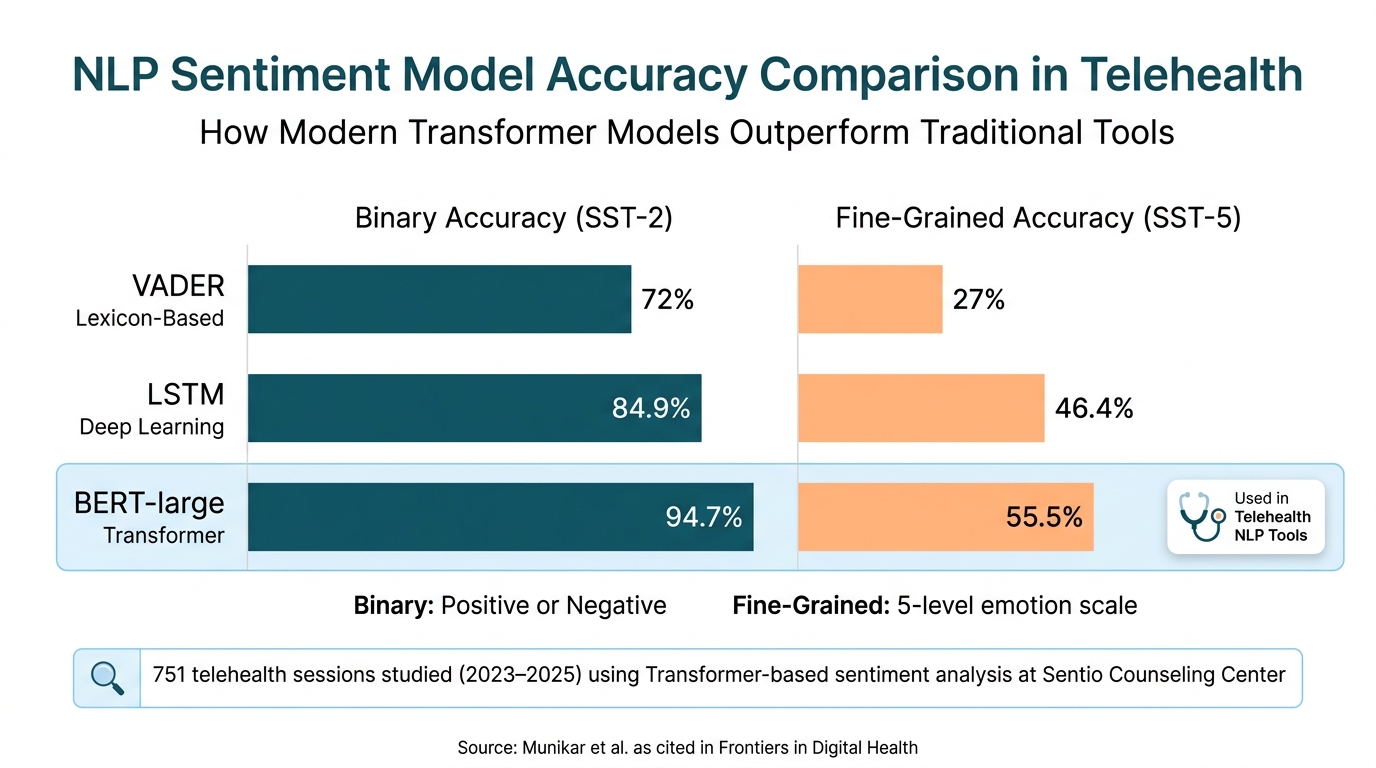
NLP Sentiment Models in Telehealth: Accuracy Comparison
In telehealth sessions, clients might say they’re "fine", but their tone of voice or other cues can tell a different story. This is where NLP tools step in. By analyzing text, vocal prosody (like pitch, tone, and cadence), and even facial expressions, these systems create a "digital phenotype" of a patient’s emotional state. This layered approach goes far beyond just the spoken words, offering a deeper understanding of the client’s feelings [3][5].
Earlier sentiment analysis tools relied on counting positive or negative words, which often led to oversights. For instance, phrases like "not happy" were misinterpreted. Modern transformer models, such as BERT, have changed the game. They process entire sentences, capturing nuances like sarcasm and negation. For example, BERT-large achieves an impressive 94.7% accuracy in binary sentiment tasks compared to just 72% for traditional lexicon-based tools like VADER [4].
| Sentiment Model | Binary Accuracy (SST-2) | Fine-Grained Accuracy (SST-5) |
|---|---|---|
| VADER (Lexicon) | 72% | 27% |
| LSTM (Deep Learning) | 84.9% | 46.4% |
| BERT-large (Transformer) | 94.7% | 55.5% |
| Source: Munikar et al. as cited in Frontiers in Digital Health [4] |
These advancements aren’t just theoretical – they’re making a difference in practice. Between 2023 and 2025, the Sentio Counseling Center studied 751 telehealth sessions using Transformer-based sentiment analysis. The research revealed that patients flagged as "at risk" of dropping out showed distinct sentiment patterns, confirming the reliability of automated sentiment tracking as a tool for assessing client distress [4].
"Direct measurements of sentiment from therapy sessions are appealing since they do not have compliance or completeness issues vs. a separately-administered instrument." – Douglas K. Faust, Sentio University [4]
To maintain privacy, these NLP tools process data locally, ensuring compliance with HIPAA standards – an absolute requirement in clinical environments [4]. It’s important to note that these tools are designed to assist therapists, not replace them. Sentiment data serves as an additional input for clinicians to consider, rather than providing automated conclusions.
2. Communication Pattern Analysis for Couples and Families
Building on emotion detection, NLP takes telehealth counseling to another level by analyzing communication patterns. It doesn’t just focus on what couples say but also examines how and when they say it. Through transcription and turn-level segmentation, NLP creates detailed dialogue maps that track conversations between partners, family members, and clinicians. These maps provide insights that would be nearly impossible to achieve manually, especially across multiple therapy sessions [1][9]. This kind of analysis helps uncover patterns that can directly influence therapeutic success.
One critical pattern NLP can detect is the demand-withdraw cycle. This occurs when one partner seeks emotional connection or change while the other retreats or becomes unresponsive. By identifying emotional cues, defensive reactions, and conversational pauses in real time, NLP pinpoints these dynamics. Research shows that online interventions addressing these cycles have reduced mutual avoidance communication by up to 62% and demand-withdraw behaviors by as much as 65% [10].
NLP also evaluates conversational balance. A 2026 study by OurRitual analyzed 1,285 telehealth sessions involving 160 therapists and nearly 1,200 couples. The findings revealed that therapists spoke 43.8% of the time, while the first partner to speak accounted for 39.8%, and the second partner contributed just 26.2% [9]. These imbalances can signal issues like dominance, disengagement, or stonewalling – often before a therapist notices them during the session.
"The therapist justifiably takes up more speaking time since they’re guiding the conversation, asking questions, and offering reflections." – Efrat Aran, Data Lead, OurRitual [9]
Beyond overall speaking time, NLP can detect specific negative cues like contempt markers – linguistic signs of sarcasm or dismissiveness. Research from Shokouh Navabinejad and Mehdi Rostami at the KMAN Research Institute highlights these markers as strong indicators of divorce risk. On the flip side, emotional validation and balanced turn-taking serve as protective factors [8]. For therapists at practices like Growth and Change Counseling, which offers a 12-week intensive Marriage Rescue Institute program for couples in crisis, this data can provide actionable insights from the very first session.
"Early-session communication deficits captured through natural language processing serve as powerful predictors of premature dropout in couple therapy." – Shokouh Navabinejad, Department of Psychology and Counseling, KMAN Research Institute [1]
This kind of communication analysis works hand-in-hand with other NLP tools that summarize sessions and monitor progress.
3. Session Summaries and Insight Dashboards for Telehealth Clinicians
After each session, NLP tools step in to de-identify sensitive data from transcripts. These tools, paired with an LLM, integrate the client’s treatment plan and clinical prompts to create structured session summaries that adhere to documentation standards. This automated process helps clinicians stay on top of treatment progress without the burden of manual note-taking.
The impact of such tools is clear. In April 2024, Talkspace introduced its "Smart Notes" generative AI tool for mental health providers. Within just one year, 162 full-time and 1,366 contractual providers used Smart Notes on a HIPAA-compliant telehealth platform to generate over 286,000 clinical notes. The tool achieved a 94% weekly usage rate and an impressive 97.7% provider satisfaction rate [11]. A separate analysis revealed that these AI-generated notes had an average text similarity score of 93% compared to the final submitted notes, demonstrating their alignment with clinician expectations [11].
"AI-powered documentation tools, such as Smart Notes, are a feasible and acceptable approach to supporting MHPs… without compromising note quality." – Kaitlin E. McCrudden et al., Researchers, Talkspace [11]
Beyond documentation, session summaries and dashboards add another layer of insight for clinicians. NLP-powered dashboards provide a detailed view of a client’s progress over time, tracking factors like speaking ratios, sentiment changes, avoidance behaviors, and emotional spikes through longitudinal charts [12][14]. By automating progress tracking, clinicians save over two hours each week – valuable time that can be redirected toward client care [12].
One standout feature is automated topic categorization, where the system organizes session content into clinical themes such as symptom changes, treatment goals, or medication concerns [12]. This feature helps solve a common telehealth challenge: the "cold start" issue, where clinicians may struggle to recall details from prior sessions. With a pre-session case summary already sorted by topic, these gaps are filled seamlessly. As one Clinical Director shared:
"The summaries are very accurate and strong. They often line up with what I hear in session, and most of the time I only need to make small edits." – Clinical Director [13]
That said, clinicians remain responsible for reviewing and editing AI-generated notes. For example, Talkspace’s Smart Notes requires at least one manual edit to ensure accuracy and maintain therapist control over the record. It’s also important to note that general-purpose AI tools, like standard ChatGPT, are not HIPAA-compliant and should never be used for clinical documentation.
4. Risk Detection and Clinical Decision Support in Remote Care
NLP plays a key role in remote care by identifying high-risk language in real time, adding another layer to session summaries and progress tracking. It uses a two-step process: first, a keyword filter scans for phrases like "tired of being alive" or "can’t go on." Then, a Transformer-based classifier steps in to evaluate the context and confirm whether there’s an actual risk [16]. This approach not only builds on earlier emotion and communication analyses but also directly supports clinical decision-making.
In October 2022, Cerebral introduced the Crisis Message Detector-1 (CMD-1), a tool designed to flag signs of suicidal ideation, homicidal ideation, and domestic violence within electronic medical chats. Over the course of one month, CMD-1 analyzed 102,471 messages, achieving a sensitivity of 97.5% and a specificity of 97.0%. It also dramatically cut the median response time from 9 hours to just 9 minutes [16].
"CMD-1 reduced response times to crisis chat messages by nearly two orders of magnitude, from over 9 hours on average to 9 minutes (median)." – npj Digital Medicine [16]
NLP doesn’t stop at crisis detection. It also tracks changes in tone, engagement, and content between sessions, flagging any deviations from a client’s usual patterns for supervisors to review [15]. Multimodal NLP takes this further by combining text analysis with speech prosody, detecting inconsistencies between what a client says about their well-being and how they sound [3].
These systems, which keep clinicians in the decision-making loop, ensure that risks are flagged quickly and accurately, making significant strides in crisis detection and response times.
5. Tracking Progress Over Time for Couples and Individuals
NLP provides a way to observe how clients progress over time by analyzing their language patterns across sessions.
One key metric is linguistic distancing – a shift in language from first-person singular (e.g., "I feel") to second- or third-person perspectives (e.g., "you feel" or "they felt") and from present to past or future tense. These subtle shifts often signal improved emotional regulation. A 2025 study in Computational Psychiatry examined 455,379 messages from 3,727 clients on Talkspace using Meta’s LLaMA 3.1 (70B) model. The study found that large language models (LLMs) were far better than traditional word-count tools at predicting changes in depression and anxiety scores (PHQ-8 and GAD-7) over a minimum of six weeks [6].
"LLMs offer a more nuanced and context-sensitive approach to assessing language, significantly enhancing our ability to model the relations between linguistic distance and symptoms." – Mostafa Abdou et al., Computational Psychiatry [6]
For couples, progress hinges on effective communication. NLP tracks communication reciprocity, which reflects how evenly partners engage in dialogue over time. Research from the KMAN Research Institute studied 148 Canadian couples’ early therapy sessions and found that NLP could predict premature dropout with 92% accuracy. Couples who completed therapy showed increasing reciprocity, while those who dropped out experienced a decline [1].
"Communication reciprocity declined over time in dropout couples, whereas it increased in treatment completers." – Shokouh Navabinejad, KMAN Research Institute [1]
Another important measure is topic progression. Successful therapy often transitions from broad relationship issues in early sessions to deeper concerns like trust and betrayal by sessions three to five. If this progression stalls, it may signal the need for a therapeutic adjustment [9]. Platforms such as Growth and Change Counseling use these insights to provide clinicians with a data-driven view of their clients’ progress.
Ethical and Privacy Considerations
NLP tools used in telehealth manage sensitive therapy data, which comes with strict legal and ethical responsibilities.
A secure legal framework is the cornerstone of ethical data handling. At the heart of HIPAA compliance lies the Business Associate Agreement (BAA). Any NLP vendor handling Protected Health Information (PHI) must sign this agreement. Without a signed BAA, sharing client data constitutes a HIPAA violation [7][17]. Importantly, consumer-grade tools like ChatGPT Free or Plus lack BAAs, making them unsuitable for clinical use [17][19]. On the other hand, clinical NLP tools designed for healthcare – typically priced between $29 and $200 per month – are built to meet these compliance standards [7][17].
Technical safeguards are just as critical as legal agreements. The best tools implement AES-256 encryption at rest and TLS 1.2 or 1.3 in transit, alongside audit logs maintained for at least six years [7][21]. Many platforms now adopt zero-retention architecture, meaning session data is processed in memory without being permanently stored [7][17]. Considering healthcare data breaches are projected to cost an average of $7.42 million per incident in 2025, these measures are not just precautions – they’re necessities [20]. These safeguards ensure that while NLP tools enhance clinical insights, they also protect sensitive client information.
Clinician oversight remains non-negotiable: a licensed therapist must review, edit, and sign off on every AI-generated draft before it becomes part of the clinical record.
"The AI is a tool, like dictation software or a template. If the AI hallucinates a detail… and you sign without catching it, that is on your license." – Jesse, Registered Psychotherapist [7]
Beyond security and compliance, maintaining client trust is paramount. Informed consent should include an AI disclosure addendum that names the tool, explains how data will be used, and provides an opt-out option [7][18]. California’s AB 302 law now mandates explicit disclosure of AI use in professional services [18]. At Growth and Change Counseling, any technology used in telehealth sessions – including NLP-assisted tools – is governed by a commitment to transparency, client safety, and clinician accountability.
Conclusion
As highlighted earlier, incorporating NLP into telehealth counseling enhances the effectiveness of clinicians. It’s important to note that NLP isn’t about replacing therapists – it’s about helping them work more efficiently. With tools like emotion detection, communication analysis, session summaries, risk flagging, and progress tracking, NLP becomes a powerful ally for skilled professionals.
"The future of couples therapy is not AI replacing therapists… It is a hybrid model where each does what it does best." – Figs O’Sullivan, Certified EFT Therapist [2]
This hybrid approach allows telehealth practices to thrive. NLP handles tasks like pattern recognition and documentation, freeing up clinicians to focus on building trust and guiding emotional growth. The result? A more effective and streamlined therapeutic process.
For example, within the Marriage Rescue Institute’s 12-week framework, NLP tools can identify harmful communication patterns early on. This gives therapists a clear starting point and helps couples move forward more quickly. The same principle applies to individual therapy, family counseling, and treatments for anxiety, trauma, or addiction – when clinicians have better insights, they can provide more informed care.
However, the success of NLP in telehealth depends on expert oversight. When used responsibly – ensuring HIPAA compliance and platform security, informed consent, and human involvement – NLP doesn’t cut corners; it enhances the quality of care. It’s a tool to support, not replace, the human connection at the heart of therapy.
FAQs
Is NLP used during my session, or only afterward?
Natural language processing (NLP) plays different roles depending on when it’s applied – during or after therapy sessions.
During sessions, AI tools equipped with NLP can monitor relational patterns or offer real-time clinical insights to help therapists better understand the dynamics at play. This can be particularly useful in identifying communication styles or emotional cues that might otherwise go unnoticed.
After sessions, NLP often takes on an analytical role. It can process session recordings or transcripts to assess therapeutic progress, predict potential outcomes, and streamline documentation for therapists. This post-session analysis provides valuable feedback and helps ensure continuity in care.
One example of using integrative therapy methods is at Growth and Change Counseling. They also offer couples coaching through The Marriage Rescue Institute, focusing on rebuilding and strengthening relationships.
How accurate are NLP emotion and risk alerts in real therapy conversations?
NLP models have shown impressive accuracy in detecting clinical signals, achieving reliability comparable to human experts in controlled environments. These systems can evaluate sentiment, semantics, and topics to identify risks such as hopelessness or suicidal thoughts. However, while they excel at spotting trends and addressing surface-level issues, their role is to support therapists, not replace them. Ongoing research is key to ensuring these tools remain dependable across various real-world situations.
What should I ask a provider to confirm their NLP tools are HIPAA-compliant?
To ensure an NLP tool aligns with HIPAA regulations, start by checking if the provider has signed a Business Associate Agreement (BAA) with the vendor. This agreement is a critical step in safeguarding protected health information (PHI).
Next, dig into the tool’s technical safeguards. Ask if the data is encrypted both during transmission and when stored. It’s also important to find out if the tool relies on clinical content for training and how it handles session data – specifically, whether it’s stored, retained, or deleted after use.
Finally, remember that these tools are designed to assist with administrative tasks and insights, not to replace human expertise. The provider should always retain responsibility for clinical decisions, ensuring that the tools serve as a support system rather than a substitute for professional judgment.
Related Blog Posts
- Best Practices for Multicultural Telehealth Counseling
- Ultimate Guide to Telehealth for Neurodiverse Couples
- Telehealth Training for Addiction Counseling
- Human vs. AI: Ethical Boundaries in Counseling
