Couples therapy works best when there are clear, measurable goals. Without them, progress can feel aimless. Research shows that around 70–73% of couples move from distress to recovery with structured approaches, and about 90% see major improvements. This guide breaks down 10 practical steps to help you strengthen your relationship through therapy, track your growth, and build healthier habits.
Here’s a quick overview of the steps:
- Prepare for therapy: Reflect on key issues and personal roles.
- Set SMART goals: Use the Specific, Measurable, Achievable, Relevant, and Time-bound framework.
- Open communication: Build trust and practice active listening.
- Apply exercises daily: Simple habits like weekly check-ins or small acts of affection.
- Track progress: Monitor behaviors like arguments or positive gestures.
- Adjust goals as needed: Revisit and refine your objectives regularly.
- Handle setbacks: View challenges as opportunities to learn.
- Maintain progress: Practice skills even after therapy ends.
- Seek extra support if required: Intensive programs can help with deeper issues.
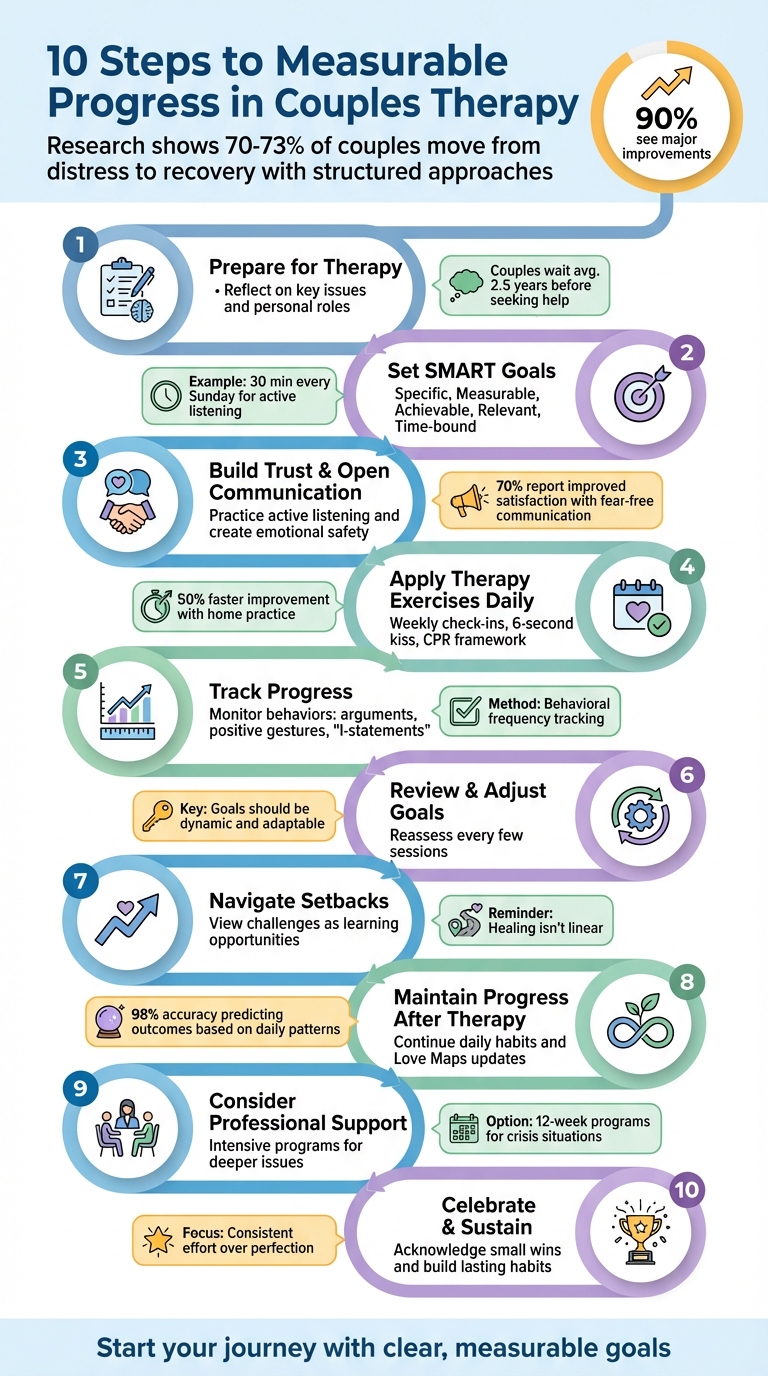
10 Steps to Measurable Progress in Couples Therapy
Couples Therapy Goals and Interventions: Internal Check-In
Step 1: Prepare for Therapy
Starting therapy without preparation is like visiting a doctor without explaining your symptoms. The real work begins even before the first session – when couples take the time to pinpoint what’s not working and what they hope to improve.
Studies show that couples wait an average of 2.5 years before seeking professional help, often allowing small issues to solidify into entrenched patterns[7]. This preparation phase is about getting specific: Are communication breakdowns during arguments the main problem? Are financial conflicts spiraling into blame? Or is there a lack of emotional or physical connection?
Meaghan Rice, PsyD, LPC, a therapist at Talkspace, highlights the importance of identifying key areas for improvement:
"It’s important to reflect on the 3 categories in your relationship that you feel need the most work. We can reach these answers by reflecting on topics that continuously resurface when there’s conflict."[7]
From here, both partners can individually prepare to get the most out of therapy.
Understand Each Partner’s Perspective
Before stepping into therapy, each partner should take time to reflect on their own. This means steering clear of blame and asking tough questions like: What role do I play in our issues? What am I genuinely willing to change?
Journaling can be a powerful tool here. Instead of writing something vague like "We argue about money", try being more specific: "When my partner made a large purchase without consulting me, I felt disrespected and worried about our savings goal." This level of detail gives your therapist a clearer picture to work with.
Another helpful exercise is a "gratitude check." Reflect on moments when the relationship felt strong or connected. These positive memories can act as a reminder of what’s worth fighting for and help establish a foundation of strengths to build on. Research shows that roughly 70% of couples who go through therapy report improved relationship satisfaction[4]. But that improvement starts with honest self-reflection – not pointing fingers.
Once both partners have done this individual work, it’s time to align on what you expect from therapy.
Set Realistic Expectations
Think of therapy as a workout for your relationship – it takes effort, consistency, and a willingness to push through discomfort. Dr. Sarah Schewitz, psychologist and founder of Couples Learn, explains:
"Therapy isn’t a magic wand – it’s more like a workout for your relationship. And just like the gym, real results take time, consistency, and sometimes a little discomfort."[6]
Expect gradual progress rather than instant fixes. The journey is rarely straightforward – you might feel like you’re making strides one week and hit a wall the next. A therapist isn’t there to play referee or decide who’s "right" or "wrong." Instead, they’ll help you recognize patterns in your interactions and guide you in responding differently when old triggers come up.
Before your first session, have an open conversation with your partner about expectations. Are you both fully committed to working on the relationship? Or is one partner seeking clarity about whether to stay or separate? Agreeing on the core question – Why are we here? – is crucial for therapy to have a chance at success.
Step 2: Define Relationship Goals Using SMART Criteria
Take the pain points you’ve identified and turn them into clear, actionable goals. The SMART framework is a handy tool for this – it helps transform vague ideas into targets you can actually measure and achieve.
So, what does SMART stand for? Specific, Measurable, Achievable, Relevant, and Time-bound. Let’s break it down with an example. Instead of saying, "We need to fight less", you could set a SMART goal like: "For the next three months, we’ll spend 30 minutes every Sunday evening practicing active listening and sharing thoughts using ‘I’ statements." [8]
Mara Hirschfeld, LMFT, explains it well:
"Relationship goals are the aspirations and intentions a couple has for their partnership. These goals reflect what matters most to the couple and what they want to create together." [8]
Here’s how each part of SMART works in practice:
- Specific: Be clear about the action you’ll take. For instance, instead of "spend more time together", say, "engage in one new activity together every other week."
- Measurable: Have a way to track progress. For example, commit to showing affection daily through specific actions and jot them down in a shared journal.
- Achievable: Aim for goals that challenge you but are realistic.
- Relevant: Make sure the goals align with your values and vision as a couple.
- Time-bound: Set a deadline to keep yourselves accountable.
A useful approach is the "Rule of 6s": set long-term goals for 6–12 months, short-term goals for 6 weeks, and immediate steps you can take within 6 days. For example, instead of saying, "Stop arguing about money", reframe it as: "Every Friday, we’ll do a 15-minute check-in to review our spending and plan for upcoming expenses." [3]
Research backs this up. A study of 118 couples found that shared goals significantly boosted relationship satisfaction. Even just believing a goal is mutual can make both partners feel more invested in the outcome. [8]
Once your SMART goals are in place, the next step is to make sure both partners are on the same page.
Work Together on Goal-Setting
One common mistake? When one partner sets a goal without involving the other. For example, if one person decides, "We’re saving $10,000 for a house this year", without discussing it, it can lead to frustration or resistance. As Mara Hirschfeld points out:
"When goals come from a place of mutual agreement, couples are far more likely to stay motivated and committed." [8]
Creating goals together turns them into a shared mission rather than a solitary task. To do this, try the "Realize, Evaluate, State" framework: [9]
- Realize that you each bring unique perspectives and desires to the table.
- Evaluate why the goal matters and how it can strengthen your relationship.
- State the goal clearly – write it down in a measurable way and keep it visible, like on the fridge or in a shared digital note.
Sometimes, priorities may clash. For example, one partner might want to save money while the other dreams of traveling. Instead of focusing on the conflict, look for shared values – maybe you both want to "build a life of adventure." This could lead to a compromise, like planning an affordable trip while still contributing to savings.
Make it a habit to check in on your goals quarterly. Life changes – whether it’s a new job, health challenges, or family needs – so be ready to adjust timelines or scopes as necessary. And don’t forget to celebrate small wins along the way. Recognizing progress keeps both of you motivated and engaged.
| Vague Goal | SMART Goal |
|---|---|
| Improve communication | For the next three months, we’ll set aside 30 minutes every Sunday evening to practice active listening and "I" statements. |
| Spend more quality time | Starting this month, we’ll engage in one new shared activity every other week, taking turns to pick the activity. |
| Be more affectionate | Every day, we’ll show affection through one specific action – like a compliment, a touch, or a kind gesture – and record it in a shared journal. |
| Resolve conflicts effectively | Over the next two weeks, we’ll research a conflict resolution method and apply it during disagreements, following the steps correctly 80% of the time. |
Step 3: Build Trust and Open Communication
Once you’ve set your goals, the next step is creating a space where both partners feel comfortable being honest. As John Mark Kane, LMFT from Growth and Change Counseling, explains:
"I believe that therapy is a safe space for people to be whoever they are right now, no matter how bad they feel about themselves or their lives. It is in this place of vulnerability that we can admit our struggles, face our true selves, and then grow to become all that we are meant to be!" [5]
Research supports this idea – emotional safety is one of the strongest indicators of a stable relationship [10]. When partners feel secure, they’re more likely to open up, which is essential for making progress. In fact, 70% of couples report improved satisfaction when fear-free communication is prioritized [4]. To get there, focus on two key skills: active listening and creating emotional safety.
Building trust takes time and consistency, but these skills can help lay the foundation.
Practice Active Listening
Active listening isn’t just about hearing your partner; it’s about truly understanding their perspective and making them feel valued. One effective method is reflective listening. This involves repeating back what your partner said to ensure you’ve understood them correctly. For example, if your partner says, "I feel overwhelmed when you make plans without asking me", you could respond, "So you’re saying you feel left out when I don’t check in with you first?" This small gesture can validate their feelings and minimize misunderstandings [11].
Another helpful strategy is using "I" statements instead of "you" accusations. For example, instead of saying, "You never listen to me", try, "I feel unheard when I’m talking, and you’re on your phone." This approach shifts the focus to your feelings and reduces defensiveness [10][11].
To strengthen your listening skills, consider setting aside 20 minutes each day to discuss external stressors like work, family, or finances – avoiding relationship issues during this time. One partner speaks while the other listens empathetically, then switch roles. This habit can help you practice judgment-free listening and deepen your connection over time [10].
When your partner is speaking, resist the urge to plan your response. Instead, focus entirely on what they’re saying and ask open-ended questions like, "How did that make you feel?" or "What do you need from me right now?" This shows genuine interest and encourages deeper conversations [10].
Create Emotional Safety
Trust thrives in an environment of emotional safety. Without it, partners may become defensive or shut down altogether. One helpful framework for fostering this safety is the ATTUNE method: Awareness of your partner’s emotions, Turning toward them, Tolerance, Understanding, Non-defensive responding, and Empathy [13].
Starting tough conversations gently can also make a big difference. Replace criticism with softer statements like, "I feel disconnected and want us to spend more time together." This approach helps prevent discussions from escalating into negativity or defensiveness [10][11]. As Zach Brittle, LMHC, puts it:
"The work of attunement and trust building is a single conversation spread out over the many seasons of a marriage." [13]
If emotions start to run high, take a 20-minute break to calm down with deep breathing before continuing the discussion [10][11].
It’s also important to view conflict as an opportunity for growth. John Mark Kane offers this perspective:
"Conflict is a pathway to intimacy. If there’s no conflict in a relationship, at least one person isn’t being genuine." [5]
When you approach disagreements as chances to better understand each other, rather than as threats, you create room for meaningful connection. Interestingly, research shows that in the later stages of therapy, accepting your partner’s behaviors emotionally has a stronger link to relationship satisfaction than the frequency of those behaviors [12].
Step 4: Apply Therapy Exercises to Daily Life
Real change in relationships happens outside of therapy sessions. Studies reveal that couples who actively practice relationship skills at home improve about 50% faster, with 70% reporting positive outcomes compared to those who rely solely on in-office sessions [14]. The key is weaving these exercises into your everyday life.
As Kayla Crane, LMFT from South Denver Therapy, explains:
"The couples who make the most progress aren’t the ones who spend the most time in my office. They’re the ones who take what we work on and practice it at home. Consistency beats intensity every time when it comes to relationship repair." [14]
Simple Yet Powerful Therapy Exercises
Start with practical steps that help build meaningful connections. For example, the 6-second kiss is a quick but impactful way to foster closeness. This brief moment during departures or reunions triggers bonding hormones like oxytocin, creating a sense of connection [14]. Another helpful tool is the Speaker-Listener technique, where one partner holds an object to signify they have the floor, speaks using "I" statements, and the other listens attentively before summarizing what they heard. This ensures both partners feel heard without interruptions [14].
For deeper emotional connection, try the "CPR" Check-In Framework once a week. Each partner shares three things: a Compliment (something they appreciate), a Problem (gently expressing a challenge), and a Resolution (a step they can take to address the other’s needs) [17]. Another great exercise is the Caring Days technique, where each partner lists five small, specific actions that make them feel loved – like preparing coffee or sharing a 60-second hug – and commits to doing at least one daily [18].
Here’s a quick rundown of exercises, their purposes, and the time they take:
| Exercise | Purpose | Time Required |
|---|---|---|
| 6-Second Kiss | Encourages physical connection during departures and reunions | 12 seconds/day [14] |
| Speaker-Listener | Ensures both partners feel heard and understood | 10–15 minutes [14] |
| CPR Check-In | Weekly conversation to share appreciation and address concerns | 30–60 minutes [17] |
| Caring Days | Promotes positive daily actions for affection and connection | Daily action [18] |
| Love Maps | Strengthens understanding of each other’s inner world through thoughtful questions | 15–20 minutes [14] |
These exercises, when practiced consistently, lay the groundwork for lasting improvements in your relationship.
Make It a Habit
Consistency is the secret to making these exercises stick. Start small to avoid feeling overwhelmed. For instance, in the first week, focus on a simple daily exercise like the 6-second kiss. In Week 2, add a daily stress-reducing conversation. By Week 3, schedule a weekly check-in, and in Week 4, incorporate conflict management tools [15]. These small, regular efforts not only highlight the strengths in your relationship but also prevent minor issues from snowballing [14]. Even a quick morning gratitude share can help make healthy communication second nature [16].
Step 5: Track and Measure Progress
Once therapy exercises become part of your daily routine, the next step is tracking progress. Why? Because without keeping tabs, it’s hard to tell if your efforts are paying off or if adjustments are needed. One effective method is behavioral frequency tracking – essentially, counting how often certain actions occur. For example, you could monitor the number of arguments each week, how frequently you use "I-statements" during disagreements, or the times you share positive gestures like compliments or physical affection. Research involving 134 married couples found that increasing positive behaviors early in therapy significantly boosted satisfaction [12].
Brian D. Doss, an expert in couples therapy outcomes, highlights how progress evolves over time:
"Change in behavioral frequency was strongly related to improvements in satisfaction early in therapy; however, in the 2nd half of therapy, emotional acceptance was more strongly related to changes in satisfaction." [12]
This underscores the importance of tracking specific behaviors early on, while emotional acceptance becomes more critical later in the process. By keeping track, you turn your efforts into measurable results.
Track Specific Behaviors
Start by choosing two or three specific behaviors to focus on. These could include reducing interruptions during conversations, increasing daily check-ins, or using "softened startups" when discussing sensitive topics [11][2]. Record these behaviors daily or weekly in a notebook or an app. Tracking consistently helps you identify patterns – like what’s working and what’s not – so you can adjust as needed.
Once you’ve logged the data, you can take it a step further by using assessment tools to get a broader view of your relationship’s progress.
Use Assessment Tools
Assessment tools are excellent for creating a baseline and tracking growth over time. They help quantify progress, making it easier to stay focused on your goals. For instance, the Prepare/Enrich assessment evaluates key aspects of your relationship, such as communication, finances, and intimacy [1]. The Relationship Check-In allows you to rate satisfaction in specific areas and flag priorities for improvement [19]. Another useful approach is solution-focused scaling, where you assign a score to abstract concepts like trust or emotional connection (e.g., rating trust on a scale of 1 to 10). If trust feels like a "4" today, you can set a goal to move it to a "5" by next week [11].
As Sagebrush Counseling explains:
"Assessments are an objective way to track progress and can be beneficial when collecting data over time." [1]
Incorporating these tools regularly – starting at the beginning of therapy and revisiting them every few weeks – offers clear insights into what’s improving and where more work is needed.
sbb-itb-596b85d
Step 6: Review and Adjust Goals Regularly
Tracking progress is only part of the process; it’s equally important to periodically pause and evaluate what’s working and what needs to change. Life evolves, and your goals should evolve with it. If a goal starts to feel out of reach or no longer aligns with your situation, don’t hesitate to tweak it. As South Jersey Coping Clinic explains:
"Goals should be dynamic and adaptable to changing circumstances and needs. If certain goals prove to be unrealistic or unattainable, couples should feel empowered to adjust them accordingly." [2]
Make it a habit to set aside time every few sessions to review your progress. Use this opportunity to discuss challenges, reassess priorities, and recalibrate your focus. By fostering a collaborative feedback loop between both partners and the therapist, you can stay on the same page and address small issues before they escalate. This process also creates space to celebrate progress and tackle setbacks in a constructive way.
Celebrate Small Wins
Progress isn’t always about big leaps – it’s often the small victories that matter most. Whether it’s fewer arguments in a week or making an effort to use "I-statements" during disagreements, these moments are worth acknowledging. Julie Rohovit, PhD, from the University of Minnesota, highlights this idea:
"Any progress toward achieving goals, be it a huge stride or a modest step, is improvement and a very positive and hopeful sign of a better quality of life." [3]
Celebrate these wins in ways that feel meaningful to you – plan a special date night, share a heartfelt conversation about what you’ve achieved together, or simply express gratitude for your partner’s efforts. Recognizing these moments not only strengthens your connection but also keeps motivation alive. Remember, therapy is often about the journey, not just the destination. When these small wins stop driving progress, it’s a signal to reassess your approach.
Refocus When Progress Stalls
Hitting a plateau is a normal part of the process, but it’s also a sign to step back and reevaluate. If progress slows, dig deeper to uncover what might be holding you back. It could be unresolved past experiences, unmet needs, or deeply ingrained habits. When this happens, try breaking down larger goals into smaller, more manageable steps. For example, instead of aiming to "improve communication" broadly, focus on something specific like "practice active listening for 10 minutes during daily check-ins."
If a particular strategy or exercise isn’t working, don’t be afraid to pivot. Experiment with new approaches while keeping communication open with your therapist and each other. Adjusting your methods can help reignite momentum and get you back on track.
Step 7: Navigate Setbacks and Build Resilience
As you continue working on your relationship, it’s important to prepare for the occasional bumps in the road. Progress isn’t always smooth or predictable. Some weeks, everything may seem to fall into place; other times, old habits and patterns might resurface. Therapist A G from Sagebrush Counseling reminds us:
"Healing isn’t a linear process." [1]
Recognizing this truth can help you stay grounded and maintain perspective when challenges arise.
Understand Normal Fluctuations
It’s natural to feel like you’re backtracking when conflicts pop up again, but these moments don’t necessarily mean you’ve lost progress. In fact, what might feel like a setback could actually be a step toward deeper connection. For instance, if your partner reveals a vulnerability they’ve never shared before, it might feel uncomfortable at first – but it’s also a sign of growing trust [21]. Instead of focusing solely on the latest disagreement, try to see conflicts as part of a bigger picture. Recurring patterns often point to unresolved issues, such as communication gaps or unmet needs, that need attention. When these fluctuations happen, rely on the strategies that have worked for you before.
Revisit Core Strategies
When setbacks occur, going back to the basics can be incredibly helpful. Techniques like active listening and using "I-statements" – discussed in earlier steps – are powerful tools for defusing tension and fostering understanding [11]. Recommit to practices like regular check-ins and completing therapy exercises. Before each session, take a moment to reflect on your personal goals. Ask yourself: What kind of partner do I want to be? What specific actions can I take this week to improve? Dr. Ellyn Bader highlights the importance of shared effort:
"Sustained improvement in an interdependent relationship requires equal effort from both partners – as in pairs figure skating, teamwork creates exceptional outcomes." [20]
Rather than viewing setbacks as failures, see them as opportunities to sharpen your skills and strengthen your relationship for the long haul.
Step 8: Maintain Progress After Therapy
Therapy might have an endpoint, but the work of maintaining a healthy relationship continues every day. Research from the Gottman Institute’s "Love Lab" revealed that relationship outcomes could be predicted with 98% accuracy based on patterns of interaction and daily habits [22]. This highlights the importance of small, consistent efforts in keeping a relationship strong. As Couples Therapist Laurel van der Toorn explains:
"It’s not the grand gestures that sustain a relationship; it’s the small, consistent acts of love and care." [22]
With these insights in mind, let’s explore how to carry forward the progress made in therapy.
Continue Practicing Skills
True change requires ongoing effort. Therapy sets the stage, but it’s the daily habits that truly strengthen your connection over time. A great way to stay connected is by updating your "Love Maps" – a term for understanding your partner’s current dreams, fears, and daily stresses. Spend 20 minutes each day focused on each other, sharing thoughts and listening deeply. Simple actions like physical touch and expressing gratitude can release oxytocin, which builds trust and deepens your bond [22]. When conflicts arise, handle them with care to avoid triggering defensiveness [11][21].
Know When to Seek More Help
Sometimes, even with the best intentions, extra support is needed. If old patterns resurface or certain topics – like finances or intimacy – become difficult to navigate, it might be time to schedule a booster session with your therapist. Many couples find that occasional check-ins help address small concerns before they grow into larger problems. Research published in the Journal of Marital and Family Therapy shows that 70% of couples who go through therapy report greater satisfaction in their relationship [4]. This serves as a reminder that reaching out for help is always a smart step when challenges arise.
Step 9: Consider Professional Support Options
Sometimes, couples need more than weekly therapy sessions to tackle deeply ingrained patterns. Intensive programs are designed to condense months of traditional therapy into shorter, focused formats, giving relationships a much-needed push when they feel stuck [11]. For couples dealing with serious issues – like infidelity, addiction, or the possibility of separation – specialized support can offer the structure and intensity required to make meaningful progress. This step highlights programs tailored for couples who find standard sessions insufficient.
Growth and Change Counseling
Growth and Change Counseling, based in Campbell and San Jose, CA, provides services aimed at delivering fast, measurable results. Their flagship program, The Marriage Rescue Institute, is a 12-week intensive designed specifically for couples in crisis. John Kane, LMFT, the program’s founder, explains:
"The Marriage Rescue Institute, our 12-week program is designed to restore marriages in crisis!" [5]
This targeted approach helps couples rebuild their relationships by addressing core issues like anxiety, depression, and conflict, while also enhancing relational intelligence. Unlike traditional therapy, which can be open-ended, their method is focused on solutions. As Arione Capolupo, LMFT, puts it:
"We don’t believe in endless therapy. Our goal is to get you in and out as quickly as reasonably can be done and do it in a way that hopefully you will never need to come back!" [5]
In addition to their in-office programs, Growth and Change Counseling offers telehealth services across California, making it easier for couples to access help no matter where they live. These flexible options ensure that progress is within reach for anyone in the state. Couples interested in learning more can schedule a free consultation by calling +1 408 461 9658 or emailing support@johnmarkkane.com.
Conclusion
Making measurable progress in couples therapy using the 10-step framework isn’t about achieving perfection – it’s about building a shared, actionable plan. When couples set SMART goals, commit to daily therapy exercises, and regularly assess their progress, they create steady momentum through consistent, tangible improvements.
Research underscores the importance of this approach. Early in therapy, behavioral changes often boost satisfaction, while over time, emotional acceptance becomes the cornerstone of long-term relationship health [12]. The journey doesn’t end when formal sessions do. Couples who sustain their progress often develop meaningful rituals, schedule regular check-ins, and continue applying the skills they’ve learned to everyday life.
As John Kane, a respected Relationship Therapist, explains:
"What you believe about yourself defines and shapes all of your relationships!" [5]
This perspective highlights how tracking progress not only helps couples recognize their growth but also challenges old habits and fosters deeper relational awareness.
Progress isn’t always linear – it’s normal to face setbacks. Celebrate small wins, adapt your goals, and let your relationship evolve naturally. Whether you’re attending regular sessions or seeking more intensive support through resources like Growth and Change Counseling’s Marriage Rescue Institute, the commitment to measurable progress equips you with the tools to nurture a healthier, stronger partnership – one step at a time.
FAQs
How can we set realistic and achievable goals in couples therapy?
Setting goals in couples therapy works best when they’re specific, measurable, attainable, relevant, and time-bound (SMART). For instance, instead of vaguely saying “improve communication,” you could aim for something like, “spend 15 minutes each evening discussing the day without interruptions for the next four weeks.” This method provides clarity, defines success, and gives a clear timeline to track progress.
Both partners should openly share their priorities and collaborate on goals that address individual needs while aligning with the overall direction of the relationship. Breaking bigger goals into smaller, actionable steps makes progress feel manageable and helps avoid overwhelm. Using tools like regular check-ins, progress tracking, or simple rating scales can highlight what’s working and where adjustments might help.
At Growth and Change Counseling, structured goal-setting plays a central role in their 12-week Marriage Rescue Institute program, keeping couples focused, accountable, and moving toward meaningful change.
How can we maintain the progress we made after couples therapy ends?
Maintaining the progress you’ve made after couples therapy means turning what you’ve learned into everyday habits. A simple but powerful way to do this is by setting aside time for regular relationship check-ins. These could be quick daily chats or weekly sit-downs where you share how you’re feeling, celebrate what’s working, and address any areas that need attention. These moments of connection can help keep communication flowing and stop small issues from snowballing into bigger ones.
Another helpful idea is keeping a shared journal where you jot down wins, challenges, and new goals. Revisiting your initial therapy goals once a month can also be a motivating way to track your progress. Incorporating key skills – like active listening, using "I" statements, and resolving conflicts in a healthy way – into routines such as date nights or monthly relationship reviews can go a long way in strengthening your connection.
If you notice things starting to slip, don’t hesitate to schedule a quick follow-up with your therapist. For example, Growth and Change Counseling offers post-therapy check-ins to help you stay on track, tackle new challenges, and continue growing together as a couple.
What should we do if we face setbacks during couples therapy?
Setbacks are an inevitable part of the therapy journey, and they can actually offer meaningful lessons. Rather than seeing them as failures, try to view these moments as chances to learn and grow. Take a step back to reflect on how far you’ve come and pinpoint areas that might need a little extra attention. Be open with your therapist about the specific challenges you’re facing – they can help you adjust your goals or strategies to better align with where you are now.
It’s important to remember that progress in couples therapy doesn’t follow a straight line – there will be highs and lows along the way. Show yourself some kindness, focus on the skills you’re working on (like better communication or handling conflicts), and keep track of your progress to spot any recurring patterns. At Growth and Change Counseling, therapists encourage couples to see setbacks as opportunities to fine-tune their approach and stay committed to creating a stronger, healthier relationship.
Related Blog Posts
- Solution-Focused Therapy for Addiction Recovery Couples
- Trauma Recovery for Couples: A Path to Healing
- Addiction Recovery and Marriage: What Works
- Solution-Focused Scaling for Addiction Recovery
