Work stress can damage a good marriage fast, but couples can slow it down with a few clear habits. The main fix is simple: stop treating each other like the problem and start treating stress like the problem. Research cited in the article points to outside stress as a major driver of relationship trouble, and one study of 87 couples found that one partner’s job stress often spread to the other at home.
If I had to sum up the article in plain English, it comes down to this:
- Spot the signs early: irritability, shutdown, phone scrolling, short tempers, and talks that only cover chores or schedules
- Protect the first hour at home: take 20 to 30 minutes to cool down before hard talks
- Use short check-ins: spend 10 to 15 minutes asking, “Do you want listening, help, or space?”
- Put limits on work talk: try a 15-minute cap
- Guard couple time: even 20 minutes without kids, chores, or money talk can help
- Shift chores during hard weeks: split work by current energy, not old habits
- Get help if the pattern sticks: therapy can help when distance, blame, or burnout keep repeating
The big idea: a marriage under job pressure usually does not need more blame. It needs better timing, more direct support, and stronger daily routines.
That’s the lens I’d use for the rest of this article: less “you’re the issue,” more “how do we handle this together?”
Is Work Stress Taking a Toll on Your Relationship?
sbb-itb-596b85d
How Work Stress Shows Up in Marriage
Work stress often comes home as irritability, withdrawal, and mental absence.
That matters because these patterns can help couples spot trouble early, before it turns into distance or resentment. And in many marriages, the signs show up in pretty predictable ways.
| Work Stressor | How It Appears at Home | Likely Effect on Marriage |
|---|---|---|
| Long Hours | Fatigue, canceled plans, logistics-only relationship | Relationship maintenance and intimacy get neglected [1][5][7] |
| Unpredictable Schedules | Short tempers, inability to be present, constant strain | Resentment over imbalance and loss of shared routines [7][11][5] |
| Commuting | Irritability immediately upon arrival home | Partner starts walking on eggshells to avoid conflict [2] |
| Deadlines | Present but distracted and preoccupied | Partner feels invisible, unimportant, or quietly rejected [2][7] |
| Job Insecurity | High anxiety, repeated reassurance-seeking | The supportive spouse feels drained and overburdened [2] |
Stress Spillover and Stress Crossover at Home
Spillover happens when work stress changes one partner’s mood and behavior at home. Crossover happens when that stress starts affecting the other partner too.
Research puts this into plain view. A 2014 study published in the Journal of Family Psychology followed 87 couples in which one partner worked as a paramedic. Higher daily work stress for the paramedic was linked to rumination and emotional withdrawal at home. That, in turn, led to more tension and maladaptive coping in the spouse [10]. As psychologist Dr. Alexandra Solomon explains:
"Stress is highly contagious… our nervous systems key off each other, especially in an intimate relationship. How you are doing affects your partner." [10]
So one hard workday can shape the whole evening. Not because either person is failing, but because stress moves from one person to the other.
Early Warning Signs Couples Should Not Ignore
The early signs are easy to wave off as "just a rough week." But patterns tell the real story.
Watch for small withdrawals. Maybe one person scrolls through a phone during dinner. Maybe minor issues, like a gas bill, spark sharp reactions. Maybe everyday physical affection starts to fade – the quick hug, holding hands, the small gestures that say I’m still here with you [8][7][5].
Other signs can show up more quietly: conversations that stay stuck at logistics, chronic physical tension, and a growing sense that the marriage keeps getting pushed aside. Those signals often mean the couple is carrying too much stress, and the connection between them is starting to thin.
How Couples Can Rebuild Connection After Stressful Workdays
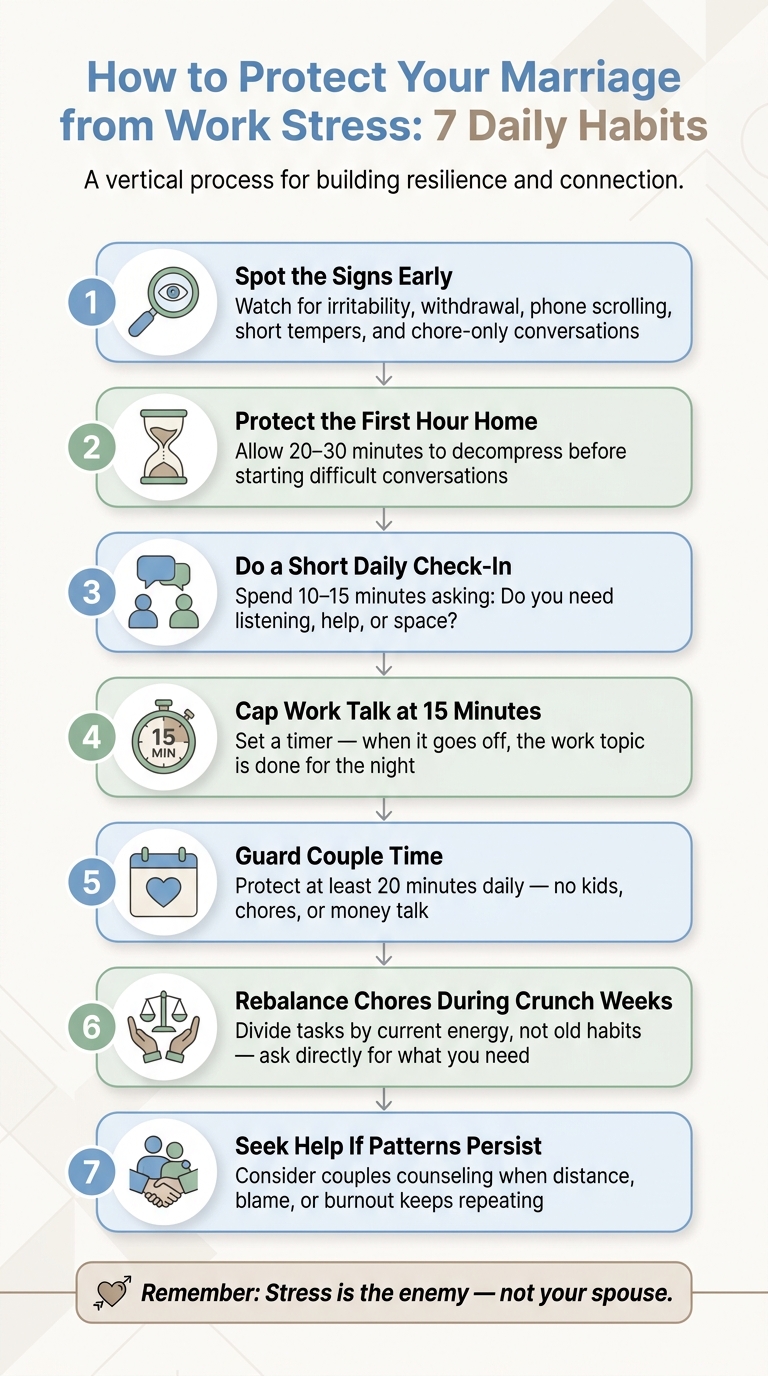
How to Protect Your Marriage from Work Stress: 7 Daily Habits
Seeing the warning signs is one thing. Figuring out what to do next is the hard part.
The good news is that small, steady actions can help couples deal with after-work spillover together instead of letting it slowly wear down the marriage [1][13]. The point isn’t to make work stress disappear. It’s to face it as a team. A good place to start is the first hour at home, when spillover tends to hit the hardest.
Use Short Daily Check-Ins and Clear Support Requests
One of the simplest tools that works well is a short, structured check-in. Aim for about 10 to 15 minutes, but only after both partners have had a little time to come down from the day [2]. In many cases, that means giving each other 20 to 30 minutes to decompress before talking [2][12].
A simple prompt can make this much easier: ask whether your partner wants to be listened to, helped, or given space [2]. That cuts out the guesswork. It also helps the other person respond in the right way, whether that means empathy, problem-solving, or just backing off for a bit.
And if you’re running on fumes, say that plainly. You can still reassure your partner that you’re okay, even if you don’t have much to give in that moment.
Replace Criticism With Validation, Repair, and Better Timing
Once both people have had time to settle, that’s the better moment to bring up touchy topics. After a rough workday, it helps to wait 10 to 20 minutes before starting a hard conversation, so you’re both calmer when it begins [3][6].
If tension starts to rise anyway, name the stress instead of snapping, going cold, or shutting down [10]. Be direct. Say you’re too stressed to be good company right now and need 30 minutes before reconnecting. That kind of clarity matters. It keeps your partner from having to read the tea leaves and wonder what’s wrong.
Set Limits on Work Talk to Keep the Job From Taking Over the Marriage
If work talk keeps swallowing the evening, put a firm cap on it. One simple way to do that is to set a 15-minute timer for talking about work. When the timer goes off, the topic is done for the night [2].
That boundary isn’t about brushing off a partner’s bad day. It’s about making sure the relationship doesn’t get crowded out by the job.
Small transition rituals can help too. Changing clothes as soon as you get home, taking a short walk, or sitting in the car for five minutes of slow breathing before going inside can all signal that the workday is over [2][6]. These physical cues help your brain shift from work mode to home mode.
Adjust Time, Roles, and Routines to Protect the Relationship
Good communication helps. But if the weekly setup at work and home keeps grinding people down, stress sticks around.
Packed calendars, uneven chores, and too little downtime can wear on a marriage fast. Time, household roles, and recovery periods can ease that strain or make it worse. This part is about changing the setup, not just trying to fix the mood.
Cut Time Scarcity and Protect Time Together
When life gets packed, the relationship often gets whatever scraps are left over. That usually doesn’t work for long.
Instead of waiting for some perfect free weekend, protect short, repeatable time together. Put specific hours on the calendar and treat them as protected relationship time [5]. Even 20 minutes that are off-limits to kids, chores, and money talk can help rebuild connection [8]. At the start of each week, plan at least three short things to do together, like a 30-minute walk or cooking dinner side by side [5].
Protected time only works if both people treat it as non-negotiable.
Rebalance Household Duties During High-Stress Periods
Stress-heavy weeks go better when couples deal with the load as a team instead of turning on each other. Fixed roles at home can fall apart fast when one person hits a crunch period. A product launch or tax season changes the math.
During those stretches, divide tasks by current capacity, not old habits [11].
Before a known high-stress period starts, sit down and sort out what changes, what can wait, and what needs to be dropped [6]. A direct ask helps a lot here. "I’m underwater this week – can you take dinner and school pickup?" is much easier to answer than a general complaint [6].
There’s also a catch with paid help. Bringing in a cleaner or nanny doesn’t always cut the load in the way people expect. If one partner still has to manage the scheduling, follow-up, and mental tracking, that planning burden may stay put even if the hands-on task is gone [8].
Once the work is split in a fairer way, it’s easier for both people to recover.
Support Sleep, Physical Health, and Recovery Between Work and Home
When stress never drops all the way, little things at home can feel much bigger than they are. That’s why sleep and recovery matter so much.
Protect enough sleep, and build in a short decompression period before jumping back into home life [7][6]. If both partners come home drained, stagger that downtime: one person gets 20 minutes first while the other handles the immediate needs, then they switch [9]. It also helps to make the bedroom and dinner table phone-free so the times that matter most for recovery don’t get chipped away [1][6].
If the load still feels too heavy, outside support can help couples stay coordinated.
When Professional Counseling Can Help a Marriage Recover
Sometimes routines and better boundaries help. Sometimes they don’t. When the same fight keeps coming back, counseling can help couples change the pattern at its source.
This kind of support tends to help most when the issue isn’t a lack of love. It’s when stress keeps barging into the marriage and taking over. In those cases, the couple often isn’t fighting each other as much as they’re stuck in a loop they can’t break on their own.
A few signs tend to stand out: emotional distance, avoidance, and one partner carrying the relationship for too long until burnout hits.
What Couples Counseling Can Address in Work-Stress Cases
Counseling can help couples step out of blame and look at the stress pattern instead. A skilled therapist can shift the focus away from attacking each other and toward dealing with the stress itself [1]. That change can make tense talks feel less reactive and less personal.
Therapy can also help with issues that work pressure often makes worse, such as anxiety, depression, addiction, trauma, or burnout [7][4]. If one partner is emotionally drained, the marriage often can’t heal all the way until those struggles are dealt with too.
Growth and Change Counseling for Couples Under Work Pressure
For couples in California who want structured support, Growth and Change Counseling offers a next step. For couples in severe distress, the practice offers The Marriage Rescue Institute – a 12-week directive couples process built to help repair a marriage when the pattern has become deeply stuck.
"The Marriage Rescue Institute, our 12 week marriage program is in the habit of putting marriages in dire circumstances back together!" – John Mark Kane, LMFT [4]
Self-guided changes may fit mild strain. Weekly therapy may fit recurring conflict. A structured 12-week process may fit severe distress or separation talk.
Conclusion: Small Changes, Shared Effort, and Timely Support Can Heal a Marriage
Whether a couple starts with check-ins, role shifts, and protected time, or moves into structured support, recovery depends on acting before resentment hardens. Work stress can wear down a marriage through irritability, withdrawal, lack of time, and repeated conflict.
But that damage doesn’t have to last. The stress is the enemy, not your spouse. When both partners can hold on to that idea, and get help before the pattern locks in, healing is much more likely.
FAQs
How can we tell if work stress is hurting our marriage?
Work stress doesn’t stay at work. It can follow your partner home and put quiet pressure on your marriage.
Sometimes the signs are easy to miss. Your partner may seem quiet, irritable, or emotionally withdrawn even when they’re right there with you.
You might also notice that you feel more like roommates than a couple. Intimacy can drop off. Small household issues can turn into arguments. And a partner may seem distant or checked out because their mind is still stuck on work worries.
What should we do if one of us needs space after work?
Say what you need clearly and early instead of going quiet and pulling away. It helps to agree on a plan ahead of time so that space feels like a healthy reset, not rejection.
You might say, "I had a difficult day and need 20 or 30 minutes to decompress before we connect." Even a small transition ritual can help both of you reset and show up with more presence. And if your partner is burnt out, give them space without judgment.
When should we consider couples counseling?
Consider couples counseling when work stress starts turning into constant conflict, poor communication, or emotional distance in your relationship.
If the strain feels chronic, or you can’t seem to get on the same page about what to do next, professional support can help you reconnect. In many cases, getting help early works best. Growth and Change Counseling offers specialized help through The Marriage Rescue Institute.
Common Questions About Work Stress at Growth and Change Counseling
- Q&A: Managing Anger and Communication in Marriage
- Ultimate Guide to Resilient Marriages
- Checklist for Strengthening Neurodiverse Relationships
- Christian Counseling for Emotional Triggers in Marriage
