Healing intimacy after sexual addiction is possible, but it requires time, faith, and intentional effort. Sexual addiction can deeply damage trust, emotional safety, and spiritual connection in a marriage. However, combining Christian principles with professional counseling offers a path to recovery.
Key Steps to Recovery:
- For the addicted spouse: Practice radical transparency, seek specialized support, and commit to consistent behavioral changes.
- For the betrayed spouse: Prioritize emotional safety, set boundaries, and engage in individual counseling to process trauma.
- For the marriage: Rebuild trust gradually through open communication, nonsexual bonding, and structured counseling programs.
Christian Perspective:
- Faith provides strength and hope for healing, emphasizing grace, repentance, and connection.
- Biblical teachings, such as James 5:16, highlight the importance of confession and accountability in the healing process.
Professional Support:
- Certified counselors and structured programs, like the 12-week Marriage Rescue Institute, guide couples through recovery.
- Tools like accountability software and trauma-informed therapies address both addiction and betrayal trauma.
Recovery is a long-term process, often taking 1–3 years, but with patience, faith, and support, couples can rebuild trust and intimacy.
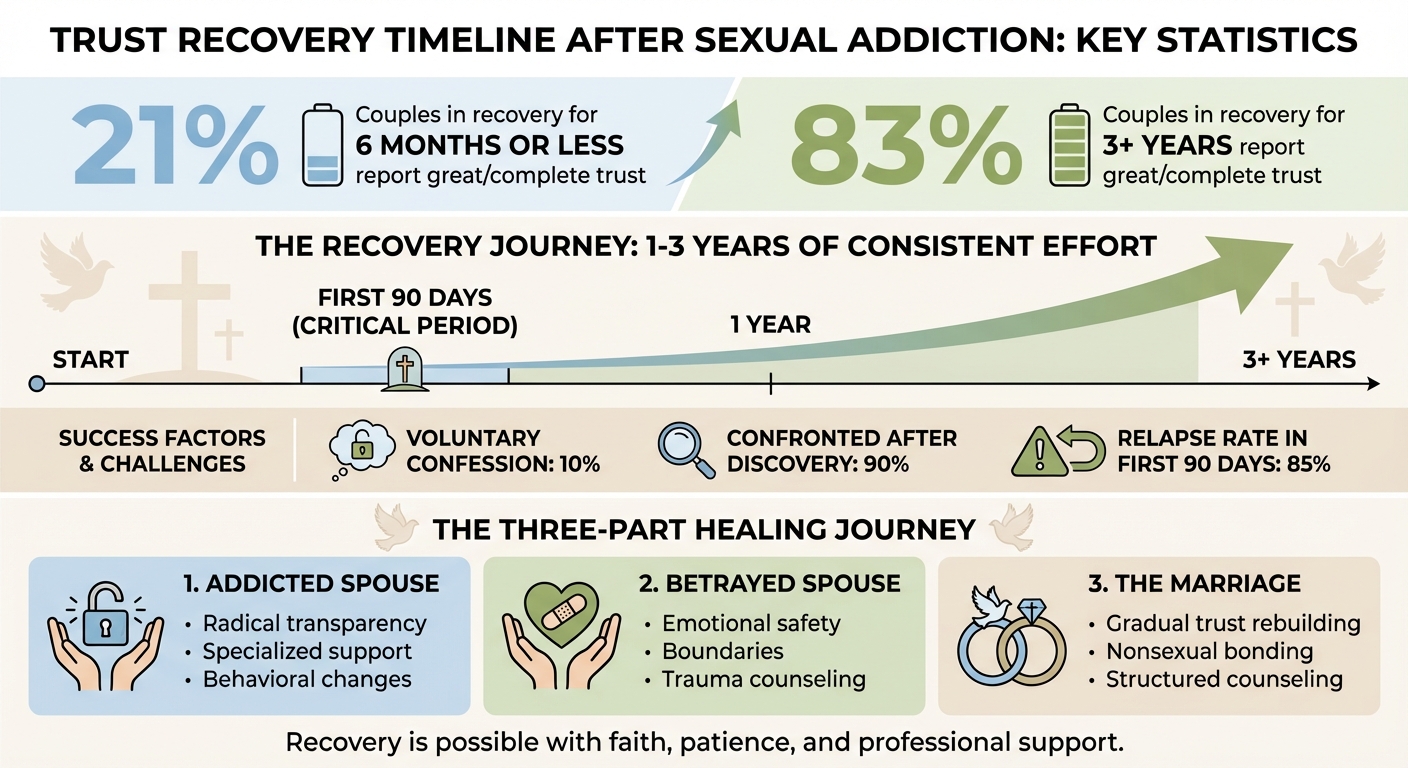
Trust Recovery Timeline: Statistics on Healing After Sexual Addiction
An Expert in Sexual Addiction Speaks to Wives
How Sexual Addiction Damages Intimacy
Sexual addiction chips away at the core of marital unity, unraveling the trust and connection that hold a sacred marriage together. In Christian teachings, marriage is viewed as a "one-flesh" union, symbolizing Christ’s unwavering commitment to the Church. However, sexual addiction disrupts this covenant, replacing devotion to one’s spouse and God with self-centered pursuits. Ellen Mary Dykas, Director of Equipping for Ministry to Women at Harvest USA, puts it this way:
"Sexual unfaithfulness breaks trust at the most vulnerable aspect of oneness as a spouse chooses, rather than forsakes, something or someone instead of the one to whom they promised faithfulness" [1].
This betrayal of trust leaves deep emotional and spiritual scars, threatening the very foundation of the relationship.
Emotional and Spiritual Trauma of Betrayal
The discovery of sexual addiction often leads to what’s known as betrayal trauma, a form of relational trauma that can mirror the symptoms of Post-Traumatic Stress Disorder (PTSD). Studies reveal that spouses of individuals struggling with sexual addiction are more likely to experience PTSD than codependency [4]. This trauma reshapes how a spouse perceives marital safety and intimacy, leaving them feeling destabilized [7].
The spiritual impact can be just as jarring. Questions like How could God allow this? or Can I ever trust my spouse – or even God – again? often arise. Yet, while the pain is overwhelming, understanding and addressing it is a critical step toward finding grace and beginning the process of healing.
How Trust and Physical Intimacy Break Down
Trust doesn’t shatter all at once – it erodes over time through secrecy and deception. An addicted spouse often leads a double life, where even small lies hint at a larger pattern of betrayal [5]. Geremy Keeton, Senior Director of Counseling Services at Focus on the Family, explains:
"Trust is fluid, like a river. It flows based on how consistently it’s fed. It takes daily input to keep trust at a healthy level. When a spouse discloses a pornography issue, trust dries up" [6].
Rebuilding this trust requires intentional, faith-driven actions over time. Physical intimacy also suffers, as the betrayed spouse may feel objectified rather than valued [1]. Comparisons to pornography or the idea of an affair can deepen emotional barriers, leading to questions like, Am I enough? Was I ever enough? Meanwhile, the addiction itself alters brain function, diminishing impulse control and emotional awareness, leaving the addicted spouse physically present but emotionally disconnected [7].
When Marital Intimacy Becomes Unsafe
The cyclical nature of addiction – oscillating between excess and withdrawal – creates an environment where intimacy feels anything but secure. During phases of excess, the addicted spouse may appear emotionally detached, angry, or even defiant. In withdrawal, they might spiral into shame, becoming withdrawn or depressed [7]. This inconsistency keeps the betrayed spouse in a constant state of vigilance, where even moments of closeness can trigger painful memories or fears of further rejection [6].
Without a clear, structured plan to restore trust, these cycles can make intimacy feel fragile and unstable. Jon Spadino, Volunteer and Group Leader at Connected Marriage, emphasizes the importance of creating a foundation for rebuilding:
"Safety + Being Heard and Understood = Building Blocks of Intimacy" [5].
To restore intimacy, both safety and understanding must be rebuilt through consistent, observable actions – what experts call "trust deposits." Without these, intimacy will remain as uncertain as standing on shifting sand instead of solid ground [6].
Building a Christ-Centered Foundation for Recovery
Recovering from sexual addiction is not something anyone can tackle alone. It’s a journey that involves three key areas working together: the healing of the addicted spouse, the healing of the betrayed spouse, and the collective healing of the marriage itself [5][3]. This approach acknowledges that while each individual needs their own support, the relationship also requires focused care and effort. Rebuilding trust is a process that often takes one to three years of steady, intentional work [2][6]. During this time, patience and persistence become powerful spiritual practices.
A Christ-centered recovery process strikes a balance between grace and truth. It’s about pairing compassion with honest accountability, creating a foundation for real and lasting change. However, relying on faith alone – like simply saying, “I just need to pray more” – is not enough. True healing demands both spiritual and practical work [2]. Faith serves as a source of hope and strength, walking alongside the therapeutic efforts necessary for recovery.
Here’s how the journey begins for the addicted spouse and the betrayed spouse.
Steps for the Addicted Spouse
Radical transparency is the first step. This means willingly sharing all passwords, checking in regularly, and giving your partner full access to your devices and social media. Addiction thrives in secrecy, so eliminating it is crucial [2][6]. Interestingly, only about 10% of addicts confess on their own, while the other 90% are confronted after their behavior is discovered [8]. Don’t wait for confrontation – take the initiative to change.
Specialized support is also critical. Join a Christ-centered recovery group such as Celebrate Recovery, Pure Desire, or SAA, and work with a Certified Sex Addiction Therapist (CSAT) to address the deeper emotional pain that fuels addiction [2][3]. Install accountability software like Covenant Eyes without needing to be asked [6][8]. These actions demonstrate your commitment to rebuilding trust and honoring your marriage. Geremy Keeton, Senior Director of Counseling Services at Focus on the Family, offers this advice:
"The more you pressure [the betrayed spouse] to trust you, the more difficult it will be for her. You have to see things from her perspective" [6].
Steps for the Betrayed Spouse
For the betrayed spouse, emotional safety is the priority. Set clear boundaries – not as punishment, but as a way to protect your heart while your partner works on their recovery [2][6]. This could involve separate sleeping arrangements, transparency around schedules, or other measures that create space for healing. These boundaries help you separate your emotional well-being from your partner’s actions [9], giving you the room to focus on your own recovery.
Individual counseling with a therapist trained in betrayal trauma is another important step. This allows you to process the shock and pain of discovery without feeling pressured to immediately “fix” the marriage [2][5]. Grieving the loss of trust and safety is necessary before forgiveness can take root [2]. Joining a support group of women who have experienced betrayal can also be incredibly helpful, providing a safe space to share and heal [5].
God’s Grace in Restoration
As both partners follow these steps, God’s grace becomes a guiding force, offering strength and the possibility of renewal. Jon Spadino, a Volunteer and Group Leader at Connected Marriage, provides a fresh perspective on recovery:
"The opposite of sexual addiction is not sobriety – it is connection: connection in marriage, family, and all close-in relationships" [5].
This shifts the focus from simply stopping harmful behavior to building deeper, more meaningful connections – with God, with each other, and with the community. As James 5:16 reminds us, "Confess your sins to one another and pray for one another, that you may be healed" [2]. Confession opens the door to healing through vulnerability and connection.
While prayer and spiritual practices are essential, they work best when paired with clinical support and accountability. Begin to see your spouse not just as a romantic partner but as a fellow believer in Christ. This perspective fosters humility and patience, which are key to rebuilding trust [8]. Sharing your recovery story in a supportive community can also help break the grip of shame [5]. Grace doesn’t replace the need for consistent, visible actions – it creates the foundation for trust to grow over time [6].
For couples looking for personalized, Christ-centered clinical support, Growth and Change Counseling offers specialized services to help restore and rebuild marriages.
sbb-itb-596b85d
Rebuilding Trust and Emotional Intimacy
Rebuilding trust is a gradual process, often taking one to three years of consistent effort [2]. It’s about creating a sense of safety and reconnecting step by step. As Jon Spadino, a Volunteer and Group Leader at Connected Marriage, explains:
"Safety + Being Heard and Understood = Building Blocks of Intimacy" [5].
Before physical intimacy can return, emotional closeness must be prioritized. This means focusing on transparency, honest communication, and intentional, nonsexual bonding. Every small, consistent action contributes to regaining lost trust [6].
Setting Boundaries and Creating Transparency
Transparency is non-negotiable when rebuilding trust. Providing complete digital access, such as sharing passwords, can help create a sense of safety [11].
In addition to digital openness, keeping a daily progress log can demonstrate steady, observable change over time [10]. Blair Bisher, Founder of BPB Counseling, emphasizes:
"Trust is gained in drops, lost in buckets" [10].
Grand gestures like expensive gifts or one-time acts of service might seem appealing, but they lack the consistency required to rebuild trust. Instead, focus on small, dependable actions that show reliability. For the betrayed spouse, setting boundaries can also be crucial – not as a form of punishment, but as a way to protect emotional well-being. These might include separate sleeping arrangements, regular check-in calls, or location sharing to provide reassurance and manage the emotional fallout of betrayal [5].
Once boundaries are established, the next step is structured disclosure for deeper healing.
Therapeutic Disclosure and Communication Skills
A guided disclosure process, supervised by a counselor experienced in sexual addiction recovery, is a critical step [5]. This structured approach ensures that the betrayed partner receives the full truth in a safe and controlled setting [13].
After disclosure, communication becomes the bedrock for rebuilding emotional connection. Reflective listening is key – repeating back what your spouse says helps them feel understood [12]. Use "I" statements to express your feelings without assigning blame, and avoid dismissive responses like "Yeah, but…" when your partner shares their pain [5][11].
For Christian couples, communication can also include spiritual practices. Praying together, studying scripture as a couple, and attending church can strengthen the marriage by fostering a deeper connection through faith [11].
Strong communication lays the groundwork for rebuilding emotional intimacy.
Nonsexual Bonding and Emotional Closeness
Once open and honest communication is in place, the focus shifts to restoring emotional bonds through nonsexual connection. Emotional intimacy must come first before reintroducing physical closeness. Start with simple, nonsexual gestures like holding hands, hugging, or kissing without any expectation of sex [1].
Scheduling regular "no-issue" date nights – where discussions about addiction or recovery are off-limits – can help couples rediscover fun and friendship [12]. Short, honest check-ins, held daily or weekly, provide a space to discuss progress, boundaries, and emotional well-being [2].
Jon Spadino offers an insightful reminder:
"The opposite of sexual addiction is not sobriety – it is connection: connection in marriage, family, and all close-in relationships" [5].
Shifting the focus from merely stopping harmful behaviors to building meaningful connections transforms the recovery process. As both partners invest in emotional closeness, they create the foundation needed to eventually restore physical intimacy.
For couples looking for professional guidance, Growth and Change Counseling provides specialized services, including The Marriage Rescue Institute – a 12-week intensive program designed to help couples in crisis rebuild their marriages.
Restoring Physical Intimacy in a Healthy Way
Reclaiming a Biblical Understanding of Sex
The Bible describes sex as a "one-flesh" union – a powerful image of complete trust and vulnerability [1]. It’s not just a physical act; it’s a covenantal expression, mirroring Christ’s relationship with the Church (Ephesians 5:31-32). Unfortunately, sex addiction distorts this sacred bond, reducing what should be a selfless and mutual connection into something disconnected and self-serving. Dave White, Author and Director, explains it well:
"Sexual expression is analogous to a deeper, eternal reality – a husband and wife are to be devoted to one another… as a reflection of Jesus’ desire that we be utterly devoted to him." [1]
The journey to recovery begins by rejecting these distortions and the societal pressures that treat sex as merely physical. Instead, couples can rebuild intimacy as a covenantal gift – one that strengthens their relationship before God. This renewed perspective lays the foundation for intentionally restoring physical closeness in a meaningful way.
Gradual Reintroduction to Physical Intimacy
Rebuilding physical intimacy takes time and should never be rushed. Juli Slattery, President and Co-founder of Authentic Intimacy, offers this reminder:
"Though the goal may be to rebuild sexual intimacy, emotional intimacy is the main priority. Without it, sexual intimacy isn’t intimacy–it’s just sex." [13]
Taking a temporary break from sexual activity can be beneficial, providing the betrayed spouse with space to process their emotions while allowing the addicted spouse to rewire their responses toward genuine connection. This pause creates room for healing and emotional safety, which are essential before reintroducing physical closeness.
When both partners feel ready, start small. Begin with non-sexual gestures like holding hands or hugging, gradually moving toward deeper intimacy as trust and safety grow. Establishing boundaries – such as keeping the lights on or choosing specific settings for intimate moments – can help create a secure and comfortable environment. This step-by-step approach helps bridge emotional healing with physical connection, fostering a "new normal" that prioritizes mutual safety and trust.
Managing Triggers and Preventing Relapse
Triggers – whether internal, like anger or loneliness, or external, such as familiar environments – can disrupt progress. Couples can create a trigger map to identify and prepare for high-risk situations. Relapse often follows a predictable path: emotional distress leads to mental cravings, which can escalate into physical actions. The first 90 days of recovery are especially critical, with relapse rates reaching up to 85% during this period [16].
However, a single lapse doesn’t have to spiral into a full relapse. As Steven M. Melemis of Modern Therapies explains:
"Recovery involves creating a new life in which it is easier to not use." [15]
One helpful tool is the HALT acronym, which encourages individuals to check if they are too Hungry, Angry, Lonely, or Tired – states that increase vulnerability to triggers. When cravings arise, they typically last 15–30 minutes [14]. During this time, techniques like "urge surfing" can help. This involves observing the craving as it rises and falls, much like riding a wave. Having an emergency response plan – such as calling a trusted friend or stepping away from a triggering situation – can also provide immediate support.
Transparency is key to rebuilding trust and managing triggers. Psychological challenges like mood swings, irritability, or disrupted sleep can linger for up to two years, often fueling additional cravings. Maintaining open communication within a recovery circle – spouses, counselors, and support groups – ensures unspoken feelings don’t hinder progress. Replacing old habits with new, shared activities can also help rewire the brain’s reward system, creating a foundation for lasting intimacy and connection.
Conclusion: A Journey of Faith, Healing, and Renewal
Healing intimacy takes time – typically one to three years of consistent, intentional effort [2][17]. The numbers tell a compelling story: 83% of couples in recovery for over three years report having great or complete trust in their partners, compared to just 21% of those in recovery for six months or less [17]. These figures highlight an essential truth: patience and persistence lead to meaningful progress. This steady transformation opens the door to deeper healing, both emotionally and spiritually.
True recovery goes beyond simply stopping harmful behaviors. It’s about creating a balance where honesty and compassion work together to build lasting change. Faith plays a key role here, offering strength through difficult times. As Psalm 34:18 reminds us: "The Lord is close to the brokenhearted and saves those who are crushed in spirit" [2].
While personal effort is vital, professional support can make a significant impact. Therapists experienced in trauma and recovery provide essential guidance, helping couples navigate both clinical and spiritual healing [2]. For example, Growth and Change Counseling offers tailored support, including The Marriage Rescue Institute, a 12-week intensive coaching program designed for marriages in crisis. With offices in Campbell, San Jose, Los Angeles, and Roseville, CA, as well as telehealth options across California, expert help is always within reach. This professional guidance complements your faith journey, ensuring that each step forward is rooted in both practical strategies and spiritual growth.
Recovery thrives on radical transparency, accountability, and supportive community connections. Whether through individual therapy, couples counseling, or groups like Celebrate Recovery, breaking free from isolation is crucial [2][18]. The journey isn’t about achieving perfection – it’s about making steady progress. Repentance is not about self-punishment; it’s about turning toward healing and renewal [2]. With faith, patience, and expert support working together, restoration becomes not just possible, but attainable.
Common Questions About Healing with Growth and Change Counseling
How can Christian values help couples rebuild intimacy after sexual addiction?
Marriage, from a Christian perspective, is seen as a sacred covenant that mirrors Christ’s unchanging love for His Church. When sexual addiction disrupts this bond, the gospel provides a pathway to restoration through repentance, forgiveness, and grace. Couples are encouraged to approach the journey with humility – acknowledging the pain caused, seeking forgiveness, and committing to accountability together.
Practical steps to rebuild trust and emotional safety include praying as a couple, studying Scripture, and participating in faith-based counseling. By rooting the healing process in God’s vision for marriage, couples can work toward restoring intimacy and experiencing a renewed connection grounded in grace.
What are the first steps for rebuilding trust after sexual addiction?
The first step for a spouse struggling with addiction is to work on regaining trust. This starts with openly admitting the problem, committing to recovery, and taking actionable steps to eliminate destructive habits. Real transformation happens when the root causes are addressed through structured treatment and a focus on accountability.
As recovery progresses, practical measures are crucial. These might include engaging in faith-based counseling, being fully transparent, and using safeguards like accountability software. Consistently practicing honesty, sharing passwords, and setting boundaries around device usage can go a long way in restoring trust within the relationship.
For couples looking for a Christian-based approach, Growth and Change Counseling provides tailored support. Their 12-week intensive coaching program, offered through The Marriage Rescue Institute, offers a clear, faith-driven path toward healing and rebuilding the relationship.
How does betrayal trauma impact rebuilding trust and intimacy in marriage?
Betrayal trauma – stemming from a partner’s sexual addiction or infidelity – can shatter the emotional and relational foundation of a marriage. For the betrayed spouse, the aftermath often brings overwhelming feelings of isolation, shame, and a heightened state of vigilance. These emotions make it incredibly challenging to feel secure or begin the process of rebuilding trust. Healing from such a deep wound takes both time and deliberate effort.
Restoring trust doesn’t happen overnight. It requires establishing healthy boundaries, fostering emotional and physical safety, and addressing the pain and grief at the core of the betrayal. Forgiveness, while important, isn’t enough on its own; trust is rebuilt through consistent and dependable actions from the partner who caused the harm. Programs like the 12-week couples coaching offered by Growth and Change Counseling provide a structured, faith-based approach to help couples navigate this difficult path. With the right support, they can work toward reconnecting on a foundation rooted in grace and truth.
Related Blog Posts
- Root Causes of Shame in Sexual Addiction
- How Faith Helps Rebuild Trust After Addiction
- How Faith Helps Couples Overcome Addiction Together
- How Accountability Supports Intimacy Restoration
