When addiction impacts a family, it creates chaos that forces members to take on specific roles to cope. These roles – The Addict, Enabler, Hero, Scapegoat, Mascot, and Lost Child – are survival mechanisms that help maintain a fragile balance but often cause long-term emotional harm. Here’s a quick breakdown:
- The Addict: Their behavior dominates the family, leading others to adjust around their actions.
- The Enabler: Protects the addict from consequences, unintentionally prolonging the addiction.
- The Hero: Overachieves to mask family dysfunction, often at personal emotional cost.
- The Scapegoat: Acts out to deflect attention from the addiction, often becoming the "problem child."
- The Mascot: Uses humor to lighten the tension but hides their own emotional struggles.
- The Lost Child: Withdraws into isolation, avoiding conflict but feeling ignored and unimportant.
These roles provide temporary relief but perpetuate dysfunction. Breaking free involves recognizing these patterns, setting boundaries, and seeking support through therapy or groups like Al-Anon or Nar-Anon. Recovery is possible for both individuals and families.
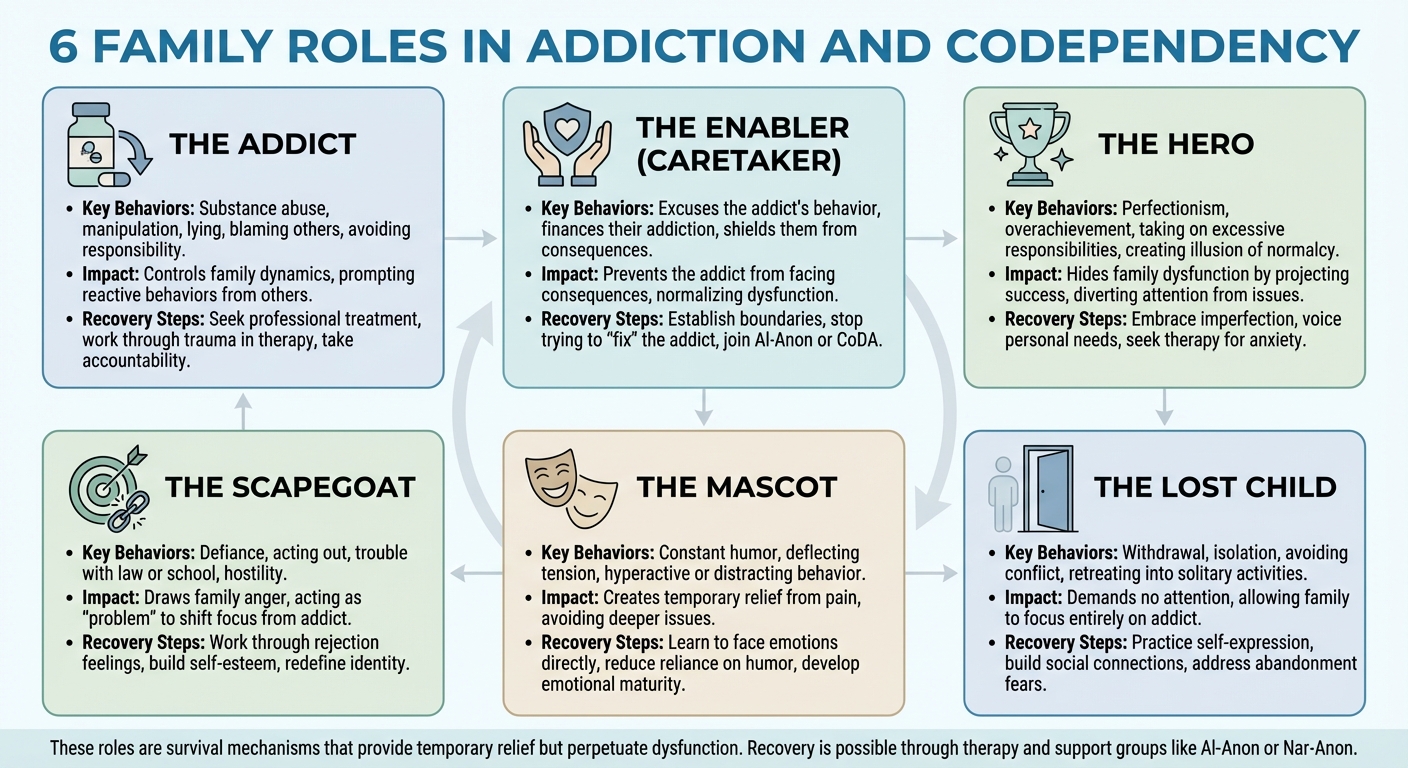
6 Family Roles in Addiction: Behaviors, Impact, and Recovery Steps
Revealing the Family Roles in Addiction & Codependency
1. The Addict
The addict is the pivotal figure shaping the dynamics of a family affected by substance abuse. With over 24 million people in the United States struggling with addiction to drugs or alcohol, this issue impacts countless households [4]. The addict’s needs and behaviors dominate the family environment, setting the tone for daily life and emotional interactions. As a result, family members often find themselves rearranging their lives to cope with the unpredictability that addiction brings.
When the addict is a parent, their substance abuse can disrupt the family structure entirely. Children may be forced to take on adult responsibilities, such as paying bills or caring for younger siblings, which destabilizes the household and places immense pressure on the kids [4].
"Alcoholic families are in ‘survival mode.’ Usually everyone is tiptoeing around the alcoholic, trying to keep the peace and avoid a blow up." – Sharon Martin, Licensed Counselor and Social Worker [2]
To maintain their habit, the addict may resort to lying, manipulating, stealing, and shifting blame onto others [4]. Phrases like "I wouldn’t drink if you didn’t nag" or "You’re overreacting" are common deflections that leave family members feeling confused and invalidated. This behavior fosters an atmosphere of denial and secrecy, often teaching children – whether explicitly or implicitly – to remain silent about the turmoil at home [5].
As the addiction deepens, the ripple effects become more pronounced. The addict’s increasing isolation and neglect of responsibilities force other family members to step in and take on roles they may not be equipped to handle. Emotional neglect becomes a common experience for children, as the family’s energy is consumed by managing the chaos. These dynamics set the foundation for the reactive and often dysfunctional roles that other family members adopt in response to the addict’s behavior [4].
Understanding the Addict Role at Growth and Change Counseling
The enabler, sometimes referred to as the "Caretaker" or "Codependent", is a role often seen in families dealing with addiction [6]. This role involves shielding the addicted individual from the natural consequences of their actions, which, while well-intentioned, can unintentionally prolong the addiction and make recovery more challenging [1].
"The Enabler is a family member who steps in and protects the alcoholic/addict from the consequences of his or her behavior. The motivation for this may not be just to protect the alcoholic/addict but to prevent embarrassment, reduce anxiety, avoid conflict or maintain some control over a difficult situation." – MARR [1]
Enablers often take on responsibilities that should fall to the addicted person, such as covering up mistakes, paying bills, or handling childcare. In some cases, they may even provide money, transportation, or bail [1][3]. These actions are frequently driven by a fear of conflict, a desire to maintain family harmony, or a sense of obligation to ease the addict’s struggles [1]. Unfortunately, this behavior comes with a steep personal cost.
"Enabling provides families a level of comfort similar to what drugs or alcohol provide their addicted loved ones." – Intervention Helpline [7]
The toll of enabling is significant. Enablers often sacrifice their own emotional and physical well-being, while their actions may foster a sense of entitlement in the addicted individual, further hindering recovery [6][3]. This dynamic traps both the addict and the family in unhealthy patterns, making true healing difficult for everyone involved.
Breaking the cycle of enabling requires setting clear boundaries and allowing the addicted person to experience the consequences of their choices. Support groups like Al-Anon, Nar-Anon, or Codependents Anonymous can be invaluable for those seeking to shift from enabling behaviors to providing meaningful support for recovery [6].
3. The Hero
In families impacted by addiction, the Hero steps forward as the overachiever, striving to bring order to the chaos. This individual often shines in academics, sports, work, or other activities, creating a facade of normalcy to mask the turmoil caused by a family member’s addiction.
"The Hero of the family is the one who is most controlling and often exhibits Type A personality: a responsible, hard-working, and overachieving perfectionist." – HVRC [3]
While their accomplishments may appear impressive, they often come at a personal cost. Beneath the surface, the Hero grapples with feelings of isolation, anxiety, guilt, and shame. They take on the weight of maintaining the family’s reputation, believing their success can somehow compensate for the dysfunction at home. This relentless pressure to achieve perfection can take a toll on their physical and mental health [3].
The Hero’s need for control often stems from the chaos they cannot manage within the family. They adopt adult responsibilities early, using their achievements as a shield to hide their deeper frustrations and resentment. Unfortunately, this pattern can carry into adulthood, leading to ongoing struggles with control and unresolved emotional pain [2].
Breaking free from the Hero role requires a shift in perspective. Recognizing that personal success cannot resolve family dysfunction is a crucial step. Support groups like Al-Anon, Nar-Anon, or Adult Children of Alcoholics offer guidance in letting go of this role. Professional counseling can also help address the trauma that fuels their perfectionism. This journey is an essential part of healing, not only for the individual but for the entire family [8].
4. The Scapegoat
In families dealing with addiction, the Scapegoat often ends up being labeled as the "problem child." This label shifts focus away from the core issue – the addiction – by drawing attention to disruptive or rebellious behavior. Typically, this role is taken on by the middle or second-oldest child, who copes with the chaos at home by acting out. While the Hero works to maintain a picture-perfect image, the Scapegoat becomes a lightning rod for the family’s frustrations.
"The scapegoat is a family member who creates other problems and concerns in order to deflect attention away from the real issue." – MARR [1]
The Scapegoat often bears the brunt of the family’s unspoken anger. Confronting the addicted individual may feel too overwhelming, so the Scapegoat becomes the target instead. Their struggles – whether it’s failing grades, rebellious outbursts, or even experimenting with substances – become the family’s focus, creating a vicious cycle. Unfortunately, this dynamic can lead the Scapegoat down a similar path of substance use or self-destructive behavior.
Behind their defiance, the Scapegoat is often grappling with feelings of rejection and loneliness. Over time, the "bad kid" label can become internalized, leaving them with deep-seated trust issues, self-doubt, and a fractured sense of self-worth. These emotional scars can make it difficult for them to build healthy, lasting relationships as they grow older.
Breaking out of this role starts with understanding that it’s a response to dysfunction, not an unchangeable identity. Family therapy can help untangle these harmful patterns, offering a chance to heal and rebuild connections. Support groups like Al-Anon, Nar-Anon, or Adult Children of Alcoholics provide a safe space to share experiences and gain perspective. For more personalized help, Growth and Change Counseling offers specialized services to navigate these challenges. Up next, we’ll dive into another key role within these family dynamics.
sbb-itb-596b85d
5. The Mascot
The Mascot steps into the role of the family "jester", using humor as a way to deflect the chaos and tension caused by addiction. Often the youngest in the family, this individual becomes the go-to comedian, always ready with a joke or some lighthearted antics whenever conflict arises. Their goal? To keep everyone laughing so the painful reality of addiction remains unspoken. Like other roles in a dysfunctional family, the Mascot’s humor is a survival tactic – a way to cope with overwhelming stress.
"The Mascot attempts to use humor as a means to escape from the pain of the problems caused by addiction." – MARR [1]
On the surface, the Mascot seems carefree and full of energy, but beneath the jokes lies a much heavier emotional burden. Behind the laughter, they often carry deep feelings of shame, fear, anger, and loneliness. Their constant need to entertain stems from a yearning for approval and validation, as if their worth depends entirely on their ability to make others feel better. Unfortunately, this reliance on humor as a shield prevents them from learning healthier ways to manage anxiety and stress, leaving them emotionally vulnerable and at risk of developing their own struggles with substance abuse.
The Mascot’s behavior can also unintentionally undermine recovery efforts. By making light of addiction or cracking jokes about serious issues, they may unintentionally normalize dysfunction, making it harder for the family to confront the reality of the situation. What begins as a way to survive can turn into a lifelong pattern, where they struggle to express genuine emotions or handle serious situations as adults.
Breaking free from this role means recognizing humor as a defense mechanism that hides deeper emotions. Individual therapy can help the Mascot address the trauma they’ve been covering up, while family counseling provides a safe space to share honest feelings without fear of unraveling the family dynamic. Support groups like Al-Anon or Nar-Anon can also offer insights into patterns of codependency. Growth and Change Counseling, which operates throughout California, specializes in family therapy and can guide families toward healthier dynamics. Understanding and addressing this role lays the groundwork for exploring the Lost Child, which we’ll discuss next.
6. The Lost Child
In the complex dynamics of family roles, the Lost Child is the one who often goes unnoticed. They navigate the chaos around them by retreating into silence and isolation, believing that staying invisible might shield them from harm or conflict [9]. Unlike the Hero, who seeks approval through accomplishments, or the Mascot, who uses humor as a defense mechanism, the Lost Child tries to survive by blending into the background.
"By fading into the background, this child tries to find safety by hiding." – Rebekah Brown, Author and Trauma Survivor [10]
To cope with the unpredictability of their environment, Lost Children frequently turn to solitary activities like reading, gaming, or watching television. Some even create elaborate fantasy worlds to escape reality [6] [9] [11]. In families with narcissistic or addicted parents, the Lost Child may be held up as an example of how "well" the family is functioning, simply because they don’t cause any trouble. However, this quiet compliance comes at a heavy emotional cost [10]. Their needs are often ignored, leading them to internalize the belief that they are unimportant [9]. Over time, this can result in deep loneliness and persistent feelings of depression.
As they grow into adulthood, Lost Children often face challenges in expressing emotions and building close relationships. Having relied solely on themselves for so long, they may also carry a sense of omnipotence guilt – the false belief that they are responsible for their family’s problems and must fix everything. When they inevitably fail to meet these impossible expectations, shame can overwhelm them [9].
Healing from this role starts with acknowledging and expressing long-buried needs [11]. Therapy can be an essential tool in helping Lost Children work through suppressed anger and profound loneliness [9]. Learning to set boundaries – like saying "no" without being consumed by guilt – is another vital step in the recovery process [9]. Support groups such as Al-Anon, Nar-Anon, or Adult Children of Alcoholics (ACA) can also provide a sense of community and reassurance that they are not alone in their struggles [2].
For families looking to disrupt these harmful patterns, Growth and Change Counseling offers family therapy across California. This creates a safe environment where Lost Children can share their thoughts and feelings without fear of judgment or dismissal.
How to Break Free from Family Roles
Breaking free from family roles starts with recognizing and understanding the role you’ve been playing. Are you the Hero, Scapegoat, Mascot, or Lost Child? Take a moment to reflect on how this role has shaped your behavior. Maybe you’ve been taking on responsibilities that aren’t yours to solve, or perhaps you’ve been suppressing your emotions to keep the peace. These patterns often feel second nature because they’ve served as survival mechanisms for so long. The key is to challenge the beliefs that keep you stuck in these roles. For instance, you might hold onto ideas like "I need to be perfect to make up for the chaos" or "my feelings don’t matter." As The Recovery Team notes, "Breaking free from a role means recognizing what’s yours to carry and what isn’t." This could mean stepping back from covering for someone else’s substance use or saying no to responsibilities that aren’t truly yours, even if it feels uncomfortable. With this awareness, you can begin to prioritize your own needs and protect your well-being.
Another crucial step is setting boundaries, though this can feel daunting if you’re used to overextending yourself. Start small – say no to one extra task or responsibility. Practice expressing your needs clearly, whether through direct conversations or with the help of a therapist. According to Opus Behavioral Health, "The overall goal in overcoming codependency is to make each person whole." This shift allows you to move away from constantly managing family crises and toward personal growth, helping you develop a more independent and genuine sense of self.
Sometimes, personal efforts alone aren’t enough, and professional support becomes essential. Family therapy provides a safe, structured space for honest communication, helping to rebuild trust and address misunderstandings. Individual counseling can also help you tackle personal struggles, such as anxiety or depression, that stem from years of family dysfunction. Support groups, too, can be an invaluable resource, offering perspectives from others who have faced similar challenges.
Growth and Change Counseling, for example, offers family therapy services across California. Their approach helps family members identify and move past unhelpful roles while building healthier communication and coping strategies tailored to each family’s unique situation. The journey from self-awareness to seeking professional guidance is a vital step in creating healthier, more balanced family dynamics.
Comparison Table
This table provides an overview of each family role, highlighting key behaviors, its impact on codependency, and suggested recovery steps.
| Role | Key Behaviors | Codependency Contribution | Recovery Steps |
|---|---|---|---|
| The Addict | Substance abuse, manipulation, lying, blaming others, avoiding responsibility. | Controls family dynamics, prompting reactive behaviors from others. | Seek professional treatment, work through trauma in therapy, and take accountability for actions. |
| The Enabler (Caretaker) | Excuses the addict’s behavior, finances their addiction, shields them from consequences. | Prevents the addict from facing consequences, enabling their behavior, and normalizing dysfunction. | Establish boundaries, stop trying to "fix" the addict, and join support groups like Al-Anon or CoDA. |
| The Hero | Perfectionism, overachievement, taking on excessive responsibilities, creating an illusion of normalcy. | Hides family dysfunction by projecting success, diverting attention from underlying issues. | Embrace imperfection, voice personal needs, and seek therapy to manage anxiety and stress. |
| The Scapegoat | Defiance, acting out, trouble with the law or school, hostility. | Draws family anger, acting as a "problem" to shift focus away from the addict. | Work through feelings of rejection, build self-esteem, and redefine identity apart from family blame. |
| The Mascot | Constant humor, deflecting tension, hyperactive or distracting behavior. | Creates temporary relief from family pain, avoiding deeper issues. | Learn to face emotions directly, reduce reliance on humor as a defense, and develop emotional maturity with therapy. |
| The Lost Child | Withdrawal, isolation, avoiding conflict, retreating into solitary activities. | Demands no attention, allowing the family to focus entirely on the addict. | Practice self-expression, build social connections, and address abandonment fears through counseling. |
These roles often take shape during childhood and can persist into adulthood, influencing relationships and stress management later in life. Identifying your role is a critical step in breaking free from these patterns. With awareness, you can begin to implement the recovery steps outlined here, creating space for healthier relationships and personal growth.
Conclusion
The roles within a family affected by addiction – The Addict, Enabler, Hero, Scapegoat, Mascot, and Lost Child – are coping mechanisms born out of household turmoil. While these roles may provide temporary relief from tension, they often mask deeper emotional struggles. As Sharon Martin, a licensed counselor and social worker, explains:
"Children crave and need predictability… Alcoholic families are in ‘survival mode.’ Usually everyone is tiptoeing around the alcoholic, trying to keep the peace and avoid a blow up." [2]
Understanding these roles is just the beginning. The path to healing involves identifying your role, challenging its unwritten rules, and learning to set boundaries while advocating for your own needs.
Healthy Life Recovery emphasizes that addiction impacts every member of the family [12]. Over time, clinging to these roles can lead to chronic stress, anxiety, and fractured relationships. However, recovery is achievable when family members confront these patterns through therapy and support groups like Al-Anon or Nar-Anon.
If you’re ready to take that first step toward change, professional guidance can make all the difference. Growth and Change Counseling offers family therapy, addiction recovery support, and individual counseling in Campbell, San Jose, Los Angeles, and Roseville, CA, as well as telehealth options. Begin your journey toward healing today.
FAQs
How can families set healthy boundaries with a loved one struggling with addiction?
Setting boundaries is an essential step for protecting both the family’s well-being and the individual facing addiction. Begin by identifying behaviors that feel harmful or unacceptable, and establish clear limits. When communicating these boundaries, aim for calm and straightforward language. For example, you might say, "I won’t provide money for substances", or "I’ll step away if conversations become aggressive." Make sure your expectations are specific and easy to follow.
Sticking to these boundaries is just as important as setting them. If a boundary is crossed, follow through with fair and reasonable consequences. This shows that your limits are firm and not open to negotiation. At the same time, don’t forget to take care of your own emotional health. This might mean limiting contact during especially stressful periods or steering clear of conversations about substance use during family events.
For extra support, consider reaching out to a therapist or counseling service, like Growth and Change Counseling, to help manage these situations and strengthen family relationships.
What are the long-term effects of family roles in addiction and codependency?
Addiction doesn’t just affect the person struggling with it – it impacts the entire family, often creating specific roles that individuals take on to cope. These roles, including the addict, enabler, hero, scapegoat, lost child, and mascot, can leave deep emotional and psychological marks, shaping behaviors and relationships long after the addiction is addressed.
Each role comes with its own challenges. For instance, enablers often have trouble setting boundaries and may develop chronic anxiety from constantly managing crises. Heroes, on the other hand, might strive for perfection to compensate for the family’s struggles, leading to burnout and an overwhelming need to succeed. Scapegoats and mascots often deal with suppressed emotions, sometimes acting out or using humor as a defense mechanism, which can make forming healthy connections difficult. Meanwhile, lost children may retreat into isolation, finding it hard to build close, intimate relationships. At the center of it all, the addict’s behavior tends to keep the family locked in a cycle of chaos and crisis.
Understanding these roles is a powerful step toward breaking free from these patterns. Professional counseling, such as the support offered by Growth and Change Counseling, can guide families through this process, helping them heal and create healthier, more supportive dynamics.
How does therapy help families break unhealthy roles in addiction and codependency?
Therapy helps families identify and break free from unhelpful roles like the Hero, Caretaker, or Scapegoat. These roles often stem from deep emotions and fears, and a skilled therapist works to bring these patterns to light. Through this process, family members gain self-awareness and learn healthier ways to interact with one another.
In family therapy, the emphasis is on creating clear boundaries, improving communication, and fostering shared accountability. By addressing behaviors that enable dysfunction and teaching assertiveness, therapy lowers anxiety within the family system. This creates space for genuine recovery and stronger connections. Growth and Change Counseling offers personalized support to individuals and families, providing both in-person and telehealth services throughout California to help them achieve meaningful, lasting change.
Related Blog Posts
- Family Systems Model for Addiction Recovery
- Scapegoat Role in Addiction Recovery
- Hero Role in Family Systems: Healing Strategies
- Family Roles and Boundaries in Addiction Recovery
