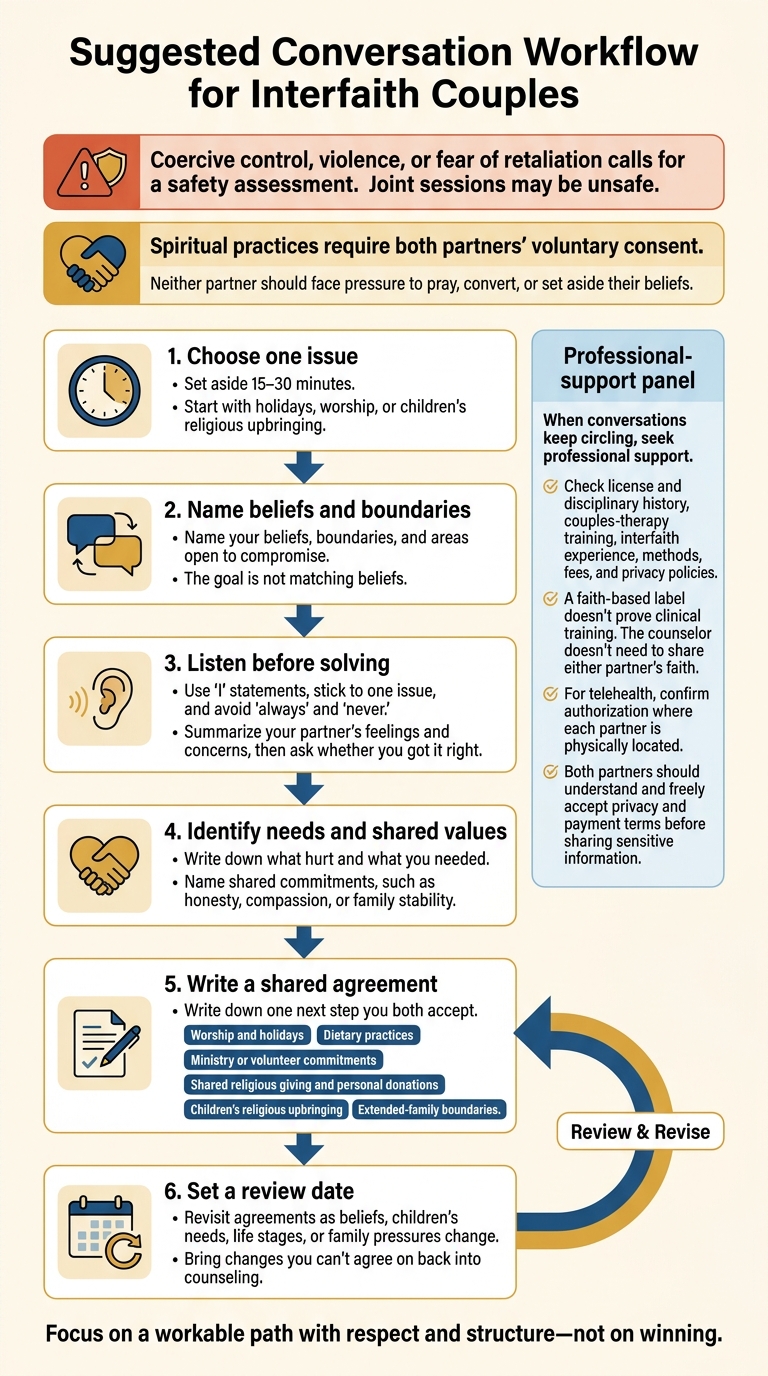
You don’t have to share a faith to build a strong relationship. I recommend starting with one decision – holidays, worship, or children’s religious upbringing – and setting aside 15–30 minutes to discuss what each partner needs.
Faith-based counseling can help you turn those conversations into shared plans. But <u>spiritual practices require both partners’ consent</u>. Neither partner should face pressure to pray, convert, or set aside their beliefs.
In this guide, I’ll cover how to:
- Name your beliefs, boundaries, and areas open to compromise.
- Listen without blame and address the feelings behind disagreements.
- Write agreements about home life, children, and extended family.
- Check a counselor’s license, interfaith experience, fees, and privacy policies.
- Recognize when individual care or a safety assessment should come before joint sessions.
The goal is not matching beliefs. It’s making decisions that respect both of you.
Interfaith Couples: From Conflict to Shared Agreements
Muslim/Christian Interfaith Counseling
sbb-itb-596b85d
Work Through Religious Conflict in Counseling
Once beliefs are clear, marriage counseling in Roseville can help reduce repeated arguments by focusing on behavior, unmet needs, and decisions couples can make together.
Practice Reflective Listening and Set Discussion Rules
Listen to understand before you respond. Summarize your partner’s feelings and concerns, then ask whether you got it right. Use “I” statements, stick to one issue, and avoid words like “always” and “never.” During sessions, a counselor can step in when blame or withdrawal takes over.
Identify Emotional Needs and Shared Values
Emotion-focused counseling looks at the feelings behind conflict, including anger, fear, and shame. Before trying to solve the issue, write down what hurt and what you needed. Then name shared commitments, such as honesty, compassion, or family stability, that can guide your decisions. Bring that same respect to any spiritual practice introduced during a session.
These approaches help couples shift from blaming each other to solving problems together.
| Approach | Purpose | When it may help |
|---|---|---|
| Values clarification | Find shared priorities without erasing differences | Partners disagree about family goals or religious commitments. |
| Communication training | Practice listening and reduce blame | Partners repeatedly respond to discussions by protecting their position rather than listening. |
| Emotionally focused interventions | Address resentment and fears beneath conflict | Feeling rejected or disconnected keeps arguments going. |
| Family-boundary work | Set limits with relatives and outside commitments | Family or ministry pressure keeps fueling conflict. |
| Trauma-informed care | Address how past harm affects closeness | Religious shame or trauma keeps conflict active. |
Require Consent for Spiritual Practices
Prayer and other spiritual practices require voluntary consent. Attending faith-based counseling does not mean agreeing to every practice, and saying no must never lead to pressure. When religious shame or trauma is involved, care should protect each person’s choice – not demand spiritual participation.
Create Agreements for Marriage and Family Life
Once counseling brings shared values and nonnegotiables into focus, turn them into written agreements for daily life. Record each decision and a date to review it. The goal is a shared plan, not a running tally of who gave up what. Start with the practices that shape your daily routines most.
Agree on Religious Practices and Household Decisions
Agree on worship, holidays, dietary practices, and ministry or volunteer commitments. Include whether you’ll attend services together or observe separately. Set a budget for shared religious giving, with a separate line for personal donations.
Plan Children’s Religious Upbringing and Set Family Boundaries
Decide how you’ll teach and practice each faith at home, then put the agreement in writing. Include boundaries for extended family around ceremonies, religious instruction, and participation. Clear rules can help prevent the same family conflicts from surfacing again and again.
Review Agreements as Beliefs and Circumstances Change
Schedule regular check-ins to revisit your plan as beliefs, children’s needs, life stages, or family pressures change. Update your agreements and set review dates for decisions you haven’t settled. Bring changes you can’t agree on back into marriage counseling.
Choose a Counselor Who Respects Both Partners
After you’ve clarified your beliefs and written agreements, look for a counselor who gives both partners equal respect. A faith-based label doesn’t prove clinical training or experience with interfaith couples. The counselor doesn’t need to share either partner’s faith, but should respect both worldviews.
Psychotherapy treats mental health concerns. Pastoral counseling provides religious guidance, while coaching focuses on skills and relationship goals. Check clinical credentials separately from clergy status. No provider should impose theology, push conversion, or replace needed care with spiritual direction.
Ask About Training, Methods, Fees, and Privacy
- Credentials and methods: Check the clinician’s license and disciplinary history through your state board. In California, use the Department of Consumer Affairs license search[3]. Ask about couples-therapy training, interfaith experience, evidence-informed methods, and what to expect in the first sessions. Confirm goals, progress reviews, scheduling, and how the counselor will handle differing beliefs during sessions.
- Telehealth: Confirm that the counselor is authorized to work with each partner in the state where that partner is physically located[4][5].
- Privacy and payment: Ask for written policies covering confidentiality, record keeping, outside communication, telehealth security, session length, fees in U.S. dollars, cancellation terms, insurance, and any diagnosis required for billing[6][8]. Clarify the legal and ethical limits of confidentiality, including any “no secrets” policy for individual disclosures. Both partners should understand and freely accept these terms before sharing sensitive information.
Recognize When Other Support Is Needed
Joint sessions aren’t always enough. Some couples also need individual therapy, family therapy, parent coaching, or specialized treatment for trauma or how addiction impacts marital stability. If the clinician can coordinate referrals, ask for that help when couples sessions fall short.
Coercive control, violence, or fear of retaliation calls for a safety assessment. Joint sessions may be unsafe in these situations. If both partners want clergy consultation, authorize contact and specify what information can be shared. No provider should guarantee reconciliation.
Consider Growth and Change Counseling
When considering a specific practice, check whether its approach fits both partners’ needs. Growth and Change Counseling offers couples coaching through The Marriage Rescue Institute, plus therapy and parent coaching in Campbell, San Jose, Los Angeles, Roseville, and through telehealth across California[7]. Confirm current availability, fees, clinician credentials, interfaith experience, privacy terms, and whether religious concepts are optional.
Conclusion: Put Respect and Agreements Into Practice
Once you’ve clarified your beliefs and set agreements, put them to work in everyday decisions about faith. Listen for the feelings and needs behind each belief, and make sure your agreements protect both partners’ dignity and emotional safety.
Choose one unresolved issue: religious practice, children’s upbringing, or boundaries with extended family. Set aside 15–30 minutes. Use “I” statements, listen without interrupting, and write down one next step you both accept.[1][2]
After reaching your first agreement, set a review date. Revisit it when beliefs or family responsibilities change.[1] If conversations keep ending in resentment or circling back to the same conflict, seek professional support rather than pushing for agreement.[9] Focus on a workable path with respect and structure – not on winning.
FAQs
Can faith-based counseling help if one of us isn’t religious?
Yes, faith-based counseling can work well even if one partner isn’t religious. Growth and Change Counseling pairs evidence-based psychological practices with relational intelligence to help couples without imposing religious beliefs.
Sessions focus on communication, conflict resolution, and emotional safety. Both partners learn to respond with consistency and care, work through differences respectfully, and strengthen their bond.
What if we can’t agree on our children’s faith?
Start by separating core beliefs from preferences you’re willing to adjust. Put your shared goals in a household agreement, including your wish to bring up compassionate children. Make clear that religious schooling and milestones require both parents’ consent.
Keep children out of disagreements, and avoid criticizing the other parent’s beliefs.
If you feel stuck, Growth and Change Counseling offers support, including The Marriage Rescue Institute, to help you work through these challenges and agree on a shared direction.
How can we tell if counseling is working?
Look for changes in everyday interactions, not an end to your differences. Progress means more honesty, compassion, fidelity, service, and shared responsibility.
During counseling with Growth and Change Counseling, watch for less criticism and contempt, new tools to work through recurring conflicts, and a closer emotional connection. Success means being better prepared to resolve conflicts on your own, rather than depending on counseling.
Related Blog Posts
- 5 Ways Faith Supports Emotional Healing in Marriage
- How Christian Counseling Supports Family Healing
- How Shared Faith Builds Marital Resilience
- Faith and Marriage: Solutions for Spiritual Mismatches
