Arguments often spiral out of control when emotions take over. Emotional regulation – the ability to manage your feelings – can prevent conflicts from escalating and help you communicate more effectively. Here’s how you can manage emotions during disagreements:
- Recognize triggers: Criticism, feeling unheard, and unresolved past issues often spark arguments.
- Take breaks: Stepping away for 20–30 minutes can help reset stress levels.
- Use grounding techniques: Try deep breathing, muscle relaxation, or the 5-4-3-2-1 method to stay calm.
- Communicate clearly: Use "I" statements and active listening to express feelings without blame.
- Practice mindfulness: Regular mindfulness exercises improve emotional awareness and response.
These strategies help you stay composed, enabling healthier conversations and stronger connections. If conflicts persist, professional support might be a helpful next step.
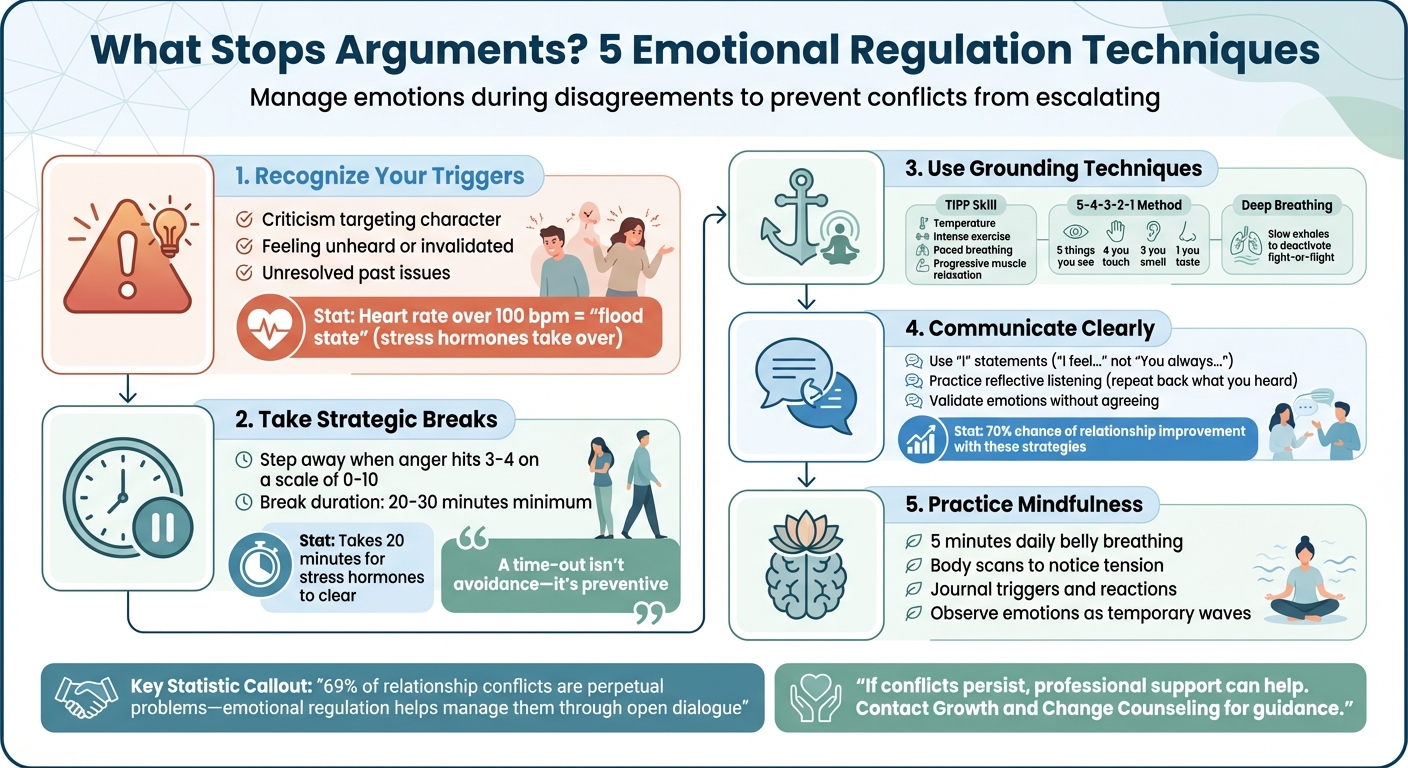
5 Essential Emotional Regulation Techniques to Stop Arguments
Why You Lose Control in Arguments (and How to Stop It)
Common Emotional Triggers in Relationships
Recognizing what sparks arguments is a crucial step in managing them. Disagreements often stem from emotional triggers that leave you feeling attacked, dismissed, or hurt. Spotting these triggers early allows for thoughtful responses rather than knee-jerk reactions. For instance, saying, "I feel criticized" helps shift your focus from raw emotion to a more rational approach, encouraging intentional communication. Let’s dive into how these triggers often show up, such as through criticism, defensiveness, or feelings of invalidation.
Criticism and Defensiveness
Criticism targets your partner’s character instead of addressing a specific behavior. For example, instead of calmly expressing, "I felt hurt when you forgot our plans", criticism might sound like, "You’re so selfish and unreliable." These personal attacks often provoke defensiveness, which can quickly escalate the situation. Defensiveness is a form of counterattack – denying responsibility, making excuses, or shifting blame. This dynamic is part of the "Four Horsemen" of destructive communication – criticism, contempt, defensiveness, and stonewalling – which research shows can predict relationship breakdown with over 90% accuracy [4].
Feeling Unheard or Invalidated
Arguments about small things, like chores or schedules, are rarely about the tasks themselves. Instead, they often reveal unmet emotional needs – like the need to feel seen, heard, or valued. When these needs go unacknowledged, even trivial disagreements can become outlets for deeper frustrations [4]. For instance, snapping over unwashed dishes might actually stem from feeling unappreciated for your overall efforts. This "iceberg effect" means surface-level disputes often hide underlying issues, such as a lack of security, respect, or emotional connection.
Unresolved Emotional Baggage
Emotional triggers are often tied to unresolved wounds from childhood or past relationships [6]. A partner’s tone might remind you of a critical parent, or being ignored could bring up feelings of abandonment from a previous relationship. These connections to past pain can intensify your reactions in the present. When this happens, your body might enter a state of "flooding", where your heart rate exceeds 100 bpm, making it nearly impossible to stay calm or open to your partner’s perspective [1][2]. Recognizing these links between past and present helps explain why old wounds can amplify current conflicts.
Emotional Regulation Techniques for Managing Conflict
Once you’ve pinpointed your triggers, the next step is figuring out how to manage your emotional reactions in the heat of the moment. Self-regulation is all about recognizing your internal state and regaining control during a conflict. When your nervous system is out of balance – think a racing heart and spiraling thoughts – it’s tough to listen, empathize, or stay curious about your partner. Let’s dive into specific methods to help you stay composed during those challenging moments.
Track your anger on a scale from 0 to 10. Step away from the conflict when your anger hits a 3 or 4. Why? Once your heart rate climbs to 100 beats per minute or more, you’re entering a “flood state,” where stress hormones take over. It takes about 20 minutes for these hormones to clear out, so a time-out should last at least 20 to 30 minutes to let your body reset [1].
Name your feelings to shift from reacting to responding. Simply labeling what you’re feeling – like saying, “I feel my chest tightening” or “I’m getting overwhelmed” – can move your brain out of fight-or-flight mode and into a more aware, thoughtful state [2][8]. This awareness helps you communicate more clearly and respond with intention rather than reacting impulsively. Studies show that reframing a situation before your emotions fully take over (a process called cognitive reappraisal) works better than suppressing your emotions, which can actually heighten stress and discomfort [3].
Need a quick reset? Try the TIPP skill:
- Temperature: Splash cold water on your face to trigger the "dive reflex", which helps lower your heart rate.
- Intense exercise: Do a plank or another burst of activity for 60 seconds.
- Paced breathing: Focus on slow, deep exhales.
- Progressive muscle relaxation: Tense and then release different muscle groups systematically [1].
Another handy grounding tool is the 5-4-3-2-1 method. Use your senses to bring yourself back to the present: name 5 things you see, 4 you can touch, 3 you hear, 2 you can smell, and 1 you can taste. This technique helps pull you out of the emotional whirlwind and back into the moment [1][2].
Set clear time-out rules to manage conflict effectively. Agree on a codeword, decide when you’ll reconvene, and avoid rehashing the argument during the break [2]. As Megan Pardy from Stanford Couples Counseling explains:
"A time-out isn’t avoidance – it’s preventive, to keep one or both of you from doing or saying something you may later regret" [2].
During the break, try SKY breathing – slow, deep breaths that engage the vagus nerve, triggering your body’s relaxation response [7]. Partners can also practice co-regulation by using calming gestures, like a soft tone, a gentle touch, or reassuring words such as, “We’re okay, let’s take a moment to slow down” [2].
Mindfulness and Emotional Awareness
Mindfulness takes emotional regulation to a deeper level by sharpening your awareness and reshaping how you respond to conflict. Through regular practice, mindfulness strengthens what researchers refer to as "executive control", which enhances your ability to notice internal signals and respond to disagreements with intention rather than impulse. Remarkably, mindfulness can even rewire neural pathways, helping to shift your automatic reactions in stressful situations [10].
One of the key shifts mindfulness brings is recognizing emotions like anger as temporary experiences, not permanent traits. This perspective – often called the "witness" mindset – allows you to observe emotions as fleeting waves rather than as fixed parts of your identity [10]. It builds on earlier techniques, such as naming your emotions, to prevent unnecessary escalation. As mindfulness teacher Gillian Florence Sanger puts it:
"When you become more mindful of your emotional landscape, self-awareness increases and you experience an increase in your ability to moderate your responses" [10].
A simple way to start is with five minutes of belly breathing each day. Place one hand on your chest and the other on your belly to ensure you’re engaging your body’s relaxation response. Pair this with body scans, where you mentally check in from head to toe, noticing tension like a clenched jaw, tight chest, or racing heart – clues that you might be getting upset [1].
Journaling can also help you process emotions. Write down triggers, physical reactions, and thoughts to shift out of fight-or-flight mode and into a state of conscious awareness [2]. Over time, this practice can reveal patterns in what sets you off and help you develop strategies to handle those triggers more effectively.
Instead of avoiding tough emotions, mindfulness encourages you to face them with curiosity and without judgment. This approach not only transforms how you handle conflict but also pairs seamlessly with active listening techniques by keeping you grounded in the present moment.
Using Active Listening and "I" Statements
Once you’ve managed your emotions, the next step is to focus on clear and effective communication. A great way to do this is through active listening. This means truly hearing and understanding your partner’s perspective, rather than just waiting for your turn to speak or trying to "win" the conversation. One helpful technique is reflective listening, where you repeat back what your partner has said to confirm you’ve understood them. For example, you might say, "So, what I’m hearing is that when I [action], it makes you feel [emotion]. Did I get that right?" [11]. This simple practice can help prevent misunderstandings from spiraling into bigger conflicts.
Another powerful tool is shifting to "I" statements when expressing frustration. Instead of saying, "You’re always on your phone," try something like, "I miss our connection and feel alone when we’re together" [9]. This approach focuses on your feelings rather than placing blame, which naturally makes it easier for your partner to hear you without getting defensive. Licensed Marriage and Family Therapist Tiara Lipps explains:
"Fighting fairly doesn’t mean repressing emotions – it means expressing them in a way your partner can hear" [9].
Validation is equally important in fostering connection. You don’t have to agree with your partner’s perspective to acknowledge their feelings. For instance, saying something like, "I can see how frustrated you are about this," shows that you recognize their emotions and that their experience matters [11]. This ties back to the mindfulness and self-awareness techniques mentioned earlier, encouraging a deeper bond. In fact, research indicates that couples who use these communication strategies have a 70% chance of significantly improving their relationship [11].
When tensions rise, staying genuinely curious can make a big difference. Instead of reacting defensively, try asking thoughtful questions like, "Can you help me understand what that feels like for you?" or "What would be most helpful from me in those moments?" [11]. This approach not only slows down knee-jerk reactions but also fosters empathy by helping you uncover the emotions behind your partner’s words.
sbb-itb-596b85d
Physiological Calming Techniques
When emotions run high, your body often shifts into fight-or-flight mode, making it hard to communicate effectively. Psychologist Dr. Brian Gersho explains, "once our heart rate reaches 100 beats per minute or higher, we are filled with adrenaline" [13]. At this point, most people struggle to have meaningful conversations or truly listen to their partner [13]. To counteract this, calming your body is essential. Here are some practical techniques to help reset your system.
Deep breathing is one of the simplest and most effective tools. When emotions take over, many people unknowingly hold their breath or breathe shallowly [14]. By taking slow, intentional breaths – with a longer exhale – you can deactivate the fight-or-flight response. This creates a much-needed pause, giving you a chance to lower emotional intensity before reacting impulsively [13][8].
Another helpful approach is addressing physical tension. Progressive muscle relaxation (PMR) targets the tightness that often builds during conflict. Start by tensing each muscle group, from your forehead to your toes, then release the tension while imagining it melting away [14]. Dr. Ellie Lisitsa from The Gottman Institute advises: "Tense and relax parts of your body that feel tight or uncomfortable. Feel the warmth and heaviness flow out of your limbs. Take your time" [14]. For best results, step away from the conflict and focus solely on the sensations in your body [2].
Physical grounding exercises can also help when your mind feels overwhelmed. Techniques like the 5-4-3-2-1 method are great for anchoring yourself [15]. Another quick fix is splashing cold water on your face, which triggers the "dive reflex" and instantly slows your heart rate [1]. Even planting your feet firmly on the ground can help you reconnect with the present moment [2].
If you need to step away to use these techniques, establish a neutral signal – like a specific word or gesture – so your partner knows you’re not walking out on them [2]. These methods not only reduce physical stress but also prepare you to return to the conversation with a clearer, calmer mindset.
Building Resilience Through Cognitive Reappraisal and Emotional Check-Ins
Expanding on earlier mindfulness techniques, using cognitive strategies can take emotional regulation to the next level, helping to build resilience in relationships.
Cognitive Reappraisal: Shifting Perspectives
When emotions run high, logical thinking often takes a backseat. Cognitive reappraisal is a tool to bring clarity back into the picture by reframing how you interpret your partner’s behavior. Instead of jumping to negative conclusions, try seeking alternative explanations. For instance, if your partner forgets to pick up groceries, rather than thinking, "They don’t care about me", consider, "They’ve been swamped at work this week."
This mental shift helps move you out of "negative sentiment override" – where even neutral actions feel like personal slights – and into "positive sentiment override," where you’re more likely to give your partner the benefit of the doubt [4]. Reframing isn’t about ignoring real issues; it’s about looking past surface-level conflicts (like who forgot to do what) to uncover deeper needs, such as feeling valued or secure. This concept, often called the "Iceberg Effect", highlights how visible disagreements often mask these underlying emotional needs.
Naming your emotions out loud – like saying, "I feel overwhelmed" – can also help shift your mindset from reactive to reflective [2][8]. Pair this with mindful listening and consider the issue as a shared challenge. Ask yourself, "What does my partner need?" alongside "What do I need?" This curiosity lays the groundwork for solutions that benefit both of you.
By reframing your thoughts, you create space for meaningful emotional check-ins, which can further enhance your connection.
Emotional Check-Ins for Connection
To complement reframing, make time for regular emotional check-ins. These conversations prevent minor misunderstandings from escalating into major conflicts. Timing is everything – have these discussions during calm, neutral moments, not in the heat of an argument or immediately after [17]. Set aside time to share recent emotional experiences, taking turns while the other person listens without offering advice or counterarguments [17].
The listener’s role is simple: understand, not fix. Use reflective phrases like, "It sounds like you felt frustrated when that happened", to show you’re truly hearing them [17]. If their feelings don’t immediately make sense, ask follow-up questions until you reach a place of genuine understanding. As The Gottman Institute explains:
"Emotional intelligence can mean the difference between getting stuck in frustrating patterns that leave you feeling lonely or working through challenges together" [17].
It’s worth noting that 69% of relationship conflicts are perpetual problems – ongoing differences that may not have a perfect resolution [4]. Emotional check-ins aren’t about solving these issues but managing them through open dialogue.
You might also try incorporating the "Stress-Reducing Conversation" into your daily routine. Spend time discussing external stressors, like work or traffic, while making an effort to take your partner’s side and avoid offering unsolicited advice [16]. This practice keeps outside pressures from seeping into your relationship and reinforces the idea that you’re a team tackling life together.
Seeking Professional Support for Emotional and Relational Growth
While self-regulation can strengthen personal resilience, seeking professional help often takes this growth to the next level. Trained therapists can help couples navigate deeper issues such as anxiety, depression, or addiction, providing a safe and judgment-free environment for honest, vulnerable conversations [5].
Growth and Change Counseling specializes in helping individuals and couples build emotional resilience and relational intelligence. Their approach is centered on achieving measurable results [5].
For couples facing serious challenges – whether living apart, on the brink of divorce, or caught in harmful cycles – the Marriage Rescue Institute, a program within Growth and Change Counseling, offers a structured, intensive 12-week program. As John Mark Kane, LMFT, the founder, explains:
"The Marriage Rescue Institute, our 12‑week marriage program is in the habit of putting marriages in dire circumstances back together!" [5]
In addition to couples therapy, Growth and Change Counseling provides individual therapy for challenges like anxiety, depression, addiction, and trauma. They also offer family and parent coaching, as well as specialized support for neurodiverse couples. These services help bridge communication gaps and foster healthier relationships by improving social understanding and connection [5][12]. Whether in-person at their offices in Campbell, San Jose, Los Angeles, and Roseville, CA, or through telehealth across California, their professional guidance complements self-regulation strategies by addressing deeper relational dynamics.
Acting sooner rather than later can make a significant difference. Breaking harmful patterns is easier before they become deeply ingrained. If conflicts are escalating or physical stress signs like a heart rate over 100 bpm appear, it’s time to consider professional intervention. To learn more or schedule a free consultation, contact Growth and Change Counseling at +1 408-461-9658 or visit their website [5][12].
Building Resilience with Growth and Change Counseling
Disagreements don’t have to define your relationship. Once you recognize that not every conflict has a simple solution, your perspective shifts. It’s no longer about "winning" but about navigating challenges with care and understanding. Emotional regulation isn’t about avoiding disagreements altogether – it’s about fostering a sense of safety and stability that allows for honest, meaningful conversations.
The strategies we’ve discussed – like taking a mindful 20-minute break, using "I" statements, and practicing cognitive reappraisal – are practical tools to break unhealthy cycles. As Megan Pardy wisely states:
"Self-regulation isn’t about perfection – it’s about capacity. The more skilled you become at managing your internal world, the safer and more connected your relationship becomes" [2].
Every time you take a moment to notice your emotions or choose curiosity instead of criticism, you’re strengthening that capacity.
If you’re looking to deepen these skills, professional support can be an invaluable resource. While self-awareness is the starting point, working with a professional can help uncover hidden triggers and create personalized strategies for long-term change. If self-help tools aren’t enough, consider reaching out to experts like those at Growth and Change Counseling (https://johnmarkkane.com). Whether through couples counseling via The Marriage Rescue Institute or individual and family therapy, their guidance can help prevent conflicts from escalating further.
Taking action early can make all the difference. The longer harmful patterns persist, the harder they are to break. If you feel stuck in recurring arguments or notice tensions rising, seeking help is a courageous and proactive step. Investing in your relationship – whether through practicing emotional regulation or seeking professional guidance – can transform conflicts into opportunities to grow closer and build a stronger connection.
FAQs
How can I recognize my emotional triggers during arguments?
Recognizing what sets off your emotional triggers begins with paying attention to the moments that spark intense feelings during a disagreement. After an argument, take some time to reflect on the situation. Ask yourself: What exactly upset me? Was it specific words, a certain tone, or particular actions? Consider whether it reminded you of a past experience or an unresolved issue. Your body can also give you clues – physical reactions like a racing heart, a clenched jaw, or a tight chest often signal a trigger.
Keeping a simple journal to jot down these patterns after conflicts can be incredibly helpful in spotting recurring themes. Once you identify a trigger, try to explore its deeper roots. Understanding why something hits a nerve is a crucial step toward handling your reactions more calmly. If you find it challenging to uncover or manage these patterns on your own, Growth and Change Counseling provides professional support to help you build emotional regulation skills and strengthen communication in your relationships.
What are some quick ways to stay calm during an argument?
Staying calm during an argument often begins with using grounding techniques to help you regain focus and manage your emotions. One simple yet powerful method is the 5-4-3-2-1 exercise. Here’s how it works: silently identify 5 things you can see, 4 things you can touch, 3 things you can hear, 2 things you can smell, and 1 thing you can taste. This technique redirects your attention from intense emotions to your immediate surroundings, helping you feel more centered.
Another approach is body-focused grounding, which involves connecting with your physical sensations. Start by taking slow, deep breaths, then tense and relax different muscle groups, beginning with your feet and moving upward. If emotions feel particularly overwhelming, step away for a moment, plant your feet firmly on the ground, and try counting backward from 100 in increments of 3. These actions can help soothe your nervous system and anchor you in the present moment.
For long-term support, working with a therapist can be incredibly helpful. Professionals like those at Growth and Change Counseling specialize in teaching couples emotional regulation techniques to enhance communication and reduce conflict.
How do I know when to seek professional help for relationship conflicts?
If you and your partner find yourselves caught in the same arguments that escalate quickly and leave you both feeling unheard, it might be time to consider professional support. These patterns often emerge when managing emotions becomes challenging, and attempts to resolve conflicts on your own only seem to make things worse. You might also notice lingering feelings of anger or anxiety that interfere with daily life, or even a growing sense of hopelessness about your relationship.
Other warning signs include frequent miscommunication, constant conflict, or feeling like even the smallest disagreements spiral into major battles. Couples counseling can provide the tools to rebuild trust, improve communication, and develop healthier ways to connect. Reaching out for help isn’t a sign of failure – it’s a step toward building a stronger and more fulfilling partnership.
Growth and Change Counseling offers specialized couples counseling through The Marriage Rescue Institute, a 12-week intensive program designed to help couples navigate tough situations and restore their connection. Services are available in Campbell, San Jose, Los Angeles, Roseville, and through telehealth across California.
Related Blog Posts
- Top Emotional Regulation Tips for Couples
- Top 5 Techniques for High-Conflict Couples
- How Couples Manage Anger During Parenting Conflicts
- 5 Steps to De-Escalate Co-Parenting Arguments
